Plant care
Moss pole vs coir pole vs trellis: choosing a support for climbing houseplants
· Updated
Quick answer
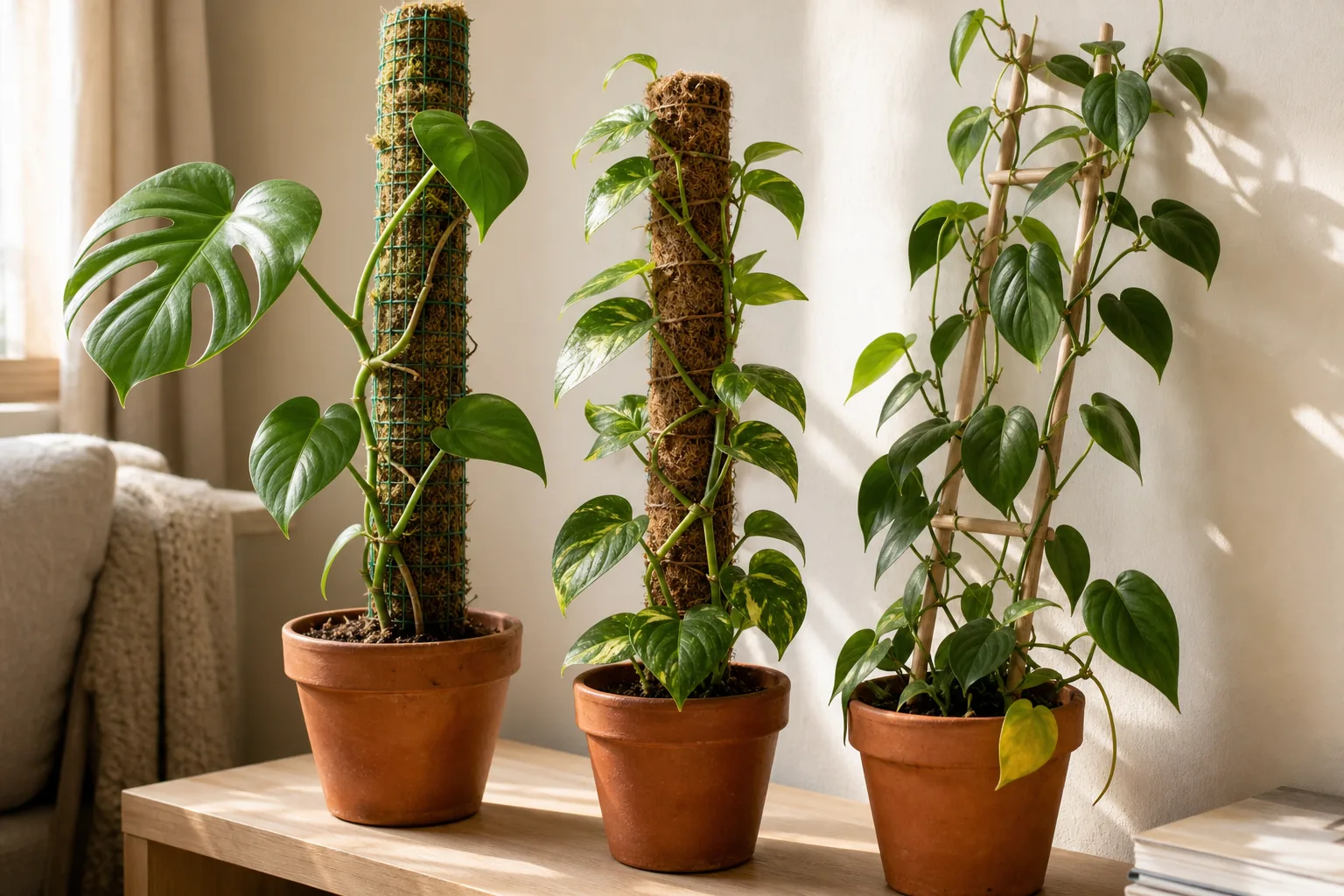
A moss pole keeps the most surface moisture and gives adventitious aerial roots the grippiest, dampest surface to latch onto, but it often dries out within a few days in a typical indoor room and needs active watering or misting. A coir pole uses compressed coconut-husk fiber wrapped around a stake, holds moisture well, re-wets easily, and is widely described as lower-maintenance. A trellis is an open lattice of wood, bamboo, or metal with no moisture reservoir, and it suits plants that climb by twining rather than by aerial roots. The right choice depends on how your plant climbs, how humid and airy your room is, and how much maintenance you want to do.
What “moss pole,” “coir pole,” and “trellis” actually mean
By category, a moss pole is sphagnum moss fiber wrapped in a mesh (usually plastic or fiberglass) around a wood or PVC core. The moss fiber is the same moisture-retentive material used as a growing medium, and the wrap is what aerial roots can weave into.
A coir pole wraps compressed coconut-husk fiber matting around a similar stake. Coco coir is described in horticulture sources as a moisture-retentive, pH-neutral fiber. In potting-media research, where coir is most often compared against sphagnum peat moss (a related but distinct material), coir absorbs and releases water more slowly and re-wets easily after drying.
An indoor trellis is an open lattice of wood slats, bamboo canes, or powder-coated metal, with no moisture-holding wrap. It does not store water and does not give roots anything fibrous to grip. It provides structure, and the plant either twines around it or is held in place with soft plant ties.
How climbing houseplants attach, and why the support material matters
Most indoor climbers fall into two attachment groups. Aroids like Monstera, many philodendrons, and pothos send out adventitious aerial roots, rootlets that emerge from the stem above the soil and can absorb moisture and nutrients from the surfaces they touch. These roots will latch onto a nearby support if one is in reach, and a porous, slightly damp surface gives them something fibrous to weave into and a small local moisture source. A hard dry surface does neither.
The other group climbs by twining. Hoya and some philodendrons wrap their stems around a thin structural member instead of producing gripping aerial roots. A flat moss or coir wrap does not give these plants anything to twine around, so they often need a small lattice, a hoop, or a soft tie to start. This difference is the single biggest reason the right support varies by plant.
Moisture and humidity: what each support does to the air right around the leaves
A moss pole is the most moisture-holding of the three, because sphagnum fiber holds a lot of water relative to its weight. In a typical indoor room it often dries out within a few days, which is why many growers report misting daily or running a humidifier nearby. Sphagnum moss is described by at least one moss-product manufacturer as preferring humidity of around 60 percent and up and being useful in enclosed spaces such as terrariums, which matches what indoor growers observe: the wrap stays damp longest when the surrounding room is already on the humid side.
A coir pole holds moisture well too, but the fiber releases it more slowly than sphagnum and re-wets quickly when you do water it. For most indoor rooms this means less day-to-day attention. Coir is also pH-neutral, while sphagnum peat moss tends toward the acidic side, which matters more for potting mixes than for a pole wrap but is worth noting if your tap water or fertilizer pushes pH in either direction.
A trellis holds no moisture at all. There is nothing to water, no surface to grow mold on, and no local humidity effect. If your goal is a low-maintenance structure, this is its main appeal.
There is a real caution here. Damp organic fiber in a cool room with poor airflow can grow surface mold. The US EPA recommends keeping indoor relative humidity below about 60 percent (ideally 30 to 50 percent) to discourage mold, and the Broome County NY health department notes that relative humidity above 70 percent is the range most favorable to mold spore growth. A damp moss or coir pole is a local moisture source, not a room humidifier, but if the room itself is on the humid side and the air is still, the pole surface is the place you are most likely to see fuzzy growth first. A simple precaution is to keep the wrap lightly damp rather than soaking, give the plant some airflow, and watch the pole in winter when rooms are closed up.
Size, weight, and stability in an ordinary room
Pole height and diameter vary widely by product, so check the specific item before you buy. A short pole in the rough range of 12 to 24 inches is usually enough headroom for a small plant in a 4- to 6-inch pot for its first year. A large floor Monstera usually needs stacked or extended poles over time.
Weight matters more than people expect. A coir pole of the same size is generally heavier than a moss pole because of the compressed fiber wrap, which can help stability in a tall pot but adds weight in a small or lightweight container. A tall moss pole in a small nursery pot can become top-heavy once the plant leans into it, and that is the most common cause of tipped pots.
Open trellises are usually the lightest of the three and the easiest to wall-mount if you want a plant to climb a vertical surface rather than the inside of a pot. Fasteners and metal edges are worth a quick check before you set one up in a home with pets or small children.
Durability, cleaning, and when each support needs to be replaced
A moss pole compresses and sheds fiber as it ages, especially if it has been kept wet and rewet for many months. Mineral or salt crust from tap water and fertilizer is something growers commonly discuss on long-lived moss poles, though the higher-confidence sources in this comparison do not document the effect directly. When the wrap thins or starts to shed visibly, it is easier to replace the whole pole during a repot than to patch it.
A coir pole lasts longer as a wrap because the fiber is denser, but it can still shed at the edges and occasionally harbor surface growth in still, humid rooms. Replacement is similar: swap during a repot.
A trellis is the longest-lived of the three. Wood and bamboo can be wiped down with a damp cloth. Powder-coated metal can be wiped and dried. There is no organic wrap to compact, no fiber to replace, and no damp surface to worry about.
Which plants tend to suit each support
These are experience-based fits, not absolutes. Your room, your watering routine, and how aggressive your plant’s aerial roots are will all push the answer in one direction or another.
Monstera and most philodendrons other than trailing heartleaf send out the thickest, most active adventitious aerial roots of the common indoor climbers. They benefit most from a porous, slightly damp vertical wrap, which is why a moss or coir pole tends to suit them. If you want a fuller read on Monstera in a real room, the Monstera care in a real room guide is a useful companion. For the specific step of attaching a Monstera to a moss pole once you have chosen one, the Monstera-specific moss pole attachment walkthrough covers that next step.
Pothos produces smaller aerial-root nubs that benefit from a wood plank, moss pole, or coir pole but grip less aggressively than Monstera roots. Many growers find pothos does equally well on a sturdy trellis or a moss pole, and the difference comes down to whether you want it to climb a single column or trail and fan. The pothos care in real rooms guide goes deeper on how pothos tends to behave day to day.
Heartleaf philodendron climbs more gently than Monstera and is happy on a small coir or moss pole, a slim trellis, or even a shelf where the vines can drape and re-root. The heartleaf philodendron care guide is a useful companion if that is your plant.
Hoya climbs slowly by twining and rarely produces gripping aerial roots. It usually prefers a sturdy trellis, small hoop, or open lattice, and it prefers drier conditions than a constantly damp pole provides. If you are growing a Hoya and the room is cool or still, a moss pole is the riskiest of the three choices for that plant. The Hoya care guide covers the slower, drier routine these plants tend to prefer.
Trailing plants like pothos, heartleaf philodendron, and string-of-hearts do not strictly need a pole at all. They are happy on a shelf, in a hanging pot, or on a small trellis where their vines can weave in and out.
For a general overview of how to add any of these supports safely without breaking stems, the general guide to supporting climbing houseplants picks up where this comparison leaves off.
A short decision rule for choosing between moss pole, coir pole, and trellis
If your plant climbs by adventitious aerial roots and you can keep a wrap lightly damp without making the room feel damp, a moss pole gives the grippiest surface and rewards the most attention. A coir pole is the same idea with less maintenance, more weight, and a slightly drier feel between waterings.
If your plant climbs by twining or you want it to spread horizontally, a trellis is the simpler and safer choice. There is no moisture to manage and no mold risk on the support itself, only the ties to check.
If your room is cool or still and you are not running a humidifier, a constantly damp moss pole is the highest-maintenance and highest-mold-risk option in the comparison, and a coir pole or trellis will likely be the easier fit. For a fuller read on ordinary-home humidity and how it affects plant care, the ordinary-home humidity guide is a useful companion. Before you decide where the pole will stand, it also helps to read the natural light in the room, since placement near a bright window changes both light and how quickly the wrap dries.