Plant care
Why your houseplant soil stays wet for days, and how to check before you repot
· Updated
Wet potting mix days after watering is a symptom, not a diagnosis, and it usually has more than one contributing cause at the same time. Before deciding that the plant needs a new pot, walk through five checks in order: the pot and its drainage path, the potting mix itself, the room’s temperature, light and air movement, your recent watering rhythm, and a quick look at the root ball. Repotting is the right answer in some of these cases, but it is rarely the only answer, and repotting a plant already stressed by wet conditions can make things worse if the real cause is the pot setup or the room rather than the mix or the roots.
If you are not sure whether the wet soil is the cause or the symptom, start with the overwatered vs underwatered diagnostic order so the broader picture is in view before you start changing things.
A calm baseline: what “wet too long” usually means
There is no fixed number of days a houseplant “should” take to dry out. Dry-down time depends on the pot, the substrate, the plant species, the season, the room’s temperature and humidity, and how much light the plant receives. The most useful comparison is to your own prior observation: this plant, in this pot, in this room, dried within a few days a few weeks ago, and now it is still wet after the same window. That gap is the symptom worth investigating, not the absolute number.
Slow dry-down is rarely one thing. More often it is a substrate that has lost its structure in a pot that traps a little water at the bottom, in a room that is cooler and dimmer than it was a few months ago. The five checks below help you sort out which of those is contributing most in your case.
Check 1: the pot, the cachepot, and where the water goes
Start here because it is the cheapest and fastest to inspect, and because the cheapest fixes (emptying a saucer, clearing a blocked hole) often produce the biggest change in dry-down time.
What to look at:
- Does the pot have a drainage hole, and is anything blocking it? A single piece of settled mix, a circling root, or a layer of landscape fabric can seal a hole without you noticing.
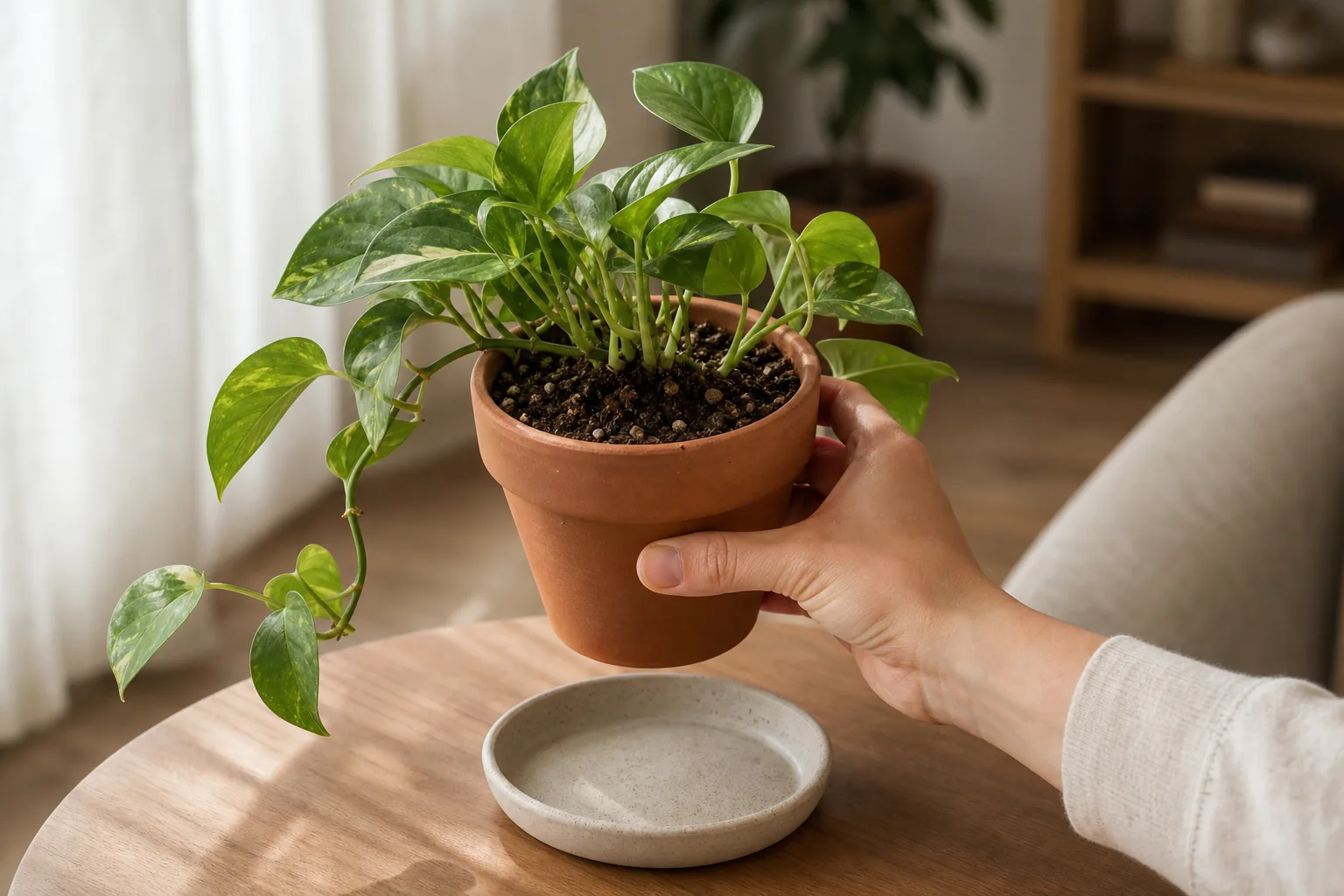
- Is the pot sitting in a saucer or cachepot with standing water? Water that drains into the saucer and then sits there re-wicks back up into the substrate through the drainage hole and keeps the lower root zone saturated. Empty the saucer or cachepot within about 20 to 30 minutes of watering.
- Is the pot oversized for the root ball? A large volume of moist substrate with a small root system takes much longer to dry, because nothing is pulling water out of the mix.
What to feel:
- The pot wall. Unglazed terracotta is often described as more breathable than plastic or glazed ceramic, because water and air can move through the wall; plastic and glazed ceramic hold all drying at the substrate surface and the drainage hole. In a cool, dim room this difference is large; in a warm, bright, airy room it is small.
A reasonable finding here is that the saucer is the problem, or that the pot has no practical drainage path that can be corrected without drilling or moving the plant. For more on how pot setup changes dry-down, see how the pot, cachepot, and drainage setup change how long soil stays wet.
One misconception worth naming: adding a layer of pebbles or charcoal at the bottom of a pot without a drainage hole does not fix it. Water still collects at the bottom in a perched water table, and the lower roots sit in it.
Check 2: the potting mix itself
If the pot checks out, the substrate is the next most common cause.
What to look at:
- Does water bead on the surface or run down the inside of the pot wall instead of soaking in within a few seconds? That is a sign of either a hydrophobic mix (one that has dried out fully and is now repelling water) or a crusted, compacted surface.
- Has the mix settled noticeably below the rim of the pot? That is a sign that the structure has changed; large pore spaces are smaller and the substrate holds more water against gravity than it did when it was fresh.
- Is the surface sealed, mossy, or pulling away from the pot wall? All of those are compaction cues, and compaction is documented to reduce the large pore space that lets water move through a substrate.
- How long has this mix been in the pot? Months to years in a container is normal, and the structure does change over that time. For the visible signs and the typical timeline, see signs that the potting mix itself has lost its structure.
What to feel:
- A fresh, airy mix is loose between your fingers with visible crumbs of bark, perlite, or pumice. An aged, compacted mix feels fine and dense, like wet coffee grounds.
A reasonable finding here is that the mix is simply old and tired, and that a refresh will do more than any change to the pot. If a new bag is in your future, how to read a bag label for aeration and drainage is worth a quick read so you can match the next bag to the plant and pot rather than to a friend’s recommendation.
Check 3: room temperature, light, and air movement
Same plant, same pot, same mix, different room. This is where many readers get tripped up without realizing it.
What to look at:
- Where did the plant sit a few months ago, and where does it sit now? A move from a bright window to a deeper corner, or from a warm living room to a cooler bedroom, can slow dry-down dramatically without anything else changing.
- Is the room cooler than it was? Indoor temperatures often drop in autumn and winter as heating habits change. Cooler air slows evaporation from the substrate surface.
- Is the air still? Stagnant air slows transpiration. A gentle ceiling fan, a nearby vent, or a regularly opened window speeds it up.
A reasonable finding here is that the season shifted the baseline. The actionable point is to compare current dry-down to your own prior observation rather than to a number from the internet. A plant that dried in a few days over the summer may take noticeably longer in the same pot during winter, especially if light and temperature have both dropped, not because anything is wrong with the watering, but because the baseline has shifted.
Check 4: your recent watering rhythm
This is the check that catches the most well-meaning plant owners.
What to look at:
- How much water are you delivering per watering? A small amount from a watering can with a narrow spout often wets only the top inch or two of substrate.
- How often are you checking? If you are watering on a fixed schedule rather than by feel, you may be watering again before the middle and lower root zone has had a chance to dry.
What to feel:
- A finger or a plain wooden chopstick pushed an inch or two into the substrate tells you more than a schedule does. If it comes out clean and damp, the substrate is still wet below the surface, even if the top looks dry. For a fuller look at reading soil moisture and pot weight by feel, see how to read soil moisture and pot weight by feel.
- The weight of the pot right after watering and again 24 hours later is one of the most reliable indoor signals of how fast the substrate is actually drying. A pot that feels almost as heavy the next day has not dried much.
A reasonable finding here is that the watering rhythm has been topping up a substrate that never had a chance to dry through. Smaller, more frequent sips often keep the bulk of the root zone permanently damp while the surface goes through a wet-dry cycle. A full soak that drains freely, followed by a real dry-down window, is what most extension guidance describes as the healthier rhythm, in most cases.
Check 5: a quick look at the roots
This is the closest thing to a hard inspection step in this article. Slipping the plant out of the pot is recommended by university extension services as a routine diagnostic, and it costs nothing.
How to do it:
- Wait for a day when the substrate is on the drier side, not saturated.
- Tip the pot on its side, support the stem, and gently slide the root ball out. If it does not want to come, do not force it; try again on a drier day.
- Look at the root ball, then slide it back in.
What to look at:
- Healthy roots are firm and pale, ranging from white to cream to tan or light brown depending on the species, and the root ball holds its shape loosely with substrate visible between the roots.
- A root-bound mass holds the exact shape of the pot, with roots circling the outside and often exiting the drainage hole. The mix has largely been replaced by roots. For a fuller look at the difference between a snug root system and a root-bound one, see how to tell a snug root system from a root-bound one.
- Very dark, soft, mushy, or smelly roots are a sign worth taking seriously. A loose, bark-like outer layer that slides off when you handle the roots is also a warning cue. These are signs to slow down, not a confirmed diagnosis from this article; a local nursery or extension service can confirm what you are seeing if you are unsure. If the leaves have been showing brown edges or tips at the same time, that is another companion cue worth checking; see brown leaf edges as a possible companion symptom.
When repotting is the right move
Repotting is the right move when the inspection actually points to it. Three cases that justify it:
- The mix is structurally broken down. The substrate is fine, dense, and compacted, and has been in the pot long enough that a refresh is overdue.
- The root ball is genuinely root-bound. The mass holds the shape of the pot, roots circle the outside, and most of the mix is gone.
- The pot has no workable drainage path. If the pot has no drainage hole and cannot be drilled or moved into a cachepot that lets water drain, repotting into a pot that does is a legitimate response.
In each of these cases, move up by only a small increment in pot size, into a substrate matched to the plant’s actual needs, and have a plan for aftercare. For the broader decision, see when repotting is the right next move, and once you have committed to it, what to expect in the days after repotting.
When repotting would make things worse
Repotting is not a neutral act for a stressed plant. It disturbs the roots and moves the plant into a fresh volume of moist substrate.
- If the cause is the room, repotting into a fresh pot of mix in the same dim, cool corner will simply produce the same problem again in a few weeks.
- If the cause is the watering rhythm, a fresh pot of mix is an invitation to keep overwatering.
- If the cause is a pot that is already too big for the plant, repotting into an even larger pot extends the wet-soil window. Move up only one small increment at a time.
In these cases, the lowest-risk next step is to stabilize the existing conditions first: empty the saucer, move the plant to a brighter or warmer spot, slow the watering rhythm, or refresh the top inch of mix without disturbing the roots. Then watch how the substrate dries over the next week or two before deciding whether repotting is needed at all.
A short inspection order you can use this week
- Pot and drainage. Drainage hole clear? Saucer empty? Pot size reasonable for the root ball?
- Mix. Does water soak in or bead on top? Has the mix settled? How long has it been in the pot?
- Room. Where did this plant sit a few months ago? Has the temperature, light, or air movement changed?
- Watering rhythm. Full soak or small sips? How often? By feel or by schedule?
- Roots. Slide the plant out on a dry day. Firm and pale, or dark and soft? Loose or tightly circling?
If the inspection points to the mix or the roots, repotting may be the right move. If it points to the pot, the room, or the watering rhythm, a smaller change is almost always lower-risk. And if the inspection is inconclusive, the safe default is to stabilize conditions and watch for a week, rather than to repot a plant that may not need it.