Plant care
Why pest problems sometimes appear after bringing a plant home
· Updated
If your plant looked clean when you brought it home and you are now spotting bugs, sticky leaves, fine webbing, or tiny flies, the most likely explanation is that one of three things — or some combination of them — has had a few weeks to develop. Pest problems appearing after purchase is a common and well-documented pattern, not a sign that your room, your watering, or your pot caused them. The first two to four weeks are the highest-risk window for a hidden introduction to become visible, and a short isolation-and-inspection routine catches most of it before it reaches the rest of your collection.
University extension services name newly purchased plants as a recognized route by which indoor pest populations are introduced, and they describe plants under stress — the move, a change in light, water stress, root disturbance — as more susceptible to insect and mite injury once a pest is present. The pattern you are seeing usually fits one of three overlapping paths, and understanding which one matches your situation is more useful than rushing to spray.
Why pest problems often appear after the plant is already home
A quick inspection at the store catches the easy cases — winged aphids flying off the foliage, a heavy mealybug colony leaving white tufts and sticky residue, thick spider mite webbing across the leaves. For what a more thorough pre-purchase pass looks like, see how to inspect a houseplant before you bring it home. What a quick in-store pass often misses is the stage the pest is in. Many of the most common indoor pests are small, immobile, or live in the soil at the stage they would have been on the plant at purchase: scale insects as tiny bumps along the stems, root mealybugs beneath the soil surface, spider mites as a thin colony along the underside of one leaf, fungus gnat larvae in the upper layer of the potting mix, thrips tucked into leaf folds. A plant can be carrying any of those and still look clean to a casual glance.
A second reason is that some of these pests do not stay small for long. Several common indoor pests have a generation time short enough that an undetected population becomes visible within two to four weeks under normal home temperatures. That is why the problem so often shows up after the inspection window has technically passed.
A third reason is that the home is itself part of the story. Indoor conditions — warmer, drier air, less airflow, a stable temperature — can be more favorable for some pests than the conditions they came from in a greenhouse, and a plant that is also adjusting to a new room is less able to compensate for feeding damage. None of this means your room “caused” the bugs. It means the bugs were more likely to thrive once the plant and the conditions met.
The three real explanations, working together
Most new-plant pest cases are not a single cause. They are a small hidden introduction plus favorable indoor conditions plus a plant whose defenses are briefly lowered by the move. Breaking the explanation into three paths helps you look at the right places rather than blame yourself.
Path one: pests that arrived on the plant, hidden by size or stage
The most common late-appearing pests are exactly the ones that are hardest to spot on a quick in-store pass. Scale insects look like small, hard bumps on stems and leaf veins and are nearly impossible to scrape off with a fingernail. Root mealybugs live in the soil and only become obvious when they spread up the stem or when the soil surface shows white waxy deposits. Fungus gnat larvae live in the upper layer of moist potting mix and are not visible from above. Early-stage spider mites are a faint stippling on a single leaf underside — easy to miss unless you know to check. None of these mean the store was careless, and none of them mean the plant arrived heavily infested.
Path two: dormant life stages that took time to show themselves
Eggs and immature stages of several common indoor pests can be present on a plant for a couple of weeks before anything obvious appears. Colorado State University’s College of Agricultural Sciences notes that spider mites can complete a generation in one to two weeks under warm, dry indoor conditions, and a mature female can lay many eggs. The University of Alaska Fairbanks Cooperative Extension Service describes a young mealybug reaching adulthood in two to eight weeks depending on temperature and humidity, with a single female laying several hundred eggs. Thrips follow a similar pattern, completing a generation in a few weeks under warm indoor conditions with all life stages on the plant. What looks like a sudden appearance is usually a population that has been quietly developing since the plant was still at the grower or the shop.
Path three: pests drawn to a stressed plant in a new room
Extension sources describe plants under stress as more susceptible to insect and mite injury. The stress of being moved — a different light level, lower humidity, a draft, drier air, watering too soon or too late, root disturbance if the plant was repotted at the store — does not create pests out of nothing. It makes an existing or arriving pest population easier to establish and harder for the plant to outgrow. Stressed plants may also push out softer new growth, which several sap-sucking pests can feed on more easily. The implication is that the same plant, two months from now, once it has acclimated to its new spot, will be less hospitable to many of the same pests.
The highest-risk window is weeks two to four, not week one
Week one often still looks clean even when a small introduction is present. Weeks two to four are when the population crosses the threshold from invisible to visible on the leaves, the stems, or the soil surface. Botanical-garden guidance on new houseplants commonly recommends isolating them for two to three weeks for exactly this reason, with a re-inspection around the end of that window. A few pests — particularly slow-reproducing scale insects — can take longer than four weeks to become conspicuous, so “highest-risk” is more accurate than “only-risk,” but the two-to-four-week window is where most new-plant pest problems first declare themselves.
What to do the moment you notice the first sign
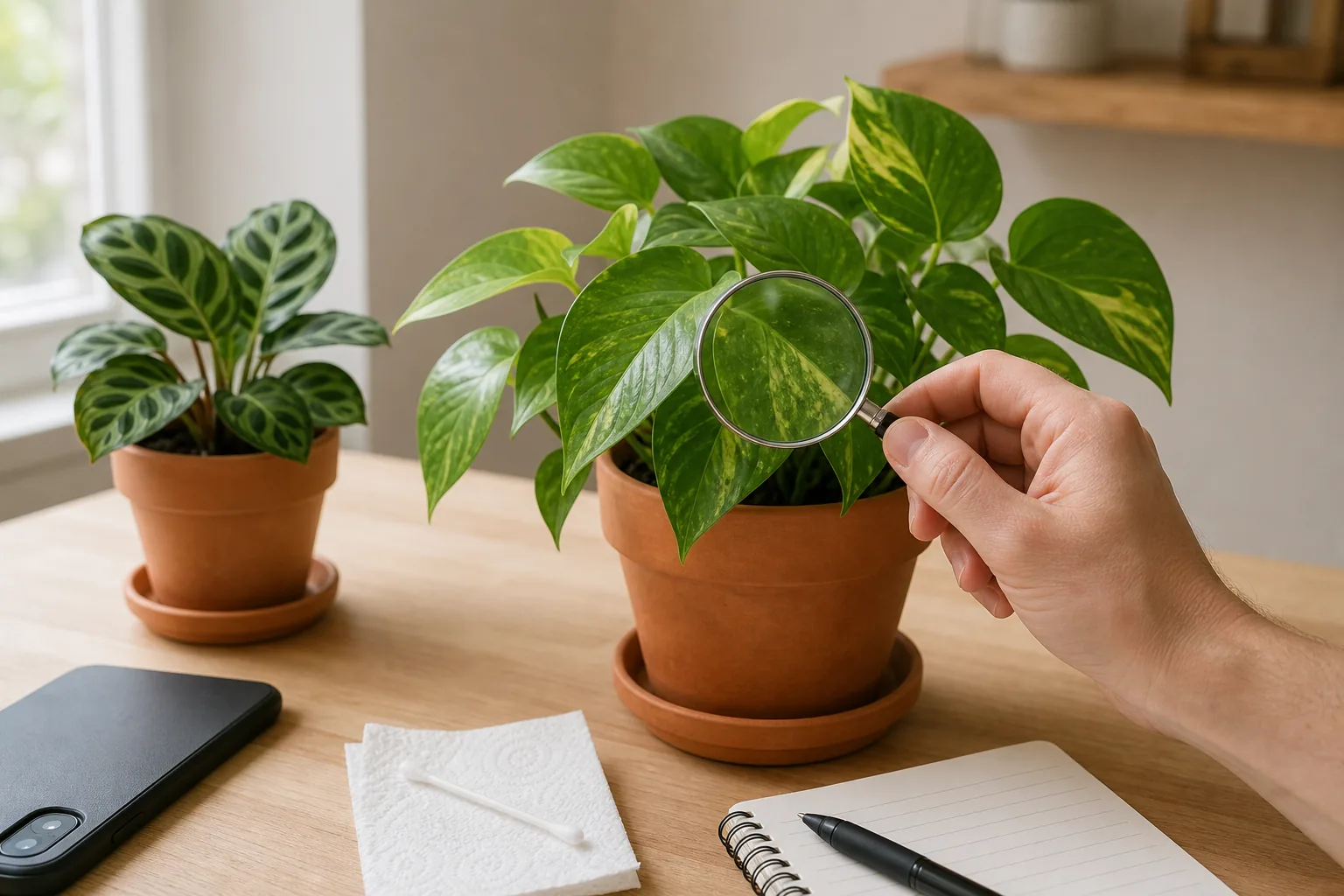
The single most useful move is to slow down and look, rather than reach for a spray. A brief, structured inspection tells you which pest you are dealing with and lets you act proportionately — wipe, rinse, isolate, or move on to a more specific plan. For the step-by-step version of this routine, see how to inspect and isolate a new houseplant. The four common first signs are useful as inspection triggers rather than diagnoses.
- Sticky residue on leaves or on the surface below the plant usually means honeydew from a sap-sucker (mealybug, scale, aphid, or whitefly). Inspect the leaf axils, the undersides of leaves, and along the stems before wiping anything off. Sticky leaves on a houseplant walks through what to look for.
- Tiny dark flies hovering near the soil surface most often point to fungus gnats around houseplants. Their larvae live in the upper layer of consistently moist potting mix, and the adults emerge over a similar short window after the plant arrives home.
- Fine webbing between leaves and stems, especially under drier winter air, is most often spider mites on houseplants. They tend to flare when a plant has been moved into a warmer, drier indoor environment.
- Cottony white tufts at leaf joints and along stems are usually mealybugs on houseplants, and the colony visible at week two is often a population that has been quietly developing for a few weeks.
Small, hard bumps along stems and leaf veins that do not scrape off easily are most often scale insects on houseplants, and the immobile adults are frequently the stage that was already present at purchase.
If you are not sure which sign you are seeing, isolating the plant and waiting a few days usually makes the diagnosis easier, because most pests will multiply or move enough to become identifiable on a second look.
How to keep a new-plant pest problem from spreading
The most useful thing you can do for the rest of your collection is treat every new plant as if it might be carrying something invisible for the first few weeks. That looks like a short isolation period away from other plants, a baseline inspection at arrival, and a second inspection around week two or three — the moment when most hidden populations first cross the visible threshold. Stable placement and a calm watering routine during this window help the plant acclimate and reduce the stress contribution to the equation. How to acclimate a new houseplant in the first two weeks covers what “stable placement” means in practice.
If you find a pest during this window, isolate the affected plant further from the rest of the collection and resist the urge to apply a broad-spectrum treatment before you have identified what is there. For species-specific confirmation and treatment, the Houseplant Supplies posts on mealybugs, spider mites, scale, fungus gnats, and sticky leaves each cover identification and the calmer indoor options to consider before any pesticide decision. If you choose to use a product indoors, follow the label exactly and contact a qualified local nursery, your regional extension service, or — for pet- or child-safety questions — your veterinarian or poison control resource.
Common questions about new-plant pests, briefly answered
Is this my fault? Usually no. The most common explanation is that a small hidden introduction was already on the plant, and the indoor conditions plus recent stress let it grow. The room, the pot, and your watering habit are unlikely to have created pests out of nothing.
Does this mean every new plant will have pests? No. Many plants arrive clean and stay clean. The risk is per-introduction and depends on source, season, and inspection, and a short isolation period is what reduces it.
Should I throw the plant out? That depends on the species, the severity of the problem, and what you are willing to invest in treatment. A heavy scale infestation on a cheap annual is a different decision from a light mealybug presence on a slow-growing plant you care about. The species-specific pest posts cover this question for each case.
Will the pests go away on their own? Usually not on the visible plant, but a small, contained population caught during isolation is much easier to manage than one that has had a few more weeks to spread to a collection.
Sources
- Common houseplant insects and related pests — Clemson University Home & Garden Information Center
- Managing houseplant pests — Colorado State University Extension
- Houseplant pests — Colorado State University, College of Agricultural Sciences
- Houseplant pests and control — University of Alaska Fairbanks Cooperative Extension Service
- Protecting houseplants from pests — Kemper Center for Home Gardening (Missouri Botanical Garden), via Discover + Share