Plant care
Christmas cactus care indoors: a year-round, observation-first guide
· Updated
If your Christmas cactus drops buds, shrivels at the segments, or simply refuses to rebloom, the cause is almost always environmental, not nutritional. Christmas cactus is a forest epiphytic cactus native to Brazilian coastal mountains, not a desert succulent. That single fact reframes every other care choice: it wants brighter indirect light than a desert succulent, an airy mix that still holds some organic matter, a more even watering rhythm than a true cactus, and a cool, short-day bloom trigger rather than a fertilizer regime. Get those four pieces right and most Christmas cacti will rebloom year after year.
This guide walks through the year in the order you actually experience the plant, with a focused section on what changes in the six to eight weeks before bloom.
What kind of plant a Christmas cactus actually is
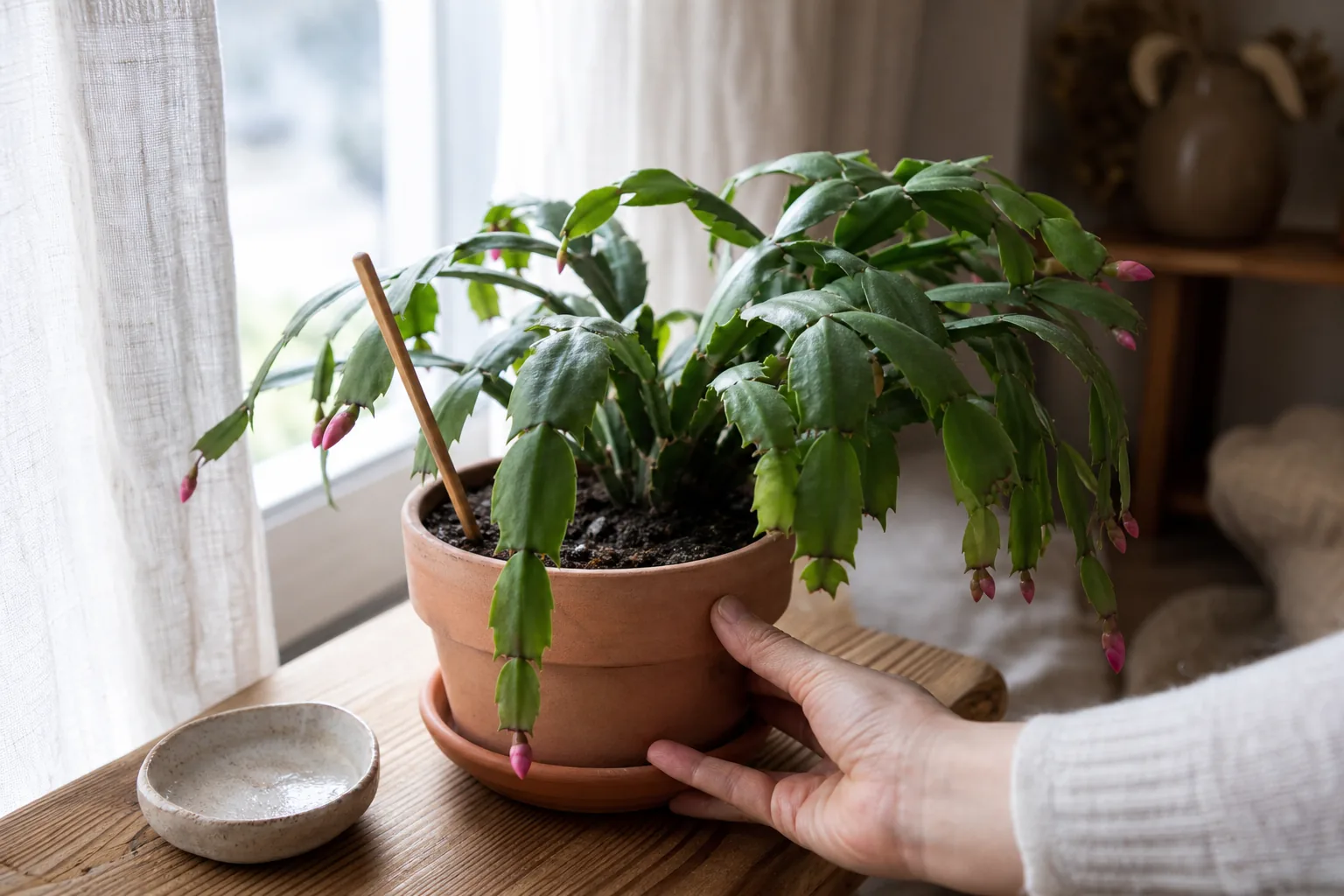
The genus Schlumbergera contains epiphytic cacti that grow on tree branches in shaded, humid Brazilian coastal ranges. They are not desert cacti, even though the word “cactus” suggests otherwise. The flat, segmented pieces you see are actually stem segments called cladodes, joined end to end. They store water but they also photosynthesize, and they evolved under a forest canopy rather than open sun.
This matters for three reasons:
- They tolerate more moisture around the roots than a desert cactus, but they still need air at the roots, so the mix must drain freely.
- They prefer filtered or indirect light. Direct sun bleaches the segments.
- They have a clear seasonal rhythm: spring and summer growth, fall bud initiation under cool nights and long nights, late-fall or winter bloom, and a quiet rest afterward.
You may also see plants sold as Thanksgiving cactus (Schlumbergera truncata), Christmas cactus (S. bridgesii and most modern hybrids), and Easter cactus (Rhipsalidopsis or Hatiora gaertneri). Most “Christmas cacti” sold today are hybrids. The practical at-a-glance cue is segment-edge shape: claw-like pointed projections suggest Thanksgiving cactus, more rounded or scalloped edges suggest Christmas cactus, and rounder segments with bristly edges suggest Easter cactus. The bloom cues below apply to all three, just in shifted windows.
The contrast matters for the rest of this article: a Christmas cactus is not watered like a desert succulent and should not be grown like one. If you already keep succulents, think of this plant as occupying the same room but a different care lane. The general framing in the indoor succulent care guide is useful background, even though the watering and mix details diverge.
Light: bright, indirect, and steady through the year
University extensions and botanical gardens consistently describe Schlumbergera light needs as bright but indirect or filtered. An east-facing or north-facing window is a reliable default. A west-facing window works if the plant is set back a few feet from the glass or shaded by a sheer curtain. A south-facing window is often too bright unless the plant is off to the side or the light is filtered.
Too little light produces thin, weak new segments and a plant that struggles to set buds. Too much direct sun reddens or bleaches segments and stresses the plant. If you are not sure whether a spot counts as bright indirect, reading the natural light in your room is a useful starting point.
A common misconception: bloom does not require dim daytime light. The trigger is dark hours at night, not low light during the day. The plant still needs bright indirect light through the bloom window, and winter-light homes can be dimmer than the plant prefers. Winter houseplant care walks through how lower seasonal light shows up in real rooms.
Watering rhythm: more even than a desert cactus, drier than a tropical
The right rhythm is closer to a Phalaenopsis orchid than to a desert cactus. Water thoroughly until excess drains from the pot, then let the top inch or so of mix dry before watering again. In active growth (spring and summer) the mix dries faster and you will water more often. During the post-bloom rest and through the bud-set window, water less, but never let the mix go bone-dry or stay soggy. The principle of watering by observation instead of a calendar applies directly here.
Two checks help you read what the plant actually needs:
- Stick a finger or a chopstick an inch into the mix. If it comes up cool and damp, wait. If it feels dry at that depth, water.
- Lift a small nursery pot when freshly watered and again when dry. The weight difference is the most reliable signal until you learn the rhythm.
As a general houseplant guideline, softened water and very high-mineral water are worth thinking about, especially if you see tip browning or bud drop despite consistent care. Most municipal tap water is fine; if yours is heavily fluoridated or you use a salt-based softener, switching to filtered water or rainwater for this plant is a reasonable step. The effect is not specifically documented for Schlumbergera in extension sources, so treat it as one variable among several.
Pot, drainage, and mix
Schlumbergera prefers a snug pot. Overpotting is one of the most common routes to root rot because a large volume of mix holds water around a small root system for too long. A drainage hole is the safer default, even when the plant sits inside a decorative cachepot. The reasoning behind that drainage and cachepot setup is worth a quick read if you keep plants in decorative pots without holes.
The mix should drain freely but retain some organic matter. A dry, gritty desert-cactus mix is the wrong choice; a soggy standard potting mix is also wrong. A workable recipe:
- One part standard houseplant potting mix
- One part perlite, pumice, or coarse orchid bark
That gives a mix that holds some moisture, lets excess drain, and stays airy around the roots. Some growers add a small handful of worm castings or compost for a slow nutrient boost, though this is optional and not specifically endorsed by extension sources. The principles are explained more fully in choosing a potting mix that actually drains.
The seasonal rhythm: growth, rest, and bloom
Treating the plant as a year-round cycle is more useful than a list of rules.
- Spring and summer (active growth): new segments appear at the tips. Water when the top inch is dry, light feeding every few weeks with a balanced houseplant fertilizer at half strength, optional pinching or pruning to shape.
- Early to mid-fall (bud initiation): the photoperiod and temperature conditions described in the next section do the work. Hold off on fertilizer and reduce water slightly, but do not let the mix dry hard.
- Late fall through winter (bloom): keep the plant where it is and water without splashing the buds. Do not move it, do not repot it, do not start a new fertilizer schedule.
- Late winter through early spring (rest): the bloom tapers. The plant may look tired. This is part of the rhythm, not a problem. Reduce water, skip fertilizer, and wait for visible new segment growth before resuming normal care.
What actually triggers bloom, and what does not
The bloom trigger is a short-day photoperiod response: roughly twelve to fourteen hours of uninterrupted darkness each night, sustained for about five to six weeks, combined with cool nights. Missouri Botanical Garden, Michigan State University Extension, and University of Minnesota Extension all describe this combination.
Two practical points:
- The dark hours have to be uninterrupted. A streetlight through the window, a hallway light left on overnight, or a reading lamp at the bedside can reset the cue.
- Cool nights help. The commonly cited range across reputable sources is about 50 to 65°F (10 to 18°C), with most extension sources clustering around 55 to 65°F. There is no single threshold, and cultivar response varies. A spare bedroom with the heat turned down at night is often a better spot during this window than a warm living room.
You do not need to put the plant in a closet for a fixed number of days. In most homes the natural short-day cycle of fall and winter already provides the dark hours, and consistency matters more than a folklore protocol. Sugar water, banana peels, and ice cubes are not supported by extension sources as a care protocol; they tend to cause more problems than they solve.
Why buds drop, and how to read the cause
Buds are the part of the plant most sensitive to change. Common causes that extension publications mention include:
- A recent move or rotation, especially during bud set.
- Drafts from a window, exterior door, or heating vent.
- Sudden temperature swings, including a warm living room at night.
- Very dry indoor air from winter heating.
- Watering extremes, either bone-dry mix or waterlogged roots.
- Recent repotting during bud set.
A short diagnostic checklist:
- Has the plant moved in the last two or three weeks?
- Is it near a draft, vent, or exterior door? The framing principle in drafts, vents, and temperature swings covers this well.
- Has the heating pattern changed?
- Is the mix moist or dry right now? Lift the pot.
- Are the segments still plump and firm, or starting to wrinkle?
Wrinkled, soft, or reddened segments: a calm troubleshooting flow
- Wrinkled and limp segments usually point to underwatering, or to root damage from a mix that stayed too wet. Lift the pot. If it is heavy and wet, the roots may be suffocating. If it is light and dry, the plant needs a thorough soak.
- Red or purpled segments usually mean too much direct sun or cold stress. Move the plant back from the window or filter the light.
- Soft, mushy segments at the base of the plant usually mean rot. Unpot, look at the roots, and remove any that are brown and mushy before repotting into fresh, airy mix.
In all three cases, the fix starts with observation and a small adjustment. Reaching for fertilizer is usually not the answer. The diagnostic order in diagnosing brown or shriveled segments covers the same principle for a wider range of houseplants.
Repotting, propagation, and what to skip in bloom season
Repot only when the plant has clearly outgrown its pot (tight rootball, watering trouble, toppling) and ideally just after bloom finishes, not during bud set or full bloom. Move up only one pot size; Schlumbergera likes to be snug.
Propagation is straightforward. Twist off a piece of two to four segments at a joint, let the cut end rest and callus for a few hours to a day, then set it upright about an inch deep into a small pot of the same airy mix you would use for the parent plant. Keep the mix slightly damp and the pot in bright, indirect light. New growth at the tip is the sign that roots have formed.
Skip these during bloom: heavy fertilizing, moving the plant to a new spot, and repotting. Any of these can cause bud drop.
A short, realistic checklist for the weeks before bloom
- Place the plant once and leave it there for the next six to eight weeks.
- Keep night temperatures as cool as the room allows, without making the household uncomfortable.
- Make sure the dark hours are actually dark. Cover or move the plant away from any overnight light source that might interrupt the cycle.
- Water when the top inch of mix is dry, no more.
- Skip the folk fixes.
- Inspect every few days for the segment-by-segment swelling that means buds are forming.
What to do after bloom ends
Continue normal watering and light. If a segment or two shrivels, that is normal for an older segment and not a crisis. Hold off on a major repot until the plant is back into active growth. Some readers are tempted to compost a tired-looking plant after bloom; resist that. The post-bloom rest is part of the rhythm, not a failure. Within a few weeks you should see new segment growth at the tips, and that is the signal to resume light feeding and slightly more frequent watering.
A note on pets
Some households ask whether Schlumbergera is safe around cats or dogs. Houseplant Supplies does not make pet-safety determinations. The ASPCA maintains an up-to-date list of plants and their reported effects on pets, and it is the most reliable reference for your specific household.
Sources
- Missouri Botanical Garden — Schlumbergera truncata Plant Finder
- Michigan State University Extension — How to care for and get your holiday cactus to rebloom
- University of Minnesota Extension — Holiday cacti
- University of California ANR — Cactus from the Rainforest: Christmas Cactus
- Royal Horticultural Society — How to grow Christmas cactus