Plant care
Phalaenopsis orchid care: reading roots, light, and the dry-down rhythm
· Updated
A Phalaenopsis orchid is one of the easiest houseplants to keep alive once you stop treating it like a typical houseplant. It is not a soil-grown plant with roots buried in a pot of dirt. It is an epiphyte, a plant that grows on tree branches in the wild, and its thick roots, its bark or moss medium, and its preference for bright indirect light are all parts of one biological system. The most useful care habit is observation: read the roots, feel the medium, and watch the leaves. The less useful habit is following a fixed schedule.
What makes a Phalaenopsis different from a typical houseplant
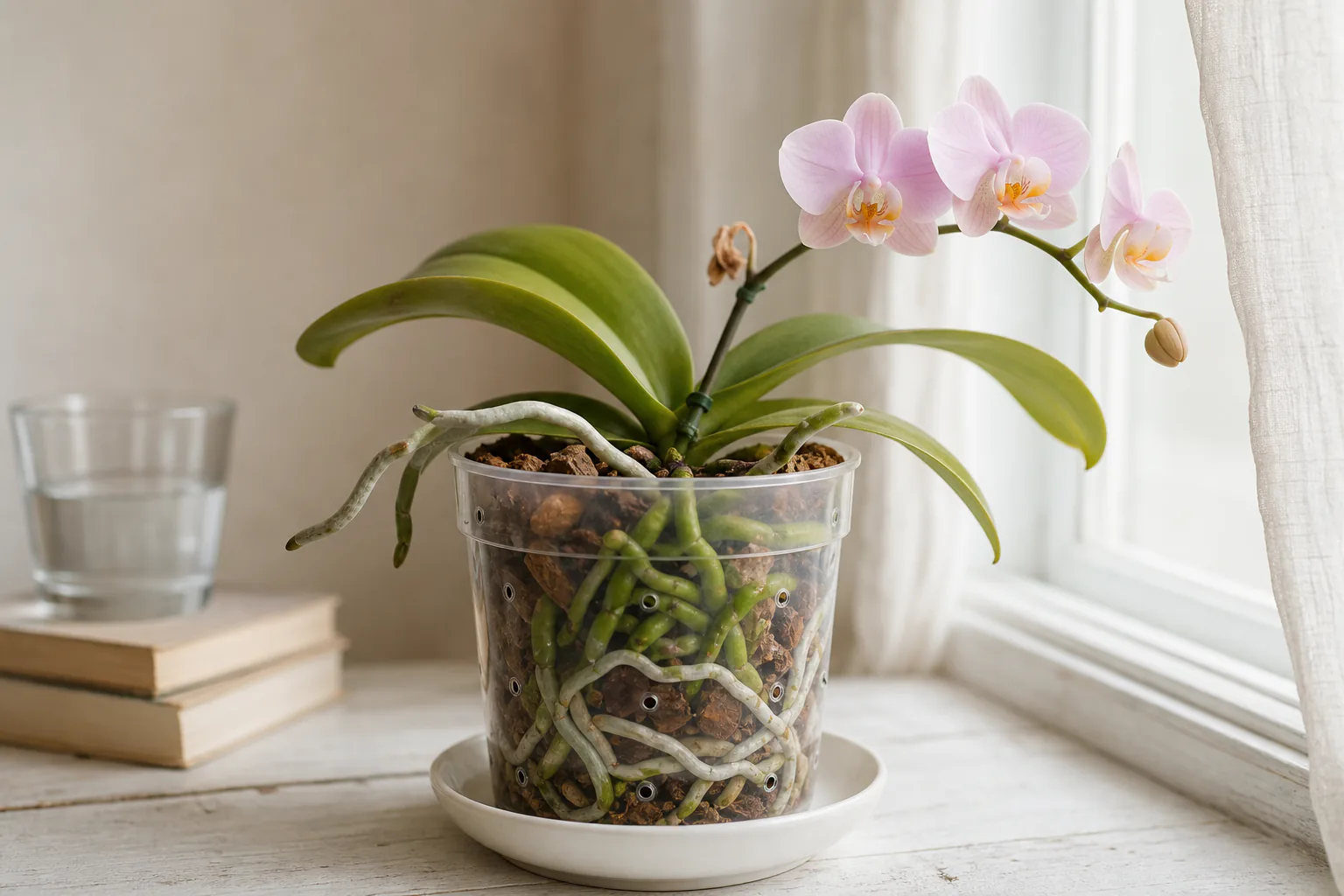
Most foliage houseplants are terrestrial. Their roots evolved in soil, and the standard approach is to water when the top inch of potting mix dries, then let the pot drain. A Phalaenopsis is built differently. In its native range it clings to tree bark with roots that stay partly exposed to air, soaking up rainfall and humidity and photosynthesizing while they are at it. When growers pot a Phalaenopsis, they are trying to imitate those conditions, which is why the pot is filled with chunky bark or loose sphagnum moss rather than soil, and why the pot is usually clear so light reaches the roots.
This is also why a Phalaenopsis often arrives in a small plastic pot packed with a dark, dense plug of peat or tightly compressed sphagnum. That plug is built to keep the plant hydrated on a shipping bench, not in a living room. The same plug can stay wet for weeks once it is sitting in a real home, and that is one of the most common starting points for the slow decline many new orchid owners see.
Reading the roots: green, silver, plump, and wrinkled
If you learn only one skill for this plant, let it be reading its roots through the clear pot. The roots are thicker than the roots of most houseplants, and they are wrapped in a spongy outer layer called velamen that changes color with moisture.
A healthy root looks like this: it is firm to a gentle squeeze, and it shifts from bright green when wet to silvery or whitish when dry. That color change is not a problem. It is the plant telling you what it needs. If the roots inside the pot are green, the medium is still moist. If they are silver and the pot feels light when you lift it, it is time to water.
Rotted roots look different. They are mushy, papery, or hollow when squeezed, and they often turn brown or black. A root that no longer changes color when you water is a root that is no longer working. Some root loss is normal as bark breaks down, but a plant with mostly mushy roots is one that has stayed wet too long. Aerial roots, the ones that wander out of the pot and into the air, are also normal. They participate in photosynthesis and pull in humidity, and they are not a sign the plant needs a bigger pot.
Light a Phalaenopsis actually needs in a real room
Phalaenopsis orchids want bright, indirect light. The American Orchid Society suggests a maximum of around 1,500 foot-candles, which is a useful anchor number but easier to act on in window-placement terms.
An east-facing window, where the plant gets gentle morning sun and bright light for the rest of the day without harsh direct exposure, is the most commonly recommended placement. A south or west window can also work if the plant sits a few feet back from the glass or is filtered by a sheer curtain, especially during the brightest part of the day. A north window is usually too dim unless the room is unusually bright or supplemented with a grow light.
The leaf itself is the simplest light meter. Smithsonian Gardens notes that a slightly yellow-green or olive tone suggests the light is in the right range. Deep, dark green leaves usually mean the plant wants more light. Reddish patches or yellowed, scorched areas mean it is getting too much direct sun. The general principle of reading the natural light in a room before placing a houseplant applies here just as it does for any other plant.
Watering and the dry-down question in bark or moss
The single most common cause of a struggling Phalaenopsis is watering the way you would water a pothos: on a regular schedule, into the same pot, into the same medium. The orchid’s bark or moss dries differently from potting soil, and the time between waterings can swing widely with the seasons. The Smithsonian notes that orchids may need water somewhere in the range of every 5 to 14 days depending on heat, light, and humidity in the home. That range is wide on purpose, because the right answer for any given week depends on the plant, the pot, and the room.
The American Orchid Society’s guidance is to water thoroughly and not water again until the medium is nearly dry. In practice, that looks like this: take the plant to a sink, run room-temperature water through the pot for a minute or so, let it drain completely, and put it back. Lift the pot before and after to feel the difference. A dry pot is noticeably lighter than a wet one, and the bark will feel dry to the touch an inch or so into the medium.
The ice-cube method is one option some beginners use. A 2017 study in the journal HortScience found that ice cubes placed on bark media did not drop the root-zone temperature enough to harm the plant. The trade-off is that the method delivers a small, slow-melting volume of water, and it is a commercial practice rather than a horticultural consensus. The American Orchid Society continues to recommend thorough watering with a dry-down period between waterings, and many experienced growers follow that guidance because a thorough soak is closer to the volume of water an orchid would receive in its native habitat. Either approach can work; the important part is that the medium has a chance to dry down between waterings and that the plant never sits in standing water inside a decorative cachepot. Empty the cachepot within 15 to 30 minutes after watering.
The general principle of watering based on observation rather than a schedule applies here even more than it does for a typical houseplant, because the orchid’s medium is designed to dry out.
A simple dry-down routine
- Lift the pot. If it feels light and the roots inside look silver, water. If it still feels heavy and the roots are green, wait.
- Stick a finger into the medium near the edge of the pot. If the bark is still cool and slightly damp a knuckle down, wait a day or two.
- Water in the morning so any moisture that lands in the crown has time to evaporate before night.
Potting medium and pot choice: why the original setup may need changing
The medium a Phalaenopsis grows in shapes the whole care routine. Bark dries faster, lets air reach the roots, and is closer to the plant’s natural growing conditions. Sphagnum moss holds water longer, which can be useful in dry homes or in small pots, but if it is packed too tightly it can suffocate roots and stay wet for too long. Neither medium is universally better; the right choice depends on the home’s humidity, the pot size, and how often the owner tends to water.
The original plug from a gift plant is usually the worst version of either medium, because it is densely packed and often already partly broken down. The American Orchid Society typically recommends repotting every one to two years, often after a bloom cycle, because bark decomposes and the original medium becomes less airy. The practical signs to look for are bark pieces that have gone soft, dark, and crumbly, a medium that stays wet for more than a week, a sour smell from the pot, and roots inside the pot that are mushy rather than firm.
A clear pot with drainage holes makes root observation much easier. Decorative cachepots are fine as long as the inner pot is removed for watering and the cachepot is not allowed to hold standing water.
After the blooms drop: what is normal and what is not
Most Phalaenopsis orchids are sold in bloom, and the blooms last for several weeks before the flowers fade and drop. This is normal and is not a sign the plant is dying. A healthy Phalaenopsis with firm leaves and healthy roots can rebloom from the same spike or send up a new one. A common practice is to cut the old spike just above a node after the last flower falls, which can encourage a side branch and another round of blooms on the same spike. Other growers cut the spike all the way back and wait for a new one. Both are reasonable; the plant will follow its own timeline.
The conditions that support reblooming include bright indirect light, a steady watering and feeding routine during active growth, and cooler nights in the cooler months. A specific timeline should not be promised, because light, temperature, and plant health all vary, and a second bloom can come in a few months or take longer.
A few things are not normal and are worth a closer look: loss of multiple leaves, a soft or mushy crown at the base of the leaves, a sour smell from the pot, or roots that stay brown and mushy after watering. These are signs of crown rot or root rot, usually from water sitting in the crown or in a wet medium for too long. For persistent symptoms, reaching out to a local orchid society or extension service is a more reliable next step than guessing.
Common mistakes Phalaenopsis owners make
A few patterns come up again and again.
Treating the orchid like a foliage houseplant. Watering on a fixed schedule, repotting into standard potting soil, and ignoring the medium all lead to the same outcome: a plant that slowly suffocates in a too-wet, too-dense mix.
Leaving the plant in standing water. A decorative cachepot with no drainage will hold water at the bottom of the inner pot and rot the roots, even if the rest of the care is reasonable.
Repotting into regular potting soil. Standard potting soil holds far more water than bark or loose moss and is one of the fastest ways to kill a Phalaenopsis.
Panicking when blooms drop. A Phalaenopsis without flowers is a plant in its natural rest phase, not a plant in decline. With healthy leaves and roots, the next bloom cycle is a matter of time and conditions.
Over-fertilizing. Orchids are light feeders, and a gentle, regular feeding during active growth is usually enough. Strong doses of fertilizer can burn roots and build up salts in the medium.
The plant is more forgiving than it looks. A Phalaenopsis can sometimes recover from significant root loss when a few firm roots remain, when the medium is fresh and airy, and when watering is paced to the plant rather than to the calendar. The work is in the observation.
Sources
- American Orchid Society, Phalaenopsis culture sheet
- American Orchid Society, Principles of light
- Smithsonian Gardens, Care of Phalaenopsis
- Texas A&M AgriLife Extension (Texas Superstar), Care of Phalaenopsis orchids
- New York Botanical Garden, Phalaenopsis (moth orchid) LibGuide
- HortScience (American Society for Horticultural Science), Ice cube irrigation of potted Phalaenopsis orchids in bark media (South, 2017)