Plant care
Can a houseplant live in a windowless bathroom?
· Updated
A houseplant can live in a windowless bathroom only if it still has a usable light source. The Royal Horticultural Society puts it directly: bathrooms with no windows are not suitable for growing live plants. That sounds harsh, but it is a useful starting point because it forces a clear question, which is where the light will come from if not a window. The bathroom’s humidity helps with leaf condition and watering rhythm, but it does not replace photons. The realistic path is to read the existing artificial light in the room, decide whether to add a small supplemental light, and then pick a plant whose tolerance matches the actual light outcome.
What a bathroom without a window actually means for a plant
A windowless bathroom is a specific case of an already-dim room, and it is worth saying so out loud. No direct sun. No indirect sun from a frosted pane. No light bleeding in from an adjacent hallway window during the day. The plant’s only photons are the ones the existing fixtures put out, plus whatever a supplemental light is added.
This is different from a bathroom with a small frosted window, which still contributes some daylight to the low-light band, and different from a powder room with a skylight or a sun tube. If the bathroom has any daylight at all, even heavily filtered, the answer starts to look more like a low-light room than a fully dark one, and a different set of expectations applies. The rest of this piece assumes there is no meaningful daylight reaching the plant.
Read the light that is already in the bathroom
Before choosing a plant, the honest move is to inventory what is already there. A typical windowless bathroom has one or more of: an overhead fixture on a switch, vanity bulbs around a mirror, a nightlight, or sometimes a recessed LED. Together, those are the plant’s entire light budget unless a supplemental light is added.
University of Minnesota Extension defines low light for foliage houseplants as roughly 50 to 250 foot-candles and ties that range to a north window or a fairly dark corner, explicitly a dim spot near a window rather than a windowless interior. UF/IFAS adds a useful reference point: rooms lit only by fluorescent bulbs often measure around 40 foot-candles or fewer, which sits below even the low-light band. The realistic baseline for an overhead-only windowless bathroom is below the range extension services call low light, with the caveat that the exact number depends on wattage, fixture height, and how long the light is actually on.
A few practical questions help make this concrete:
- How many hours per day is the bathroom light on? Many bathrooms are dark for most of the day, then lit for short stretches in the morning and evening. A 20-minute shower light is not a daily light integral.
- Where would the plant sit relative to the fixture? Counter level is closer to a vanity bulb; floor level is farther from a ceiling fixture and therefore dimmer.
- Is the fixture on a dimmer, or is it a single fixed wattage? Even modest changes in brightness matter at these low levels.
If the answer is a low-wattage overhead bulb on for a couple of hours a day, the realistic answer is that this is not enough light, on its own, to sustain most foliage houseplants long-term. The method for reading the light more carefully is covered in how to read the natural light in a room, and the same observation framework applies to artificial light, just with a much lower starting baseline.
Bathroom humidity and temperature swings: a real benefit with a real ceiling
The bathroom does have one genuine advantage, which is humidity. A shower raises the relative humidity in the room for as long as the door stays closed and the fan stays off, and the plant’s leaves and potting mix respond to that. This is enough to slow mix drying and to keep humidity-tolerant foliage looking good. The honest take on whether houseplants actually need added humidity, and how bathroom humidity compares with humidifiers and pebble trays, is in whether houseplants need added humidity.
It is not enough to count as a terrarium. The variability is the part that gets glossed over. Humidity climbs during a shower, holds briefly afterward, then drops once the exhaust fan runs or the door opens. In a bathroom used at all, the plant spends most of the week in ordinary indoor humidity, with periodic spikes during showers rather than a steady tropical climate. Some species tolerate that pattern well; others, especially those prone to rot, do not. A working bathroom is not the same as a sealed glass cabinet, and treating it that way is how plants end up sitting in cold, wet mix with soft stems.
Heat is the other variable. Bathrooms are often near outside walls, above unheated spaces, or right next to the exhaust fan. After a hot shower, the air cools quickly. The combination of slow-drying mix and cool air is common in windowless bathrooms, and it favors plants that tolerate wet feet less than the humid air would suggest. Plants in this room are also dealing with the airflow side of things, from drafty exterior walls to bathroom ventilation, and the order in which to read drafts, vents, and bathroom microclimates is covered in drafts, vents, and bathroom microclimates.
If you add supplemental light: what to look for without overbuying
Once the existing light has been honestly read, the next decision is whether to add a small supplemental light. University of Maryland Extension treats supplemental lighting as a standard, recognized category for rooms where natural light is insufficient, and notes that artificial lighting can improve the quality of light a plant receives. LED and fluorescent are the most common options.
This article is not going to turn into a grow-light buying guide, but a few principles help frame the question without overclaiming. Distance and duration matter more than the specific bulb. A light that is too far from the foliage contributes little, regardless of wattage. A light that is on for an hour a day is unlikely to make up for a windowless room on its own. The variables to think about are how close the fixture sits to the plant, how many hours per day it runs, and whether the spectrum is described as full-spectrum or as a daylight-balanced bulb. Bathroom-safety considerations, including moisture, fixture rating, and distance from water, belong in the manufacturer’s instructions for whatever light is being considered, and any electrical decisions should follow the label and any relevant local code, not an article.
A practical compromise that some readers use is rotation. Keep the plant in the windowless bathroom most of the time for the humidity and the look, and bring it into a brighter room for a day or two on a regular cadence so it can recover under usable light. This is a reader-side workaround consistent with extension guidance to match the plant to the actual light environment, and it is a realistic option for someone who does not want to install a fixture in the bathroom.
Plant choices that are honest matches for a windowless bathroom
Plant names should come after the light question, not before. The candidates below are framed for what they can actually do under the light outcome the reader has, not for a generic bathroom plant label.
- ZZ plant (Zamioculcas zamiifolia). Widely recognized as exceptionally tolerant of low light and dry conditions. With supplemental light, it can grow steadily. Without it, it tends to sit in a slow holding pattern.
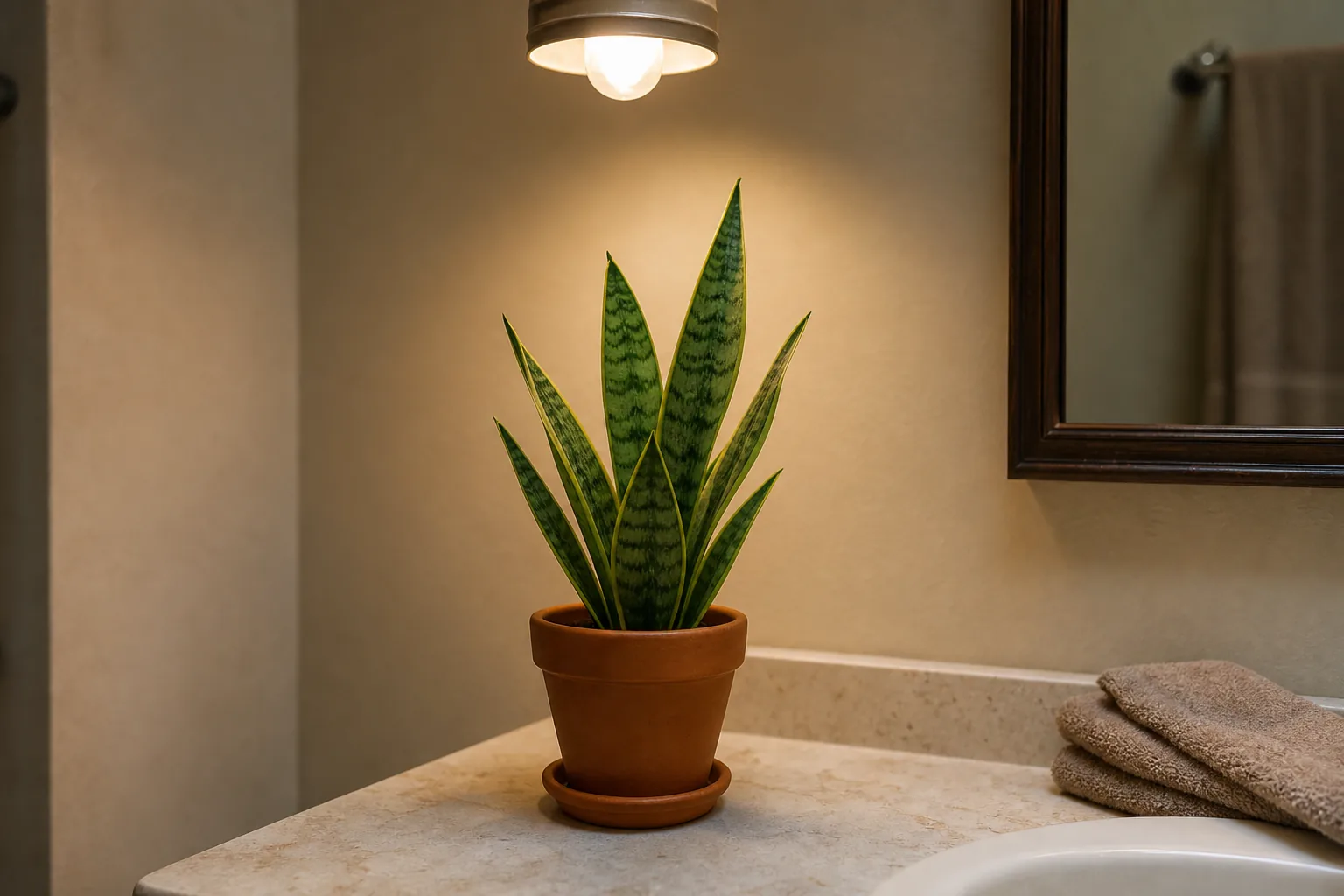
- Snake plant or mother-in-law’s-tongue (Dracaena trifasciata). Named by Chicago Botanic Garden as a denizen of the dark, adapted to understory conditions with little light. The same caveat applies: tolerant of low light, not of zero light.
- Cast-iron plant (Aspidistra elatior). Another Chicago Botanic Garden pick, valued for tolerance of dim, dry interiors.
- Pothos and heartleaf philodendron. Often listed for low-light bathrooms. They will generally grow more slowly than they would in brighter light, and leggy stems are a common sign the light is still too low — the diagnostic order for that is in why houseplants get leggy.
- Peperomia, sometimes called radiator plant. Mentioned by Chicago Botanic Garden as an understory-adapted option, one that tends to prefer bathroom humidity over dry indoor air.
The honest pairing for every name on this list is that they are low light tolerant, but still need some usable light, whether that is a dim spot near a window or a few hours under a supplemental light. None of the cited sources endorse any plant as thriving in zero natural light. The longer version of those expectations is laid out in what low-light-tolerant houseplants can actually do.
Survive vs. thrive: setting expectations you can actually hold the plant to
In a windowless bathroom without supplemental light, doing fine usually means the plant is in a low-energy holding pattern. Existing leaves persist. New growth slows or stops. The plant is not dying, but it is not visibly growing either. That is a real and acceptable outcome for a reader who wants a green presence in the room and is willing to accept slow or no visible change.
Thriving in this context means new leaves emerging at a normal pace, fuller foliage, and recovery from prior stress. That requires usable light, and a typical overhead bathroom fixture alone does not provide it. The plant-level signs that the existing light is not enough are the same as in any other dim room — leggy stems with longer gaps between leaves, smaller-than-before new leaves, pale color, and a reluctance to push new growth. How those signals read in order is covered in why houseplants get leggy.
If the goal is a plant that grows visibly and fills in, the honest answer is that a windowless bathroom without supplemental light is not the right room for that goal, and a different spot in the home is.
A short weekly check that fits a room you don’t live in
A bathroom plant is often in a room the reader visits quickly. A weekly inspection rhythm fits better than a daily one, and a simple weekly houseplant care routine can be adapted for a bathroom by keeping the steps short.
- Moisture. Stick a finger an inch into the mix. In a dim, cool bathroom, the mix dries slowly. Water only when that inch is dry, not on a fixed cadence; the framework for that is in how to water without a schedule.
- Leaves and stems. A quick scan for yellowing, soft growth, or new leggy stems. Any of those is information, not a verdict.
- Distance from the light. Has the plant been moved, or has a new item been placed in front of the fixture? A small shift in distance matters at these low levels.
- Rotation, if part of the plan. Move the plant to a brighter room for a day if rotation is the chosen workaround.
When to stop, reassess, and ask a local source
A general article can set the frame and the realistic expectations, but a specific bathroom is, in the end, a specific room. A powder room with a single low-wattage bulb on a dimmer, a basement bath with a fluorescent strip, and an interior apartment bath with LED downlights are three different setups. A local nursery or a state extension office can look at the actual room and the actual fixtures and give a more specific answer.
Houseplant Supplies is not a diagnostic service. The goal here is to give the reader a clear-eyed starting point: windowless bathrooms are not, by default, suitable for live plants; humidity helps but does not replace light; supplemental lighting is the recognized way to change the answer; and a small, honest plant list only makes sense once the light in the room has been read.
Sources
- Royal Horticultural Society — Best bathroom plants
- University of Minnesota Extension — Lighting for indoor plants and starting seeds
- University of Florida / UF/IFAS Gardening Solutions — Light for Houseplants
- University of Maryland Extension — Lighting for Indoor Plants
- Chicago Botanic Garden — Denizens of the Dark: Indoor Plants for Low-Light Spaces