Plant care
When to pot a water-propagated cutting: a readiness checklist
· Updated
Why the timing question matters more than it looks
When a cutting has been sitting in a jar of water for weeks, the question “is it ready?” starts to feel urgent. But readiness is not just about whether roots exist. It is about whether the root system you have grown is in the right shape to shift from a water environment to a soilless mix without collapsing.
In horticultural guidance, water-propagated roots are commonly described as thinner, more delicate, and packed with fine root hairs, while soil-grown roots tend to be thicker and tougher. No peer-reviewed study in the surfaced sources quantifies this distinction, so it is best understood as a widely discussed functional adaptation rather than a strict biological category. The practical implication: roots that linger in water become progressively less suited to mix, and a single primary root with no branching is rarely enough to anchor a cutting in a new pot.
That is why the decision moment deserves more attention than the moment of cutting or the moment of first root emergence.
The short answer: a readiness checklist in three tiers
Before unpacking the details, here is the scannable version. Match what you see in your jar to one of three tiers.
Not yet ready A single pale root, no branching yet, stem still firm but with no new growth, water still clean. Wait another week or two and recheck.
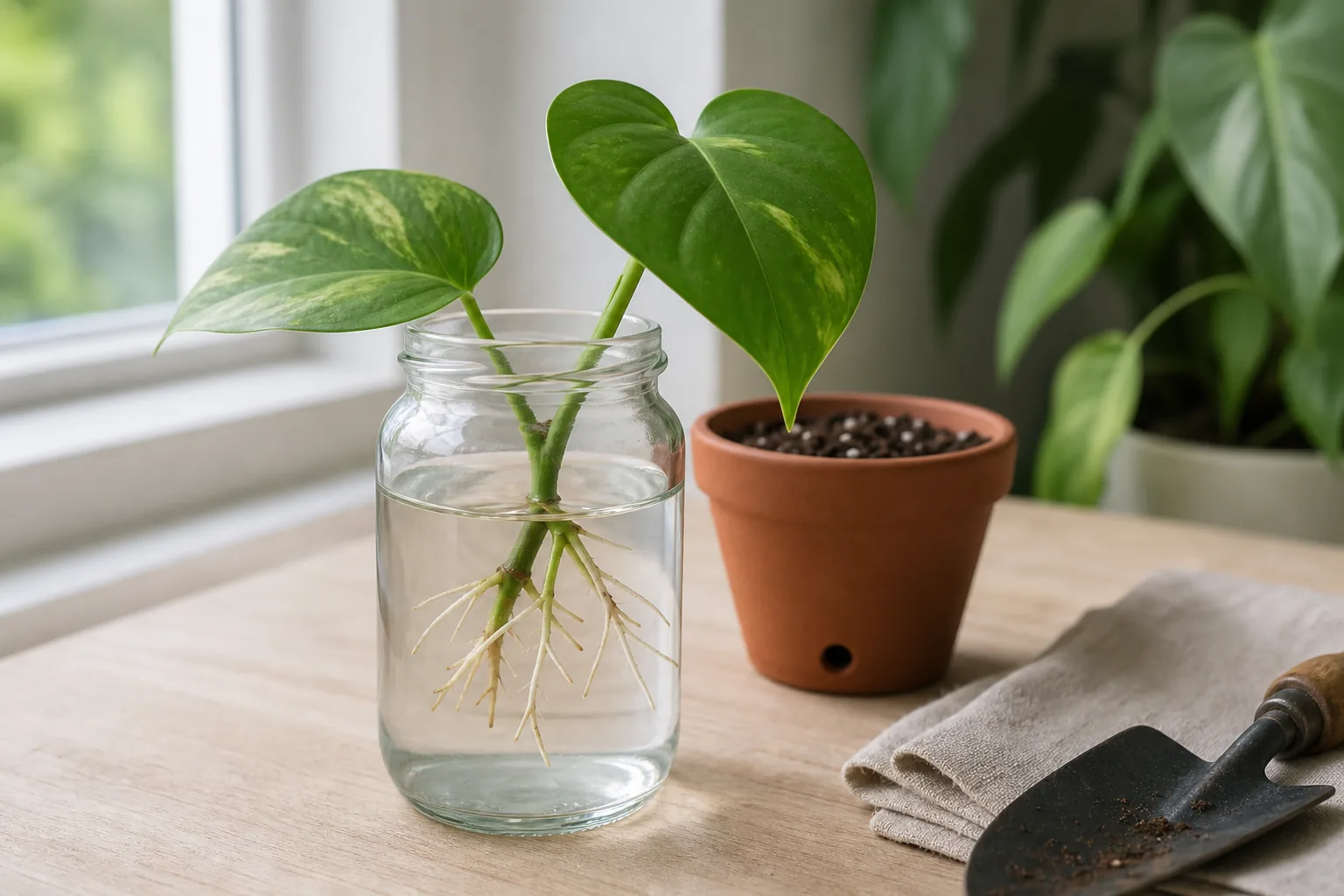
Ready now A primary root roughly 2 to 5 cm (about 1 to 2 in) long with visible secondary rootlets near the node, pale or cream-colored and firm, on a stem that still looks healthy and turgid. Pot up soon.
Waited too long Very long, bare primary roots with little or no secondary branching, browning or mushy root tips, green algae coating the roots or jar, stem becoming woody or hollow, foul-smelling water. Transfer now, but expect a longer recovery and watch for rot.
This three-tier framing is a probability tool, not a guarantee. No single signal is decisive on its own. The closer the cutting matches the middle tier across multiple signals, the more confident you can be.
Observable signals that roots are ready
The recurring readiness cue across houseplant guidance is a primary root of roughly 2 to 5 cm (about 1 to 2 in) with visible secondary rootlets near the node. Treat this as a common pattern rather than a hard rule. A cutting with only one long root and no branching is described in multiple sources as still too young, even if the primary root looks impressive.
Color and firmness matter as much as length. Healthy water roots are typically pale, cream, white, or light tan, and they feel firm when gently touched. They are delicate, so do not squeeze or pull, but a clean pale tone is a much better sign than brown or translucent.
Stem and node condition is a co-equal signal. A turgid stem with a clean cut at the node, no yellowing or blackening, and a leaf (if present) that is still firm rather than drooping supports readiness. If the stem is starting to soften near the cut or the leaf has gone limp and papery, the cutting is signaling stress rather than readiness, even if the roots look fine.
Optional confirmation: new growth. A small new leaf unfurling above the node, or a visible bud swelling, is sometimes cited as soft confirmation that the cutting has moved past emergency rooting and into active growth. It is not required, but if it is there, it is reassuring.
Observable signals that you should wait a little longer
A single primary root with no visible side roots is the most common “wait” signal. The root may be longer than 2 cm already, but if it is a solitary thread with no branching, it has not built the network it will need to anchor in mix.
Other wait-now signals include:
- Roots that are very pale and thread-thin, almost translucent
- A stem that is still soft at the node or cut
- Yellowing leaves, even mild, especially if the lowest leaf is fading
- No new growth visible anywhere on the cutting
- Water that is still clean and clear, which is good for the cutting but not a readiness cue on its own
If two or more of these are present, give the cutting another week or two in bright, indirect light and check again.
Observable signals that you have waited too long
The “waited too long” tier is less discussed than the “ready now” tier, but it is real and worth watching for.
Watch for very long primary roots with little or no branching. Roots that have grown many inches or sat for many months in water without developing secondary rootlets are described in hobbyist accounts as having spent too long in the jar. The longer a root sits in still water, the more it adapts to that environment, and the harder the transition to mix tends to be. A 3 to 5 inch root with healthy secondary branching can still transition well; what signals trouble is the absence of that branching rather than the length itself.
Brown or mushy root tips are a rot warning. Some healthy water roots can be light tan, but tips that turn dark brown, feel squishy, or slough off when touched are decaying. Cloudy, slimy water or a fungus-like film on the inside of the jar are companion signals.
Green algae coating the roots or jar is not immediately fatal, but it is commonly attributed to light reaching the water more than it should, and it usually means the vessel is overdue for a clean. Algae competes for oxygen and makes the root environment less hospitable.
Stem signals at this stage include:
- The stem becoming woody, brown, or hollow near the cut
- Yellowing that has progressed past one leaf to the whole cutting
- A foul smell from the water
If these are present, transfer promptly. The cutting may still survive, but expect slower establishment and watch closely for rot in the first few weeks.
Why readiness varies by species and conditions
Two identical cuttings can reach the same readiness tier at very different times depending on species, light, water temperature, and the home environment.
Pothos and heartleaf philodendron are the most commonly cited forgiving transitions. They root quickly in water and tolerate a slightly early or slightly late move into mix. If you are propagating for the first time, these are reasonable starting points; see our pothos care and heartleaf philodendron care guides once the cutting is established.
Monstera and Hoya are widely described as slower and more sensitive. They tend to root more deliberately and benefit from a stricter readiness check, particularly visible secondary branching before transfer. Our Monstera care guide has more on what to expect from a slower-rooting species.
Environmental factors shift readiness timelines. Extension publications consistently note that light, temperature, and humidity influence how quickly a cutting develops roots. High light intensity can be detrimental to cutting rooting because it raises leaf temperature and transpiration, while moderate, bright, indirect light is broadly recommended. A cutting in a dim corner will simply take longer to reach any of the three tiers than the same species in a brighter spot.
Honest limitation: no single signal is decisive. The checklist is probabilistic. When in doubt for a slow species, err slightly on the side of waiting, since a single primary root that fails in mix is harder to recover from than a healthy unbranched root that stays in water for another week or two.
The day of the transfer: what to set up first
Once the cutting matches the middle tier, set up the new home before you move it. Have a small pot with drainage ready, choose a mix that suits the species, and lightly moisten the mix so it is not bone dry.
For most leafy tropicals, a small starter pot appropriate for a single rooted cutting, often cited around 8 to 10 cm (3 to 4 in) in hobbyist guidance, works well. Larger pots hold more moisture than a small new root system can use, and that mismatch is a common cause of post-transfer rot. Our guide on when to repot a houseplant frames the small-pot decision in more depth if you want to revisit it later, and our guide on choosing a potting mix covers the species-by-species matching.
The actual transfer mechanics, including how to remove the cutting without snapping roots, how to settle the mix, and how to water in, are covered in a sibling article focused on the transfer itself, so this page stays narrow on the readiness decision.
What realistic post-transfer looks like
The first two to three weeks after potting up are a stabilization period. The roots that grew in water are now sitting in a very different environment, and it is common for the cutting to look slightly worse before it looks better. Mild droop on the day of transfer and a day or two after is normal, especially in lower-humidity rooms.
Growth typically slows. The cutting is putting energy into growing new soil-adapted roots rather than pushing out new leaves. Some lower leaves may yellow and drop, which can be alarming if you have been watching the jar for weeks, but it does not mean the transition has failed on its own.
The biggest avoidable risk after transfer is overwatering. The new root system cannot pull moisture from mix as quickly as it pulled from a jar, and the mix stays wet longer than a reader used to a propagation schedule expects. The jar rhythm and the soil rhythm are different, and switching to watering by observation rather than the old refill-the-jar cadence helps the new roots settle. Our after-repotting care article walks through how to read the mix and the plant rather than the calendar. If you are unsure whether the cutting is struggling because of overwatering or underwatering, our guide on the telltale signs of watering problems helps you tell the two apart before changing anything.
Realistic expectations: establishment is often a matter of weeks rather than days for forgiving species, and can run longer for slower species or for cuttings moved at the edges of the readiness window. The single biggest variable is the match between the root system’s readiness at transfer time and the mix’s moisture level afterward.
Honest limitations of this checklist
The three-tier framing is built on what multiple houseplant sources describe as common readiness patterns, anchored in extension guidance about how species and conditions change rooting speed. It does not come from a controlled study, and no single signal is decisive.
There is no magic number. The 2 to 5 cm range is a recurring common pattern in the surfaced guidance, but several sources note that cuttings can be moved earlier or later and still succeed, especially with forgiving species. Equally, cuttings that match the “ready now” tier perfectly can fail to transition, and cuttings that match it only loosely can thrive.
Some species simply do not propagate well in water, and no readiness checklist will rescue them. If a cutting has been in water for months with no rooting at all, or if a cutting that looks ready in the jar has failed to establish in mix two or three times in a row, the issue is more likely the species or the cutting itself than the timing.
Finally, this page is one decision in a longer process. The readiness tier tells you when to move. Choosing a pot, choosing a mix, settling the cutting, and managing the first weeks in mix each have their own tradeoffs. Treat this checklist as the first gate, not the whole garden.
Sources
- NC State Extension — Propagation (Extension Gardener Handbook, chapter 13): https://content.ces.ncsu.edu/extension-gardener-handbook/13-propagation
- SDSU Extension — Propagating houseplants: https://extension.sdstate.edu/propagating-houseplants
- Oregon State University Extension — Environmental factors affecting plant growth: https://extension.oregonstate.edu/gardening/techniques/environmental-factors-affecting-plant-growth
- Tombesi et al., Influence of light and shoot development stage on leaf cutting rooting (NCBI PMC): https://pmc.ncbi.nlm.nih.gov/articles/PMC4654426/
- Love That Leaf — How to propagate indoor plants in water step-by-step: https://www.lovethatleaf.co.nz/blogs/plant-care-guides/how-to-water-propagate-indoor-plants