Plant care
Variegated houseplants and light: a realistic expectation
· Updated
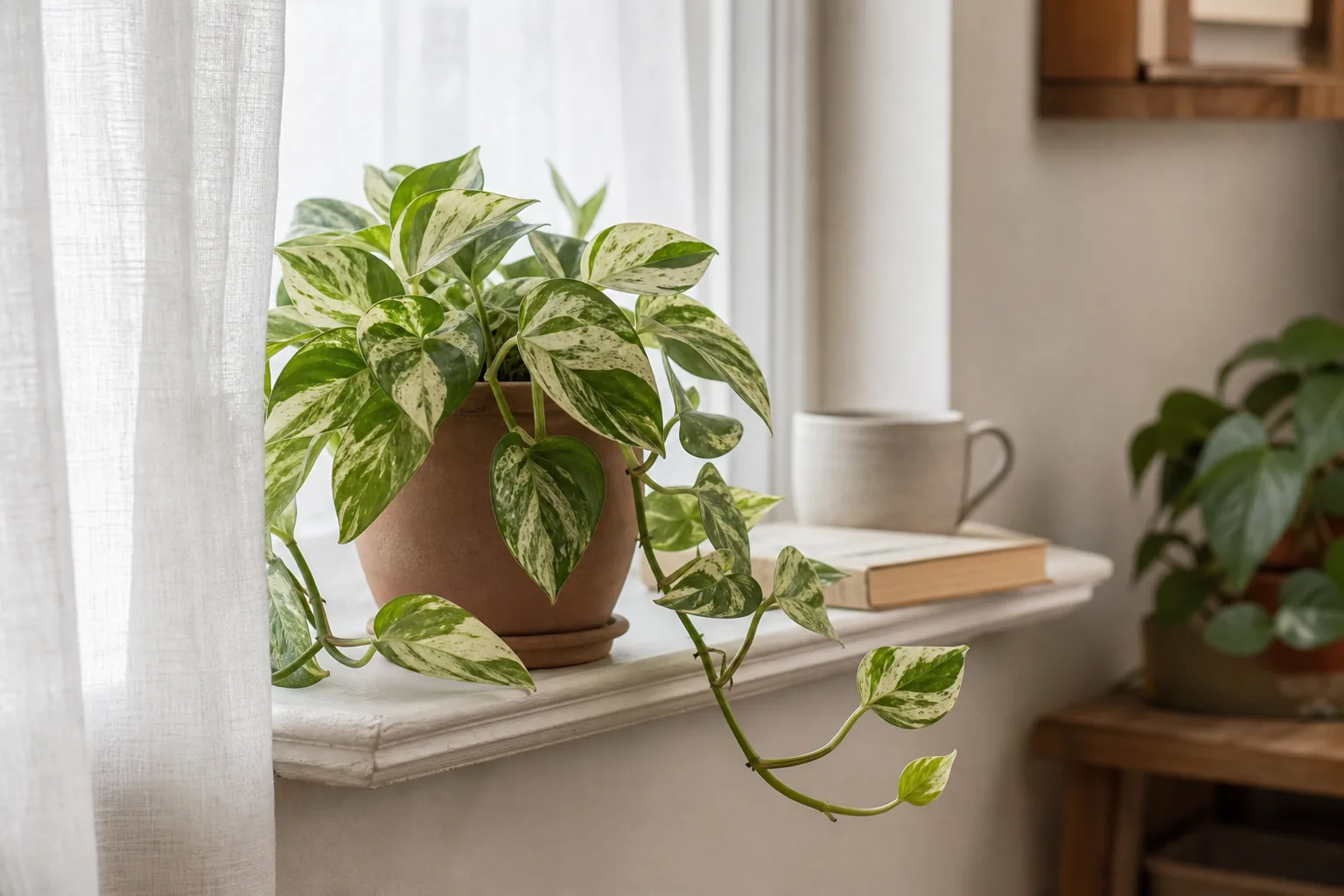
A variegated houseplant usually wants a brighter and steadier indirect light position than the same species in its fully green form, while still being protected from harsh direct sun on the pale sections of its leaves. That sounds like a contradiction until you look at what variegation is actually doing on the leaf. Once you understand that, the plant itself becomes the easiest measurement tool you have.
What variegation is actually changing on the leaf
Variegation is not a paint job. Some of the cells in a variegated leaf cannot make chlorophyll, the pigment that captures light energy and powers photosynthesis. The white, cream, yellow, or pink sectors of a variegated leaf contribute little or nothing to photosynthesis. The green sectors are doing all the photosynthetic work on their own.
This matters for two reasons. First, a variegated leaf has less productive area per square inch than a fully green leaf on the same plant. Second, the pale sectors have less ability to handle bright light safely, because chlorophyll is what absorbs and processes that light energy. Without it, pale tissue is widely reported in horticulture literature to scorch, bleach, and crisp faster than green tissue when strong direct sun hits it.
There are also different ways a plant can be variegated, and they do not all behave the same way. Chimeric variegation, the unstable kind with clearly defined white or pink sectors, is what you see on plants like Monstera Albo Borsigiana, and is often how sources categorize pothos cultivars such as N’Joy or Manjula. Genetic mosaic variegation, where the pattern is more uniform and stable across the plant, is what you see on Monstera Thai Constellation. Viral variegation exists but is uncommon in the trade and is outside the scope of any at-home diagnosis. The differences matter because chimeric cultivars can revert to all-green growth for reasons light alone cannot fix, while stable mosaic cultivars tend to keep their pattern more reliably.
Why that usually means a brighter, steadier indirect light
If each leaf has less productive tissue, the plant has to compensate by capturing more usable light overall. That is why the New York Botanical Garden’s houseplant FAQ lists insufficient light as the most common reason houseplant variegation fades: the plant cannot maintain the non-working sectors when the working ones are starved.
The shift in expectation is not toward more intense sun. It is toward a more dependable supply of bright indirect light for more hours of the day. University of Maryland Extension describes indoor light categories in foot-candles, with medium-bright at roughly 100 to 500 foot-candles (east or west window out of direct sun) and high at roughly 500 to 1000 foot-candles (south or some west windows). That is a working scale, not a rule, and a variegated plant is usually sitting toward the brighter end of that band.
The total daily hours of usable light, sometimes called photoperiod, matters too. Iowa State University Extension notes that typical indoor supplemental lighting runs 12 to 14 hours per day, with a minimum around 10 hours. That is a useful reference point when you are evaluating how much usable light a window plus any grow light is actually delivering.
How to read your room before you move a variegated plant
Before you move a variegated plant, it helps to confirm what kind of light it is actually sitting in. The brightest indirect spot in one room can be a dim corner in another room, and the spot that worked in October can be a scorch zone in late April once the sun angle changes. Walking through how to read the natural light in your actual spot helps, but a quick sanity check is:
- Stand where the plant sits at midday and look toward the window. Can you see open sky without seeing the sun? That is bright indirect.
- Does direct sun touch the leaves for more than an hour or two in the morning or afternoon? That is filtered or partial sun, which can work for some variegated plants and scorch others.
- Can you read a book comfortably without a lamp during the day? You are probably in a medium-bright spot.
- Is the spot lit only by ambient room light, with the window across the room? That is medium to low, and is where variegated plants tend to lose pattern first. The realistic ceiling for any variegated plant in that corner is what low-light-tolerant houseplants can actually do in a dim room, which is to survive, not to maintain heavy white or pink sectors.
On-plant signs the variegated plant is asking for more usable light
The plant itself is a better signal than any number. Look at the newest, smallest leaf and the most recent gap between leaves, called an internode, and compare it with what older growth looked like a few months ago. Longer internodes, smaller new leaves, and a leaning stem are classic light signals on any houseplant, and they tend to show up on variegated plants before fully green ones.
Signs the plant is asking for more usable light:
- New leaves are coming in smaller than the older ones.
- The space between new leaves is getting longer, so the stem looks leggy or stretched.
- The plant is leaning toward the window or light source.
- New growth is coming in mostly green while the older leaves still show the variegated pattern.
- Growth has slowed or stalled outside of the seasonal slowdown you would expect for the species.
If new growth is coming in greener than the older leaves, that is the variegation-specific version of the leggy-stretching symptom. It usually means the plant is conserving energy by dropping the most expensive sectors to maintain. A steady increase in usable light often brings the pattern back on subsequent leaves, but only on new growth. Already-reverted mature leaves will not repaint themselves.
On-plant signs the pale sectors are getting too much direct light
The opposite problem looks different, and it is the trap many people fall into when they try to fix fading by moving the plant closer to a sunny window.
Signs the pale sectors are getting too much direct light:
- White or pink patches bleach to a translucent yellow-white before going brown or papery.
- The pale areas crisp first while the surrounding green tissue still looks healthy.
- Brown, dry edges appear only on the pale parts of the leaf.
- Damage shows up on the side of the plant that faces the window.
If you see this, the fix is not more light. The fix is more shade on the pale tissue. A sheer curtain, a set-back from the glass, or a move to a brighter indirect spot away from direct sun will usually stop the damage within a few weeks. New leaves that come in afterward can still show full pattern even when the burned leaves never recover.
Adjusting placement seasonally without losing the pattern
Placement is not a one-time decision. A north window with a bright sky view can be ideal in midsummer and gloomy by midwinter. A spot a few feet back from a south or west window can be perfect in January and brutal in May once the sun angle climbs.
A simple seasonal re-check works well. Every couple of months, look at the newest leaf and the most recent internode and compare them with what the plant looked like the last time you checked. If internodes are stretching, move the plant toward more usable light. If pale sectors are crisping, move it away from direct sun or add a sheer layer. Do not make both changes at once, because then you will not know which one helped.
A short observation routine for variegated houseplants
Once a month, take a photo of the newest leaf from above and a second photo of the full plant from the side. Keep both for a few months. Photos flatten the slow changes that are easy to miss in person, especially the gradual loss of variegation or the slow lengthening of internodes. If you can compare a new leaf with a photo from six months ago, you will usually see the direction the plant is heading.
It is also worth resisting the urge to relocate a newly purchased variegated plant multiple times in its first weeks at home. The plant is already adjusting to a different room, different humidity, and a different watering rhythm. Give it a stable spot, then judge the light after it has had a chance to settle. Acclimating a new variegated houseplant goes into more detail on that first two-week window.
What to check next if the pattern still fades or burns
If you have brightened the indirect light, set the plant back from direct sun, and waited through a couple of new leaves, and the pattern is still fading or the pale tissue keeps crisping, a few other things are worth looking at.
- Confirm whether your plant is chimeric or stable mosaic. A Monstera Albo and a Thai Constellation will not behave the same way under stress. The species page on Monstera light and space expectations walks through how placement differs by cultivar.
- If you are growing a variegated philodendron such as Pink Princess or Brasil, the heartleaf philodendron care by placement page covers how variegated philodendrons respond on a shelf, in a hanging pot, or on a windowsill. Many of the same light cues apply.
- For variegated pothos, including Marble Queen and N’Joy, the pothos cultivar and variegation differences section explains how each type tends to hold or lose its pattern.
- Check the watering rhythm. Repeated underwatering or overwatering stresses the plant and can accelerate pattern loss regardless of light.
- Look at the roots if the plant is otherwise declining. A rootbound plant in old, compacted mix cannot support new growth no matter how good the light is.
- Rule out pests before assuming the issue is light. Indoor pests such as mites and thrips can mark pale sectors in ways that look like scorch.
If the plant continues to decline after working through this list, your local independent nursery, a county extension office, or a qualified indoor plant specialist can take a closer look. Plants vary by species, cultivar, potting mix, light, temperature, season, water quality, and the home, so any checklist has limits.
The realistic answer is that variegated houseplants sit toward the brighter end of bright indirect light, that the plant is the source of the answer, and that already-reverted mature leaves will not regain their pattern. New growth is the only place the current conditions will show up, which is why a slow, steady, observation-based approach almost always works better than chasing a single light number.
Sources
- Why is the variegation fading on the leaves of my houseplant? - New York Botanical Garden
- Lighting for indoor plants - University of Maryland Extension
- Plant Geek: Variegation - Michigan State University Extension (PDF)
- Important considerations for providing supplemental light - Iowa State University Extension
- Chimeras - University of Florida IFAS Plant Propagation