Plant care
Small houseplants for shelves: a placement-first guide
· Updated
Small houseplants for shelves: a placement-first guide
Short answer: measure the shelf before you choose the plant. Standard floating shelves are usually 6–12 inches (15–30 cm) deep and standard bookcases are commonly 10–12 inches deep, which fits a pot around 5 inches (~13 cm) in diameter but leaves little room once the plant grows. Check what light actually reaches the shelf surface, because a shelf below or away from a window usually receives meaningfully less light than the windowsill. Match a habit — trailing, compact rosette, small upright, or miniature bushy — to the space rather than falling for a species list, and choose from a short shortlist of commonly available plants whose mature size and footprint suit that habit. Plan how you will water it before you buy.
Why “small plant for a shelf” is a placement question first
Most “small plants for shelves” lists start with the plant and work backward. The trouble is that “small” gets used loosely. Retailers commonly sell “small” or “mini” plants in grow pots around 5 inches (~13 cm) in diameter, but a plant that fits in a 5-inch pot today will not necessarily fit the shelf a year from now. The pot’s footprint is rarely what overflows a shelf — the mature width and trailing length of the plant are.
The better starting point is the surface itself. A shelf has fixed dimensions, fixed light, fixed access, and (if it is a floating shelf) a fixed load rating. Picking the plant to match those constraints is more reliable than picking the plant first and hoping it stays small. If you are still at the room level, the broader room-first framework for choosing a houseplant is the better starting point.
Measure the shelf before you pick the plant
Three numbers and one question:
- Depth. Standard floating shelves typically run 6–12 inches deep, with 8 inches described as the most popular depth for bathrooms. Standard bookcases usually run 10–12 inches deep, with slimmer decorative units at 8–10 inches and heavier storage shelves at 12–15 inches. Subtract any wall thickness, the lip of a bracket, and room for a saucer or cachepot. That is the realistic envelope for the mature plant.
- Clearance above. A plant’s mature height matters when there is a shelf above it. Upright and bushy habits need headroom; trailing habits convert that headroom into downward drape.
- Width between supports or walls. This is the mature footprint envelope, not the pot diameter. A 6-inch pot in the center of a 24-inch shelf is fine; the same pot on a 10-inch-deep ledge leaves only 2 inches of horizontal run for the plant to spread.
- Can you actually lift a watering can to it? If the shelf is high, narrow, or has nothing to stand on in front of it, that is a watering problem waiting to happen.
A simple rule of thumb: leave at least an inch of clearance on every side of the mature plant, and leave room to get a hand or a small watering can in and out.
Light at shelf height is usually lower than at the windowsill
A shelf directly under a window is rarely as bright as the windowsill itself. The sill catches unobstructed light at the height of the glass, while the shelf surface is several inches below it and often a foot or two back from the pane. A shelf several feet into the room, or on a wall perpendicular to the window, is usually noticeably dimmer than the sill.
The honest way to read this is by observation rather than by a foot-candle number. The Houseplant Supplies guide to reading the natural light at shelf height walks through how to do that on the actual shelf surface rather than at the window, which is the only place that matters for placement.
For shelves away from the window, low-light-tolerant species (snake plant, ZZ, pothos, some philodendrons) are the safer shortlist. For a more honest picture of what those plants can and cannot do in a dim spot, see what low-light-tolerant houseplants can actually do. For shelves in a bright corner, the species list opens up considerably.
Habit categories that suit shelves
A plant’s habit is what determines whether it fits a shelf over time. Four categories cover most of the commonly available small houseplants:
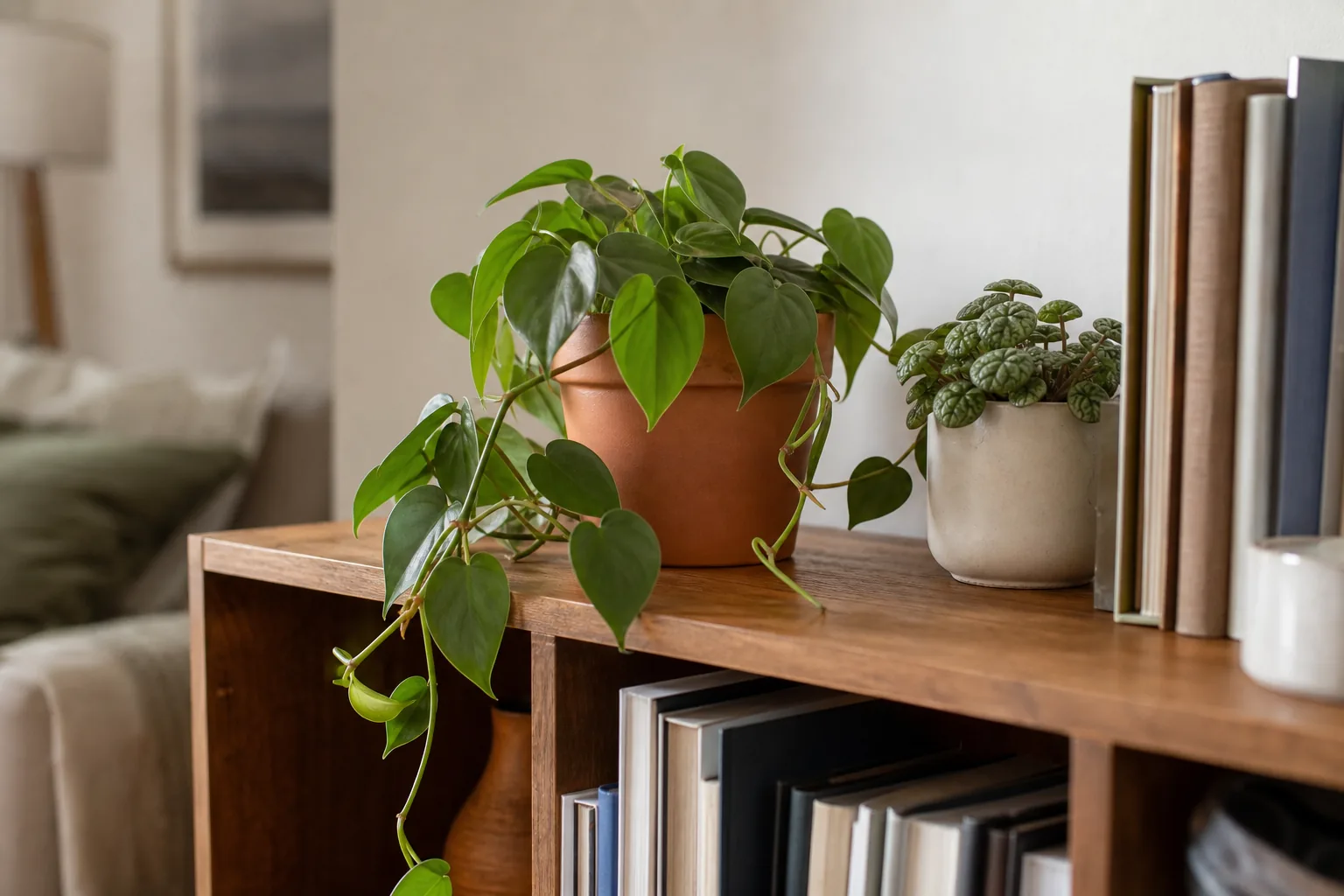
- Trailing. Vines that drape over the shelf edge: heartleaf philodendron, pothos, spider plant, hoya, rhipsalis. Best when overhang is welcome and the shelf edge is clear below.
- Compact rosette. Plants that grow outward in a tight circular form: bird’s nest snake plant, small succulents such as haworthia, echeveria, or small aloes. Best for narrow ledges and high-traffic shelves where overhang would get in the way.
- Small upright. Plants that grow upward in a contained column: pilea peperomioides, peperomia obtusifolia, small sansevierias. Best where you want a clear silhouette and limited spill.
- Miniature bushy. Plants that spread outward more than they trail: nerve plant (Fittonia), small ferns. Best where there is room for the spread and the light is medium rather than low.
Most species fit more than one of these descriptions depending on cultivar and conditions. Treat the categories as a way to think about fit rather than as fixed species tags.
A short shortlist of commonly available small houseplants
The species below come up repeatedly across shelf-plant guides and are widely available at nurseries and garden centres. Mature indoor sizes are given as ranges — conditions, pot size, and light all change growth rate. Each species has its own care page on Houseplant Supplies if you want to go deeper.
- Heartleaf philodendron. Trailing vine; mature indoor length can reach several feet if allowed, but the plant is easily pruned back. Tolerates medium to low light. Good on shelves where some overhang is welcome.
- Pothos (Epipremnum aureum). Trailing vine with thicker, often variegated leaves; similar length range to heartleaf philodendron. Tolerates medium to low light.
- Peperomia (obtusifolia, caperata, and other small varieties). Mostly compact or mounding; many cultivars stay under about 8 inches tall. Best on narrow ledges where a tidy footprint matters.
- Pilea peperomioides. Small upright with rounded leaves, usually staying within the pot silhouette. Prefers medium light and may stretch in lower light conditions.
- Spider plant (Chlorophytum comosum). Arching habit with plantlets that can drape several inches past the shelf edge. Generally does best in medium to bright indirect light; tolerates average home conditions.
- Bird’s nest snake plant (Sansevieria trifasciata ‘Hahnii’). Compact rosette that stays small relative to upright snake plants, usually a hand-span or so across at indoor maturity. Often described as tolerant of lower light and missed waterings; treat those as a tendency, not a guarantee.
- Nerve plant (Fittonia albivenis). Miniature bushy, usually low and spreading. Often sold as needing steady moisture and disliking dry air, so it may not be the easiest shelf plant for hot or dry rooms.
- Small succulents and air plants. Useful where the shelf is shallow and dry; air plants do not need soil at all.
This is a shortlist, not a definitive list. Use it to anchor the habit categories above rather than as a shopping list.
Watering, pot weight, and accessibility on a shelf
Three practical things go wrong on shelves that do not go wrong on a windowsill:
- Hard-to-reach shelves. If lifting the plant down is awkward, you are less likely to check it regularly. Watering by feel rather than on a schedule becomes more important, not less. The guide to when to water without using a schedule explains the observation method that works best when a plant is out of easy reach.
- Pot weight. Wet terracotta is dense. If the shelf is floating, has no visible bracket, or you are not sure of its mounting, plastic or fabric grow pots are safer than a row of wet terracotta. The guide to pot drainage and cachepot setup covers how pot setup affects watering more generally.
- No drainage. Decorative pots without drainage holes are common for shelves because they look tidier. They are workable for low-water species (some succulents, snake plants) but risky for anything else, especially on a shelf where you cannot easily tip the pot to drain. Bottom-watering in a cachepot with a saucer is a reasonable compromise for trailing plants you do not want to lift down.
Check the shelf manufacturer’s specifications for load tolerance if you are not sure. Wet soil in a terracotta pot is meaningfully heavier than the empty shelf looks, and floating shelves in particular vary widely in their rated capacity.
When trailing is the right choice — and when it is not
Trailing plants are the most photogenic on shelves, and the most likely to come down. A pothos or heartleaf philodendron with a long drape looks great until a cat, a toddler, or a passing elbow catches the vine.
Trailing is the right choice when the shelf is high, the area below is clear, and no one will pull at the vines. Trailing is the wrong choice when the shelf is at child or pet height and the area below has hard surfaces, electronics, or anything breakable.
A compact rosette or small upright gives up the visual drape in exchange for stability. For shelves at eye level in a living room or office, that is often the better trade.
Pets, children, and stability
Shelves change the way people and animals interact with a plant. A trailing pothos that is harmless on a high windowsill becomes reachable when it is on a low bookcase. Several species commonly recommended for shelves (pothos, philodendron, certain calatheas) appear on toxicity lists for cats and dogs. The Houseplant Supplies pet-aware verification method walks through how to check species individually rather than relying on a generic “pet-safe” list — use that approach before placing any plant where a pet or child can reach it.
For stability on the shelf itself, a wider, heavier pot is harder to knock over than a small grow pot slipped into a lightweight cachepot. Trailing plants get top-heavy as the vines grow, so the base needs to be solid.
When to skip the shelf idea and ask a local nursery
A shelf plant that thrives in a photo can underperform in real conditions, and a shelf that looks right in a render may not have the depth, light, or load tolerance to support what is on it. If your shelf is shallow and deep in a room with no nearby window, has uncertain mounting, or sits at exactly the height a curious pet can reach, the honest answer is that it is not a great placement for most plants — and that is a question for a local nursery or a knowledgeable grower, not for a listicle.
Plant behavior varies with species, cultivar, pot, light, water, and the home. Treat this guide as a framework for narrowing the choice, and treat any specific plant you pick as something to observe over its first few months on your specific shelf.
Sources
- Hernest — Height of a Bookcase: Standard Sizes & Expert Guide: https://www.hernest.com/blog-detail/height-of-a-bookcase-standard-sizes-expert-guide-b-192.html
- Shelfology — The Ultimate Guide to Floating Shelves: https://shelfology.com/pages/the-ultimate-guide-to-floating-shelves
- Lyons Crafted — Choosing the Right Shelf Depth: https://lyonscrafted.com/blogs/floating-shelves/choosing-the-right-shelf-depth
- The Spruce — 21 Plants That Can Fit and Grow on a Shelf: https://www.thespruce.com/houseplants-perfect-for-shelves-5208150
- The Spruce — 33 Types of Peperomia You Can Grow at Home: https://www.thespruce.com/peperomia-types-7368765