Plant care
Pothos leaves curling: what to check before you change anything
· Updated
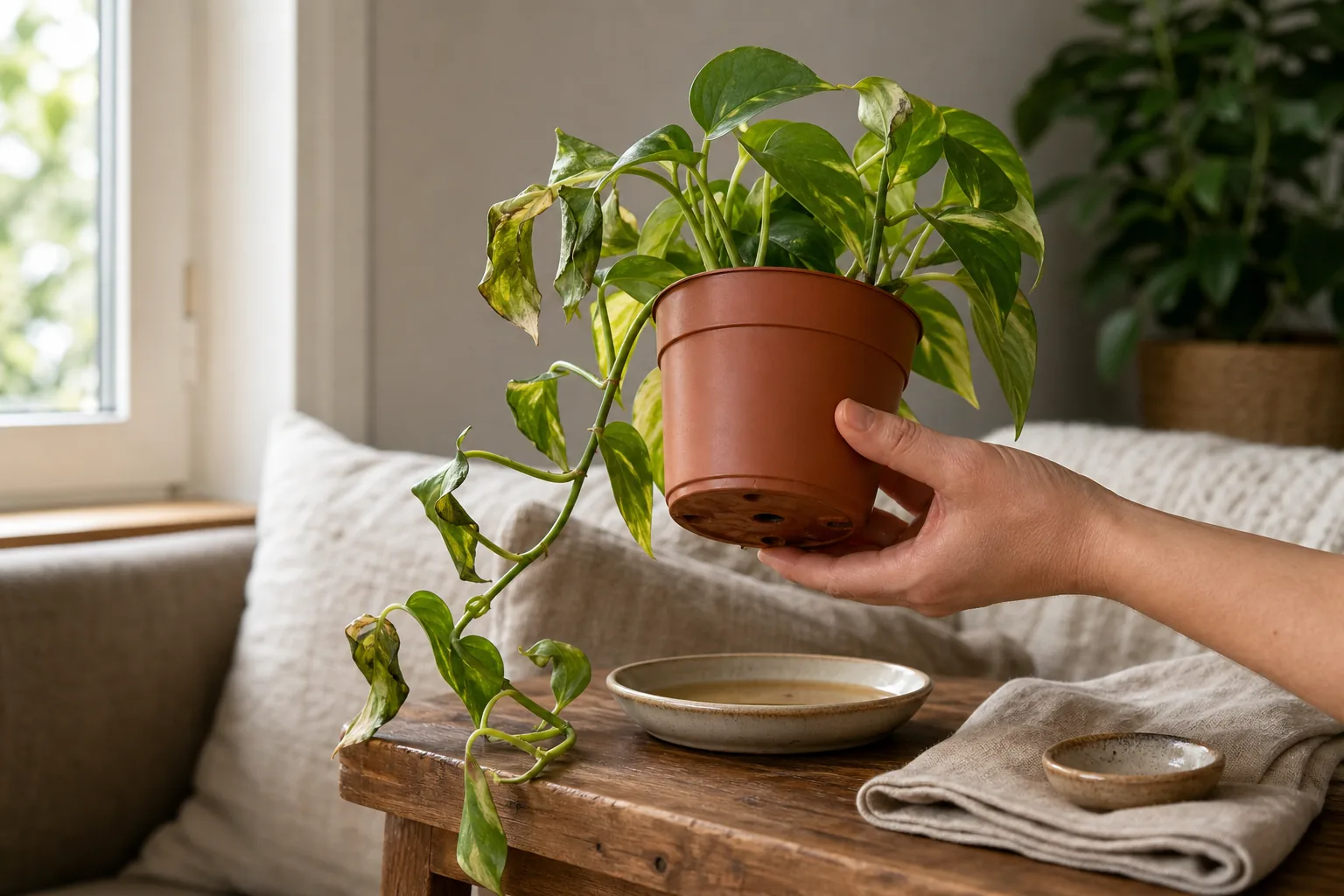
Pothos leaves curling is a stress signal, not a single diagnosis. Both under- and overwatering can produce it, and so can intense light, cold drafts, heat from a vent, root restriction, recent repotting or a move, and sap-feeding pests. The right first step is a five-to-ten-minute inspection of the pot, the spot, the room, and the undersides of the leaves, not a quick fix from a list.
This guide is for indoor pothos (Epipremnum aureum, sometimes sold as golden pothos or devil’s ivy). Plants sold as “satin pothos” or “silver pothos” are usually Scindapsus, and “heartleaf pothos” is sometimes a heartleaf philodendron in trade. Their care overlaps but is not identical, so if your plant is not clearly an Epipremnum aureum, the symptom can carry a slightly different weight. For pothos specifically, the inspection below is a reliable starting point, and the Houseplant Supplies pothos care hub covers the baseline expectations for light, water, and growth.
A note before you read on: a leaf that has already curled usually keeps its shape, even after the underlying cause is corrected. New growth at the vine tips is the truer readout of recovery, not the older leaves.
What “curling” usually means on a pothos
Curling is a general-purpose stress signal. The leaf is responding to something in the water supply, the light at the spot, the air around it, or the roots under it, and the response tends to be the same: edges fold, blades cup, and tips sometimes crisp. Two different pothos in the same room can curl for opposite reasons, which is why the leaf shape alone is not enough to settle the question.
Clemson University’s Home & Garden Information Center treats leaf scorch and tip dieback on pothos as often linked to intense light or low humidity, and most extension sources group the remaining drivers into watering rhythm, temperature stress, and sap-feeding pests.
First, read the shape: cupping inward vs curling downward
Direction is a starting hint, not a verdict. Extension sources do not lock a directional rule in place, but two patterns show up often enough to be useful as a first read:
- Leaves cupping upward or pinching inward, with edges that feel dry or papery, lean toward environmental stress: intense direct sun, a cold draft off a window, or air that has been unusually dry for an extended period.
- Leaves folding downward, going soft, or staying droopy across waterings lean toward water or root trouble: a mix that stays wet, a root ball that has lost function, or a pot that dries out too fast between drinks.
Treat both as hints. Pair what you see on the leaf with what you find in the pot and the room before settling on a cause.
Check the pot and soil before you change anything
Watering is the most common source of curl on pothos, and it is also the branch where the leaf-level symptoms are least reliable. The LSU AgCenter notes that yellowing, wilting, leaf drop, and curling appear in both over- and underwatering, with overwatering adding soft stems and brown or black roots as the distinguishing signals. Missouri Botanical Garden adds that overwatering damage is often misread as pest damage, because roots that concentrate near the soil surface are a typical waterlogging clue.
A three-check sequence at the pot is more useful than any single observation:
- Lift the pot right after a thorough watering, then again two or three days later. A clear weight difference means the mix is drying normally. A pot that stays heavy for a week or longer is signaling a slow-draining mix or a root system that has stopped pulling water.
- Push a finger or a chopstick an inch or two into the mix. If it comes out damp and dark, watering is recent. If it comes out dry and pale with no clinging soil, the pot is genuinely dry.
- Look at the drainage hole and the saucer. Standing water in a cover saucer for hours after watering is a stronger overwatering signal than wet soil alone, especially in a plastic pot with no inner cachepot liner.
If the pot, mix, and saucer all point the same way, you have a working hypothesis. If they conflict, the answer is in the roots, not the leaves. For the full comparison of over- versus underwatering, including how to check roots without destroying the plant, see the overwatered vs underwatered check on the Houseplant Supplies journal. For a calmer approach to timing each drink, the Houseplant Supplies guide to watering by feel walks through reading soil and pot weight instead of a calendar.
Look at the light where the pothos actually sits
Pothos prefers bright, indirect light. What tends to curl the leaves is the gap between the pothos label and the actual light at the plant’s spot:
- A sharp, hard-edged shadow on the wall or floor at midday usually means direct sun strong enough to scorch the leaf surface. Clemson HGIC notes that scorch and tip dieback on pothos are often linked to intense light or low humidity.
- Flat, low-contrast light, or a spot that gets no direct sun even in winter, tends to produce elongated internodes and small new leaves rather than curling. Curling from low light is less typical on pothos; the more common light-driven curl comes from too much direct sun.
If your pothos sits on a windowsill where afternoon sun hits the leaves directly, that single observation can move a lot of weight in your triage. For a closer look at how to read what the spot is actually delivering, see the Houseplant Supplies guide to the natural light at the plant’s spot.
Check the room: drafts, vents, sun-heated glass, and dry winter air
Once the pot and the light have been read, stand where the plant sits and feel the air for thirty seconds. Three room-level inputs are easy to miss and easy to fix:
- Cold drafts off windows in winter. A 2022 peer-reviewed study of Epipremnum aureum showed that low-temperature stress produces wilting, yellowing, and reduced chloroplast pigment content in the leaves, which is consistent with the indoor observation that a cold window can curl a pothos even when watering is correct.
- Hot air from a heating vent or radiator. Heated air directly hitting the leaves dries them faster than the roots can replace, and curl follows.
- Sun-heated glass. A pot right against a south- or west-facing window can warm the leaf surface well above room temperature in winter sun, even if the room itself feels cool.
Dry winter indoor air is a real but secondary input. Clemson HGIC treats higher humidity as helpful for pothos and links low humidity to scorch-like symptoms, but the extension material does not give a specific numeric target. Treat humidity as one input among several; it is rarely the sole cause of curling on a pothos, and a humidifier is usually not the first response. For a closer look at where to place a pothos in winter, see the Houseplant Supplies guide to drafts, vents, and sun-heated glass, and for a longer read on humidity as one input among several in real homes, see the guide to humidity in real homes.
Look at the undersides of the leaves, not just the tops
A pothos leaf looks healthy from above and still harbors the cause underneath. Turn the leaves over and check the leaf joints, the undersides, and the newest growth tips for:
- Fine webbing along the veins and at the joints, which the LSU AgCenter describes as one of the most noticeable signs of a spider mite infestation and notes that the mites are wingless.
- Sticky residue or shiny patches on the leaf, which Colorado State University’s IPM materials describe as honeydew left by aphids or other sap feeders whose heavy feeding can curl leaves and distort new growth.
- Silvery scarring or small dark specks on the leaf, which is how thrips damage is generally described in indoor IPM material, though the supplied extension sources list thrips as a pest without describing the visual signature in this detail.
- Tiny moving specks on the undersides or at the soil line, which can also be mites.
The simplest non-expert confirmation step is a tap test. Hold a sheet of plain white paper under a leaf, tap the leaf from above a few times, and look at the paper in good light. Tiny moving specks on the paper lean toward spider mites. Mississippi State Extension lists aphids, thrips, spider mites, mealybugs, scales, whiteflies, and broad mites as the common sap-feeding indoor houseplant pests whose heavy feeding can distort foliage. If the visual signals and the tap test both point toward mites, the Houseplant Supplies guide to spider mites on houseplants walks through the next steps, including when to bring in a local nursery or extension office. Avoid the urge to spray something at this stage; identifying the pest correctly matters more than treating quickly.
Think about what changed recently: repotting, a move, a new window
Curl that appeared in the last two to six weeks is worth checking against recent changes: a move to a new room, a new pot, fresh soil, a shift in watering rhythm, a new window, a new heat source, or even a recent cold snap. Pothos is adaptable but responds to abrupt shifts in light, root conditions, and temperature.
The chronic-versus-acute split below is an observation worth keeping in mind rather than a labeled syndrome in extension sources. Chronic curl tends to show up on a consistent set of older leaves and persists across waterings. Recent-change curl can show on the newest growth or on the leaves that were actively expanding at the time of the change. If the inspection at the pot, the spot, and the room was inconclusive and there was a clear change in the last month or so, give the plant a couple of weeks of stable conditions and watch the new growth before changing anything else.
What curling will not do, even after you fix the cause
A curled leaf on a pothos usually holds its shape. Even after the underlying condition is corrected, the existing curled leaves tend to stay curled because the leaf tissue has already expanded in that form. Recovery shows up in the new leaves opening flat at the vine tips, not in the older ones uncurling.
This is worth knowing for two reasons. First, it keeps you from chasing a perfect leaf shape on a leaf that has already settled. The goal is healthier new growth, not retroactively flat old leaves. Second, as a general rule of thumb, curled but still-green leaves are still photosynthesizing and removing them prematurely reduces the leaf area the plant has to recover with. Trim only leaves that are fully yellow, brown, or papery all the way through, and only when new growth has clearly taken over.
When to ask a local expert or nursery
The inspection above handles the majority of pothos curling because most causes live in the pot, the spot, the room, and the undersides of the leaves. A local nursery, a master gardener program, or your state cooperative extension office is the right next stop when:
- The visual signals point to more than one cause at once, such as curling plus sticky residue plus wet soil.
- The pot is root-bound to the point that water runs straight through, and you are deciding whether to repot now or wait.
- The leaf damage is spreading faster than the inspection can keep up with.
- You are trying to confirm a pest ID before you treat, especially if the plant came in from outdoors or from a shared plant swap.
A five-minute phone call with a local expert, ideally with two or three photos of the whole plant, a close-up of the leaf undersides, and a shot of the pot and drainage hole, will usually settle the question faster than another week of guessing at home.
Sources
- How to grow pothos indoors (Epipremnum spp.) - Clemson University Home & Garden Information Center
- Water wisely - LSU AgCenter
- Overwatering - Missouri Botanical Garden
- Houseplant pests - Colorado State University Agricultural Biology
- Outcomes of low-temperature stress on biological alterations within pothos (Epipremnum aureum) leaves - MDPI Life