Plant care
Ponytail palm care indoors: read the caudex, not the calendar
· Updated
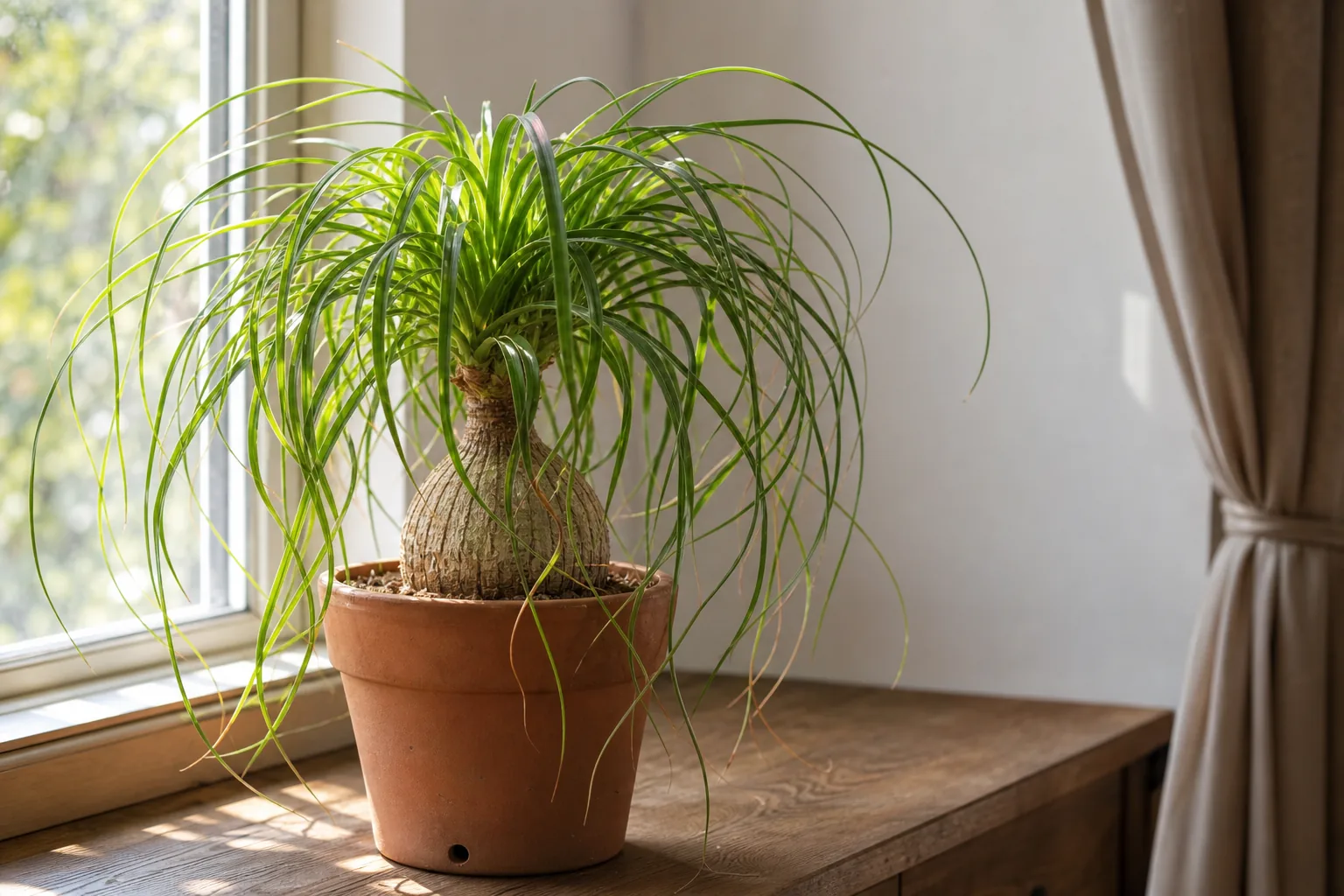
A ponytail palm (Beaucarnea recurvata) is not actually a palm. It is a caudex-storing member of the asparagus family, native to semi-arid regions of southeastern Mexico, and indoors it behaves more like a dry-climate caudex plant than a parlor palm. The swollen base stores water, the plant evolved under strong sun, and the two most common reasons indoor specimens fail are being treated like a tropical palm and being watered on a calendar instead of by observation.
If you give it the brightest direct light you can offer, a fast-draining mix in a snug pot with a drainage hole, and a long dry-down between thorough waterings, the plant is genuinely low-maintenance. Indoor growth is slow, and that is normal. New leaves emerge gradually rather than in monthly flushes; a modest number over an active season is what healthy looks like.
What a ponytail palm actually is, and why that changes indoor care
The accepted botanical name is Beaucarnea recurvata, and the plant sits in the family Asparagaceae, the same family as agaves and hostas. Missouri Botanical Garden and the University of Arizona Campus Arboretum both place it there, with Nolinaceae, Dracaenaceae, and Liliaceae showing up only as older historical names. The “palm” in the common name is a marketing accident, not a botanical fact.
In the wild, plants can reach 20 to 40-plus feet in semi-desert conditions, but the indoor version is the same species scaled down to a single swollen caudex topped by a spray of long, strappy, often-curving leaves. The caudex (sometimes called a basal stem) is the part of the plant that actually drives indoor care. It stores water and energy, so the plant is built to wait out dry spells rather than receive frequent waterings. That is why overwatering is the most common cause of failure in homes, and why treating it like a parlor palm or a majesty palm is the single most reliable way to lose it. If your plant is new to your home, a calm acclimating a newly purchased houseplant routine gives it the best start.
Light: the brightest direct spot you can give it
Both the New York Botanical Garden and Wisconsin Horticulture recommend placing ponytail palm where it gets as much light as possible, with a south-facing window called out as a good fit. The University of Florida describes the outdoor requirement as full sun to partial shade with high drought tolerance, which is consistent with a sun-loving plant.
Indoor reality is more nuanced. The plant will survive a spot with medium-bright indirect light, but over months it tends to grow more slowly, develop longer, weaker, more stretched leaves, and lean toward whatever light it can find. That is not the same as a plant that “likes” low light. The form is what tells you the difference: compact, with shorter, slightly cupped leaves in strong light; loose and droopy in dimmer light.
A practical target is the brightest window you have, ideally within a few feet of unobstructed south- or west-facing glass. Avoid pressing leaves against hot glass in summer, since the contact point can scorch. A guide to how to read the natural light in your room can help you judge whether your candidate window actually qualifies as bright direct light through the seasons.
Water: a long dry-down, then a real soak, read from pot weight and caudex
The pattern that reliably works is to let the soil dry down thoroughly, then water deeply until it runs out the drainage hole, then let it dry again. There is no fixed interval that fits every room, every season, and every pot.
Two observation cues work well together.
- Pot weight. Right after a thorough watering, lift the pot and feel how heavy it is. That is your “full” weight. As the soil dries and the caudex uses stored water, the pot gets noticeably lighter. Water again when the pot has lost most of that weight and the top several inches of soil are dry.
- Caudex firmness. A well-hydrated caudex feels firm and tight. A slight loss of firmness can serve as a soft secondary signal, alongside pot weight, that the plant is drawing on stored water and may be ready for a soak. A persistently mushy, foul-smelling caudex with yellowing leaves is a different problem and points to rot, which is covered in the troubleshooting section below.
The approach is the same one we use for watering by pot weight and observation across other caudex-storing indoor plants: read the plant, not the calendar.
Top watering that soaks the root zone and drains freely is the straightforward approach for this rot-prone species. Bottom watering is not a tested rule for Beaucarnea, and the caudex sitting in moisture drawn up from below can be harder to read than a freely draining top watering.
Pot and potting mix: drainage, snug fit, and a mineral-leaning mix
A caudex that sits in wet soil is a caudex that rots, so the two non-negotiables are a pot with a drainage hole and a fast-draining mix.
On the pot, the rule is snug rather than oversized. The plant prefers a tight fit, and a pot that is too large holds moisture in the unused soil around the roots. A general rule of thumb when you do repot is to go up only one to two inches in diameter, so the caudex sits on the soil surface with just a little room around it. A practical look at pot drainage and cachepot setup covers the rest of the mechanics, including why a cachepot with no drainage hidden underneath an inner pot is one of the easier ways to lose this plant.
On the mix, the goal is fast-draining and mineral-leaning rather than a specific recipe. NC State Extension lists perlite, pine bark, sand, sphagnum peat moss, and vermiculite as the most common container mix ingredients; UMD Extension recommends a soil-less blend of peat moss, vermiculite, and perlite for indoor plants. For a caudex-storing, rot-prone plant, lean toward the faster-draining end of that ingredient range, with more perlite, pumice, pine bark, or coarse sand relative to peat, rather than treating those ingredients as a fixed ratio. A longer walk through choosing a fast-draining potting mix is in our mix guide if you want to read labels with more confidence.
Temperature, drafts, and where to place it in the room
A normal indoor range of about 60 to 80°F is commonly cited in care guides, and most homes sit comfortably in that band year-round. The two conditions to actively avoid are cold drafts in winter and direct contact with cold window glass on freezing nights. A few feet of setback from a single-pane window in a cold climate can be the difference between a healthy plant and a damaged one.
In summer, a bright outdoor spot on a porch or patio is often a real boost, because the light and airflow indoors cannot quite match a sunny day outside. Bring the plant back inside well before nights turn cold, and acclimate it gradually rather than all at once.
Fertilizer and growth: why patience is the right answer
Ponytail palm is a light feeder. Wisconsin Horticulture suggests fertilizing once or twice during the growing season, and most retail guides recommend a single spring application. The simpler version of that guidance is to feed it lightly, if at all, and only during active growth. In a snug pot, overfertilizing builds up salts in the soil faster than the plant can use them, and that often shows up as brown, crispy leaf tips. Our fertilizer basics and when less is enough page goes deeper into that “less is more” instinct.
Indoor growth is slow, and a modest number of new leaves over an active season is normal. In the wild the plant eventually becomes a small tree; indoors it is the same species on a much longer timeline, and seed-grown retail plants usually arrive with a single caudex and a single growing point. A multi-headed indoor specimen is older or specially grown, not the result of normal indoor care. Setting that expectation up front is part of why the plant feels easy to people who understand the pace and stuck to people who do not.
Reading common problems: brown tips, soft caudex, leaning trunk, slow leaves
Most indoor problems with this plant trace back to one of three causes: too much water, too little light, or salt and mineral buildup in the soil.
- Soft, mushy caudex with yellowing lower leaves and a sour smell. This is rot, almost always from overwatering, poor drainage, or both. Stop watering, move the plant to the brightest spot you have, and unpot it to inspect the roots and caudex. Healthy interior tissue is white or pale; rotted tissue is brown, soft, and stringy. Cut back to firm, pale tissue with a clean tool, let the cut surface dry and callus briefly, and repot into a fast-draining mix in a clean pot with drainage. This is standard caudex-plant practice rather than a species-specific procedure, and a reputable caudex-care reference is worth consulting before doing it for the first time.
- Slightly soft caudex with otherwise healthy leaves. This is usually the plant drawing on stored water. It is a cue to water, not a cause for alarm.
- Brown, crispy leaf tips. Often linked to fluoride or chlorine in tap water, salt buildup from fertilizer, or an inconsistent watering rhythm. Flushing the pot thoroughly with plain water every few months and switching to filtered, distilled, or 24-hour-aged water will sometimes clear it up. Brown tips are less often a humidity problem for this plant, since its native habitat is dry. Our troubleshooting brown leaf tips page walks through the diagnostic order.
- Long, weak, leaning leaves and a generally loose form. The plant is asking for more light. Move it closer to a bright window, or to a brighter window, and expect the new growth to come in more compact.
- No new growth at all. Indoors this is not unusual, especially in winter or in the first few months after purchase. If the plant looks healthy otherwise, patience is the right answer. If it is also stretching or losing lower leaves, the issue is more often light than water.
Repotting and the caudex: when sizing up actually helps
Ponytail palm prefers to be a little tight in its pot, and it does not need frequent repotting. The most common reasons to repot are that the caudex has cracked or filled the pot, water now runs straight through without wetting the root ball, or the nursery mix is so dense that you cannot keep the plant from staying wet.
When you do repot, size up only one to two inches in diameter at a time, and use a fast-draining mix as described above. Set the caudex so that it sits on the soil surface rather than being buried, since burying the caudex is one of the easier ways to invite rot. After repotting, hold off on fertilizer for a few months and water a little more conservatively than usual while the roots settle in. Our deciding when a new pot is actually needed page is a useful second opinion on timing.
A simple way to know you do not need a new pot is to lift the caudex gently and look at the roots. If the root ball is mostly intact and not crowded, leave it alone.
A short care summary for a real room
A ponytail palm that is doing well indoors usually has a few things in common: the brightest direct light the room can offer, a snug pot with a drainage hole, a fast-draining mineral-leaning mix, and a watering rhythm built on pot weight and caudex firmness rather than the day of the week. Growth is slow, the leaves are long and a bit unruly by design, and brown tips or a slightly soft caudex are observation cues rather than emergencies. A mushy, smelly caudex with yellowing leaves is a different problem and is the signal to stop watering, inspect the roots, and act.
The rest of the indoor world tends to treat this plant as decorative furniture. It is more useful to treat it as a small, slow, sun-loving caudex that happens to have leaves on top. That framing is what makes the care make sense.
If you share your home with cats or dogs, ponytail palm is often listed as toxic to pets in horticultural references, with saponins commonly named as the concern. Verify the current status with the ASPCA or your veterinarian before relying on that information, since severity and clinical signs are not something a plant-care page should claim on its own.
Sources
- Ponytail palm, Beaucarnea recurvata – Wisconsin Horticulture, Division of Extension, University of Wisconsin–Madison
- Beaucarnea recurvata – Plant Finder, Missouri Botanical Garden
- Ponytail palm (Beaucarnea recurvata): houseplant care – LuEsther T. Mertz Library, New York Botanical Garden
- Beaucarnea recurvata: ponytail palm – University of Florida IFAS Extension
- Beaucarnea recurvata – University of Arizona Campus Arboretum
- Plants grown in containers – NC State Extension, Extension Gardener Handbook
- Potting and repotting indoor plants – University of Maryland Extension