Plant care
Perlite vs vermiculite for houseplants: which one actually fits how you water
· Updated
Perlite versus vermiculite at a glance
Perlite and vermiculite are not interchangeable. They look different, behave differently in a pot, and answer different problems.
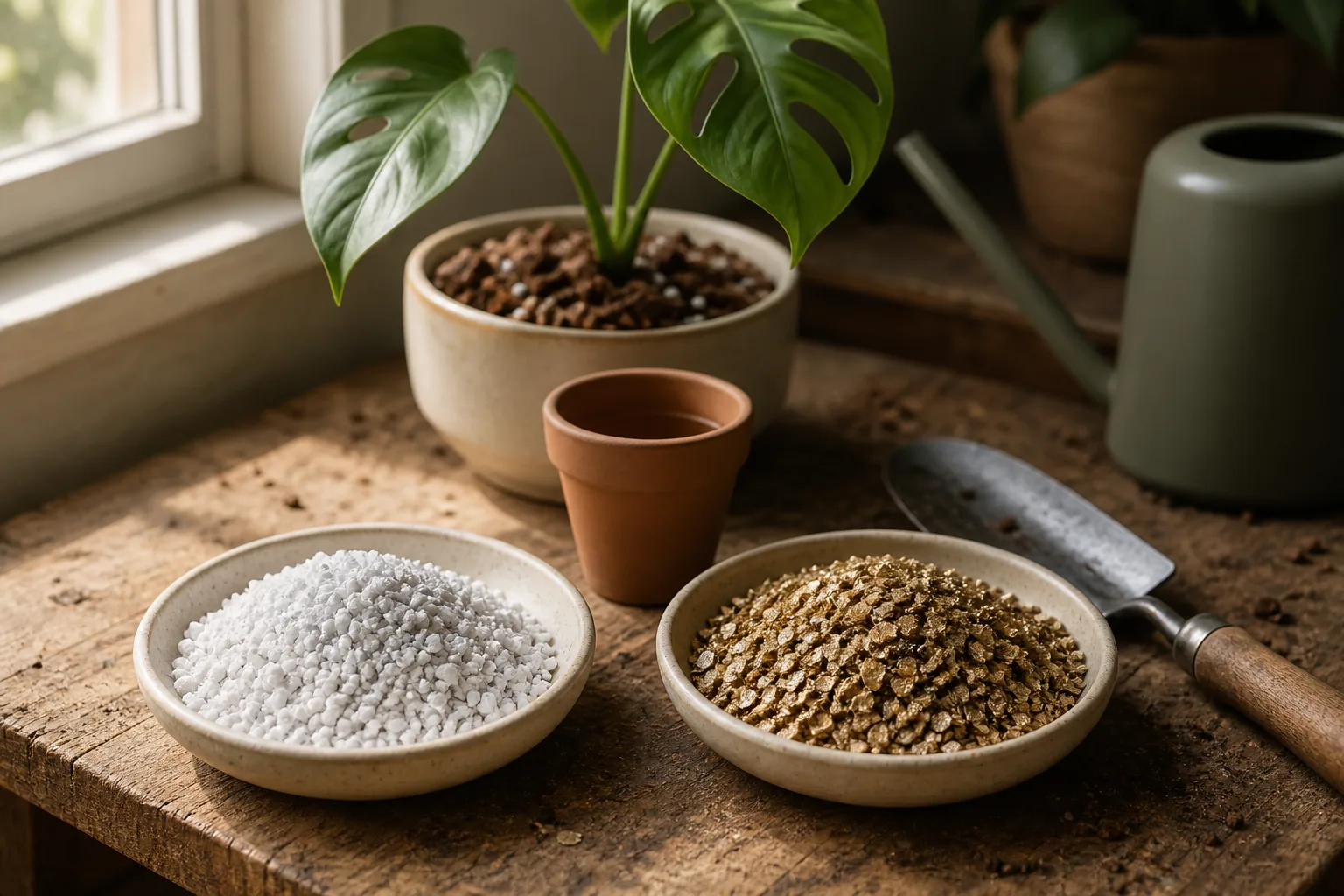
Perlite is expanded volcanic glass, bright white, gritty, and very light. Inside a potting mix it forms air pockets that let water drain quickly and keep oxygen moving around the roots. It holds almost no water and essentially no nutrients.
Vermiculite is an expanded layered mineral, golden-brown, with plate-like particles. It absorbs and holds water between those plates, and it carries a small amount of positively charged nutrient ions that roots can draw on. It is denser and slower to drain than perlite.
The practical result: perlite is the safer default for most common houseplants in ordinary indoor containers, because overwatering is the more common failure indoors. Vermiculite fits a narrower set of indoor uses, mainly moisture-loving plants, propagation, and seed-starting, and it shows up in mature houseplant mixes less often than many readers expect.
What perlite actually does in a houseplant pot
Perlite starts as a volcanic glass that is crushed and heated until trapped moisture flashes into steam, expanding each particle into a porous, sterile, chemically inert material. The LSU AgCenter describes it as stable, sterile, and bright white, and Texas A&M Aggie Horticulture classifies it as a silicous mineral of volcanic origin made by heating to expand.
In a container, those expanded particles act like small, permanent air wedges. They keep the mix from packing down, which is the usual cause of slow drainage in indoor pots. Water moves through quickly, but a small amount stays on the surface of the particles and in the gaps between them, so the mix does not go bone-dry the moment you finish watering. The structure tends to hold up better than peat or coir alone over months of watering and root growth.
Because perlite is chemically inert, it does not buffer pH and does not hold nutrients. It is a structural amendment, not a feed. If your bagged mix already contains perlite, adding more is usually unnecessary unless the mix compacts quickly or the plant clearly wants a faster dry-down. If the mix has been in the pot for a year or more, the bigger question is usually whether the whole blend needs refreshing, which the signs your potting mix has aged out guide walks through. For a primer on reading bag labels, the potting mix basics guide covers what the listed ingredients actually mean.
What vermiculite actually does in a houseplant pot
Vermiculite is a micaceous, layered mineral, typically a hydrated magnesium-aluminum-iron silicate. When it is heated to roughly 745°C, the trapped water between its layers flashes into steam and pushes the plates apart, producing the soft, golden-brown, plate-like particles you see in a bag. Texas A&M Aggie Horticulture describes vermiculite in these terms, and the LSU AgCenter notes that it is sterile but can be compacted in containers over time.
The plates act like tiny sponges. Water sits between them and is released slowly into the surrounding mix, which is why a vermiculite-amended mix stays damp longer after watering. Greenhouse and industry sources also note that vermiculite carries fixed negative charges, which means it holds a small amount of positively charged nutrient ions such as calcium, magnesium, potassium, and ammonium that roots can use later. Perlite has essentially none of this cation exchange capacity.
Two practical consequences follow. First, vermiculite is a useful medium for cuttings and seed-starting because it holds the consistent moisture those tasks need. Second, in a long-term houseplant pot, the same moisture-holding can work against plants that prefer a faster dry-down, and the plates can compress downward in deep containers, gradually reducing the air-filled pore space.
Side-by-side: water, air, weight, and nutrients
A compact way to see the difference:
- Water retention: vermiculite holds significantly more water in its structure. Perlite holds almost none.
- Aeration and drainage speed: perlite keeps the mix open and lets water move through quickly. Vermiculite slows drainage and can compact over time.
- Weight in the pot: both are very light compared with mineral soil. Perlite can float upward when over-saturated and form a thin white crust on the surface, which is cosmetic and not a sign the mix has failed. Vermiculite tends to stay in place but compresses downward in deep pots.
- Contribution to nutrients: vermiculite holds a small amount of positively charged nutrient ions. Perlite is essentially inert.
Neither amendment is a pH tool. Iowa State University Extension and Colorado State University Extension both frame pH adjustment in terms of lime, sulfur, and organic-matter management rather than perlite or vermiculite, so treat the two amendments as structural choices, not as ways to correct a pH problem.
Which houseplants lean toward a perlite-forward mix
The plants that benefit most from a perlite-forward mix are the ones that evolved in airy root environments or that store water in their tissues and dislike sitting wet.
- Succulents and cacti need a mix that dries down fast between waterings. For the dry-down rhythm that suits these plants, the indoor succulent care guide walks through the watering style they prefer.
- Phalaenopsis orchids are epiphytes. Their roots wrap around tree bark in the wild and rot quickly in dense, damp media, so a chunky mix that includes perlite suits them. The Phalaenopsis orchid mix guidance covers how the bark-and-perlite blend behaves in a real windowsill pot.
- Aroids such as Monstera, philodendrons, and pothos grow in loose, well-aerated forest-floor media in nature. Perlite keeps the structure open, especially when paired with orchid bark. Climbing aroids in particular benefit from a chunky mix because the same structure that aerates roots also gives aerial roots something to grip, which the climbing houseplant care guide explores in more depth.
- Snake plants and ZZ plants are semi-succulent and prefer to dry out between waterings.
The common thread is aeration and a faster dry-down, which lines up with the more common indoor failure mode: roots sitting wet too long.
Where vermiculite can make sense indoors
Vermiculite is less of a workhorse and more of a situational tool indoors. It earns its place in a few specific situations.
- Propagation of cuttings in a humid, covered setup where steady moisture helps roots form.
- Seed-starting, where consistent dampness and the small amount of nutrient holding support germination and early growth.
- Moisture-loving tropicals in dry homes, where the air pulls water out of the mix faster than the plant would like, and a vermiculite-amended mix extends the time between waterings.
- Ferns in dry indoor air, where the same moisture-buffering helps keep the root zone from swinging between wet and bone-dry.
Outside these situations, vermiculite is uncommon in mature houseplant mixes. If you only have one bag of amendment at home, perlite is the one that does more for more plants.
Reading your pot, watering style, and room
The amendment choice is really a watering-style decision. Before reaching for either bag, look at the pot, the room, and your own rhythm.
Pot size and drainage matter first. Small pots dry out faster than large ones. A pot without a drainage hole will hold water regardless of how much perlite is in the mix. If your pot has no drainage, perlite and vermiculite are both working against the underlying problem, and the drainage and pot setup guide walks through what to do instead.
Watering rhythm sets the margin for error. A forgetful waterer benefits from a perlite-forward mix, because the mix forgives a missed check. A careful waterer who reads the mix by feel can grow moisture-loving plants in a vermiculite-amended mix without trouble. The watering by observation approach covers how to decide when to water without leaning on the calendar.
Room conditions change how any mix behaves. A bright, warm, dry room pulls water out of the mix faster. A cool, dim, humid room holds water longer. The same blend in the same pot will dry down at very different rates in those two rooms.
Common mix ratios and how to adjust them
Treat ratios as starting points, not rules, because bagged mixes vary widely in how much peat, coir, or bark they already contain.
- General tropical houseplants: roughly one part perlite to two or three parts base mix by volume.
- Aroids that like a chunkier mix: equal parts perlite, orchid bark, and base mix, or a similar blend.
- Succulents, cacti, and other dry-side plants: perlite often makes up roughly half of the total volume, sometimes more.
- Phalaenopsis orchids: a bark-heavy mix with a meaningful share of perlite for airiness, never a peat-based mix alone.
A small test batch in a single 4- to 6-inch pot is the cheapest way to feel the difference in weight and dry-down time before committing to a full bag. If the test pot dries out in roughly the rhythm the plant prefers, the ratio is in the right neighborhood.
Practical notes: dust, rinsing, and what to skip
A few handling notes that make the difference between a clean repot and a dusty one.
- Dampen perlite in a bucket or sink before stirring it into a base mix. The dust is the main practical nuisance, and a quick wetting reduces it. The supplied extension sources describe perlite as sterile and stable, so keep the handling language to dampening and basic ventilation rather than anything stronger.
- Use coarse perlite when you can. Very fine particles float to the surface and clog the air pockets the amendment is meant to create.
- Do not substitute either amendment for a drainage hole. A mix can only drain as fast as the pot allows, and perlite in a sealed container will still stay wet.
- If your bagged mix already contains perlite, adding more is rarely the first move. Check whether the mix is actually staying too wet, and adjust watering and pot before adding more amendment.
- For seedlings, cuttings, and propagation, vermiculite is often the better pick, used on its own or mixed with a little perlite for structure.
Sources
- Growing Media for Containers Part 2: The Inorganics, LSU AgCenter
- Growing Media, Texas A&M Aggie Horticulture
- How to Change Your Soil’s pH, Iowa State University Extension
- Soils, Fertilizers, and Soil Amendments, Colorado State University Extension
- Growing Media for Greenhouse Crops: Properties, Greenhouse Management