Plant care
Indoor jade plant care: light, watering, pot and mix, and reading the signals
· Updated
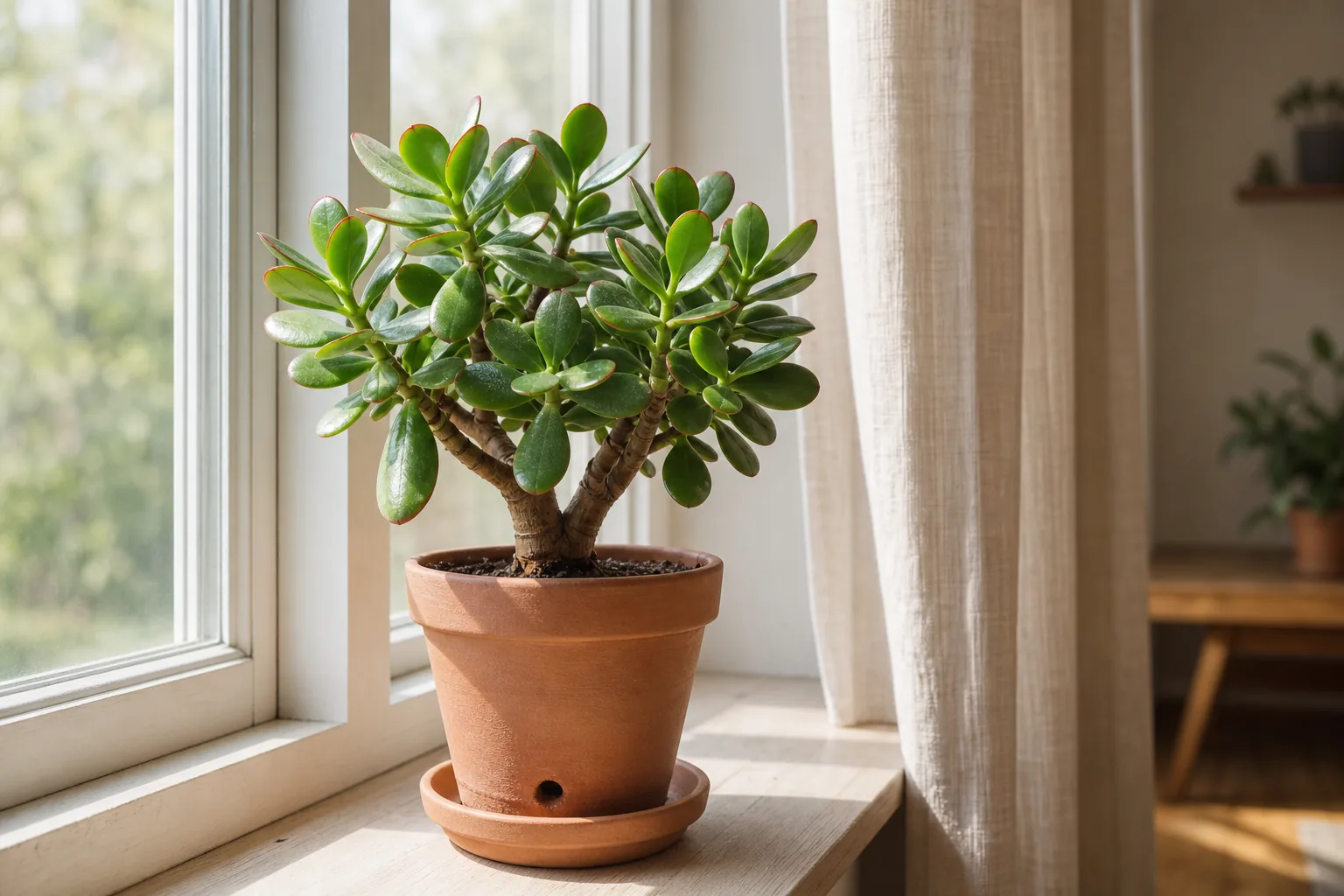
A jade plant (Crassula ovata) kept indoors needs the brightest direct light your room can offer, a fast-draining cactus-or-succulent potting mix in a pot with a drainage hole, and a true dry-down between waterings read from pot weight and soil feel rather than a calendar. Most indoor jade problems come from the combination of low light and water that arrives too often, not from any single mistake. When the spot, the pot, and the rhythm are right, jade grows slowly, holds its shape, and stays a steady participant in a room rather than a project.
This is a calm, observation-first guide. Use it to read your specific plant before you change anything.
What a jade plant is and why indoor care looks the way it does
Jade is a succulent shrub native to southern Africa, where it grows in rocky, dry, bright conditions. It stores water in thick, fleshy leaves and develops woody stems over years. Indoors, the leaves usually stay a bit smaller and the growth is slower than in ground-planted landscape jades, but the same drives apply: bright light, a gritty mix, and a real dry-down between waterings.
The plant’s adaptation to dry, sunny storage is why it tolerates a missed watering but reacts badly to wet feet in a dim room. Most mystery jade problems trace back to one of those two inputs being off.
Light: how bright is bright enough for Crassula ovata
Jade survives in bright indirect light, but it grows more compactly and holds firmer stems with several hours of direct sun. The Missouri Botanical Garden puts the threshold for best growth at a minimum of four hours of direct sunlight, or about twelve hours of bright indirect light. Penn State Extension describes jade as preferring full to partial sun and thriving in a south-facing window. South Dakota State University Extension sets the indirect-light benchmark at six hours per day. University of Wisconsin Horticulture adds that without enough light, a jade develops deep green coloration and stretched spacing between leaves.
Practical placement, in plain language:
- A south- or west-facing window with several hours of direct sun is the strongest indoor spot.
- A bright east-facing window with morning sun also works.
- A north-facing window or a shelf several feet from any window usually means stretching over time.
- If a sunny window gets harsh midday summer sun, a sheer curtain or a slight setback from the glass is a reasonable middle ground; crassulas in general appreciate some protection from the harshest midday sun.
The on-plant signal matters as much as the window label. Read the gaps between the newest leaves: tight internodes with small, sturdy new growth say the light is right. Long, pale, sprawling gaps say the plant is reaching for more. For a fuller method of judging a room before you commit a plant to a spot, see how to read the natural light in your room.
A note on temperature: jade tolerates temperatures down to about 45°F. Cold windowsills in winter can drop below that overnight in some homes, especially with single-pane glass. A leaf that goes soft and darkened on the side facing the glass is more often cold damage than a watering problem.
Watering: dry-down rhythm read from pot weight and leaves
With jade, less is more. Penn State Extension recommends watering infrequently and only when the soil is completely dry. South Dakota State University Extension frames it directly: better to err on the dry side, and notes that leaf drop is a watering issue.
What that looks like in practice:
- Let the soil dry through the entire pot, not just the surface. A shallow-surface finger test designed for tropical foliage plants is not far enough for jade.
- Lift the pot right after a thorough watering and remember that weight. Lift it again before you water; a dry jade pot is noticeably lighter than a freshly watered one. The same observation-first framework is laid out in watering without a calendar.
- When in doubt, wait another day. Jade tolerates a dry stretch better than a wet one.
When you do water, water thoroughly, until water runs from the drainage hole. A short, frequent splash that only wets the top of the mix encourages shallow roots and ongoing leaf drop.
What the leaves are telling you:
- Squishy or waterlogged leaves point to overwatering. The plant is holding more water than it can use, often because the soil isn’t drying or the light is too low to use it up. This is the failure mode the Pacific Northwest Plant Disease Management Handbook documents most often, with overwatering repeatedly diagnosed by the Oregon State University Plant Clinic.
- Shriveled, thin, slightly wrinkled leaves mean thirsty. South Dakota State University Extension names shriveled or wrinkled leaves as the thirst signal.
- Leaf drop after a move, repotting, or a sudden change in light is common and usually not a crisis if light and watering rhythm are steady. Address the highest-risk cause first rather than reaching for the watering can or repotting again.
If you are used to the water-when-the-top-inch-is-dry rule from tropical houseplants, expect jade’s rhythm to feel slow. That slowness is the point, not a problem. For an ordered inspection sequence that distinguishes overwatering from underwatering before you change anything, see telling overwatering from underwatering.
Pot and potting mix: drainage, weight, and a sturdier setup
A cactus and succulent potting mix is the standard recommendation. Penn State Extension calls it ideal. Extension guidance also notes that mixes for jade need to be very well draining. Both recommendations are tied to the same plant trait: jade is top-heavy, the mix needs to dry quickly, and the pot needs to keep the plant upright. For a label-reading approach that helps you pick a mix without depending on a single bag, see choosing a houseplant potting mix.
What that translates to in real decisions:
- Choose a pot with a drainage hole. Without one, water collects at the bottom and the roots sit in it. Cachepots can hold a smaller nursery pot inside, but the inner pot still needs to drain. For the practical reasoning behind this, see pot drainage and cachepots.
- A heavier, wider pot does double duty: it lets the sides of the root ball breathe and adds weight that keeps a top-heavy plant from tipping.
- A tall narrow pot holds more mix below the roots than a jade can use between waterings in low light, which slows the dry-down more than is helpful for most indoor situations.
If you already have the plant in a moisture-retentive all-purpose mix, you don’t need to repot urgently. A move to a cactus/succulent mix at the next repotting, with the pot sized only slightly larger than the root ball, is the more common path. A jade in too large a pot sits in wet mix longer than it can use.
Growth, pruning, and realistic indoor shape over years
Indoor jade grows slowly and modestly. Stems thicken gradually, the canopy broadens, and the plant develops the small, glossy, paired leaves that make it recognizable. The compact, tree-form shape that readers see in older specimens comes from consistent bright light and dry-down watering over years, not from fertilizer, pruning tricks, or frequent repotting.
A few honest expectations:
- New growth comes in tighter under bright light and looser under low light. The looser growth does not undo itself; new, tighter growth replaces it once conditions are right.
- Older leaves at the base of a stem will occasionally shrivel, dry, and drop. Occasional loss of older, lower leaves is normal; a steady stream of leaves dropping from across the plant is not.
- Pruning is fine when you want to balance the shape or remove a leggy branch. Cuts heal slowly. Snip above a leaf pair you want to keep, and avoid heavy pruning in the middle of a low-light stretch.
- A small, balanced, low-strength feed in spring and summer, only on a plant that is actually putting on growth, is plenty. Skip feeding in winter, and skip it entirely on a stressed plant. Follow the product label.
Don’t read a small indoor specimen as a sign that something is wrong. Indoors, slower is normal, and the older, well-tended plants you see in photos took years to look that way. For the same plant under lower light, see why a houseplant gets leggy for a recovery approach that doesn’t make the stretch worse.
Common problems: leaf drop, wrinkled leaves, mushy stems and roots
The signals to read, and what they most often mean in an indoor jade:
- Leaf drop after a move, repotting, a draft, or a new window. Common and usually transient. Address the highest-risk cause rather than repotting again. For a calm observation order, see leaf drop after a move or change.
- Wrinkled or shriveled leaves that feel thin. Thirsty. Water thoroughly, then let the pot dry again.
- Squishy, waterlogged leaves paired with a heavy, damp pot. Overwatering. Hold water, increase light if you can, and check the stem near the soil line.
- Mushy stem at or near the soil line, sometimes with a soft or off smell. The Pacific Northwest Plant Disease Management Handbook documents this as root and stem rot, almost always from overwatering. Stop watering, unpot to inspect the roots, and trim any dark, soft, or hollow sections into firm, pale tissue. Let cuts dry before repotting into a dry, fast-draining mix.
- Long gaps between leaves and a soft, leaning stem. Not enough light. The diagnosis and recovery approach for a leggy houseplant covers what to look for and how to respond without making it worse.
- A reddish blush along the leaf edges. Often a response to strong light, not necessarily stress. Watch the leaves for shriveling or bleaching alongside the color; paired symptoms change the read.
- White, cottony tufts where leaves meet stem. A common jade pest is mealybug. For diagnosis and treatment, follow a dedicated mealybug resource rather than improvising with this article alone.
If more than one signal shows at once, address the highest-risk one first: stem rot before a light issue, watering rhythm before a move, root health before fertilizer.
Seasonal adjustments: stronger summer sun, slower winter rest
Jade does not go dormant indoors the way a temperate plant does, but its rhythm shifts with the room.
In strong summer light, the pot dries faster and the plant can use more water. Water thoroughly when the pot is dry, and do not be surprised if the rhythm is shorter than in winter.
In low winter light, the same pot stays wet longer. The plant uses less, so it needs less. Err further on the dry side. A pot near a cold window in winter can also mean cold-damaged leaves on the glass-facing side. Move the plant a bit back from the glass if your windowsills run cold overnight.
Spring and early summer are the best windows for pruning, repotting, and light feeding, while the plant is actively putting on growth.
Pet safety and household considerations
Jade is listed by the ASPCA as toxic to cats and dogs. For any actual exposure, contact your veterinarian or a pet poison control line. The listing does not predict severity in a given animal, and the right response for a specific pet comes from a qualified professional.
If you share your home with pets, a jade on a high shelf, in a hanging planter, or in a room the pets do not enter is one option. A verification-first approach to pet-safe choices is laid out in pet-aware houseplant choices.
For broader indoor succulent care, the same general framework for indoor succulents in a sunny window applies, with jade’s preference for the brightest spot in the room on top of it.
When to ask a local source for help
A few situations point to a human consultation rather than another wait-and-see week:
- A mushy, dark, or collapsing main stem.
- A plant that has been chronically wet at the roots and is not recovering after a dry-down and repot.
- Any concern about pet or human ingestion.
For plant-health questions, a local nursery, a county extension office, or a master gardener helpline can look at the actual plant, the actual pot, and the actual room in a way a general article cannot. A few clear photos in bright natural light, including the soil line and the underside of a few leaves, helps a human consultant as much as it would help you judge the plant yourself.
Sources
- Penn State Extension — Jade plant, a no-fuss houseplant: https://extension.psu.edu/jade-plant-a-no-fuss-houseplant/
- South Dakota State University Extension — Jade plant: houseplant how-to: https://extension.sdstate.edu/jade-plant-houseplant-how
- University of Wisconsin Horticulture — Jade plant (Crassula ovata): https://hort.extension.wisc.edu/articles/jade-plant-crassula-ovata/
- Missouri Botanical Garden — Help for the home gardener: jade plant: https://www.missouribotanicalgarden.org/gardens-gardening/your-garden/help-for-the-home-gardener/advice-tips-resources/gardening-help-faqs/question/1550/how-do-i-care-for-my-jade-plant
- Pacific Northwest Plant Disease Management Handbook — Jade (Crassula ovata) - root and stem rot: https://pnwhandbooks.org/plantdisease/host-disease/jade-crassula-ovata-root-stem-rot