Plant care
Houseplants for a bedroom: a room-first guide
· Updated
The right houseplant for your bedroom is the one that fits the actual room: the usable light on the surface where the pot will live, the surface area itself, and the night-time temperature pattern. A short list of tolerant species is easy to find online. What is harder to find is a calm way to read the room first. This post gives you that read, then a small set of honest candidate groups, then a plain look at the air-quality and night-oxygen claims that follow this topic.
A bedroom is not just a smaller living room. It usually has weaker light, smaller available surfaces (nightstand, dresser, shelf, a floor corner), and a night-time temperature pattern driven by open windows, heating or cooling cycles, and proximity to cold glass. The same plant that thrives in a bright kitchen window can slowly decline in a north-facing bedroom two metres from the glass. Generic “best bedroom plants” lists skip this read entirely, and they lean on three claims that do not survive honest scrutiny: that bedroom plants clean your air, that they release oxygen at night in a meaningful way, and that they improve sleep. We will look at all three later in this post. For now, set the lists aside and read the room.
Why a bedroom deserves its own decision, not a generic list
The internet is full of ranked “best plants for bedroom” lists. Most of them are written for a generic reader in a generic room. A bedroom is its own environment, and a plant chosen from a list often disappoints because the list never asked about the room. The framework here is simple: read the bedroom first, then choose a small set of species that match what you found.
Step 1: read the actual light in the bedroom
The first thing to observe is how much usable light lands on the surface where the pot will actually sit, on an ordinary day. Not the brightest moment of the year, not the corner with the best afternoon glow, the surface you are willing to give up on a normal weekday.
A few questions to walk through:
- Does direct sun touch the leaves at any point in the day? If yes, that is a bright or medium-bright spot, and many more species will work.
- How many hours of indirect or filtered light does the surface receive? Anything from morning to late afternoon in indirect light is a useful band.
- How far is the surface from the window? Light intensity indoors drops sharply with distance. A spot two metres from a north-facing window is in a much weaker band than the windowsill itself.
A commonly cited indoor baseline for “low light” is around 100 footcandles, and “low light” really means indirect light or a spot a few feet from a window, not a dark corner and not a room with no window. If your only option is a hallway corner with no window, no foliage plant will thrive there without supplemental light. That is a different project, not a bedroom decoration. If you want a longer method for reading your light, our guide to reading natural light indoors walks through the same kind of observation, and sets expectations for what low light tolerance realistically means in a dim bedroom.
Step 2: match the plant to the surface area you actually have
A bedroom rarely offers a wide, sunny sill with room for a large floor plant. More often, the available surfaces are a nightstand, a dresser top, a bookshelf, a wall hook, or one floor corner. Each of those has its own constraints.
A nightstand or dresser plant has zero margin for a tipped cachepot or a water mark on wood. A small pot in a 4-inch size dries faster and forgives less. Drainage matters more on furniture than on a floor, and a cachepot with a hidden liner is often a better choice than a saucer that has to be emptied on a schedule. Our guide to pot setup and drainage covers the tradeoffs in more detail. A floor corner plant can take a heavier pot and a wider range of moisture behaviour, but it also has to live with whatever the heating register or the door draft is doing at floor level. A hanging plant by a window gets the best light in the room but is the worst place to put anything you cannot easily reach for a quick check.
Mature size matters too. A pothos that will trail two metres down a bookshelf is not a small plant. A snake plant that fills a 10-inch pot is not a nightstand plant forever. Match the pot to the surface you actually have, with the mature size in mind, not the size it is in the shop.
Step 3: account for night-time conditions
The night is when a bedroom becomes its own climate. Three things to check before you place a plant:
- Cold glass in winter. Air near a single-pane window can drop well below room temperature overnight. Many tropical foliage plants show stress when night temperatures fall below about 55°F (13°C), and a windowsill in a cold climate is a real risk in winter. A rough rule is to pull plants back from the glass by at least 60 cm (about 2 feet) when overnight outdoor temperatures drop into that range. Our drafts, vents, and windows post covers the why and the how in more detail.
- Heating and cooling vents. A plant sitting directly in a vent stream will experience rapid temperature and humidity swings. Move it at least a metre or so out of the direct path.
- Ceiling fan blade path. A constant gentle breeze at night dries foliage faster than the same plant would dry in still air, and the leaves may show brown tips over time. A plant directly under a fan blade path is a poor fit.
A modest nighttime temperature drop is actually fine for most foliage plants. Extension guidance generally says plants do well when the night temperature sits about 5 to 8°C below the daytime temperature. The problem is not the night; it is sudden, large swings. Open windows in shoulder seasons can be as risky as a window-mounted AC unit, because both create a moving stream of air that the plant cannot adjust to.
Honest candidate groups for a typical bedroom
Rather than a ranked “top 10,” here are short tolerance groups. Pick the group that matches the read you did in steps 1 to 3, then choose within it.
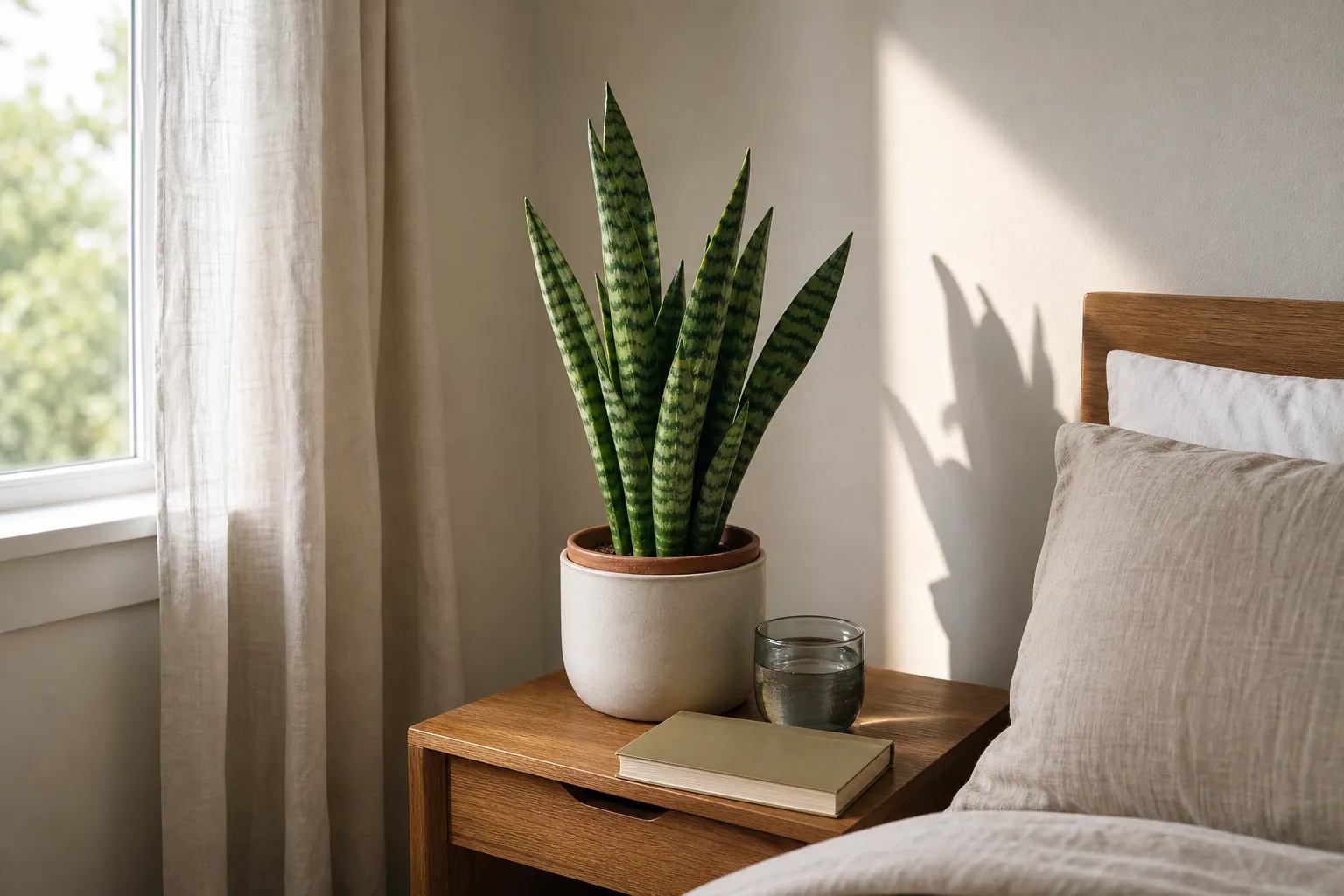
- Low light, dry air, and a small pot. Snake plant, ZZ plant, and Chinese evergreen are among the most forgiving species for a north-facing bedroom with a nightstand-sized surface. They grow slowly, which is normal rather than a sign of trouble. A handful of other species sit in the same general tolerance class, including cast iron plant, so if you go that route, look for a species-specific guide before you buy.
- Medium-low indirect light and steady moisture. Peace lily, pothos, heartleaf philodendron, and spider plant do well a step or two back from a window and tolerate the irregular watering that real life brings. Peace lily is the most communicative of the group, and drooping is its way of asking for water rather than an emergency.
- Trailing or hanging for a wall corner. Pothos, heartleaf philodendron, and spider plant in this form need a wall hook, a tall shelf, or a ceiling hanger, and they reward a stable bright position with length over months.
- Brighter bedroom with a real window. Dracaena, rubber plant, schefflera, and some orchids are not low-light plants. They need a genuinely bright spot to do well, and they reward it with steady growth.
A few species that show up on lifestyle lists are not low-light plants and will not thrive in a dim bedroom. Lavender, jasmine, and most flowering orchids need much more light than a typical north-facing room offers, and a struggling specimen is a worse bedroom companion than a tolerant one that just sits there looking fine.
The air-quality and sleep claims, looked at honestly
A short section, because the popular framing is loud and the honest answer is short.
The claim that bedroom plants purify the air usually traces back to a 1989 NASA study. That study was real, but it was done in sealed chambers designed to simulate closed environments such as a spacecraft, not ordinary homes. The report itself noted that the plant root-soil zone, not the leaves alone, was the most effective area for removing certain volatile compounds in that chamber context. The American Lung Association has publicly stated that the verdict on houseplants and meaningful indoor air-quality improvement is negative. Real bedrooms are larger, ventilated, contain furnishings and finishes that emit their own compounds, and have a much higher air-volume-to-plant-biomass ratio than the chamber.
The “plants release oxygen at night” claim usually attaches to snake plant, aloe, and some orchids. These species do use a real adaptation called Crassulacean Acid Metabolism, or CAM, in which they open their stomata and fix carbon dioxide at night rather than during the day. But the practical effect is bounded by plant biomass, by how active the plant is (CAM plants also have a “CAM-idling” mode in which gas exchange is minimal), and by the room volume. A few small pots in a typical bedroom do not measurably change overnight oxygen levels, regardless of which photosynthesis pathway the plant uses.
We are not going to make sleep, anxiety, or allergy claims. Those are clinical questions, and the evidence for a meaningful effect from a few potted plants is not there. If a plant helps you wind down because you like looking at it, that is a real benefit and it does not need clinical proof. Just do not buy the plant on the promise that it will change the air you breathe at night.
If pets sleep in the room
A “pet-safe bedroom plants” list is one of the most unreliable things on the internet, because the same common name often refers to more than one species, and toxicity varies within a genus. The accepted method is to identify any plant by its botanical (Latin) name and check that name against a recognized toxic-plant database such as the ASPCA’s toxic and non-toxic plant lists. Even non-toxic plants can cause mild stomach upset if chewed, and individual animal behaviour, a dog that chews everything versus a cat that ignores plants, is part of the answer. Our pet-aware plant choices post walks through the verification method step by step, and is a better place to start than any list.
Bringing it home: a realistic weekly rhythm for a bedroom plant
A tolerant bedroom plant does not need much. A short weekly check is enough. For the full routine, see our simple weekly houseplant care guide.
- Water by observation, not by calendar. Stick a finger into the top centimetre of soil. Water when it is dry at that depth, not before.
- Glance at the leaves for pests on the way in and out of the room. A few minutes of noticing is worth more than a long inspection once a month.
- Wipe the leaves when dust collects. Dust on the leaf surface cuts light, and in a low-light room that matters.
- Accept slow growth. A plant in a dim bedroom is surviving, not thriving. Slow or no visible growth is normal.
When to start over instead of nursing a struggling plant
Sometimes the room and the species are not a fit, and a longer period of nursing does not change that. Some signals that the match is wrong:
- Persistent leaf drop more than a month after the plant arrived, with no improvement. Our leaf-drop-after-move guide walks through the calm triage for a new plant that is shedding.
- Soil that stays wet for more than a week between waterings, or dries out in a day, no matter how you adjust.
- A plant that needs more attention than the room allows, even after a routine change.
If any of these describe your situation, the answer is usually to choose a different species rather than to work harder at the same one. The room comes first; the plant is the part that should change.
Sources
- Penn State Extension – Low Light Houseplants
- American Lung Association – Houseplants Don’t Clean the Air
- NASA – Interior Landscape Plants for Indoor Air Pollution Abatement (1989)
- Oregon State University Extension – Environmental Factors Affecting Plant Growth
- Ask A Biologist (Arizona State University) – Crassulacean Acid Metabolism