Plant care
Haworthia care indoors
· Updated
A Haworthia is one of the few houseplant succulents that genuinely fits the lighting and watering patterns of a normal room, as long as you avoid its main failure mode: a wet mix in a too-large pot.
That single sentence captures most of what you need to know. Haworthias are small, slow-growing rosette succulents from South Africa. They stay compact, they multiply through offsets at the base rather than getting taller, and they rot quickly when their roots sit in moisture. Get the pot size, the mix, and the watering rhythm right, and a Haworthia will quietly sit on a shelf for years. Get them wrong, and a soft lower leaf or a translucent spot near the crown is usually the first sign.
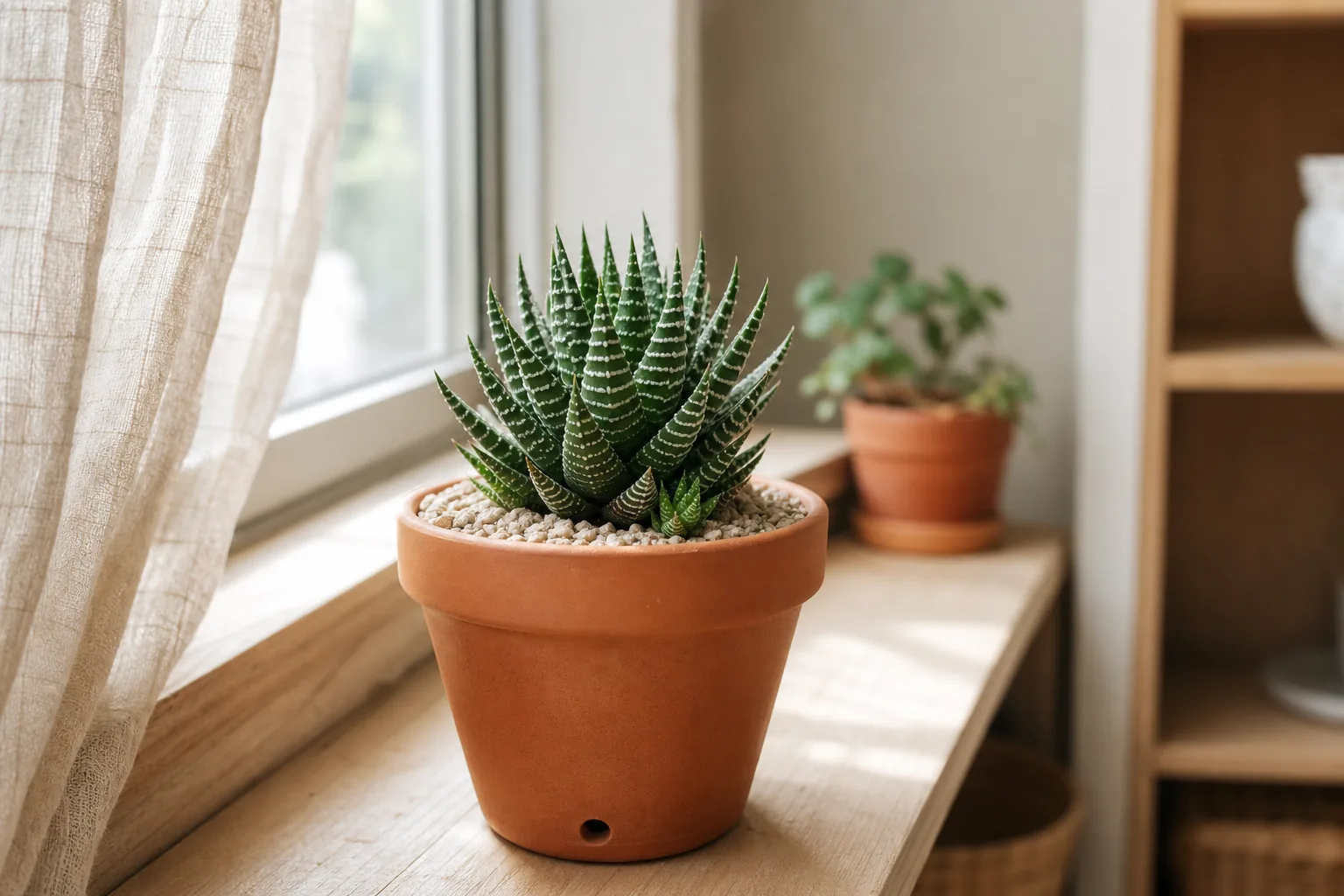
This guide is built around reading the plant rather than following a fixed schedule. Haworthias vary in shape, from the upright, white-banded zebra types sold as Haworthia fasciata or Haworthiopsis attenuata to the translucent-tipped, clump-forming species like Haworthia cooperi and H. retusa, but the underlying care is the same.
What a Haworthia is, and how it differs from the typical indoor succulent
A Haworthia is a small, leaf-storing rosette succulent native to South Africa. The genus has been separated from Aloe in recent taxonomy, and many retail zebra plants sold as Haworthia fasciata are actually Haworthiopsis attenuata; the two are routinely confused in stores. For indoor care, the species label matters less than recognizing the rosette shape and the small, fine root system.
Two traits separate Haworthia from the sunny-window succulents most indoor gardeners know:
- It tolerates less direct sun than Echeveria, Aloe, or most cacti, especially harsh midday sun through glass.
- It is more rot-prone than those same plants, because its roots are small and its water storage is modest.
If you are coming from a generic succulent post that pushes a hot, south-facing window and a weekly splash, recalibrate. Haworthia wants bright light, but not all-day direct sun, and it wants to actually dry out between waterings. For a broader look at indoor succulent care in a sunny window, our indoor succulent care generally post covers the wider context.
Light: bright but not harsh, and what “reaching for the window” looks like
The light range that consistently works for Haworthia is a few hours of direct sun, usually from an east- or west-facing window, plus bright indirect light for the rest of the day. Strong indirect light all day is workable but usually produces looser, less compact growth than a few hours of direct sun. Harsh midday sun, especially through a hot south- or west-facing window in summer, can scorch or redden the leaves.
Signs the plant is getting too little light:
- New leaves are longer, narrower, and paler than the existing rosette.
- The rosette is leaning or stretching toward the window.
- The overall color of the rosette fades from its typical deep green toward a softer, washed-out green.
Signs the plant is getting too much direct sun:
- Reddish, bronze, or brown patches on the most sun-exposed side.
- Crispy, dry patches that feel papery rather than mushy.
- A bleached or yellowed look on a hot window.
If the spot is genuinely dim, such as a north-facing room with no supplementary light, expect slow, soft growth and a higher rot risk, because the mix stays wet longer in low light. Adjusting placement is almost always a better first move than adjusting water. For a fuller framework on judging light in a real room, see our guide on reading the natural light in your room.
Watering: deep, infrequent, and why winter dryness matters more than the calendar
The watering pattern that fits Haworthia is dry through the pot, then soak. Saturate the mix until water runs from the drainage hole, then leave the plant alone until the pot feels light and the soil is dry at depth, not just dry on the surface. In a small pot in a bright, warm room in summer, that often works out to roughly once a week. In a dim, cool room in winter, it can stretch to two or three weeks or longer.
Two cues work better than any schedule:
- Pot weight. Lift the pot right after watering and again when you suspect it is dry. A bone-dry Haworthia pot feels noticeably lighter than a freshly watered one.
- Soil at depth. A wooden chopstick pushed to the bottom of the pot should come up dry, with only a few crumbs of mix clinging to it.
Winter is where most Haworthias are lost. In the coolest, dimmest weeks of the year the plant is largely dormant, the mix dries slowly, and watering on a usual schedule easily pushes roots into rot. Reduce watering sharply, or skip it entirely, when the room is cold and dim, and resume only when you see new growth inside the rosette or the soil dries quickly.
For a longer explanation of how to tell when any houseplant actually needs water, see our guide on when a houseplant actually needs water.
Pot and potting mix: small pot, gritty mix, and why snugger is usually better
Two practical decisions do most of the work in keeping a Haworthia rot-free:
- Pot size. A snug pot only slightly larger than the rosette. An oversized pot holds a volume of mix the small root system cannot use, and that unused moisture is exactly where rot starts.
- Drainage. A pot with a drainage hole, ideally set inside a cachepot rather than planted directly in a vessel that holds standing water. For the longer reasoning behind this, see our guide on drainage holes and pot setup.
On the mix: a standard cactus-and-succulent blend is workable, but for a small Haworthia in a small pot, lean grittier. Take a cactus base and amend it with inorganic grit, such as pumice, perlite, coarse sand, lava rock, or decomposed granite, until the mix feels loose, gritty, and free-draining in the hand. Pumice is often the preferred amendment; perlite, coarse sand, and small gravel are reasonable alternatives. There is no single correct ratio; the test is whether water runs through quickly and whether the pot returns to a light weight within a few days. For the wider label-reading basics behind this, our guide on choosing a potting mix goes into more detail.
Temperature, seasonal rhythm, and what realistic growth looks like indoors
A Haworthia is comfortable across a wide indoor temperature range, broadly the same range people find comfortable. It does not need a heated greenhouse or a cold snap to do well, and it does not need a special winter setup.
What it does need is recognition that growth is not constant. In a typical indoor room, active growth runs through spring and summer, slows in early autumn, and is largely paused in the coolest, dimmest weeks of winter. A Haworthia that produces no new leaves from December through February is behaving normally, not failing.
Flowering indoors is possible but inconsistent and species-dependent. A thin flower stalk rising from the rosette is a sign of a mature, well-cared-for plant, not a requirement. For an observation guide that covers the dimmer months more broadly, see our winter houseplant care post.
Reading the plant: stretched, soft, wrinkled, and color-shifted leaves
The fastest way to tell whether your Haworthia is on track is to look at three signals.
A compact rosette, firm leaves, tight banding or clear windows: the plant is getting the light, mix, and watering it needs.
An elongated rosette, paler leaves, leaning toward the window: the plant is light-starved. Move it closer to the window or to a brighter exposure before changing anything else.
Soft, translucent, or mushy lower leaves, especially with a mix that still feels damp: this is the rot signature. Stop watering, move the plant to the brightest spot you have, and let the mix dry through completely. If tissue is collapsing quickly or the crown is soft, recovery is not guaranteed; treat it as a reason to take an offset before more tissue is lost. For a fuller diagnostic order, see our guide on overwatered versus underwatered houseplants.
Wrinkled but still firm leaves, with a bone-dry mix: this is the thirst signature. Water deeply and the leaves should plump back within a day or two.
Dry, crispy brown tips on the most sun-exposed side of the plant usually point to sunburn or very dry indoor air. Brown tips that feel soft, especially after a recent watering, are more often a rot or water-quality issue.
Offsets and propagation: how a Haworthia multiplies on its own
Haworthias increase by producing offsets, small pups at the base of the mother plant, rather than by getting taller. Over time, a single rosette becomes a tight clump. That clump is usually fine to leave alone; a crowded-looking Haworthia is not the same thing as a Haworthia that needs dividing.
If you do want to separate an offset, wait until it has its own small root system and is large enough to handle on its own. Pot it in the same gritty mix, in a small pot, and treat it as an independent plant.
Leaf propagation, which works well for Echeveria and many Sedum, is generally unreliable for Haworthia. If you want more plants, offsets are the realistic path.
When something is wrong: rot, mealybugs, and what to check first
The two issues worth checking for on a regular basis are rot and mealybugs.
Rot shows up as soft, dark, or translucent tissue, usually starting at the base of the lower leaves or at the crown, almost always paired with a mix that has stayed wet for too long. The earlier you catch it, the better the odds; once the crown is collapsing, recovery is unlikely and the realistic step is to salvage any healthy offsets before they rot too.
Mealybugs show up as small, white, cottony tufts tucked between the tightly packed leaves and at the crown. They are easy to miss on a Haworthia because the rosette hides them, so a quick weekly look at the center of the plant is worth the habit. For a calm, layered approach to identifying and managing them, see our guide on mealybugs on houseplants.
Bringing a Haworthia home: a short inspection and acclimation plan
A few quick checks at the store or on the day a plant arrives save most of the trouble that follows:
- Look between the leaves and at the crown for white cottony tufts or any soft, dark tissue.
- Lift the plant out of the pot if you can and look at the roots. Healthy Haworthia roots are pale and firm; dark, mushy roots suggest the mix was already too wet.
- Note the pot size. If the pot is much larger than the rosette and the mix looks dark and moisture-retentive, plan to repot into a snugger pot with a grittier mix within the first week or two.
Once the plant is home, give it a bright spot out of harsh midday sun, hold off on watering until the mix is dry, and resist repotting for at least a week so the plant can settle in.
A quick note on pets: rather than rely on a sales tag, confirm Haworthia’s status against the ASPCA list and use the verification method described in our guide on pet-aware houseplant choices.
A short checklist for the first month
- Place the plant in a bright spot with a few hours of direct sun from an east- or west-facing window, or strong indirect light all day.
- Water only after the pot feels light and the soil is dry at depth, then soak thoroughly.
- Keep the mix gritty and the pot snug; repot only if the existing pot is clearly too large or the mix stays wet.
- Reduce watering in the coolest, dimmest weeks of winter.
- Check the rosette and crown for white tufts and soft tissue roughly once a week.
- Leave healthy offsets alone unless you specifically want to divide the clump.
If a Haworthia is treated less like a sunny-window succulent and more like a small, slow, rot-prone plant that wants bright light, a snug pot, and a dry mix, it is one of the easier houseplants to keep going for years.