Plant care
Fall houseplant care: a fall-to-winter observation guide
· Updated
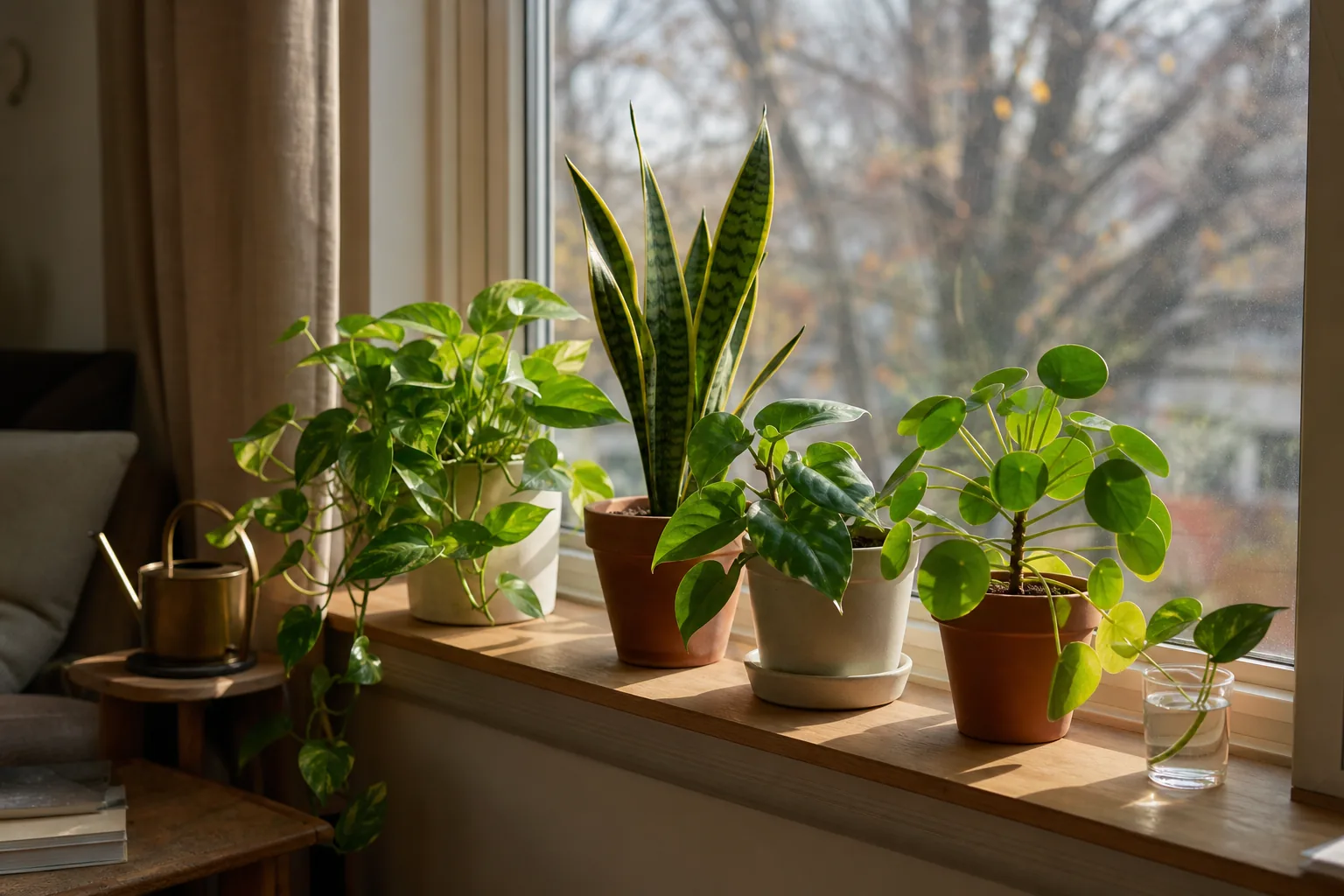
Fall indoors is mostly about noticing what the room is already doing. As the days shorten and the sun sits lower in the sky, usable light at the windows drops before most other things change indoors. Soil dries more slowly. New leaves slow down. The same window that was a friendly bright spot in midsummer starts to feel different on a cool morning. Most of the right responses in fall are subtractions: water less often, feed less often, hold off on repotting and major pruning, and let the plant coast into the slow months with the energy it still has.
This guide is written as a bridge between the summer houseplant care guide (where the adjustments ran toward more water, more food, and screening for stronger sun) and the winter houseplant care guide (where the assumption is short days and dry heated air). Fall is the in-between: the season when the shift is visible at the window, but the heating system has not yet taken over the room.
What actually changes indoors as fall begins
The first change is at the windows, not at the thermostat. Two things happen at once: each day is shorter, and the sun travels a lower arc across the sky. Together, those reduce the total usable light reaching plants at the same spots they have been sitting in all summer. University of Illinois Extension lists light, temperature, humidity, and water as the factors that drive indoor plant success, and Oregon State University Extension notes that those factors interact rather than acting one at a time, which is why a small shift in one of them tends to ripple through the rest.
For a reader this means a plant can start to look unhappy without anyone moving it, watering it differently, or feeding it differently. The room changed around it. Recognizing that the shift is in the room, rather than in the plant, is the first step toward adjusting the right things.
Re-read the light at your existing spots before you move anything
Before reaching for a grow light or dragging a plant across the room, do the midday shadow test at the spot where the plant already lives. Hold a hand or a piece of paper a foot above the leaves around noon. A soft-edged shadow means the spot still receives enough indirect light for most tropical houseplants. A sharp-edged shadow means direct sun, which not every plant wants. No visible shadow usually means the spot has become too dim to rely on through winter.
The on-plant signals matter as much as the shadow test. If new leaves are coming in smaller than the older ones, if the spaces between leaves (called internodes) are stretching, or if the newest growth looks paler than the rest of the plant, usable light at that spot has already dropped. These cues usually show up before any wilting or yellowing does, which is why they are worth a slow look. The reading natural light guide walks through the shadow test and the on-plant signals in more detail, and the leggy growth post covers stretched internodes as the earliest light signal.
The instinct in fall is to push every plant closer to the glass. Sometimes that is the right move. Often it is not, because the same window is also changing in another way (more on that below). Move a plant only when the shadow test or the on-plant signals clearly say the current spot has become too dim. A slightly cooler but brighter spot a few feet into the room is sometimes better than a week of cold glass and direct sun through the same pane.
How watering rhythm usually changes without you changing anything
Cooler soil and slower growth both lengthen the time a pot takes to dry out. The same plant in the same pot, watered on the same day each week, will start staying wet longer as the room cools. This is the most common reason a working summer routine quietly starts overwatering in fall: nothing about the plant’s location or the reader’s care has changed, but the soil’s dry-down time has.
The fix is to stop using the calendar as the trigger and start using the pot. Lift the pot and feel the weight (a dry pot is noticeably lighter than a freshly watered one), or push a finger or a wooden chopstick an inch into the soil. If the soil is still cool and damp that far down, the plant does not need water yet even if last week’s schedule says it should. The when-to-water guide covers the pot-reading approach in more detail.
Common overwatering cues, which a lengthening fall dry-down can make visible: a pot that stays heavy longer than it used to, a faint sour smell from the soil, or yellowing lower leaves on a plant that is otherwise in the same spot it has been thriving in. Those are signs to lengthen the interval, not to add anything new to the routine.
Growth slows down, and that is information, not a problem
When usable light drops, most tropical houseplants respond by slowing their growth. The visible cues are subtle: fewer fresh leaves, slightly smaller new leaves, longer internodes, less obvious daily change. UGA Cooperative Extension frames this as the underlying principle behind indoor feeding: a plant without new growth has a limited need for additional nutrients.
That is also why Missouri Botanical Garden warns against stimulating tropical houseplants with fertilizer during low-light months. Feed a plant that is not actively growing and you push it to make weak, stretched new growth it cannot support. The fall fertilizer pause should follow what the plant is doing, not a date. If new leaves are still coming in at the same pace and size, keep feeding at summer strength or close to it. If the plant has clearly slowed, drop the dose or pause until the days lengthen again. The fertilizer basics guide covers the underlying principle.
A useful rule of thumb: if everything in the collection is slowing down together, the slowdown is probably seasonal rather than a problem to fix. If one plant is showing sharp symptoms, like sudden leaf drop, dark spots, or drooping, while the rest of the collection looks the same as last month, that is a plant-specific issue worth looking into.
The same windows start behaving differently
In summer, a sunny window is mostly a sunny window: long hours of strong light and glass that stays warm or merely cool overnight. In fall, the same window can deliver warm afternoon sun earlier in the day and turn into a cold glass surface overnight as outdoor temperatures drop, before the indoor heating system is running reliably.
Feel the inside of the glass on a cool morning. If it is cold to the touch while the room air is comfortable, the leaves resting against that pane are sitting in a microclimate several degrees cooler than the rest of the room. Watch for vents that start cycling on and off on the first cold nights, too. A plant above a vent that was dormant all summer is now in a new microclimate the first time the heat kicks on. The drafts, vents, and sun-heated glass guide walks through the patterns to notice.
Most plants tolerate a cool window for a while. The combination that tends to do the damage is cold glass overnight plus warm direct sun through the same pane earlier in the day, which forces the plant to recover from each cycle. If a particular window is showing both, an inch or two of buffer between the leaves and the glass is a small fix that does not require moving the plant out of the spot.
Indoor air in early fall versus deep winter
Early-fall indoor air is usually cooler and still moderately humid. Windows get opened some of the time, heating cycles on and off unpredictably, and indoor relative humidity often tracks outdoor conditions. The genuinely dry indoor air problem tends to peak later, when the heating system runs for long stretches and outside air is cold. Ask Extension’s surviving-the-winter summary makes this indoor-air pattern explicit.
This matters because the most common fall mistake is reaching for a humidifier too early. A humidifier running while the heating system is off and windows are cracked can keep the growing medium damp for too long, which is the same problem the slower watering rhythm is trying to avoid. Grouping plants together is a gentler way to raise local humidity around the leaves without changing the room. The humidity in real homes guide covers the rest of the picture.
What is worth doing now, and what is better left for later
A short list, in order of priority.
Worth doing now:
- Re-do the midday shadow test at every plant’s current spot.
- Lengthen watering intervals until the pot dries the way it used to in summer.
- If new growth has slowed, drop the fertilizer dose or pause feeding until active growth returns.
- Spend a slow minute looking at the undersides of leaves and the leaf axils. Fall is a sensible time to spot hitchhikers, framed as a habit rather than a panic inspection.
- Move a plant off cold glass if the same window is cold overnight and sun-warmed by day.
Better left for later:
- Repotting. A plant has less energy to recover in low light, so leave it alone unless the pot is genuinely at risk: cracked, sending water straight through, or severely root-bound. The when-to-repot guide covers how to judge whether a plant actually needs a new pot.
- Major pruning or shaping. Light, selective trimming of a damaged leaf is fine, but hard pruning waits for active growth.
- Propagation. Cuttings taken in low light tend to root slowly and struggle; wait for longer days.
- A new grow light installation. Wait until the deepest part of winter to judge whether the room actually needs one. In fall, a small move or a cleared shadow-test result is usually enough.
- A humidifier as a default. Group plants first, then reassess in late fall or early winter when the heating system is running for long stretches.
A short pre-winter inspection routine
A five-minute check on the same day each week catches most of what fall quietly asks of a reader. Walk the room in this order:
- Light. Shadow-test the spot where each plant sits. Note any plant that has started leaning toward the window since last month.
- Soil. Lift or finger-check the pots. The dry-down time should match the season. If it does not, adjust the interval.
- Growth. Look at the newest leaf on each plant. Smaller or paler new leaves and longer gaps between leaves are normal in fall. Sharp symptoms on a single plant are not.
- Edges and glass. Touch the window glass and feel for cold spots near plants. Feel for air movement from a vent that just started cycling.
- Undersides. A slow look at the backs of leaves and the leaf axils. This is a habit, not a hunt.
This is the same skeleton the bringing houseplants back inside checklist uses for plants that spent the summer outdoors. Indoors year-round, it becomes a weekly rhythm rather than a one-time event.
When to ask a local source
Generic guides like this one stop being useful where microclimate, heating system, building exposure, and species differ. A south-facing window in a cold climate in October is not the same as a north-facing window in a mild one. A heat-pump home and a radiator home make different demands on the leaves nearest the wall. A tropical aroid slows its growth on a different timeline than a succulent.
For questions that depend on those specifics, a local independent nursery, a regional extension service, or a species-specific care sheet will give a more useful answer than a generic article can. If a plant is showing sharp symptoms that do not match the seasonal pattern above, treat that as plant-specific and ask someone who can see the plant.
Sources
- Low daily light integrals in northern latitudes — Mississippi State University Extension
- Growing indoor plants with success — University of Georgia Cooperative Extension
- When and how should I fertilize my indoor plants? — Missouri Botanical Garden
- Houseplants — University of Illinois Extension
- Environmental factors affecting plant growth — Oregon State University Extension
- Surviving the winter — Ask Extension