Plant care
Croton plant care indoors: keeping the color
· Updated
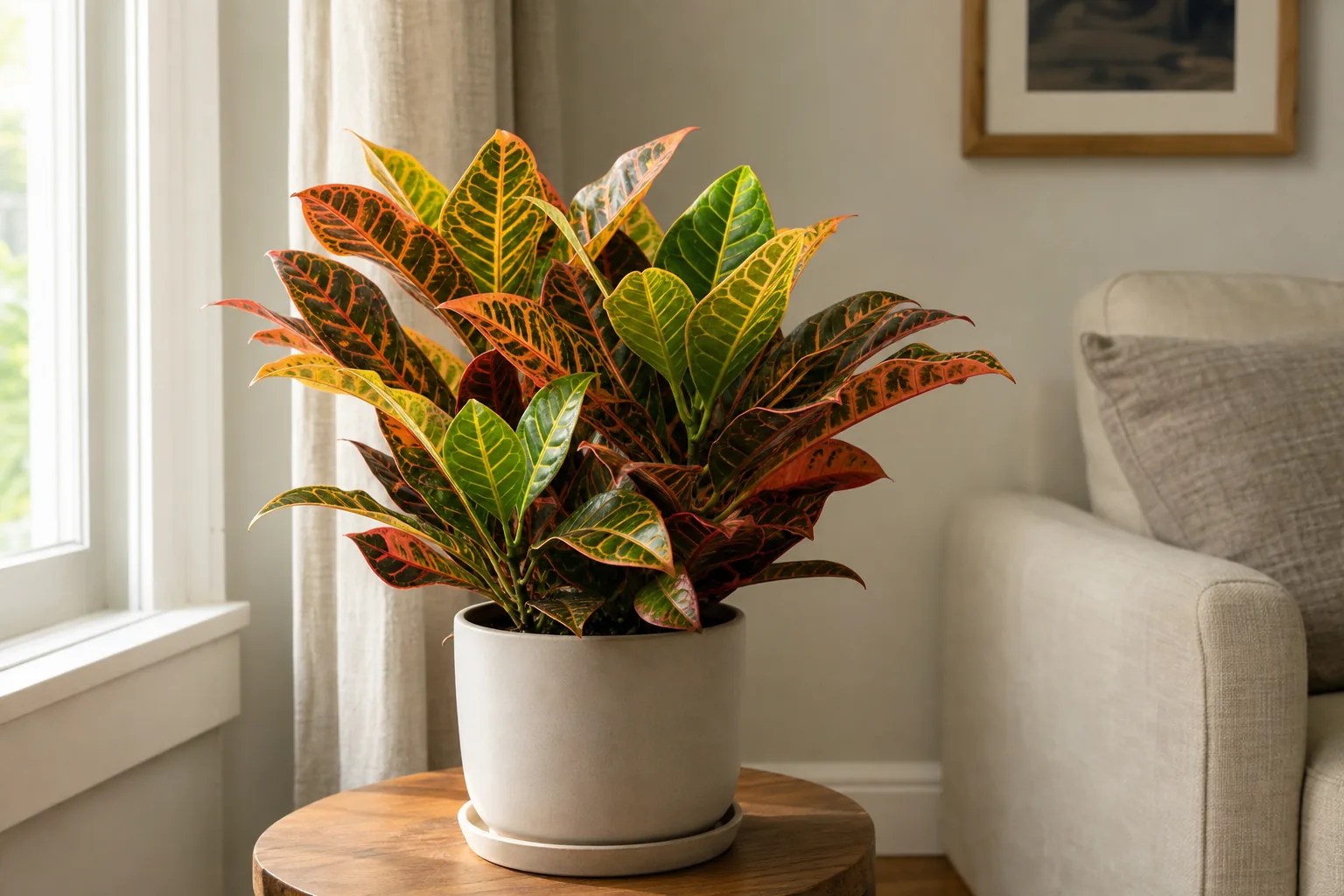
If your croton is dropping leaves or its color is fading, the answer is almost always about light, not humidity tricks or fertilizer. Crotons (Codiaeum variegatum) hold their vivid reds, yellows, oranges, and greens when they receive steady, bright indirect light and a calm placement. They react visibly to being moved, to cold drafts, and to swings between wet and bone-dry. When the conditions are right, the plant rewards you with stable color. When they are not, it shows you by dropping the leaves it can no longer support.
The key observation to make early is the color of the existing leaves. If the reds and yellows are still vivid, the light is roughly right. If the new growth is coming in mostly green, the plant is telling you it needs a brighter spot. If older leaves are dropping while the new ones at the tips are still colorful, the plant is in transition rather than failing.
What a croton is actually asking for indoors
A croton is not a low-light plant, and it is not a houseplant that will adapt to any room you place it in. University extension services describe it as needing bright indirect light, daytime temperatures roughly in the 60 to 85°F range, and soil that stays evenly moist without staying soggy. Wisconsin Horticulture Extension places the daytime range at 60 to 85°F and notes that leaf drop often follows when temperatures stay below about 50°F. UC ANR’s “Colorful Croton” article focuses on 70 to 85°F as ideal and flags sustained exposure below 59°F as a danger zone.
The plant is also reactive. Any single change can trigger leaf drop: a move from the greenhouse to the store, a draft from a window or vent, a switch from one room to another, a repotting at the wrong time. That reactivity is the source of croton’s reputation for being difficult. It is more accurate to say the plant shows you what it needs, more quickly than most other houseplants do.
Light: the single variable that drives color
Color in a croton is driven by light, not by fertilizer or by humidity. Variegation fades when the plant does not receive enough bright light, and adding nutrients to a low-light plant will not bring the color back. Hot, unfiltered midday sun, on the other hand, can scorch the leaves and bleach out the variegation.
In practical terms, “bright indirect light” translates to the brightest spot in the room that does not put the plant in direct sunbeam for hours. An east-facing window is often a good match. A west-facing window works if the light is filtered or if the plant sits a step or two back from the glass. A south-facing window in a home with strong sun usually works only if the plant is set back from the glass or shaded by a sheer curtain.
The framework for thinking about indoor light intensity comes from University of Maryland Extension, which places medium-bright indoor light at roughly 100 to 500 foot-candles, with the brighter end of a typical home (east- or west-facing windows) sitting at the upper part of that range. Croton is consistently described as a bright-light plant within these frameworks. If your room does not have a genuinely bright indirect spot, that is a reasonable reason to choose a different plant, not a problem to fix with fertilizer.
For a fuller way to read the light in your specific room, the Houseplant Supplies guide to reading natural light walks through what to look for in each direction of window.
Placement: pick a spot and leave it there
Once you have chosen the brightest indirect spot your home offers, leave the pot there. Crotons react visibly to being moved, even short distances from one side of a room to another. They also react to being rotated, so turning the pot to “balance” the growth is usually a mistake. The plant will grow toward the light; let it.
This is one reason crotons earn a reputation for being fussy. In many cases, the leaf drop that happens in the first weeks at home is a response to several moves in a short span: greenhouse to store, store to car, car to home, and sometimes a couple of room-to-room relocations while the reader finds the right spot. The plant can usually absorb one move. Two or three in a week is a different story.
Watering rhythm: steady moisture without sitting wet
Crotons want soil that stays lightly moist through the root zone and is allowed to dry slightly at the surface before the next watering. They dislike two opposite conditions equally: bone-dry soil and soil that stays wet for days. Both ends of that range will cause leaf drop.
The extension principle is to water by feel rather than by calendar. Lift the pot, press a finger into the top inch of soil, and water when the surface is just starting to feel dry. Water through the root zone until water runs out the drainage hole, and empty the cachepot afterward so the roots are not sitting in standing water. If you are not sure whether to water, wait a day and check again.
A bottom-watering routine, where the pot sits in a shallow tray of water for 15 to 30 minutes and is then removed, is a documented approach in container-houseplant guides and works well for crotons because it wets the root zone evenly without leaving the surface saturated. For a fuller framework on reading soil moisture and pot weight rather than a calendar, the Houseplant Supplies watering-by-observation post goes deeper.
Mix, pot, and drainage: airy roots and a stable base
Crotons do best in a mix that holds some moisture but drains freely and lets air back into the root zone. The principle, set out in NC State Extension’s container chapter, is that a potting mix should have high permeability to water and air, which is achieved by larger particles like perlite, pine bark, or coarse sand blended with an organic base such as peat or coco coir. A dense, compacted, all-purpose garden soil is the wrong texture for this plant.
The pot itself needs a drainage hole. Decorative cachepots are fine as long as the croton is in a functional nursery pot inside them and any standing water is emptied after watering. Cachepots with no drainage and a layer of rocks at the bottom do not create drainage; they create a pool of water at the bottom of the pot, which is what causes root rot. For more on the three common indoor pot setups and how to make each one work, the Houseplant Supplies drainage and cachepot post is the closer-cousin guide.
For the mix itself, the Houseplant Supplies guide to choosing a potting mix walks through how to read what is actually in a bag and how to match the mix to the plant rather than the other way around.
Humidity, temperature, and drafts: real tolerances vs. reputation
Crotons have a reputation for needing high humidity, but the extension sources used for this article (Wisconsin Horticulture, NC State, UC ANR, and the EDIS production paper) do not place a humidity floor for ordinary indoor culture. They focus on light, temperature, and watering rhythm. Ordinary home humidity, in the range most apartments and houses sit in, is usually acceptable for crotons if light and watering are right. Grouping plants together or running a humidifier near them is a refinement, not a requirement. For a proportionate look at whether your home actually needs more humidity, the Houseplant Supplies humidity-in-real-homes post lays out the framework.
Temperature is where crotons are more particular. They do best in the 60 to 85°F daytime range, and below about 50°F, leaf drop and cold damage become likely. The bigger indoor threat is usually not the thermostat reading 70°F; it is the cold-air microclimate. Single-pane glass in winter, an exterior door that opens often, a forced-air vent pointed at the pot, or a window seat that gets a draft from a gap in the frame can all drop the local temperature enough to trigger a croton to drop leaves even when the room feels fine. For more on the microclimate variables that often catch readers off guard, the Houseplant Supplies drafts, vents, and windows post is the closer-cousin guide.
Leaf drop, fading color, and what the plant is telling you
Two alarms show up most often with crotons: leaves dropping, and leaves fading toward green.
Leaf drop is almost always a response to a recent change. The change can be light (lower than what the plant was used to in the greenhouse), temperature (a draft or a cold window), water (a long dry period followed by heavy watering, or vice versa), or disturbance (a move, a repot, a rotation). The diagnostic is to ask what changed in the last one to three weeks. The closer-cousin leaf drop after a move or change post walks through the order to check those variables, and the first two weeks with a new houseplant post sets expectations for the adjustment window after purchase.
Fading color is almost always a light problem. The existing leaves may stay colorful for a while, but the new growth will come in greener if the light is too low. Moving the plant to a brighter spot will not restore the lost color in the older leaves, but it will bring the color back into the new growth over the following months.
One thing worth setting expectations around: leaves that have dropped will not regrow on the same stem. Recovery shows up at the branch tips and at the crown as new growth. The healthy question to ask at one month is whether the plant is putting out new leaves and whether those new leaves are holding the variegation. If yes, the plant is recovering. If no, the conditions still need adjusting.
Fertilizer, repotting, and long-term upkeep
Crotons do not need much fertilizer. A light feeding at half the label rate, applied only during active growth in spring and summer, is enough. Fertilizer does not bring back color that has faded from low light, and over-fertilizing a stressed plant compounds the problem. A single application in spring and another in mid-summer, if the plant is actively growing, is usually sufficient. For a fuller look at why less is usually better, the Houseplant Supplies fertilizer basics post explains the principle.
Repotting is best delayed until the plant has acclimated, ideally in the next active growth season. Move up only one pot size at a time, into a fresh airy mix, and avoid disturbing the roots more than necessary. Crotons tolerate staying in the same pot longer than many houseplants do. For a look at what the days and weeks after a repot actually involve, the Houseplant Supplies care-after-repotting post walks through the recovery window.
A short note on pets and people
Croton is listed as mildly toxic to cats and dogs by veterinary toxicology resources, including the ASPCA, which maintains a toxic and non-toxic plants list that is worth verifying directly for your own situation. The point is not to amplify the risk, but to verify it before bringing the plant into a home with pets. For a fuller method of choosing houseplants when you live with cats, dogs, or other animals, the Houseplant Supplies pet-aware houseplant post walks through a verification-first approach rather than another list.
A realistic first-month timeline for a new croton
In the first one to two weeks, expect some leaf drop as the plant adjusts. The cause is usually the cumulative stress of the move from greenhouse to store to home, not a failure on the reader’s part.
Between weeks two and four, look for new growth at the tips. If the new leaves are coming in with the cultivar’s expected color, the conditions are right. If they are coming in mostly green, the light is too low.
Beyond the first month, judge the plant by its newest leaves and by whether the existing variegation is holding. A croton in the right spot will stabilize within a season and will hold its color as long as its basic conditions (light, steady moisture, draft protection) are maintained. It is still a reactive plant that will tell you quickly if something changes.