Plant care
Aphids on houseplants
· Updated
If you have just noticed small soft-bodied insects clustered on a houseplant, the most useful first step is to confirm what they are. Aphids are a common indoor pest with a fairly distinct look and behavior. Mechanical steps can substantially reduce a colony if started early, though repeat inspections over the following two to four weeks are usually needed because new nymphs keep arriving. This guide covers how to recognize aphids, how to separate them from the other indoor pests already covered on this site, and how to run a measured response in the first one to two weeks before deciding whether a product is needed.
What aphids actually look like on a houseplant
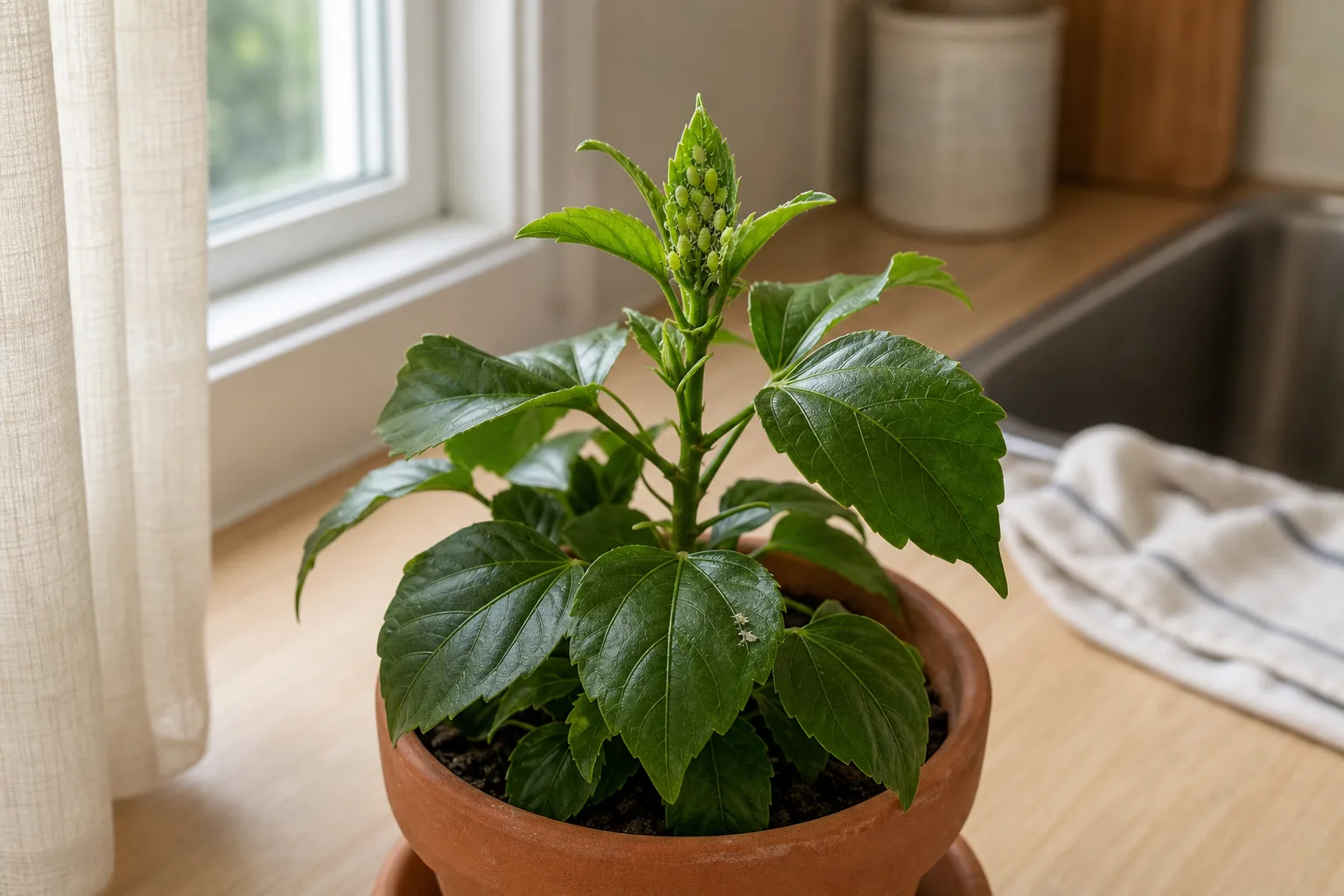
Aphids are small, soft, pear-shaped insects. Adults are usually between one and three millimeters long, no larger than about an eighth of an inch, so they are easy to miss until a cluster forms on a stem tip. The color varies. Indoor sightings are commonly green, black, pale yellow, or pinkish, and the same colony can contain several sizes at once because the young, called nymphs, look like smaller versions of the adults and feed right alongside them.
The single best field mark is a pair of short tubes at the rear of the insect called cornicles, which look a bit like tiny tailpipes. No other common soft-bodied indoor pest has those. A magnifier or the macro lens on a phone is enough to see them once you know to look.
Two other signs often appear before you spot the insects themselves. As aphids grow they shed their skins, leaving pale white flecks on leaves and stems that can be mistaken for dust. They also excrete a sticky residue called honeydew, which can fall onto leaves below and onto the surface the plant sits on. If you have noticed sticky leaves on a houseplant but no obvious bugs, the colony is likely feeding higher up on the plant.
Where aphids cluster on indoor plants
Aphids prefer tender, sappy tissue. On houseplants they tend to gather at shoot tips, on the newest unfurling leaves, along flower buds, on the undersides of young leaves, and on soft green stems. They are not usually found on tough, mature foliage lower on the plant. If you are hunting for them, start at the top of the plant and work down through the youngest growth.
Distinguishing aphids from common indoor lookalikes
Several indoor pests are easy to confuse with aphids at a glance. A short comparison helps you rule out lookalikes without restating full treatments, which are covered in their own guides.
Mealybugs are the most common mix-up. They are larger than aphids and covered in white, cottony wax that does not look like anything on an aphid. Mealybugs also move very slowly and tend to lodge in leaf axils and along stems. Aphids are pear-shaped and clearly soft-bodied. A young mealybug crawler can briefly look aphid-like; cornicles and the absence of wax tufts are the deciding features. The mealybug guide walks through identification and response in more detail.
Soft scale insects are a different problem. Once settled, they are flat or domed bumps that do not move and stay in one place on stems or leaves. Aphids move, even slowly. The mobile young stage of scale, called crawlers, can look like tiny pale specks, but crawlers usually settle into a fixed position within a short time and then stop moving.
Whitefly adults are small white insects that fly up in a cloud when the plant is disturbed. Aphids do not fly up in a cloud, even when winged forms are present. A quick disturbance test, gently tapping the stem and watching what lifts off, separates the two within a few seconds.
Spider mites are much smaller than aphids, often appearing as moving specks, and they produce fine webbing and pale stippling on the leaves rather than honeydew. If the symptom is sticky leaves and ants, think aphids first. If the symptom is dry, dusty leaves with fine webbing and tiny pale dots, think spider mites.
Why aphids sometimes show up on houseplants
Most indoor aphid introductions trace back to a plant that arrived recently, whether from a nursery delivery, a cutting from a friend, or a houseplant that spent the summer outside. Soft new growth from recent fertilizing can allow a small, previously unnoticed colony to become visible quickly. Open windows and cut flowers are sometimes mentioned as minor pathways indoors, but a recently introduced plant is a far more common source, which is why a quick pre-purchase inspection matters. Inspecting a houseplant before purchase covers the basics in a few minutes.
Indoor populations are not bound to outdoor seasons the way outdoor populations are, so an aphid sighting can happen in any month.
Winged aphids indoors are not a separate, more dangerous species. Winged adults are alates, a mobile form produced by most aphid species when the colony gets crowded. If you are seeing winged aphids on a houseplant, it usually means the infestation has been there long enough to produce them, which is itself a reason to act promptly rather than a reason to panic.
Isolating the infested plant from the rest of the collection
Before any physical treatment, move the affected plant away from its neighbors. Aphids spread mainly when nymphs, winged adults, or contaminated tools move between plants. A separate room or a corner with its own watering can, pruning shears, and saucer cuts most of that traffic.
A useful isolation routine includes washing hands between plants, not sharing tools without wiping them down, and checking neighboring plants every few days for the next two weeks, since a small colony on the original plant can spread before it is obvious. The guide on inspecting and quarantining a new houseplant walks through the same habits used here.
First mechanical steps: water, manual removal, and cleanup
For a typical indoor aphid colony, mechanical steps are the right place to start. Both UC Statewide IPM and Oregon State University Extension recommend a strong stream of water to dislodge aphids from tender shoots.
In practice this means taking the plant to a sink or shower and rinsing it with a steady, lukewarm stream, supporting the leaves from behind with a hand so soft tips do not break. Focus on shoot tips, buds, and the undersides of young leaves. Let the plant drain and dry out of direct sun.
After the rinse, several follow-up steps are worth doing in the same session:
- Prune heavily infested tips into a sealed bag rather than shaking them off over other plants.
- Wipe down nearby shelves, the pot, and the tops of lower leaves with a damp cloth to remove honeydew before it can attract other pests or grow sooty mold.
- For small, stubborn clusters on a stem, dab them with a cotton swab dipped in a standard 70 percent household isopropyl alcohol. This is a spot technique used to lift a few stubborn individuals, not a spray-on treatment. Treat a small test area first and watch for leaf damage over the next day before continuing. If the colony persists, the next move is a labeled product rather than more dabbing.
A single rinse rarely finishes the job. In warm indoor conditions, many aphid species can develop from newborn nymph to reproducing adult in about a week, and a single female can produce several live young per day for several weeks, so the population can rebound quickly. Plan to repeat the rinse and inspection every few days for the next two to four weeks, not because the first attempt failed, but because new nymphs keep arriving. A weekly houseplant inspection routine makes that habit easier to keep.
When to consider a labeled product and what to read first
UC Statewide IPM is clear that aphids seldom kill mature plants and that control is mainly warranted when damage or honeydew becomes intolerable. If mechanical steps have reduced but not eliminated the colony after seven to fourteen days, a labeled indoor product may be the next step.
At that point, the right next move is to confirm that any product you consider is labeled for indoor use on houseplants and to follow the rates, intervals, and safety directions on the label exactly. The houseplant pesticide label guide walks through what to read before you spray indoors. Do not substitute kitchen dish soap, homemade alcohol mixes, or essential-oil recipes for a labeled product. Extension sources describe insecticidal soaps and horticultural oils only as specific formulated products, and any pet- or child-safety question should be answered by the product label and your local vet or poison control center rather than by an online article.
What to watch for in the following two to four weeks
A few patterns are normal during recovery and worth recognizing so they do not look like setbacks.
- A second flush of pale nymphs, often on a different shoot tip, is expected. Repeat the rinse on those tips rather than reaching for a stronger product.
- New honeydew on lower leaves means the colony above is still feeding. Wipe it off and inspect the upper plant.
- Winged aphids may appear for a short period as the colony senses crowding. They do not mean a new, separate species has arrived.
- Ants indoors near the plant are a useful secondary signal. Ants are attracted to honeydew and can interfere with mechanical removal by disturbing aphids when you try to rinse or wipe them off, which makes the infestation harder to clear. Cleaning nearby surfaces and blocking ant trails are part of the same response.
- Sooty mold, a dark powdery coating that grows on honeydew, can appear on lower leaves where honeydew has dripped. Wipe it off with a damp cloth once the aphid colony is under control; the mold does not directly attack the plant.
When to ask a local expert
A local expert is the right next step if the colony persists despite two to four weeks of repeated mechanical removal, if the plant is heavily infested and declining, or if you are genuinely unsure whether you are looking at aphids, mealybugs, scale crawlers, or whitefly adults. Independent garden centers, university extension offices, and master gardener clinics can identify specimens under magnification and recommend a course of action for your specific plant and conditions. Houseplant Supplies is an educational journal, not a diagnostic service, and a local expert can look at the actual plant in your actual room, which an article cannot.
Sources
- UC Statewide IPM, Aphids (Home and Landscape): https://ipm.ucanr.edu/home-and-landscape/aphids/
- Missouri Botanical Garden, Aphids – indoors: https://www.missouribotanicalgarden.org/gardens-gardening/your-garden/help-for-the-home-gardener/advice-tips-resources/insects-pests-and-problems/insects/aphids/aphids-indoors
- University of Wisconsin Horticulture Extension, Aphids, in-depth: https://hort.extension.wisc.edu/articles/aphids-2/
- Oregon State University Extension, Keep aphids under control with low-risk, natural strategies: https://extension.oregonstate.edu/news/keep-aphids-under-control-low-risk-natural-strategies
- University of Alaska Fairbanks Cooperative Extension Service, Houseplant Pests and Control: https://www.uaf.edu/ces/publications/database/insects-pests/houseplant-pests.php
- University of Nevada, Reno Extension, Aphids and Their Management in Home Gardens: https://extension.unr.edu/publication.aspx?PubID=3230
- Mississippi State University Extension, Insect Pests of Houseplants: https://extension.msstate.edu/publications/insect-pests-houseplants