Plant care
When to repot a Phalaenopsis orchid
· Updated
Phalaenopsis orchids, the kind most often sold at grocery stores and florists, tend to come with a single piece of advice that confuses more people than it helps: repot every one to two years. That cadence shows up in care tags and forum posts, but it skips the part that actually matters. For these orchids, the decision to repot is driven by what you can see — the state of the bark medium, the behavior of the roots, and where the plant is in its bloom cycle — not by a fixed schedule.
If you want the short version: repot a Phalaenopsis when the bark-based medium has visibly aged out, when roots and broken-down medium together leave the plant unstable or unhealthy, or shortly after a bloom cycle ends. If none of those signals are present, doing nothing is a reasonable, evidence-based answer.
This guide walks through what to look for, when to act, and when to leave the orchid alone. For background on general Phalaenopsis care — light, watering rhythm, and reading roots — see our Phalaenopsis orchid care guide.
Why Phalaenopsis repotting is its own decision
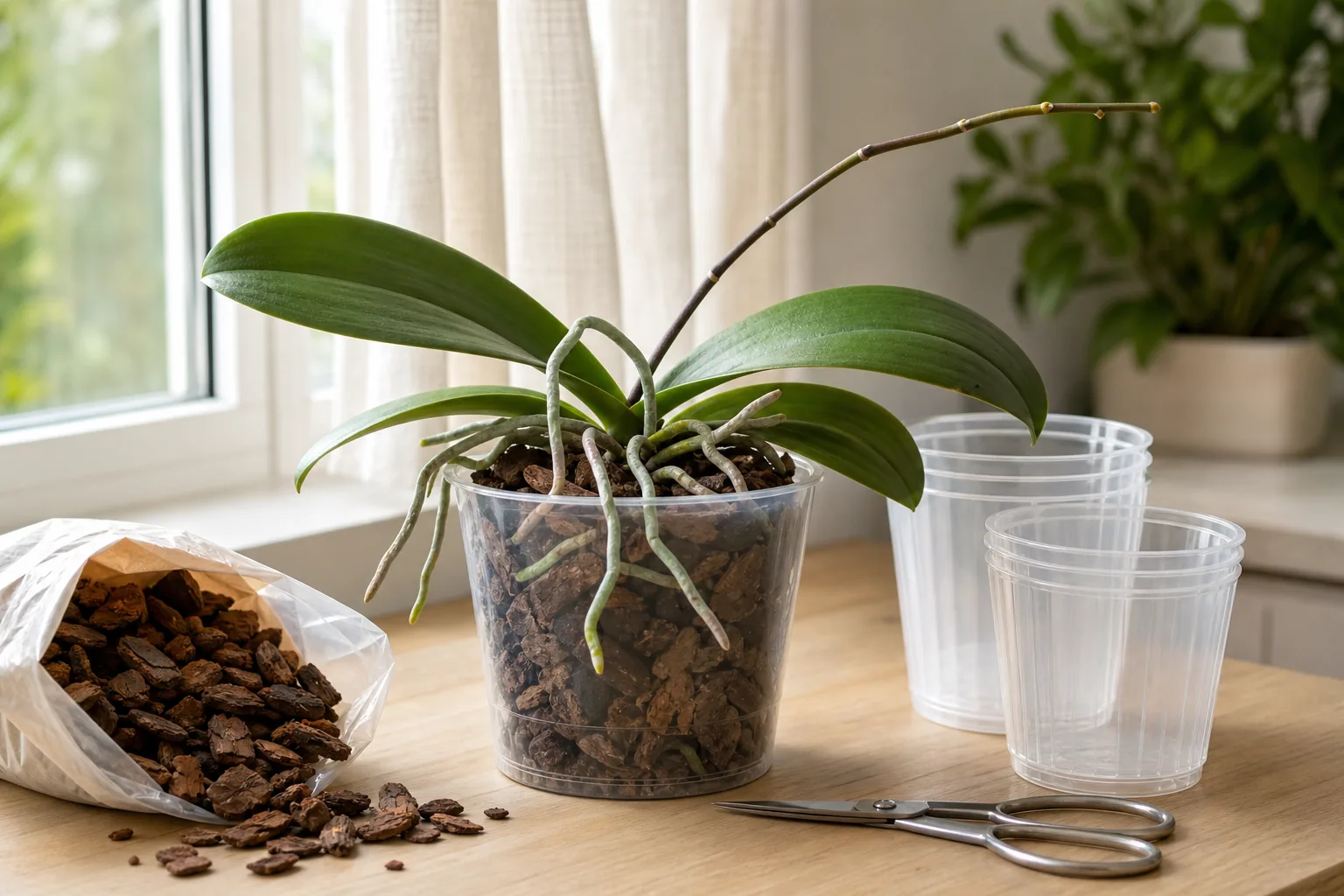
Most houseplants are repotted because they become root-bound — roots circling the inside of the pot or growing out of the drainage holes. Phalaenopsis are epiphytes, which means their wild ancestors grew on tree trunks with roots exposed to air. In a pot, their roots naturally sprawl, and a healthy plant will often push roots over the rim and into the air. That alone isn’t a problem to fix.
What does break down is the bark-based medium that Phalaenopsis are grown in — our guide to reading potting mix labels walks through why orchid mixes differ from typical houseplant soil. Over months, the bark softens, compacts, and loses the air pockets these roots need. By the time the medium has visibly deteriorated, the plant is usually overdue for a repot — even if the leaves and roots above look fine. That single difference is why the typical houseplant “is it root-bound?” test doesn’t translate well to orchids, and why our general guidance on when to repot a houseplant only partially applies.
Signal 1: The potting medium has visibly aged out
This is the most reliable cue, and it shows up before the plant looks stressed. The medium is past its prime when you notice some combination of these:
- Bark pieces are darker than when you first got the plant, soft and crumbly, and have lost their original chunky shape.
- The mix stays wet for many days between waterings, where it used to dry in a few.
- A sour or stale smell rises from the pot a day or two after watering.
- A film or surface growth appears and doesn’t clear with normal airflow.
- The bark has settled noticeably, leaving a gap between the medium and the rim of the pot.
If you’re seeing two or three of those together, the medium is doing less of its job. University of Connecticut Extension ties the practical trigger for repotting to the deterioration of the medium rather than a date on the calendar, and University of Wisconsin Extension explains why that medium has to be coarse, bark-based, and sharply drained in the first place. For a more general look at how potting mixes age out across houseplants, our guide on when a potting mix has aged out walks through similar cues.
Signal 2: Root behavior that actually warrants a new pot
Because some aerial roots are normal, the question isn’t “are there roots outside the pot?” but “what do the roots look like, and what does the medium around them look like?” Some root behavior does point to repotting:
- Roots inside the pot are mostly brown, hollow, papery, or mushy when you gently inspect them.
- The mass of roots at the core of the pot has compacted with the medium into a tight, sour-smelling block.
- New roots emerging from the crown are repeatedly dying back instead of extending.
On the other hand, a few firm, green or silvery roots over the rim of the pot, especially with white or green growing tips, are normal. Aerial roots are part of how the plant gathers moisture and light. Cutting them back as a routine tidy-up step is not recommended; if you’re unsure whether an aerial root is healthy, leave it alone. For a comparison with typical houseplant root-bound signals, our guide on what root-bound actually looks like is a useful counterweight.
Signal 3: The orchid is no longer standing securely
This is often the cue readers notice first in practice. A Phalaenopsis that wobbles in its pot, or that has become top-heavy enough to tip with a light touch, is telling you something has changed at the root level. In most cases the cause is the medium collapsing around the roots, leaving nothing for the roots to grip. A fresh, chunky bark mix gives the roots something to anchor into again. If the wobble has appeared alongside any of the medium cues above, that’s usually enough to act.
Timing within the bloom cycle: why after flowering usually wins
When the answer is yes, repot, the next question is when. The preferred window for a non-emergency Phalaenopsis repot is right after a bloom cycle ends, when the plant is shifting its energy into new roots and leaves. UConn Extension and the American Orchid Society beginner guidance on repotting both point to this post-bloom period as the gentler moment. New root tips — small, silvery or bright green, with a visible growing point — are a practical signal that the plant is entering active growth and will recover from repotting more easily.
This is a preference, not a rule. An actively blooming Phalaenopsis with sound medium and healthy roots usually does not need to be repotted just because the blooms are open. Leave it to finish the show. But emergencies — collapsed medium, rotting roots, an unstable plant — override the preferred window. If the medium has visibly failed, repotting now is better than waiting for the perfect moment.
How often this realistically comes up
The every one to two years guideline appears in many reputable places, including the Chicago Botanic Garden orchid FAQ, and it’s a fair starting check. It works as a rough reminder to look at the medium and the roots around that interval, especially if you’ve lost track. But the actual cadence in any given home depends on watering style, pot size, bark grade, humidity, and how warm the room stays. A Phalaenopsis in a bright, well-ventilated room with a coarser bark mix and a lighter watering hand can comfortably go longer. One in a cool, humid, low-light corner with a finer mix and frequent watering may need attention sooner.
Treat one to two years as a reminder to inspect, not as a deadline.
When to leave the orchid alone
Doing nothing is a valid, evidence-based answer in several common situations:
- The orchid is in active bloom, the roots you can see are firm and green or silvery, and the medium still looks chunky and drains within a few days.
- You just brought the plant home from a store and the nursery pot and medium still look sound. The orchid is already dealing with a change in environment; adding a repot on top of that is rarely necessary.
- New root tips have just emerged and are still short and tender. Wait until they’ve extended a bit before disturbing the root ball.
If none of the three signals above are clearly present, the plant will almost always benefit more from steady care than from a repot.
If the answer is yes: what changes for orchids
A full step-by-step walkthrough lives in our general repotting guide and in our post-repotting recovery guide. For Phalaenopsis specifically, a few principles differ from typical tropical houseplants:
- Use a fresh bark-based orchid mix, not standard houseplant potting soil. The mix should be coarse enough to drain quickly and let air reach the roots.
- Stay in the same pot or move up only one size. Phalaenopsis prefer to be underpotted; jumping more than one size keeps the medium wet around the roots for too long.
- Handle living aerial roots gently and avoid cutting healthy ones as a routine step.
If the orchid is in a decorative cachepot, keep it in a drained inner pot — usually the clear plastic nursery pot it came in — rather than planting directly into a container without drainage. Our guide on pot drainage and cachepots covers this setup in more detail.
When to ask a local expert instead of guessing
A few situations are worth handing off rather than working through alone: persistent root rot after you’ve removed what you could identify as damaged, an orchid that has been declining for weeks with no clear cause, or a plant with roots in such poor condition that you can’t tell what’s salvageable. A local orchid society, an independent nursery that works with orchids, or a university extension office can look at the plant in person and recommend next steps specific to your conditions. Remote descriptions rarely capture enough detail to act on confidently, especially when rot or disease is involved.
For background on general care while you decide, our Phalaenopsis orchid care guide covers how to read roots and light between repots, so the next decision is easier to make.
Sources
- University of Connecticut Extension — Orchid Care and Repotting
- University of Wisconsin Extension — Orchids Garden Facts
- University of Illinois Extension — Orchids (Garden Scoop)
- Chicago Botanic Garden — An Orchid FAQ: How to Repot
- St. Augustine Orchid Society / American Orchid Society Beginner Series — Repotting