Plant care
Watering globes for houseplants: how they work and when they fit
· Updated
A watering globe is a slow-release reservoir that empties through a simple vacuum-and-capillary mechanism. The release rate is set by the soil, the pot, the mix, the depth of the stem, the light, and the season, not by the globe itself. Globes tend to work best in small, well-drained pots in bright light with actively growing plants that like steady moisture, and tend to keep the soil too wet in dense mixes, deep pots, low-light rooms, cool seasons, or with plants that prefer a real dry-down.
What a watering globe actually does
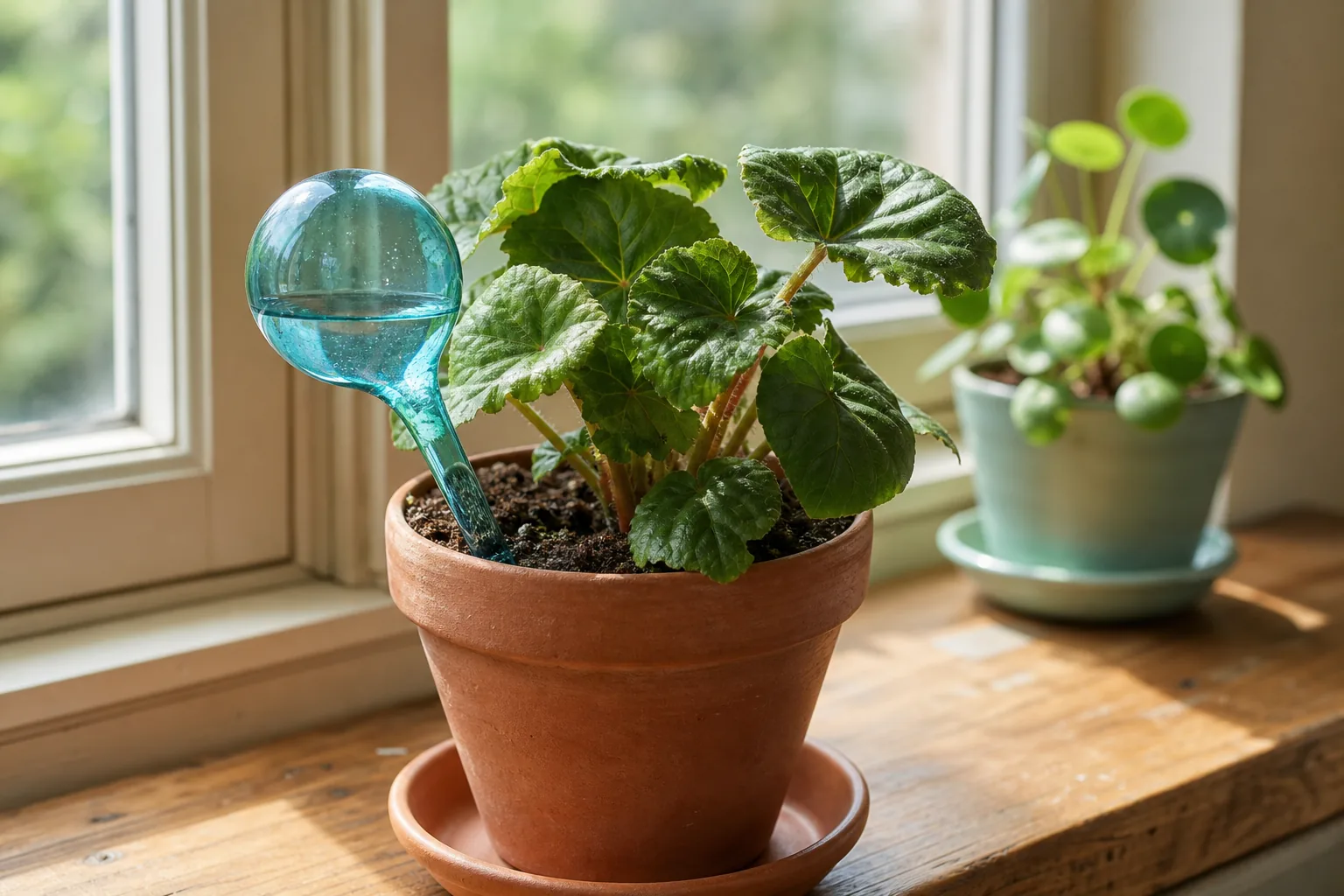
A watering globe is a hollow glass bulb (sometimes plastic) with a narrow stem. The mechanism is commonly described as a vacuum-and-capillary interaction: when you fill the bulb and push the stem into moist potting mix, water starts to seep out through the opening. As water leaves, air enters the bulb through the same opening, and a partial vacuum forms inside. That vacuum holds the rest of the water in place until the surrounding soil dries enough to pull more out. As the soil wets up again, the release slows or stops until the next dry-down.
That is the entire mechanism. The globe has no sensor, no timer, no idea what plant it is sitting in. It responds only to the moisture and air pressure right at the stem. Anything you have read about “smart” or “automatic” watering comes back to that physics-level interaction.
Why the release rate is hard to predict
The same globe can empty in two days in one pot and last more than a week in another. That wide range comes from a handful of variables that change together.
Pot size. Smaller pots dry out faster than larger ones, all else being equal, which is why a globe in a small pot can empty in a couple of days while the same globe in a deep, large pot barely releases because the surrounding soil stays damp.
Mix density. Airy mixes with bark, perlite, or coarse mineral content dry faster at the surface and let the globe empty faster. Dense, peat-heavy, or compacted mixes hold water longer and can stall the release, so the soil around the stem can stay wet for many days. The mix you potted the plant in for general care is part of how the globe behaves.
Depth of the stem. How deep the stem sits changes how much soil is in contact with the opening. Pushed deep into damp mix, the release slows because the soil at that depth is already wet and stays wet. Sitting shallow, near the surface where the soil dries between waterings, lets the globe cycle more actively.
Light, airflow, and season. A plant in bright light with leaves actively transpiring pulls water faster than the same plant in a dim corner in winter. Cool, humid rooms slow everything down. A globe that empties in two days in May on a sunny windowsill can keep the same plant too wet in January on the same windowsill.
How full the globe is. A full globe has more head pressure and releases faster at first. As it empties, the release slows because there is less water to push out and more vacuum holding the rest back.
No published extension source quotes a reliable “X days” range that covers all of these variables, because the variables are too many. Anyone naming a specific number is picking one combination, not the combination you actually have. The honest move is to learn which way each variable pushes the release and read the plant itself.
When a watering globe is more likely to help
A globe leans helpful when most of these line up:
- The pot is small to medium rather than the deepest in your collection, has drainage holes, and follows a sensible drainage and pot setup for houseplants routine.
- The mix is well-drained and on the airy side rather than compacted.
- The plant sits in bright, indirect light or a few hours of direct sun.
- The plant is actively putting out new growth and using water steadily.
- The species tolerates or prefers steady moisture (many ferns, begonias, African violets, some aroids).
- The gap you are planning for is short and predictable, more like a long weekend than a two-week trip.
Even in this setup, a globe is a supplement to observation, not a replacement for it. Lift the pot, feel the soil, and look at the leaves as your main check. See how to tell when a houseplant actually needs water for the observation habit that should stay in charge.
When a watering globe is more likely to keep the soil too wet
A globe leans risky when any of these apply:
- The mix is dense, old, or has settled and compacted, even if the plant looks fine in it under normal watering.
- The pot is deep and large, especially without coarse components in the mix.
- The room is dim, cool, or humid: low-airflow corners, north-facing windows, kitchens and bathrooms in winter.
- The plant is dormant or barely growing. Most indoor plants slow down in the shorter-day months.
- The species prefers a real dry-down between waterings: succulents, cacti, snake plant, ZZ, and other drought-tolerant species. Many “easy care” plants sit in this group, which is part of why globes trip people up.
- The stem slot sits in the wettest part of the pot, like right against a wall of a sealed cachepot, where drainage is restricted.
In these conditions the soil is already slow to dry, and adding a slow trickle tends to keep it soggy for too long. That is when root oxygen drops, roots start to decline, and the plant wilts despite the damp soil. The destination for that symptom is wilting in wet soil, which is worth reading before you install a globe on a setup you are unsure about. Telling overwatered from underwatered houseplants is a useful companion read for the early-warning signs.
How to test a globe on one plant without committing
A one-week, one-plant observation is the simplest way to find out whether a globe fits your specific pot, mix, and light. The plan:
- Pick a plant that likes steady moisture, not a succulent, in a pot with drainage and a mix that is not compacted. If the potting mix has not been refreshed in a year or more, consider repotting before adding a device.
- Water the plant normally first, let it drain, then seat the filled globe into moist (not soaking) soil.
- Lift the pot right after seating the globe and remember the weight. Lift it again at 24 hours and at 48 hours. A clear weight change means the globe is releasing water into the pot.
- Press a finger about 5 cm (roughly 2 inches) into the soil near the stem, not into it, following the soil-moisture check described in University of Maryland Extension’s guidance on watering indoor plants. The surface should not feel soggy for days on end; it should dry back a little between releases.
- Watch the plant for 7 to 10 days. New growth should look normal, leaves should hold colour, the surface should not develop a sour or stagnant smell, and the globe should empty at a pace that feels slower than “everything is wet.”
If the pot feels heavier than you expect after 48 hours, the surface stays wet, or the plant starts to yellow, drop leaves, or wilt in damp soil, treat that as the exit signal. Pull the globe, let the rootball dry down, and reassess the pot, mix, light, and species before you try again. The aim is a controlled trial, not a commitment.
Reading the signs the globe is helping or hurting
A globe that fits the plant and the setup is mostly invisible. The soil dries back a little between releases, new growth comes in normal, and the globe empties slowly enough that you refill it weekly or so.
A globe that does not fit shows up in the soil and the plant:
- Yellowing leaves or wilting in damp soil are the most common early signs of overwatering. The plant cannot use the water fast enough and roots are starting to struggle. Telling overwatered from underwatered houseplants walks through how to read those cues before changing anything.
- A faint sour or stagnant smell from the top of the soil points to surface soil staying wetter than the mix wants.
- Fungus gnats appear around the top of the soil when the surface stays constantly moist, which is a side effect of the conditions the globe is helping to create.
- Green algae on the globe neck or on the soil surface, and a chalky white mineral ring on the neck or soil under the stem, both mean the surface is staying wet for long stretches. Both are common side effects of consistent surface moisture and tap-water residue, not automatic outcomes of using a globe. A quick clean between refills keeps things tidy, and white crust on houseplant soil explains how to read that residue when it shows up.
- A globe that barely empties over a full week in a deep, shaded pot usually means the release has stalled and the surrounding soil is already wet. Re-seating the stem slightly deeper or moving the globe to a fresh spot can sometimes restart the cycle, but if the pot itself is the problem, a globe will not fix it.
Where watering globes fit next to bottom watering and self-watering pots
Three approaches are often compared for the same problem: a watering globe, bottom watering, or a self-watering pot. None of them is the right answer in every room.
Bottom watering wets the rootball from below by setting the pot in a shallow tray of water, typically for 20 to 30 minutes depending on pot size and how dry the mix is, then removes the pot and lets it dry down naturally. The reader stays in charge of when to repeat. It is a hands-on method and does not run unattended, which is part of why it tends to work for plants that want a real dry-down.
Self-watering pots use a built-in reservoir under the rootball plus a wick or capillary mat. They are designed to be refilled on a roughly predictable cadence, often with a visible water-level indicator. They share with watering globes the same dependency: the plant actually has to draw water from the reservoir, the mix has to wick properly, and the plant cannot be one that wants a dry-down.
Watering globes sit between these two. They have a smaller reservoir than a self-watering pot, are more “set and forget” than bottom watering, and have no refill indicator. They are most defensible for short gaps and matching setups, and least defensible for long unattended absences or for plants that need a real dry-down. For any absence longer than a long weekend, grouping plants, moving them away from direct sun, and a shallow water tray nearby are simpler, lower-risk patterns than relying on a single small reservoir.
A short checklist to keep with the globe
Before installing a globe on a plant, run through these:
- The pot has drainage and the mix is airy, not compacted.
- The plant is in bright light and actively growing.
- The species tolerates steady moisture, not a dry-down.
- The room is not cool, dim, or stagnant.
- The planned gap is short and predictable.
- You can check the plant and the globe’s water level weekly.
If three or more of those are no, the globe is more likely to keep the soil too wet than to help, and a different setup or no device at all is the safer call.
A watering globe is a simple tool that asks the soil a question every time it releases water. The soil answers based on the pot, the mix, the depth, the light, the season, and the species. Listening to that answer, instead of to the device, is the difference between a globe that genuinely helps and one that slowly drowns a plant that did not need steady water.
Sources
- Virginia Tech Extension: Properly watering container houseplants
- University of Maryland Extension: Watering indoor plants
- NC State Extension: Plants grown in containers, Chapter 18 of the Extension Gardener Handbook
- Oregon State University Extension: Environmental factors affecting plant growth
- Royal Horticultural Society: How plants use light for growth