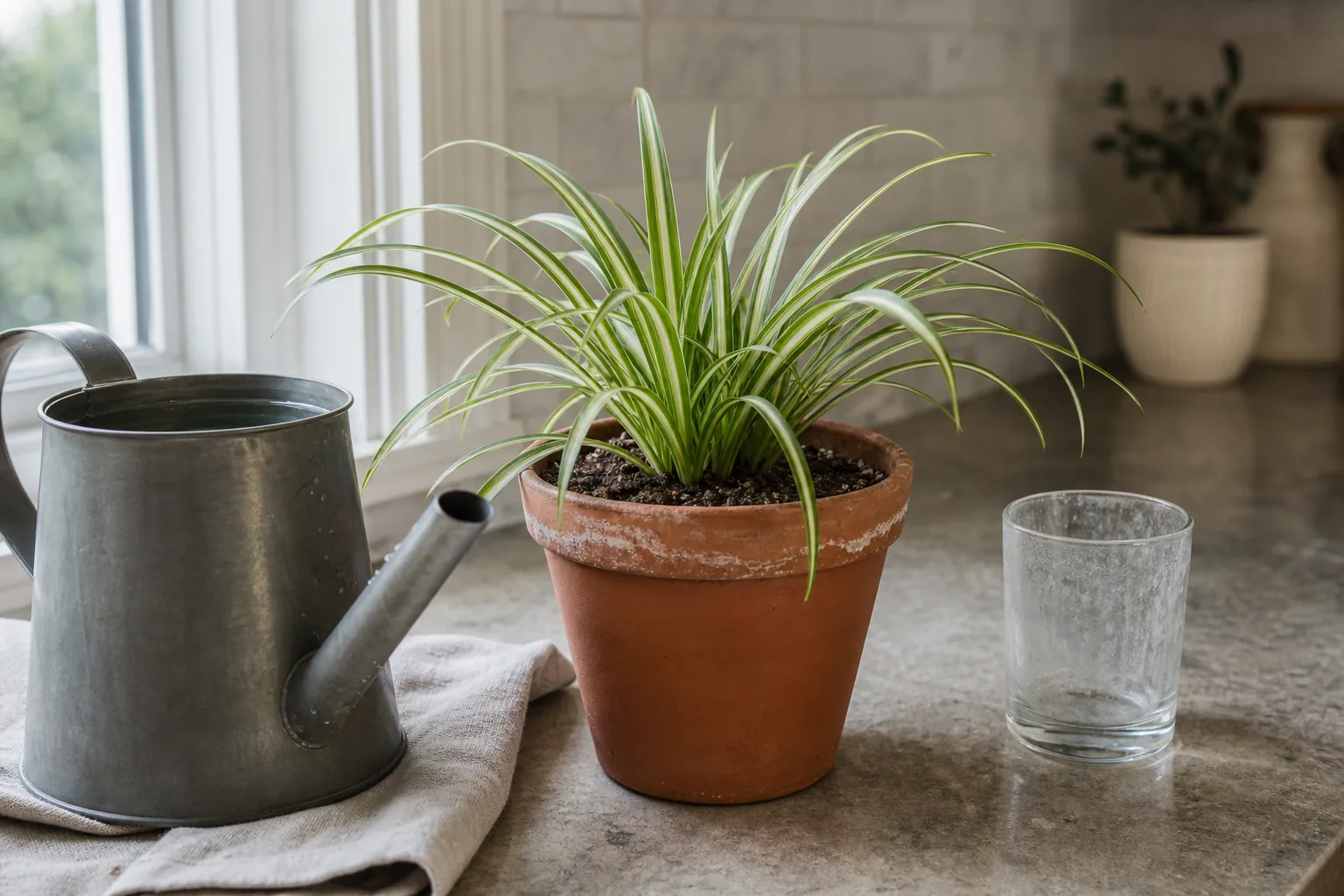
Plant care
Is tap water good for houseplants?
· Updated
For most houseplants in most homes, ordinary municipal tap water is fine. Whether it is fine in your specific home depends on what your local tap water actually contains (disinfectant type, hardness, sodium, sometimes fluoride) and which species you keep. The cheapest, most reliable check is your utility’s annual Consumer Confidence Report paired with a calm look at the plant, not a preemptive switch to a different water.
If you are reading this because of brown tips, white crust on the soil, or one finicky plant that keeps declining, the goal of this page is to give you a small, ordered set of free checks before you spend money on a filter, a pitcher, or a new water source.
What actually varies in tap water from one home to another
Tap water is not one thing. Two neighbors on different utilities, or even two buildings fed by different wells or reservoirs, can be watering with chemically different water. The components that matter most for indoor plants are:
- A disinfectant residual. Most U.S. systems use either chlorine or chloramine to keep water safe in the pipes from the treatment plant to your tap.
- Hardness minerals, mainly calcium and magnesium, picked up as water moves through soil and rock.
- Sodium, often present at low levels and sometimes elevated in regions where ion-exchange softening is widespread.
- Fluoride, added by some utilities for dental health.
- pH and trace metals, generally within the range most houseplants tolerate.
The disinfectant type and the hardness level are the two pieces most likely to be visible in your home and most likely to differ between homes.
How to check your own tap water without buying anything
You do not need a lab test or a special strip to get a useful first reading. Three free checks cover most of what an indoor gardener needs to know.
Read your utility’s annual drinking water report
U.S. community water systems are required by the EPA to publish an annual Consumer Confidence Report, and most post them online or mail them on request. The CCR lists what was detected in your water supply over the previous year, including disinfectant residual, fluoride (if added), and several other items.
For a plant-care reader, the most useful lines are:
- Disinfectant: chlorine or chloramine. This determines whether letting water sit out will help at all.
- Fluoride, if present.
- Sodium, if listed.
- Hardness. Hardness is not always on the standard CCR. If you do not see it, call or email the utility and ask. Many will share it on request.
Treat the CCR as a chemical-content reference, not a plant-care prescription. The numbers are framed for human drinking-water compliance, and there are no universally agreed ppm or grains-per-gallon thresholds that turn a plant’s behavior around on their own.
Look at what the water is leaving behind
Hard tap water leaves mineral residue as it evaporates. If your shower door fogs up with a chalky film, your kettle builds up a white scale, or you see the same kind of ring on a glass after it dries, your tap water is hard. If your pots and soil show the same white crusty ring that you see on glassware, the water is a likely source. The guide to white crust on houseplant soil and pots walks through the visual difference between mineral residue and other surface growths on soil, which is worth knowing before you assume the cause.
Look at the plant in context, not in isolation
A single plant with brown tips is not enough to diagnose tap water. Look across the collection, because water source affects every plant that gets watered with it. If five different species are thriving on the same tap water and one calathea is not, the water is less likely to be the sole cause. The watering without a calendar approach gives the rest of the diagnostic picture; the tap-water question is one branch of a larger watering picture, not a replacement for it.
The plant-side signals that point to water source rather than watering rhythm
Brown tips are one of the most common symptoms in indoor plants, and they have many possible causes. The pattern that points toward tap-water chemistry rather than watering frequency or root health looks like this:
- Browning is mostly at the leaf tip and along the margin, with the rest of the leaf staying green and firm.
- Multiple leaves on the plant show the same tip-only pattern, rather than whole-leaf yellowing.
- The soil and pot show mineral residue, and the same residue shows up on nearby glassware.
- Other plants in the room, watered the same way, are not showing the same pattern.
The pattern that points away from tap water, toward watering rhythm or drainage, looks different:
- Whole leaves going yellow or limp, often starting at the base.
- Soil that stays wet for many days after watering.
- Mushy stems or a sour smell from the pot.
- A plant that improved when you changed how often you water, not what you water with.
For a more thorough walk through the brown-tip question, the brown tips and crispy edges checklist lays out the diagnostic order without assuming the answer is your water.
Which houseplants are commonly reported as sensitive, and why “sensitive” is a soft word
You will see a fairly consistent short list of houseplants described in popular gardening media as reactive to tap-water chemistry: calathea and prayer plant (Maranta), spider plant, peace lily, Phalaenopsis orchid, fiddle leaf fig (Ficus), and African violet. The most often-cited triggers are fluoride, chlorine, and chloramine.
A few honest qualifiers matter here. University extension houseplant resources cover these species as common indoor plants but do not, in their general pages, lead with tap-water chemistry as a primary failure cause. The “tap water sensitive” framing is mostly a popular-literature pattern, repeated by indoor gardening writers, plant shops, and filter brands. It is plausible and worth taking seriously if you own one of these plants, but it is not the same thing as extension-published plant pathology. If you keep a calathea-style plant and want to give it its best shot, the calathea and prayer plant care page goes into more detail on humidity, light, and water rhythm without making water source the whole story.
The contrast group is the long list of houseplants that are usually described as easy to keep on ordinary tap water: pothos, philodendron, snake plant, ZZ, monstera, and most other common tropicals. These are the plants whose care pages rarely mention water source, which is a quiet signal in itself.
Low-cost things you can try before switching to a different water
Before changing your water source, there are a few near-zero-cost moves worth trying.
Use room-temperature water. Letting a watering can sit for an hour after filling takes the cold edge off and is one of the few water-related tips that nearly every extension houseplant resource repeats, including Oklahoma State University’s houseplant care fact sheet. Most extension resources recommend tepid water for tropicals.
Switch one plant, not the whole collection. If you suspect a sensitive species, move just that one plant to a different water source for a few weeks and compare it to a control plant on tap water. That gives you a cleaner test than switching everything at once and being unsure what changed.
Let the water sit if your utility uses chlorine. The CDC is explicit on this point: chlorine off-gasses from water left standing for a day or two, but chloramine does not. If your utility uses chloramine, the same trick does not work. Your CCR will tell you which.
Repot periodically in fresh mix. Mineral residue and salt buildup accumulate over time even on a tolerant plant. A yearly refresh of the top few centimeters of soil, or a full repot every couple of years, reduces salt buildup without requiring a change to your water source.
When a switch is genuinely worth it, and when it isn’t
A switch to a different water source is worth trying when you have a plant on the commonly sensitive list, you have ruled out watering rhythm and drainage, your water is hard or uses chloramine, and the symptom matches the tip-and-margin pattern described above. A short trial on one plant, for a few weeks, is the most efficient way to test the hypothesis.
A switch is probably not worth it when most of your collection is doing fine, when the symptom pattern points to overwatering or low humidity, or when you are choosing water based on anxiety rather than observation.
One important distinction: if your home has an ion-exchange water softener, the water coming out of the tap in your kitchen or bathroom may be softened, which is a separate problem from hard tap water. Hard water leaves mineral residue; softened water swaps calcium and magnesium for sodium, which can build up in potting mix over time. The two are often confused because both can leave residue and both are called “tap water,” but they call for different responses, and softened water for houseplants is a separate question.
What to ask your local water utility or county extension office
Two questions get you most of what you need from your utility:
- Does the system use chlorine or chloramine as the residual disinfectant?
- What is the hardness of the water, in grains per gallon or mg/L of calcium carbonate?
For plant-care interpretation, your county or regional extension office or a local master gardener program can help connect a CCR number to what plants in your area actually do on that water. Master gardener volunteer programs, including the Master Gardeners of Northern Virginia, often have houseplant watering pages that put the same questions into plain language and can suggest whether the local water is something plants in your area commonly react to.
If you are seeing a symptom that does not match the patterns above, or that is getting worse after a change, that is the moment to bring in a local expert, an extension agent, or a reputable independent nursery rather than to keep adjusting the water on your own.
Sources
- U.S. Centers for Disease Control and Prevention — About water disinfection with chlorine and chloramine: https://www.cdc.gov/drinking-water/about/about-water-disinfection-with-chlorine-and-chloramine.html
- U.S. Environmental Protection Agency — Consumer Confidence Reports (CCR): https://www.epa.gov/ccr
- Master Gardeners of Northern Virginia — Water, water, water: https://mgnv.org/houseplants/water-water-water/
- Oklahoma State University Extension — Houseplant care: https://extension.okstate.edu/fact-sheets/houseplant-care
- University of Maryland Extension — Selecting indoor plants: https://extension.umd.edu/resource/selecting-indoor-plants