Plant care
Springtails vs fungus gnats: how to tell which one is in your houseplant soil
· Updated
Springtails and fungus gnats often show up in the same places, but they are different organisms with different behaviors, and the right response to each is different.
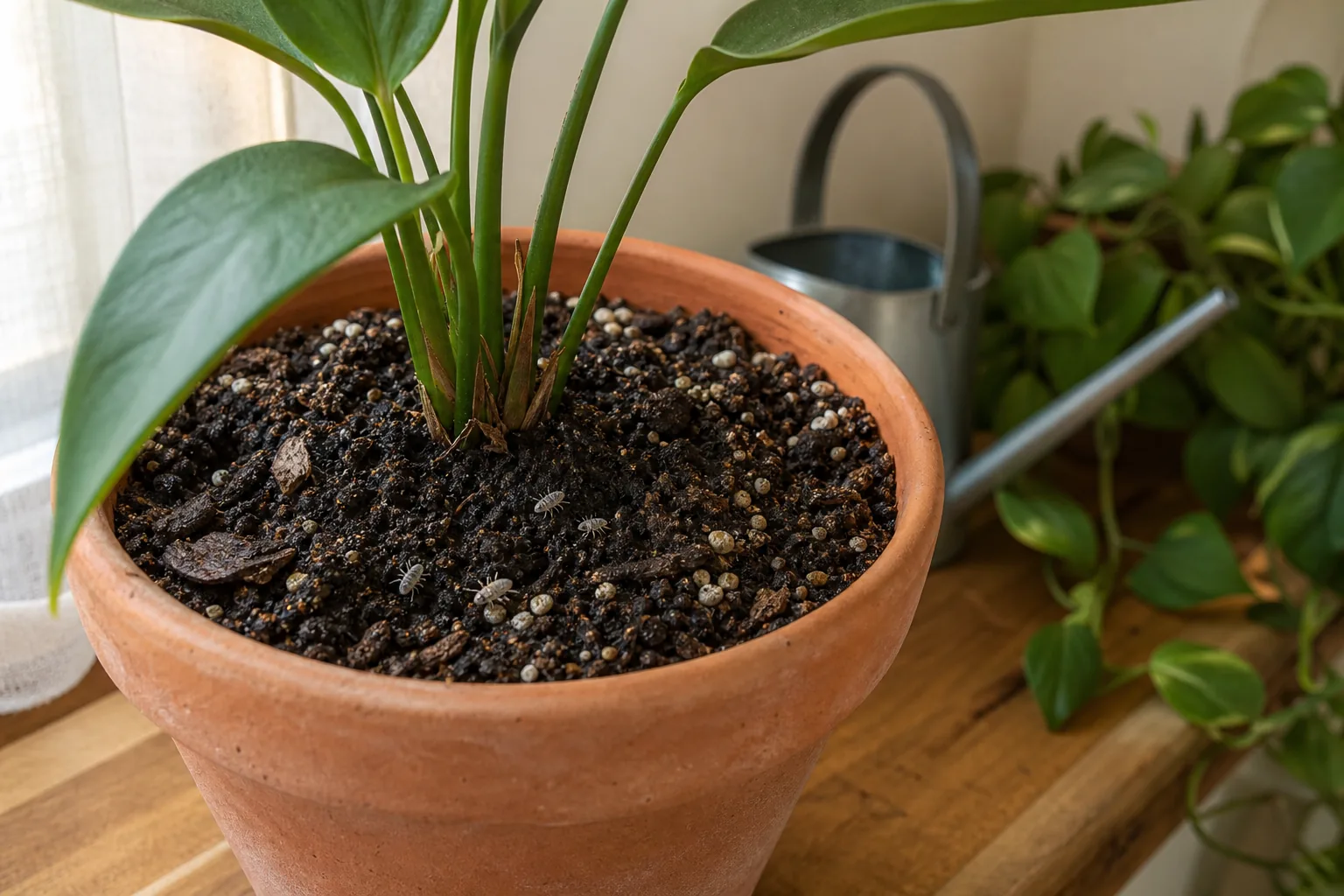
Springtails are tiny, pale or gray, rounded, and live on the soil surface; they jump when disturbed using a forked abdominal structure called a furcula, and they feed on decaying organic matter, fungi, algae, and bacteria. Fungus gnat adults are small, dark, slender, mosquito-like flies that hover low around the pot; their larvae live in the moist potting mix and feed on fungi and organic matter, sometimes chewing fine roots when populations are high. Springtails are not documented as plant pests in university extension sources and usually do not need treatment. Fungus gnats are mostly a nuisance, with larvae occasionally stressing vulnerable young plants, so the standard first response is moisture management and observation rather than an automatic pesticide.
Why springtails and fungus gnats get confused
Both springtails and fungus gnats are common around indoor potted plants. Both are tiny. Both prefer damp potting mix, so they tend to show up in the same rooms and the same pots. And both are small enough that at a glance you might just call them “those little bugs near my plant.”
The reason it matters that you tell them apart is that the appropriate response is different. Springtails are detritivores. They eat decaying organic matter rather than living plant tissue, and the right response is almost always to do nothing. Fungus gnat larvae live in the same moist mix and feed on many of the same things, but they will also chew on roots, especially when their numbers are high. Telling the two apart is therefore the first step before changing anything in the room.
Quick comparison: springtails versus fungus gnats at a glance
- Size. Both are very small. Springtails are usually the smaller of the two. Fungus gnat adults are slightly larger and leggier, especially once you include the wings and long legs.
- Color and shape. Springtails are pale, gray, or bluish with a rounded body. Fungus gnat adults are dark brown to black, slender, and mosquito-like.
- Where you see them. Springtails on or just above the soil surface. Fungus gnats hovering low around the pot and running across the soil.
- Movement. Springtails jump when disturbed, using their furcula. Fungus gnats fly weakly and run, and they do not jump in the springtail way.
- What they eat. Springtails feed on algae, fungi, decaying organic matter, and bacteria. Fungus gnat larvae feed on fungi and organic matter and may chew roots when populations are high. Adults do not feed on the plant.
- Threat to the plant. Springtails effectively none in the supplied extension sources. Fungus gnat larvae conditional, mostly nuisance for mature plants.
If you only remember one thing from this list, make it movement. Springtails jump. Fungus gnats fly.
What springtails actually are
Springtails are a large group of small arthropods called Collembola. In a houseplant pot, the ones you notice on the soil surface are typically pale or gray and rounded, and they are most active in damp conditions. Iowa State University Extension notes that springtails are abundant only in damp, moist, or very humid locations. They feed on algae, fungi, and decaying vegetable matter, and BioKIDS, a University of Michigan program, describes them as having biting mouthparts that are mostly retracted into the head, which fits their role as organisms that chew solid organic debris rather than pierce plant tissue.
The most distinctive thing about them is how they move. Cornell Cooperative Extension of Nassau County describes a forked appendage on the underside of the abdomen that can be snapped to launch the animal into the air. That is the furcula, and it is the source of the “spring” in springtail. When you tap a pot or stir the surface, the soil comes alive with little jumps. They do not fly.
Springtails are not documented as plant pests in university extension sources. Virginia Tech notes that the group shows a wide range of body shapes and coloration, with immatures that look like smaller versions of adults, so the “pale, rounded, jumping” picture is a typical description rather than a rule for every individual you might find. In a houseplant pot, springtails on the surface are a sign that the soil stays moist, not a sign that something is being eaten.
What fungus gnats actually are
Fungus gnats are small flies in the family Sciaridae. The adults are dark brown to black, delicate, and have a mosquito-like silhouette. They are weak fliers that tend to hover just above the potting mix, run across the surface, and rise in a small cloud when the plant is moved. They do not jump like springtails. According to UC IPM, the adults do not feed on foliage and are mostly a nuisance. They do not bite people.
The larvae are the stage that lives in the soil. They are small, pale, worm-like maggots that feed on the fungi and organic matter in moist potting mix. UC IPM notes that larvae primarily feed on fungi and organic matter in soil but also chew roots. Wisconsin Horticulture adds that larvae typically feed on decaying organic matter and fungi, and that if larval numbers are high they may damage roots. For most established indoor houseplants the impact is limited. The practical concern is seedlings, freshly propagated cuttings, and any plant already struggling in the same conditions.
Adults and larvae together make fungus gnats more than a harmless curiosity, though rarely an emergency for a mature, healthy plant. They are worth paying attention to, especially when the same moisture conditions that suit them are also a sign that the potting mix is staying wetter than the plant needs.
How to tell them apart by sight and behavior
When the bugs are small and quick, identification works best as a sequence of observations rather than a single glance.
- Location. Springtails live on the soil surface and on the surface film of water. Fungus gnats are usually seen in the air just above the pot, on the rim, or on nearby surfaces.
- Color and shape. Springtails are typically pale, gray, or bluish and look like little rounded specks. Fungus gnat adults are dark, slender, and clearly fly-shaped, with visible legs and wings.
- Movement. The clincher. Springtails jump, in a sudden, scatter-and-leap motion when the pot is moved or tapped. Fungus gnat adults fly in short, hovering bursts and run on the soil. They do not use the springtail jump.
- Reaction to disturbance. Both are easier to notice right after watering. If you disturb the soil and the bugs rise into the air in a small cloud and resettle on the leaves or pot rim, you are looking at fungus gnats. If they scatter in jumps across the surface, you are looking at springtails.
- Time of day. Both can be more visible in dim light or after watering. This is not, on its own, a reliable way to tell them apart.
If you can do one test, do this. Hold the pot at eye level and tap the side. Jumping specks are springtails. Small dark flies that rise and resettle are fungus gnats.
Is either one actually hurting the plant?
Springtails, no. They eat decaying organic matter, fungi, algae, and bacteria, and they are not documented as chewing houseplant leaves, stems, or roots in university extension sources. If your plant is wilting, yellowing, or losing leaves, the springtails are unlikely to be the cause, and chasing them with a treatment will not fix the underlying problem.
Fungus gnat larvae, conditionally yes. The adults are a nuisance, and the larvae are the feeding stage. In a mature, otherwise-healthy houseplant, the most common outcome is just having dark flies hovering around the plant. In seedlings, freshly propagated cuttings, or plants already sitting in heavy, slow-draining mix, the larvae can contribute to root stress when populations are high. The right framing is that fungus gnats are usually a moisture and observation problem rather than a crisis.
A useful habit is to look at the plant itself instead of only at the bugs. Persistent wilting, mushy stems, or a sour smell at the soil surface points to a moisture problem in the mix, not to springtails and not necessarily to fungus gnat larvae. If those symptoms appear without either organism being present, the cause is somewhere else. Reading more about telling overwatering from underwatering can help you read what the plant is saying about the moisture in the pot, which is the shared lever for both organisms.
What to do once you know which one you have
If you have springtails:
- Usually no treatment. Springtails are harmless detritivores, and a population on the surface is a normal part of moist potting mix.
- Let the top of the mix dry more between waterings if the population is large enough to be conspicuous. The bugs themselves do not need to be eliminated; their numbers respond to surface moisture. The same approach that supports a healthy watering rhythm for the plant itself applies here, which is what our guide to watering without a calendar walks through in more detail.
- Do not reach for pesticides, soil drenches, or home remedies. None of these are warranted for springtails in an indoor pot.
If you have fungus gnats:
- Shift to a watering rhythm that lets the top of the mix dry between waterings. UC IPM and Wisconsin Horticulture both point at overwatering and moist mix as the conditions that let larvae thrive. The mix itself matters too, since a heavier or more organic blend holds water longer; choosing a houseplant potting mix that drains freely is one of the longer-term levers for keeping the surface from staying wet.
- Confirm the larvae before escalating. Oklahoma State University Extension describes the potato slice method: lay a thin slice of raw potato on the soil surface and check after a day or two for larvae on the underside. That gives you an actual answer about whether larvae are present, separate from the adults you see flying.
- Briefly isolate the affected pot so flies are not spreading to the rest of your collection while you change the conditions. The general approach is the same one we use in inspecting and isolating a new houseplant: pause, look, and watch before reaching for anything stronger.
- If the plant looks healthy and root growth is normal, do not escalate. Most established indoor plants recover from a fungus gnat population once the surface dries out and the larvae’s food source tightens.
- For an indoor-focused plan that goes beyond this comparison, the calm, indoor-safe plan for fungus gnats walks through the same moisture-first approach in more depth.
If you are not sure which one you have, default to the steps that make sense for both. Let the surface dry more between waterings, look at the plant itself for separate symptoms, and give it a week before doing anything more aggressive. If you are also noticing a film or crust on the soil surface alongside the bugs, our piece on what white crust on houseplant soil can mean covers that adjacent observation, which often shows up in the same overwatered pots.
When to ask a local expert
A few situations are worth handing off to a local nursery, a master gardener program, or your regional extension office rather than working it out from the room.
- You have applied a dry-down rhythm for two or three weeks and the fungus gnat activity is not declining.
- Multiple plants are showing wilting or root problems, and you are not sure whether the bugs, the watering, or something else is the cause.
- You want confirmation of the identification before treating anything, especially if what you are seeing does not match either organism described here.
- You are considering any pesticide, soil drench, or horticultural product. Local extension staff can talk through which options are appropriate for your setting and how to use them safely, in line with the product label.
Houseplant Supplies is a calm, educational resource, not a diagnostic service. For an active pest problem, a local expert can usually look at a sample and tailor advice to your specific room, mix, and routine.
Sources
- UC IPM — Fungus gnats
- Iowa State University Extension — Springtail
- Wisconsin Horticulture Extension — Fungus gnats on houseplants
- Oklahoma State University Extension — Get control of fungus gnats on houseplants
- Cornell Cooperative Extension of Nassau County — Springtails and fungus gnat maggots
- Virginia Tech VCE Publications — Springtails (Collembola)
- BioKIDS, University of Michigan — Collembola, springtails