Plant care
How to read a pesticide label before using it on a houseplant
· Updated
Why the label comes before the product
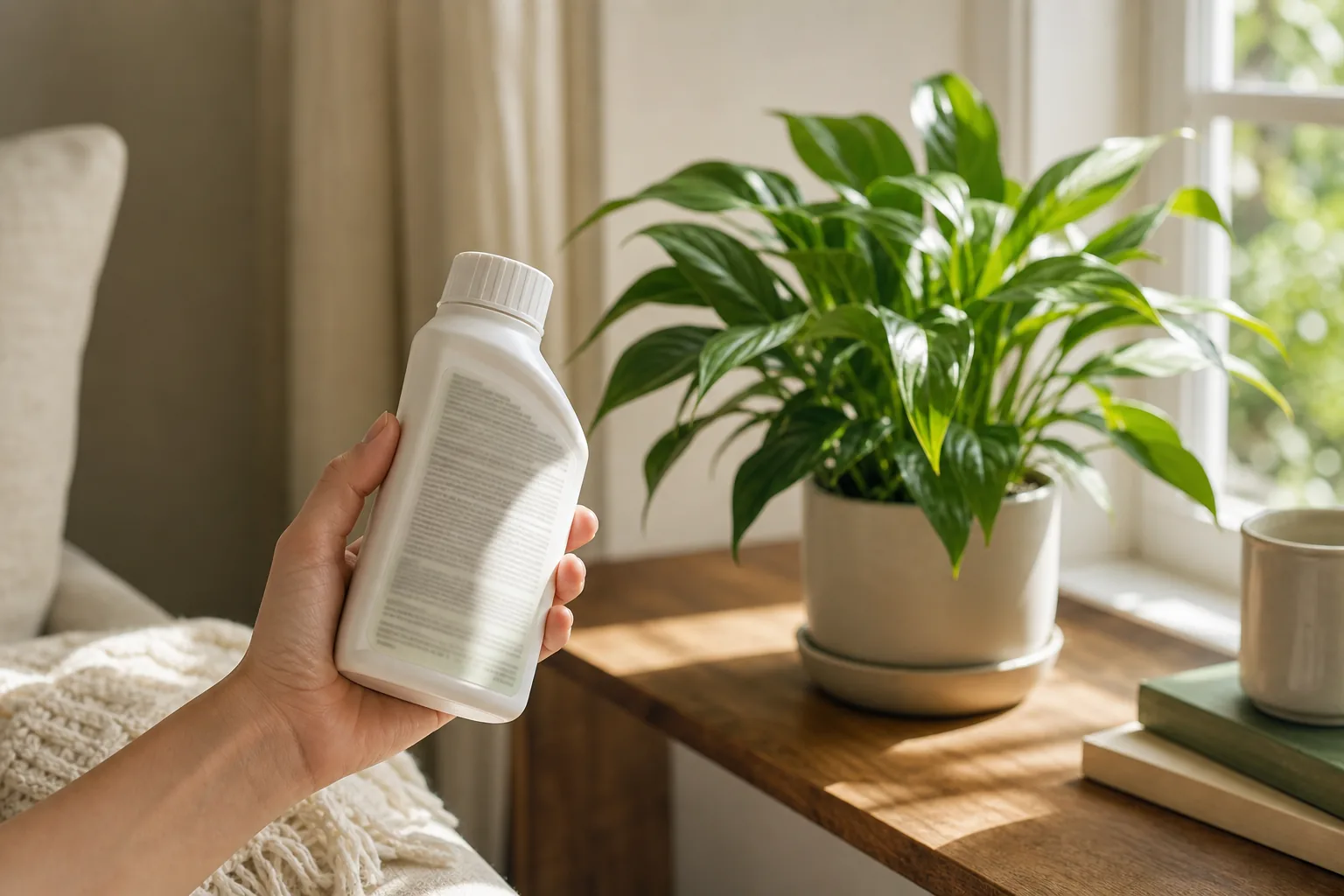
If you have reached for a pesticide product, or already have one on the counter, the bottle’s label is the first thing that deserves your attention, not the last. A pesticide label is a legal document, not marketing copy. The standard statement on the front or back panel reads: “It is a violation of Federal law to use this product in a manner inconsistent with its labeling.” Penn State Extension, Michigan State University Extension, and the National Pesticide Information Center all describe the label as a legal document providing directions on how to mix, apply, store, and dispose of a product, and naming the hazards it carries.
In practical terms this means the directions, sites, plants, pests, application rate, personal protective equipment (PPE), and reentry interval (REI) printed on the label are not suggestions. They are the legal conditions under which the product may be used. If your situation does not match those conditions, the right answer is to set the product aside, not to adapt it.
This is also the right place to mention: if you have not yet positively identified the pest you are dealing with, label-reading alone will not save you. Confirm the pest first, then read the label. The mealybug identification guide, spider mite identification guide, and scale insect identification guide walk through that step. Many pest problems arrive on new plants in the first place, so the new-plant inspection and isolation guide is worth a read before you ever need a product at all.
What to check on the front panel
Before reading anything else, find four things on the front of the bottle or box:
- Brand and product name. It is easy to miss the formulation type (concentrate, ready-to-use, granular, wipe) behind the marketing name. The label text often states this in small type.
- Active ingredient and percentage. This tells you what is actually doing the work. This article is not going to compare actives, because only the label in your hand can answer whether the product fits your plant, room, and household.
- EPA registration number. Usually formatted as two number groups separated by a hyphen, for example 62719-305. The first number identifies the registrant company and the second the specific product. Its presence means the EPA has reviewed the product and approved the label for sale. Michigan State University Extension and Penn State Extension both point to this number as the clearest “is this a real, registered pesticide?” signal.
- EPA establishment number. A separate identifier on the label, indicating the facility where the product was produced. Less central than the EPA registration number, but worth knowing what it is.
If a product has no EPA registration number at all, it is not a registered pesticide. That includes most homemade mixtures (dish soap sprays, hydrogen peroxide dilutions, essential oil blends, isopropyl alcohol sprays at unlabeled concentrations), which is one of the reasons extension services treat them differently from labeled products. The job here is to teach you to evaluate whatever is in front of you, and “no EPA registration number” is itself a meaningful answer.
Signal words and what they actually mean
The signal word on the front panel, one of CAUTION, WARNING, DANGER, or DANGER-POISON, is set by the EPA and reflects the most severe acute toxicity category the product carries across oral, dermal, inhalation, and eye or skin routes.
- CAUTION marks the lowest-toxicity band in the system, Toxicity Category III.
- WARNING indicates Toxicity Category II, moderate acute toxicity.
- DANGER indicates Toxicity Category I, the highest acute toxicity category without the poison designation.
- DANGER-POISON carries the skull-and-crossbones symbol and applies to products that are highly toxic orally, dermally, or by inhalation at the highest category. Together these four categories describe the EPA signal word system. Toxicity Category IV products do not require a signal word on the label.
A few things signal words do not do. They do not tell you whether a product is labeled for indoor use. They do not tell you whether it is labeled for your specific plant. They do not, on their own, tell you how effective the product will be against your pest. A CAUTION label is not an automatic green light for indoor houseplant use, and a WARNING label does not automatically disqualify a product. Use the signal word to understand the toxicity category you are handling, then keep reading.
Sites of use: indoor, outdoor, greenhouse, and houseplants
The “sites of use” or “where to use” section is where most label mistakes happen. Labels distinguish between several categories that look similar but are not interchangeable: outdoor ornamental, greenhouse, and indoor ornamental or houseplant. Each is a separate authorization.
UC Statewide IPM puts the rule plainly: “Never use pesticides labeled for outdoor use only indoors.” If your product’s sites of use only list outdoor ornamental or outdoor use, the label has not authorized you to use it on a plant sitting in your living room. That is a stop signal, not a creative-use invitation.
Greenhouse is a separate authorization too. Greenhouse use is not the same as residential indoor use, and a greenhouse-only label has not been written for the air your household shares with the plant. Match the wording on the label to your situation. If the wording does not match, the label has answered your question.
Only labels that explicitly list indoor use, houseplants, indoor ornamental, or equivalent wording authorize a residential indoor application. Read the sites-of-use section before any other section, because every later check depends on it.
Plants and pests listed on the label
Once a product has cleared the sites-of-use check, look for two more lists: the plants on which the product is approved, and the pests it is approved to control.
UF/IFAS Gardening Solutions directs consumers to read the label to find out which plants a product can be applied on and which plants are sensitive to it. This is the step most often skipped. If your plant, or its genus or family, is not on the list, the label has not authorized that use. The right response is to look for a product whose plant list includes your situation, or to ask your local extension office, not to assume the product will behave the same way on a plant the manufacturer did not test for.
The pest list works the same way. A product labeled for soft-bodied insects may not be labeled for fungus gnats, scale, or mites, even though it is sold as a “houseplant” product. A product aimed at one chewing insect may not be labeled for the sap-sucker you actually found. Match the pest on the label to what you identified. If you suspect fungus gnats rather than a foliar pest, the fungus gnat prevention guide covers the prevention-first routine that often makes a product unnecessary. If you have not yet identified the pest, return to identification first; the sticky leaves and honeydew inspection guide can help you decide which sap-sucking insect you might be seeing.
Application rate and how to read it
The application rate tells you how much product to use, in what volume of water, on what area or per plant. Concentrates are typically expressed as a dilution (so many teaspoons or ounces per gallon), while ready-to-use products have no mixing step. Some labels express rates per square foot, per plant, or per acre, and translating an agricultural rate down to a single six-inch houseplant can feel awkward.
The honest framing is this: the labeled rate is the legal rate. More is not safer, and adjusting the rate upward is a violation of federal law. If the label’s math does not fit a single small plant, that is a reason to call the manufacturer’s customer service line (printed on the label) or your local extension office, not a reason to estimate. Many extension services recommend reading the label before each use, not just the first time, because handling and storage affect what is in the bottle.
PPE, ventilation, and reentry intervals
Three sections that apply indoors as much as outdoors, even though they are easy to overlook in a residential setting:
- Personal protective equipment. The label will list what to wear: usually gloves, often long sleeves, sometimes eye protection or a respirator for concentrate products. The label specifies what protective equipment to use before mixing.
- Ventilation. Some labels include specific indoor ventilation guidance. Open a window, run a fan, move the plant to a ventilated space, whatever the label says.
- Reentry interval (REI). The REI is the minimum time that must pass after application before people (and, by extension, pets) can safely re-enter the treated area. The REI is printed on the label and applies indoors, where treated plants share airspace with the household. Treat the REI as a real number, not a suggestion. If you live with pets or children, the REI is the most important number on the label for keeping them away from the treated plant at the right time. The pet-aware houseplant choices guide discusses how to weigh that information when you are deciding whether to reach for a chemical treatment at all.
Plant safety and phytotoxicity language
Many labels include a phytotoxicity section: warnings about sensitive species, instructions to test on a small area or a single leaf before treating the whole plant, and any plant-specific cautions. The presence of this language varies by product, but the underlying point is consistent. Some plants are more sensitive to certain products than others, and the label’s plant list and any sensitivity cautions are where that information lives for the specific product you are holding.
If you are unsure whether your plant is on the sensitive list, treat the test-on-a-small-area instruction as a habit when the label includes it. It costs you one leaf and tells you whether the product is safe on your specific plant.
Comparing two products label to label
Put two bottles next to each other and walk through the same checklist on each one: signal word, sites of use, plant list, pest list, application rate, PPE, REI. The product with the more clearly matching sites-of-use and plant/pest lists, the lower signal word, and the simpler PPE is generally the more conservative indoor choice, but the comparison should be label-driven, not marketing-driven. Front-panel marketing language like “gentle” or “plant-friendly” is one category. Signal words and sites-of-use are EPA-required label elements, and the comparison should happen on those sections.
When to put the product down
Reasons to stop, even before the rate and PPE sections:
- The label lists only outdoor ornamental or outdoor use.
- The label’s plant list does not include your plant or a category that includes it.
- The label’s pest list does not include the pest you identified.
- The label is damaged, faded, missing, or in a language you cannot read.
- The product is older than you can verify, was stored in extreme heat or cold, or has separated visibly.
- You are unsure how to protect a pet, a child, a pregnant household member, or a person with a health condition during and after application.
- You feel pressured to use the product quickly and have not had time to read it.
In any of these cases, the safe move is not to use the product and not to adapt the directions. Set it aside and ask a more reliable source.
Where to confirm before you treat
When the label leaves you uncertain, three sources are designed to help:
- The manufacturer’s customer service line. Printed on the label. They can clarify indoor use, plant lists, and rate questions specific to their product.
- Your state or county extension office. University extensions publish homeowner-facing guidance and can answer questions for your region. Houseplant Supplies is not a substitute for this.
- The National Pesticide Information Center (NPIC). A government-affiliated service that answers pesticide questions, including exposure and first-aid concerns.
For ongoing indoor pest problems that a household product is not solving, a licensed pest professional with residential indoor experience is the right next step. For exposure to people or pets, the label’s first-aid section, Poison Control (1-800-222-1222 in the U.S.), and your veterinarian are the appropriate contacts, not this article.
A short label-reading checklist
Before opening or mixing any product indoors, work through this list:
- Is there an EPA registration number on the front panel? If not, this is not a registered pesticide.
- What is the signal word, CAUTION, WARNING, DANGER, or DANGER-POISON?
- Does the sites-of-use section include indoor, houseplant, or indoor ornamental?
- Is your plant on the label’s plant list?
- Is your identified pest on the label’s pest list?
- What is the labeled application rate, and does it fit your situation?
- What PPE does the label require?
- Is there an REI, and can you keep people and pets out of the treated area for that long?
- Are there any phytotoxicity or sensitive-species cautions for your plant?
- Is the label readable, current, and in a language you understand?
If any answer is no or unclear, the answer to “should I use this indoors?” is no, not yet. That is the entire point of label literacy: the label is what tells you, in advance and in writing, whether the product fits your room, your plant, and your household.
Sources
- Penn State Extension — What You Need to Know about Reading a Pesticide Label
- UC Statewide IPM — Understanding Pesticides
- National Pesticide Information Center — Reading Pesticide Labels
- Michigan State University Extension — Why and how to read a pesticide label
- UF/IFAS Gardening Solutions — Integrated Pest Management