Plant care
Propagation station vs jar: does the vessel actually matter?
· Updated
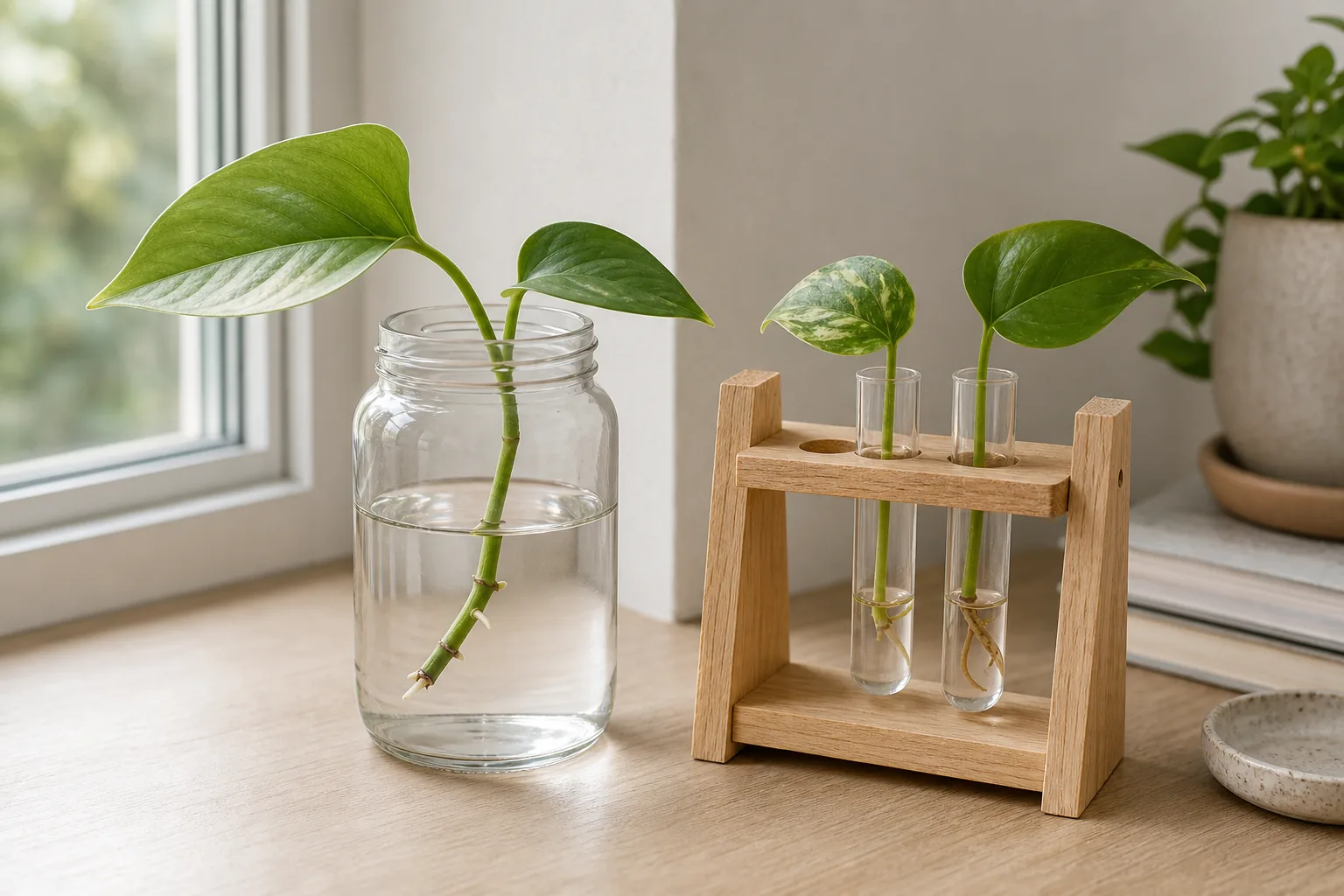
If you’re staring at a cutting in your hand and wondering whether to drop it in a jam jar or order a glass-and-wood propagation station, the honest answer is that the cutting does not care. Both vessels do the same job: hold the stem upright and keep a node submerged in water so roots can form. The differences live on your side of the glass — display, scale, ergonomics, and how easy the routine feels to keep up. Root development is shaped much more by water-change cadence, the light at the spot, and the health of the cutting than by the vessel you choose.
That doesn’t make the question trivial. A propagation station can quietly make a multi-cutting routine easier, and an ordinary jar can quietly make a single cutting invisible. Here’s how to think it through.
What a propagation station actually is
A propagation station is a category of products, not a single thing. At its simplest, it’s a stand (wood, metal, sometimes wall-mounted) with one or more openings that hold small glass tubes, vials, or beakers. Some are single-vessel desktop stands; some are long shelves with a dozen holes; some hang on the wall. The plant-facing parts are still just glass and water.
What the category is honestly optimized for is display and organization. Manufacturer and retailer descriptions lean heavily on home décor language. The plant-care claims that creep into listings — faster rooting, healthier roots, happier cuttings — aren’t supported by extension research and should be taken as marketing, not horticulture.
What an ordinary jar already does
An ordinary jar is any clean glass container with a narrow enough neck, a strip of tape across the top, or a slot cut into the lid that holds a stem upright. The internet is full of recycled examples: olive oil bottles, salsa jars, baby food jars, jam jars, and old drinking glasses. Even a tall glass with a piece of cling film stretched across the top, with a small slit for the stem, counts.
Glass is the material home propagators consistently reach for because it’s transparent (you can watch the roots) and easy to clean and sterilize between uses. That’s true whether the glass came in a flat-pack from a station maker or out of your recycling bin.
What actually changes for the cutting
Very little, and that’s the most useful thing to know up front. For a healthy cutting, the variables that matter are:
- The node (the small bump on the stem where leaves and roots emerge) is submerged and any leaves are kept above the waterline.
- The water is refreshed on a rhythm rather than left to stagnate. University of Illinois Extension suggests fresh water every 3 to 5 days as a reference, and Master Gardeners of Northern Virginia reinforces that stagnant water is unfavorable for rooting.
- The spot stays in a comfortable temperature range. Purdue’s extension publication recommends 65°F to 75°F and warns against excessive heat during rooting.
- The light is bright but indirect, since direct sun can heat a small volume of water surprisingly fast.
None of those variables are controlled by the vessel category. Both stations and jars can be cleaned, refilled, and moved. Both can sit in the right light or the wrong light. Both can overheat on a sunny sill or stay temperate on a shelf across the room.
A common community claim is that opaque or colored glass produces faster, beefier roots than clear glass. It’s a recurring observation in forums and on social media, but older horticultural literature reviewed by extension-affiliated academic writers didn’t find a meaningful effect from glass color on root production. The more defensible position is that vessel color doesn’t have a documented biological effect on rooting.
Algae on the inside of light-exposed clear glass is also a common observation. It’s not the same thing as the cutting failing. Most home guides describe algae as cosmetic in this context, and the fix is usually cleaning the glass and moving it out of direct sun rather than changing the vessel.
What changes for your routine
This is where the comparison gets honest. A propagation station and an ordinary jar feel different in the hand and on the counter.
- Refilling and changing water. Wide-mouth jars are easy to lift a cutting out of, pour, rinse, and refill. Narrow tubes are awkward: you tip them, you spill, you disturb the cutting. If you know you won’t change the water on a rhythm you can keep up, ergonomics matter.
- Cleaning. Jars with a normal opening go in the dishwasher or get scrubbed with a bottle brush. Long, narrow tubes are harder to reach into. When a cutting fails and the glass gets slimy, the time difference is real.
- Placement. A station gives you a designated spot — a wall, a desk, a shelf — where everything lives together. A jar goes wherever you can fit it: a windowsill, the corner of the kitchen, the bathroom counter.
- Failure handling. If one of eight cuttings in a station rots, you clean one tube and move on. If a jar holds three cuttings and one fails, you may end up cleaning and resetting the whole jar.
- Display. This is the station’s actual job. A wood-and-glass stand on a shelf looks intentional; a row of mismatched jars on the same shelf looks lived-in. Neither is wrong.
Where a propagation station earns its place
A propagation station is genuinely useful when:
- You have several cuttings at once and want them visible in one organized location rather than scattered across rooms.
- You have very small or thin stems that benefit from narrow tubes to stay upright.
- You want a piece of furniture or wall art that doubles as a propagation setup.
- You find that having a dedicated, fixed spot makes you more likely to actually change the water.
In other words, it earns its place on the reader’s side of the glass — in display, scale, and habit-building — not in the plant’s biology.
Where an ordinary jar is enough
An ordinary jar is genuinely enough when:
- You have one or two cuttings, or a small rotating set.
- You already own a collection of glass jars and don’t want another piece of furniture.
- You’re rooting a cutting temporarily before moving it into a pot.
- You want flexibility to move a single cutting without disturbing a whole display.
- The visual clutter of a dedicated station doesn’t suit your space.
You will not be doing it “wrong” by rooting a cutting in a recycled olive oil bottle. The plant will not know.
How to choose based on what you’ll actually do
A short decision check helps more than a long one:
- How many cuttings at once? One to three: jars. Many, or an ongoing stream: a station earns its keep.
- Where would they live? A wall, a desk, a shelf with intention: a station fits. Wherever there’s room: jars fit.
- How reliably will you change the water on a rhythm? If the answer is “honestly, when I see it,” choose the option that makes water changes easiest, which usually means a wide-mouth jar.
- Is the goal display or rooting? A station is for display-with-rooting. A jar is for rooting-without-ceremony.
A calm setup that works with either option
Whichever vessel you pick, the routine is the same.
- Clean the glass before the cutting goes in. A rinse with hot water and a bottle brush is usually enough; a soak in diluted bleach works for stubborn residue.
- Submerge the node, not the leaves. The part of the stem that will become roots needs to be underwater. Anything that can rot should be above the waterline.
- Place it in bright, indirect light. A spot near a window that doesn’t get direct midday sun is usually right. Reading the natural light in your room before placing a vessel avoids the trial-and-error of a wrong spot.
- Refresh the water on a rhythm. The 3-to-5-day figure from University of Illinois Extension is a useful reference, but the better rule is to change the water before it looks tired. It’s the same observation-first approach you’d use to water a houseplant without a schedule — watch, don’t time.
- Watch the spot for heat. A propagation vessel on a bright sill can warm up faster than you’d think, especially in a small volume of clear glass. The placement risks of drafts, vents, and sun-heated glass are worth understanding before you commit a station or a jar to a window.
- Move the cutting on when roots are an inch or two long. Water propagation is a stage, not a destination; the rooted cutting is usually headed for a pot. When that day comes for a cutting from a pothos, a heartleaf philodendron, or a Monstera, the relevant care guides walk through what the rooted plant needs next.
The vessel is one decision among many, and not the most important one. The water, the light, the temperature, and the cutting itself do the work. A propagation station and a clean glass jar are simply two ways to support that work — one with more ceremony, one with more flexibility, and both with the same quiet expectation: roots will form, and you’ll pot them up when the time is right.
Sources
- University of Illinois Extension — From one to many: a beginner’s guide to plant propagation: https://extension.illinois.edu/news-releases/one-many-beginners-guide-plant-propagation
- Purdue University Extension — New Plants From Cuttings (HO-37-W): https://www.purdue.edu/hla/sites/yardandgarden/extpub/new-plants-from-cuttings-text-only/
- Master Gardeners of Northern Virginia — Rules of Propagation: https://mgnv.org/houseplants/rules-of-propagation/
- Garden Professors (extension-affiliated academic blog) — Does colored glass help root cuttings?: https://gardenprofessors.com/does-colored-glass-help-root-cuttings/
- Brooklyn Botanic Garden — How to Propagate Houseplants: https://www.bbg.org/article/how_to_propagate_houseplants