Plant care
Prayer plant leaves curling: how to read what the plant is telling you
· Updated
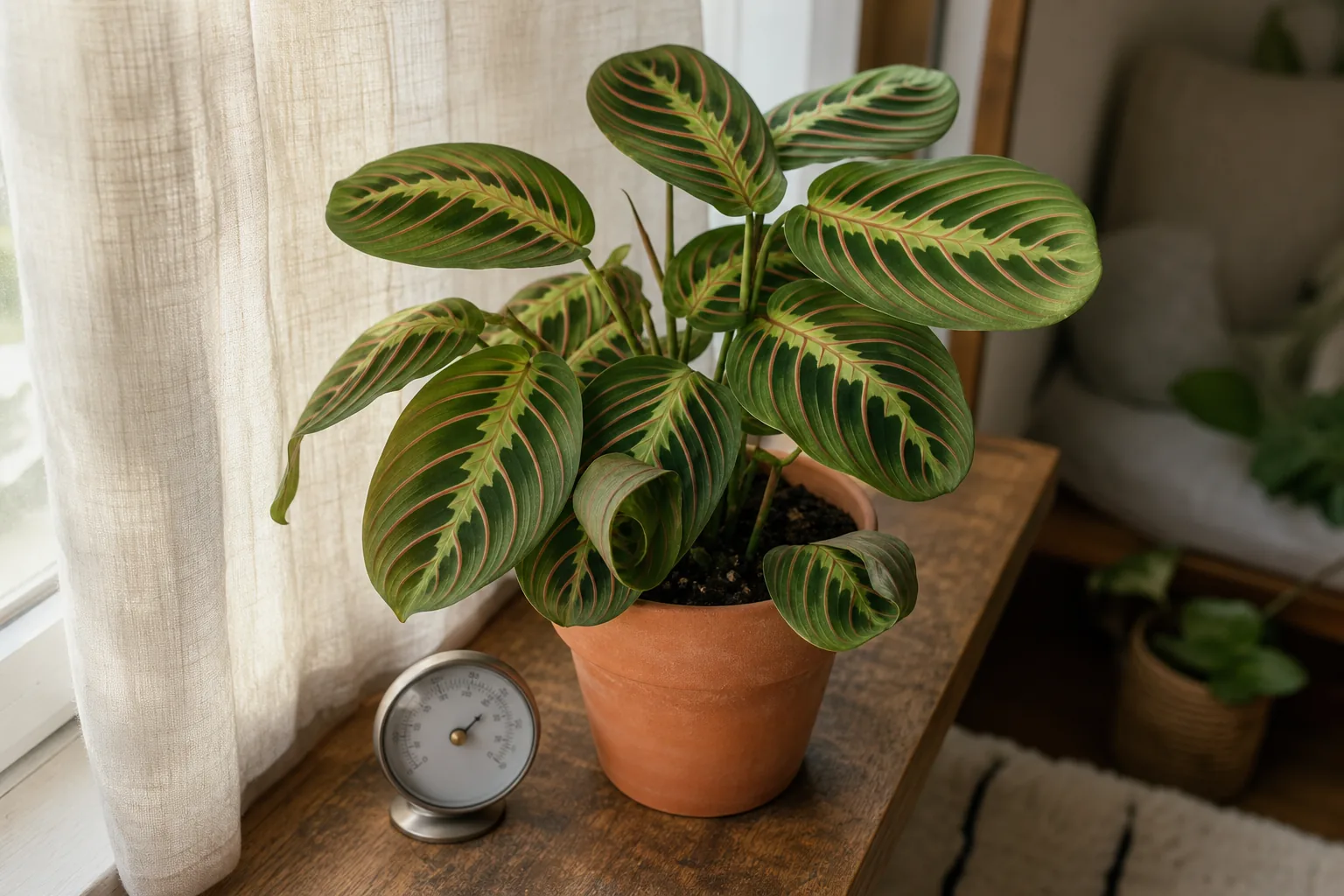
If your prayer plant’s leaves are curling, the first thing to look at is timing. Prayer plants fold their leaves upward at night as part of a normal daily movement called nyctinasty and open them again during the day. If the leaves unfold by morning and look healthy, what you are seeing is the plant doing what it does, not a problem to fix. Persistent daytime curling, new curling that affects only some leaves, or curling that comes with browning or fading is a stress signal worth working through.
Prayer plant is a common name that gets used for several plants in the Marantaceae family, most often Maranta leuconeura and various Calathea species, many of which are now classified as Goeppertia. The nyctinastic movement is most visible on Maranta. Calathea and Goeppertia species share the same humidity- and shade-loving care profile but tend to show less dramatic nightly movement. For reading curling as a symptom, the troubleshooting below applies to both.
The right first move is observation, not action. Curling is a non-specific signal. Low humidity, dry soil, harsh direct light, cold drafts, and water-quality sensitivity all show up as curling. The trick is to time the curling, note which leaves are affected, and check each of those conditions against what the plant is actually experiencing, one at a time, before changing anything.
Normal nightly folding vs persistent daytime curling
The cleanest test of whether curling is a problem is whether it reverses on the plant’s own schedule. Foliar nyctinasty is a reversible, daily oscillation in leaf orientation. Blades are typically more horizontal during the day and folded upward at night, then open again the next morning, and that is the basis of the praying hands nickname. Maranta leuconeura shows it most clearly.
Stress curling tends to look different. It persists into the day, often affects only one side of the plant or only certain leaves, frequently appears alongside brown or crispy edges, faded leaf color, or limpness, and does not reverse on its own without a change in conditions.
A few related things are not the same as stress curling:
- A new leaf can emerge tightly curled and gradually flatten as it matures. That is normal, and the timeline varies by species, light, and humidity.
- A Maranta on a particularly dry day can hold its leaves at a tighter angle than usual overnight, then open again by morning.
- A Calathea or Goeppertia may show only subtle nightly movement. If you bought it expecting dramatic praying, what you are seeing might just be how that species folds.
If the leaves open by midday and look healthy, you can probably move on.
Read the pattern: which leaves are curling and how tightly
Before changing anything, watch the plant for two or three days and note:
- Timing. Are the curled leaves open by midday, or folded all day. Curled only at night, or curled in the late afternoon.
- Location. Only the newest leaves, only the oldest leaves, one side of the plant, or all of it.
- Tightness. A gentle inward curl with healthy color is different from a tight, almost rolled-up leaf with browning tips.
- What else you see. Brown leaf edges, yellowing, fading of the leaf pattern, soft or translucent leaves, leaf drop.
A few patterns are worth flagging specifically. Curling on only the side facing a window or a vent usually points to a microclimate at that spot, not a whole-room condition. Curling that started soon after a move, a repot, or a change in watering routine often points to the change itself. New leaves that emerge curled and never flatten over multiple growth cycles is a stronger stress signal than a single slow-to-open leaf, and the same pattern can show up alongside leaf-tip damage. A similar observation order for brown leaf tips walks through that symptom in parallel.
Check the soil: moisture rhythm and the dry-down between waterings
Dry soil is one of the most common triggers for curling in Maranta and Calathea, and it is also one of the easiest to confirm by feel. Lift the pot shortly after watering, then again a day or two later. A noticeable weight drop means the soil is drying out faster than you expected, or that the pot is small relative to the plant. Stick a finger or a wooden chopstick into the top 2 to 3 centimeters of soil. If it comes out dry and the plant is curling, the soil rhythm is a strong suspect.
The reverse problem is just as common. Maranta and Calathea are sensitive to soil that stays wet for too long, which can produce curling, yellowing, and limp leaves that look surprisingly similar to underwatering. The distinguishing test is the soil itself. If the top of the soil is still damp several days after watering and the pot feels heavy, the issue is more likely overwatering than underwatering. The two patterns can overlap, especially in cool rooms or in pots without drainage. A calmer, observation-first watering routine — checking the top of the soil by feel and lifting the pot to learn its weight through the wet-to-dry cycle — is worth working through before changing anything. For that routine in full, see how to tell when a houseplant actually needs water. For the broader care picture, the general prayer plant care guide walks through how these plants fit into an ordinary room.
Re-read the light: too much direct sun is a common trigger
Prayer plants are described in botanical sources as rainforest understory plants that naturally grow in filtered light and need protection from strong direct sun. The New York Botanical Garden’s Goeppertia research guide describes the kind of light these plants want as the soft, indirect light filtering through a rainforest canopy. The same pattern shows up across extension and botanical sources. Bright, indirect light is the goal, with harsh direct sun as a frequent cause of curling, fading, and crisping.
The simplest test is the shadow test. Stand in the plant’s spot at midday and hold your hand a foot above the nearest leaf. A sharp-edged shadow means direct sun strong enough to fade or curl Maranta and Calathea leaves. A soft, blurry shadow or no shadow means the light is filtered, which is closer to what these plants want.
Curling from too much light often shows up first on the side of the plant facing the window, sometimes with yellowing or fading of the leaf pattern on the same leaves. The reverse — a plant that has lost its color and is stretching toward the window with curling — is a different problem, too little light, and looks different. If the curling is paired with a shadow that has hard edges, the spot is the most likely cause, and the right response is to move the plant back from the window or filter the light rather than to water more. A fuller walkthrough of how to read the natural light in a real room is worth pairing with the shadow test, since morning and afternoon sun at the same window can behave very differently.
Re-read the air: drafts, vents, and cold or sun-heated glass
Cold air and sudden temperature swings show up as curling, often on one side of the plant. Houseplant care literature consistently lists cold exposure and warm, dry airflow from heating vents as triggers, and a one-sided pattern is the diagnostic clue. The side facing a cold window or sitting above a heat register curls while the protected side stays open.
A few specific microclimates are worth checking before changing anything else:
- Single-pane windows in winter. The glass can be much colder than the room air an inch away, and the leaves closest to the glass will react first.
- Heating registers or radiators. The rising warm air is usually drier than the rest of the room, and Maranta and Calathea react to that dryness as much as to the temperature itself.
- Air-conditioning vents in summer. Cold airflow across the leaves produces a similar one-sided curl.
- Doors to outside or unheated rooms. A short draft each time the door opens can produce curling without the room feeling obviously cold.
Place your hand at leaf level near each suspected source and feel for moving air. If only the leaves on the side nearest the source are curling, that points to the source rather than to a whole-room problem. Our post on drafts, vents, and cold or sun-heated glass covers the room-by-room walkthrough.
A related point: indoor air in winter is often dry enough to produce curling on its own, with brown leaf edges and crispy tips on the same leaves while the soil stays moist. That is a separate condition, and it is covered in a more grounded look at indoor humidity.
Water quality: a Calathea-family trigger that is easy to miss
A widely repeated claim in houseplant literature is that Maranta and Calathea are sensitive to chlorine, chloramine, fluoride, or mineral salts in tap water, and that this can show up as curling or brown tips. Extension and botanical-garden publications do not establish this as a confirmed cause, so it is worth treating as a possible sensitivity rather than a known one.
If you have already checked soil rhythm, light, drafts, and humidity and the curling is still showing up, switching to filtered, distilled, or aged water for a few weeks is a reasonable thing to try, as one variable at a time rather than as a fix. If the pattern changes, water source may have been part of the picture. If it does not, you have ruled out one more thing without changing anything else.
This is also a good moment to look at the leaf undersides with a flashlight and, if you have one, a magnifier. Fine webbing, tiny stippling, or sticky residue points to spider mites, which can produce curling that looks abiotic but is not. Pests are usually treatable once identified, but identification needs a closer look than curling alone can provide.
What to change first, and what to wait on
If you suspect more than one trigger, change them one at a time, with at least a week or two between changes, and watch whether the new growth is curling before you adjust the next thing. A stressed plant often drops a leaf or two before it puts out new ones, and that is not necessarily a sign that you have made things worse.
A few things are worth holding off on:
- Repotting a curling plant. A stressed Maranta or Calathea will usually react badly to a fresh repot. Address the room conditions first.
- Heavy fertilizing. A curling plant is rarely a hungry plant, and excess fertilizer salts in the soil can produce curling of their own.
- Heavy pruning of curled leaves. If the leaf is still partly green, it is still feeding the plant. Wait until you can see new growth behaving normally before removing more than damaged tips.
A useful marker of recovery is new leaves emerging and unfurling without curling. The exact timing depends on season, light, root health, and how long the stress was building, so it is better framed as observation over a couple of weeks than as a fixed number of days.
When to ask a local expert
If the curling is paired with rapid leaf drop, soft or blackened stems at the soil line, or a sour smell from the pot, the plant may be dealing with root rot, which is harder to recover from on your own. A local independent nursery, a master gardener program, or your regional cooperative extension office can look at the plant in person, see the soil and roots directly, and tell you whether the issue is environmental or something more serious. Curling alone is usually not an emergency, but it is a useful signal that the plant is asking for a closer look.