Plant care
Plant mister vs humidifier for houseplants: a side-by-side comparison
· Updated
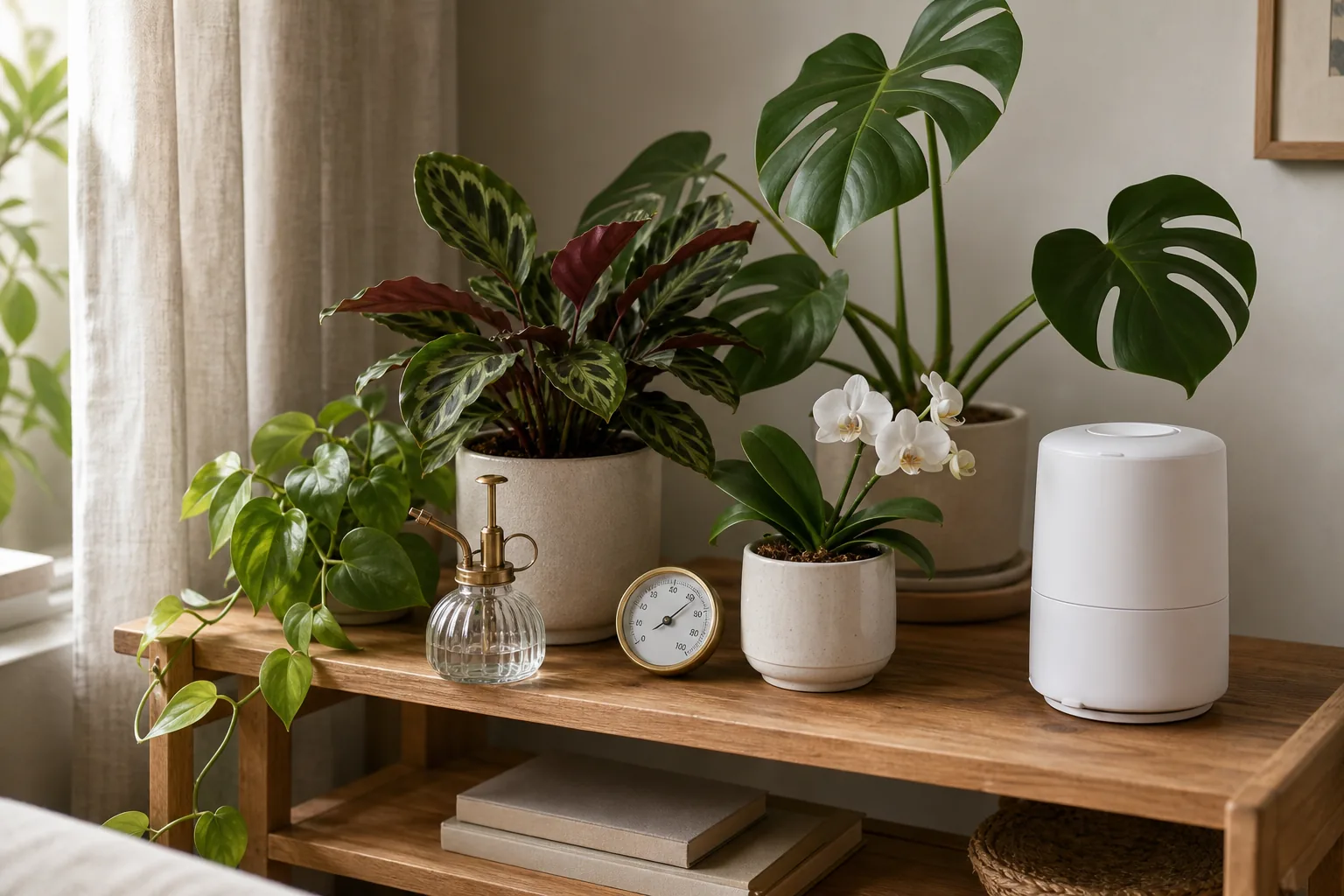
A plant mister and a room humidifier change different things in your home. A mister briefly wets the leaves and adds a short pulse of moisture to the air right around the plant; the visible droplets usually evaporate within minutes. A humidifier changes the relative humidity of the whole room over hours of runtime.
Because the two operate on different scales and at different durations, neither is a universal upgrade over the other. The honest answer to “which one should I get” depends on what is actually happening in your room, which plants you keep, and how much maintenance you want to take on.
What a plant mister actually does (and what it does not)
A pump sprayer, whether a small bottle or a pressure mister, lays water droplets on the leaf surface. Those droplets briefly cool the leaf, then evaporate. The lift in room humidity from a single pass is small and short-lived, on the order of minutes rather than hours, and the supplied extension and peer-reviewed literature does not quantify an exact figure.
What a mister does not do:
- Water the root zone. A wet leaf is not a watered plant.
- Sustain room humidity. Once the droplets evaporate, the air is back where it started.
- Substitute for water quality. If your tap water leaves mineral marks, misting with the same tap water will leave mineral marks on the leaves too. The same observation habits that explain white crust on houseplant soil apply to leaf surfaces.
What a mister can reasonably do:
- Rinse dust off broad, smooth leaves so they can keep transpiring normally.
- Offer a temporary cooling sensation on foliage in a warm, dry room.
- Serve as a daily ritual that keeps you looking closely at the plant, which often catches problems early.
What a room humidifier actually does (and what it does not)
A humidifier is an appliance that adds water vapor to the air over hours. There are three common designs.
- Ultrasonic. A vibrating diaphragm turns water into a fine, visible cool mist. Most consumer models fall here.
- Evaporative. A fan blows air through a wet wick filter. The output is invisible, and the wick needs periodic replacement.
- Warm-mist or vaporizer. Heats water to steam. The mist is warm and visible.
These distinctions matter mainly for two practical reasons. Ultrasonic units can release minerals from tap water into the air as fine white dust, and the manufacturer label for many of them specifies distilled or demineralized water to reduce that residue. Warm-mist units boil water, which leaves dissolved minerals behind in the unit rather than releasing them as a fine aerosol, so the residue profile is different from an ultrasonic model.
A humidifier does not:
- Fix watering inconsistency. Soil moisture and ambient humidity are separate variables.
- Cure brown leaf tips on its own. Brown tips usually reflect a mix of underwatering, mineral-laden tap water, low humidity, and accumulated soluble salts in the soil.
- Replace airflow. Stagnant, very humid air in a tightly closed room can encourage condensation on windows and, over time, mold on walls. Manufacturer labels and building-science guidance generally frame 30-50% relative humidity as a comfortable indoor range, with peer-reviewed indoor-air sources often citing 40-60%.
When a plant mister is the right call
A mister earns its keep when the goal is something other than sustained room humidity. Cleaning the leaves of a large monstera, philodendron, or similar broad-leaf plant once a week is a reasonable use. A layer of dust on the leaf surface can affect how the plant transpires, and a regular wipe-down is one of the cheaper ways to keep leaves working normally.
It is also the cheaper, lower-maintenance option if you only have one or two plants and you do not want to commit to running an appliance.
There are situations where misting is the wrong call:
- Fuzzy-leaved plants such as African violets and some begonias trap water between leaf hairs, which can mark or rot the foliage. This caution is repeated across most houseplant-care references.
- Plants with a history of fungal leaf spots. Splashing water on the leaves is a known route for spreading fungal spores onto indoor foliage, per the University of Maryland Extension and Kansas State Research and Extension.
- A room that reads in the 40-50% range on a hygrometer. Adding a brief pulse of moisture will not move the needle.
- Plants in persistently wet, poorly draining potting mix, where extra surface moisture feeds fungus gnat problems in houseplants.
When a humidifier is the right call
A humidifier is the right tool when the room itself is the problem. If a hygrometer reads in the 20s or low 30s for days on end, especially in winter when heating systems dry the air, a humidifier is one of the few things that actually shifts that number.
It is also more useful when you keep a cluster of plants with similar higher-humidity preferences, such as calathea and prayer plants, most ferns, or Phalaenopsis orchids. Running a humidifier for a single pothos is probably overkill; running it for a shelf of calathea in a dry apartment is closer to the intended use case.
Before committing, two practical checks:
- Read the manufacturer label for water type and cleaning schedule. Ultrasonic units in particular often specify distilled water to keep mineral dust down on nearby leaves and furniture.
- Decide where the unit will live. Putting a humidifier in a small, closed room and leaving it running can push humidity into the upper part of the range. Sustained indoor humidity above about 50% can begin to encourage dust mites and surface mold, per Farmers’ Almanac, so a humidifier left running in a tightly closed room is worth watching on a hygrometer.
Trade-offs and limits to know about each option
The two tools trade off in different ways.
A mister is cheap, takes no electricity, and can be aimed at one plant. The downsides are a short effect, the potential for fungal leaf-spot spread if overdone, and the mineral marks from hard tap water on leaves. The wet-surface effect also overlaps with the conditions that drive fungus gnat problems in houseplants, so a mister aimed at already-moist soil is asking for trouble.
A humidifier produces sustained room-level humidity and can support a whole plant shelf. The downsides are cleaning, the water-type requirement on the label, possible white dust on nearby surfaces, and the small risk of over-humidifying a poorly ventilated room.
If a reader already has a hygrometer, it is worth keeping in mind that the literature does not settle on a single humidity target for all houseplants. The peer-reviewed indoor-air sources center 40-60% for human comfort and viral viability, while EPA-aligned HVAC sources tend to favor 30-50%. Species preferences sit on top of that range.
How to decide for your specific room and plant list
A short, observation-first sequence:
- Read the room. Put a basic hygrometer where your plants live for a few days. Note the typical morning and evening readings, especially in winter.
- Look at the plant list. A pothos, snake plant, ZZ plant, philodendron, or succulent tolerates average indoor air and rarely needs either tool. A shelf of calathea, ferns, and orchids in a 25% apartment is a different situation.
- Match the tool to the gap. If the room reads low and the plant list is humidity-leaning, a humidifier is more aligned with the gap. If the room is fine and you want cleaner leaves, a mister is.
- Set a check-in. Look at the leaves again in two to four weeks. New spotting, persistent brown tips, or a fuzzy white film on the soil or pot rim all suggest the tool is not helping, or that the maintenance is being skipped.
Setup details that change how well each tool works
A few details that often get skipped:
- Water type matters more than brand. For ultrasonic humidifiers, the manufacturer label usually names the right water for that model. For misters, the same tap water that leaves white crust on houseplant soil will leave marks on leaves.
- Air circulation is part of the picture. A small fan moving air across the foliage reduces leaf-wetness duration after a misting pass, which the University of Maryland Extension and Kansas State Research and Extension tie to lower fungal leaf-spot risk.
- Placement of a humidifier affects what it actually humidifies. A unit in the corner of a large open room will not raise humidity much around a plant shelf on the opposite wall.
- A warmer, brighter room dries foliage faster regardless of tool choice, which is one more reason to start with reading the natural light in your room before reaching for either device.
When neither is the right answer
For many readers in average indoor air, neither tool is the bottleneck. Brown leaf tips are often more about tap-water mineral content, inconsistent watering, or accumulated soluble salts in the soil than about humidity. A hygrometer reading that hovers in the 40-50% range usually means the room is fine and the answer is to look at watering and water quality before adding an appliance.
For plants that prefer dry air, such as most succulents and cacti, adding moisture is not a kindness. It is a step toward the fungal and rot problems these plants are sensitive to. The full picture for that plant group is in indoor succulent care in a sunny window.
A short decision checklist before you buy (or stop using) either
- The room hygrometer is your cleanest signal. If it reads 40-50% on most days, the room is probably not the problem.
- A mister is for leaf-level work. Cleaning leaves, a quick cool pass on a warm day, and a daily look at the plant. It is not a humidity strategy.
- A humidifier is for room-level work. Sustained lift across hours, especially in winter or in dry climates. It is not a watering strategy.
- Both tools can be skipped entirely for the majority of pothos, philodendrons, snake plants, ZZ plants, and succulents in average homes.
- Read the manufacturer label before buying any humidifier. Water type and cleaning cadence vary more than people expect.
For a deeper look at whether your home actually needs humidity help, the broader question is covered in the general ‘do houseplants need humidity’ question. For a worked example of a higher-humidity-preference species, see calathea and prayer plant care. For the seasonal context in which readers most often reach for either tool, winter houseplant care is a useful companion read.
Sources
- Fungal leaf spots on indoor plants, University of Maryland Extension
- Interior landscape pest management, Kansas State Research and Extension
- Indoor humidity levels and associations with health, viruses, etc., PMC
- Relative humidity chart: ideal indoor and outdoor levels, Farmers’ Almanac
- What humidity should my house be at, Carrier