Plant care
LECA for houseplants: what actually changes when you switch
· Updated
If you have heard people online talking about LECA and wondered whether it is a smarter way to grow houseplants, the short answer is that it is a different way, not a smarter one. LECA replaces organic potting mix with sterile, fired clay pebbles and adds a water reservoir under the roots. That single change reshapes the root environment, the watering routine, and how the plant is fed. It is worth understanding those shifts before you buy a bag of pebbles and a cachepot.
This article walks through what physically changes when a houseplant moves from a traditional mix to LECA, how to read the new signals, and where semi-hydroponic growing is honestly not the right call. For the contrast baseline, it helps to be familiar with how to choose a houseplant potting mix, because the differences below only make sense against that familiar standard.
What LECA actually is, and what it is not
LECA stands for lightweight expanded clay aggregate. It is made by heating natural clay to around 1,200 °C in a rotary kiln so that the clay puffs and hardens into round, porous pebbles. The pebbles hold moisture inside their structure while leaving air space between them. The fired clay does not break down the way organic matter does, which is why the same pebbles can be rinsed and reused.
What LECA is not is a soil substitute that does the same job in a more convenient package. It is an inert medium with no nutrient content and no organic buffer. That single fact drives most of the differences below.
What changes from potting mix, at a glance
A traditional potting mix holds water, holds some air, and slowly releases a small amount of nutrients as organic matter breaks down. A LECA setup holds water inside the pebbles and air between them, but provides nothing else. The practical differences show up in three places.
- Water delivery moves from a top-watering pass that drains through the mix to a reservoir of standing water under the roots that the plant draws on as needed.
- Nutrition moves from a slow-release mix plus occasional fertilizer to a complete feeding responsibility carried by every refill of that reservoir.
- Observation moves from finger-in-mix feel and pot weight to reservoir level, root color, and any crusting on the pebbles.
If you are used to watering by observation rather than a schedule, you will keep the same habit in LECA, but the cues change. Pot weight is much less informative once a reservoir is in play.
The root environment inside a LECA pot
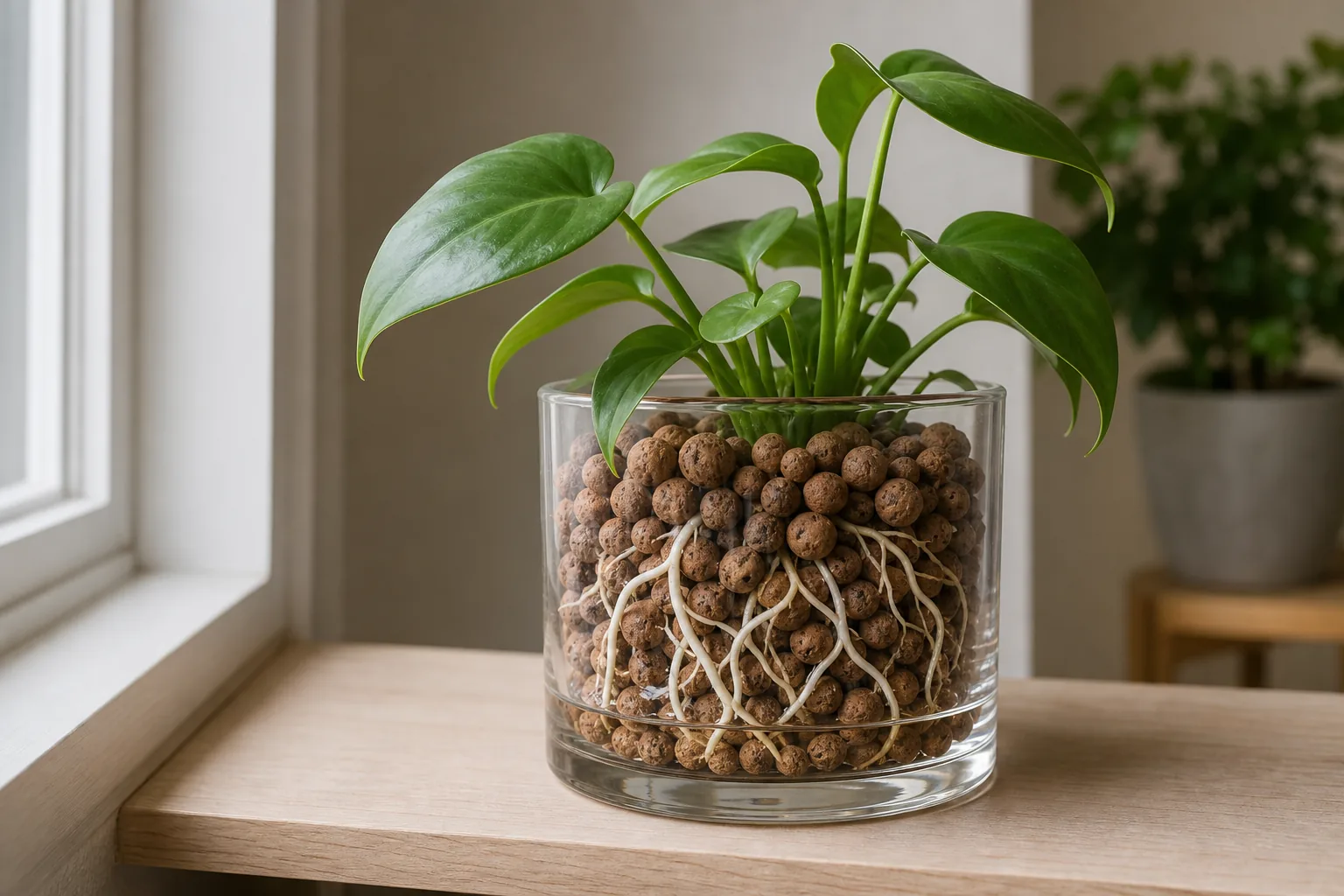
Inside a LECA pot, the lower layer of pebbles sits in or just above a shallow pool of water. Roots grow down through the pebbles toward that moisture, then fan outward. The roots closest to the reservoir stay damp, the roots in the upper pebbles stay drier, and there is always air around the roots because the pebbles do not collapse into a wet mass the way saturated organic mix can.
That air-water layering is the main reason LECA appeals to growers. It does not, however, remove the risk of root suffocation. If the reservoir is filled too high or left stagnant for too long, even roots in pebbles can sit in oxygen-poor water. Pathogens can also reach roots in any medium through contaminated tools or reused substrate, so the idea that LECA eliminates root problems is not accurate. The mechanism of waterlogging changes; the underlying risk category does not disappear.
Water, reservoir level, and how to read moisture now
Two reservoir styles are common in houseplant semi-hydro setups.
Constant-reservoir setups keep a shallow pool of water at the bottom of the pot at all times, refilled when the level drops. This suits plants that like steady moisture. Dry-back setups let the reservoir empty before refilling, giving roots a wet-then-air cycle. This suits plants that prefer to dry between drinks.
In either style, the new moisture cues are reservoir level, the dampness of the lower pebbles when you tip a few out, and root color when you gently lift the plant. Healthy roots in LECA are usually pale, whitish, or tan and firm. Brown, black, or slimy roots are the same warning sign they would be in any other medium.
Nutrients in LECA: why the mix no longer feeds the plant
Because LECA is inert, the pebbles do not contribute any nutrients. Every mineral the plant needs has to come from the water added to the reservoir. This is closer to hydroponic feeding than to traditional fertilizing, and it is the part of the switch most often underestimated.
The basics covered in the houseplant fertilizer basics guide still apply, with a few shifts. The fertilizer needs to be water-soluble and labeled for use in semi-hydroponic or hydroponic setups, diluted to a mild strength, and added to every refill during active growth. Skip the reservoir entirely during a settling period after transplant, and reduce or stop feeding during the darker, cooler months when growth slows.
A common mistake is to assume that because LECA contains clay, the plant can pull nutrients from the pebbles. It cannot. The clay is fired and stable. Treat the reservoir as the only source of nutrition.
Transitioning a plant from soil into LECA
The transition step is where most losses happen, and the failure is usually incomplete cleaning rather than LECA itself.
- Inspect the plant for pests before you start, and isolate it from the rest of the collection during the transition. The reasoning is the same as in any new-plant quarantine: any hitchhiker that survives the move into LECA has just been planted in a stable, long-term home.
- Remove the plant from its pot and gently tease away as much potting mix as possible from the root ball. Rinse the roots under lukewarm water until almost no organic debris is left. Any remaining bits of bark or peat will decay in the reservoir and feed algae and biofilm.
- Place a layer of rinsed LECA in the cachepot or net pot, set the plant on top, and add more pebbles around the roots so the plant stands upright. Water in with plain water only for the first two to three weeks so the roots can settle without being asked to process nutrients at the same time.
- Watch the plant daily for the first two weeks and weekly after that. The new conditions are a bigger change than the plant looks like it is going through, and the same acclimation mindset for a new houseplant — stable conditions, observation, no big interventions — applies here too.
Plants already growing in plain water, such as water-propagated cuttings, can move into LECA without the soil-rinsing step, which is one reason water propagation is a common intermediate stage.
Cleaning, rinsing, and whether LECA can be reused
New LECA pebbles arrive covered in fine clay dust. Rinsing them in a bucket or under a tap until the water runs clear is standard practice and worth doing before the pebbles ever touch a plant.
Used pebbles can be rinsed and reused. Pull the plant out, rinse off organic debris and old root matter, and check for a white or rust-colored crust on the pebble surface. That crust is salt buildup from tap water or nutrient solution, and it can be reduced by soaking the pebbles in fresh water and stirring them, then rinsing again. Extension programming on reused containers generally teaches that cleaning and sanitizing helps reduce disease carryover between plants, and the same principle applies to reused pebbles. If a sanitizer is used, follow the product label and any local extension guidance.
LECA does not break down the way organic mix does, but that does not mean it lasts forever in the same pot. Many growers periodically replace the top layer or refresh the whole batch when crusting or odor becomes hard to manage.
Algae, biofilm, and what is normal
Green film on the pebbles near the waterline is one of the first things new semi-hydro growers notice. In most cases it is algae, and it grows because light is reaching nutrient-containing water. It is usually a cosmetic condition rather than a plant-health crisis. The simplest mitigations are also the ones hobby sources repeat most often: use an opaque outer pot or wrap the reservoir to block light, and rinse the reservoir on a routine basis so nutrient film does not build up.
Reserve harsher responses, such as a full substrate clean-out or a sanitizer soak, for situations where the plant is also showing symptoms. Algae by itself is not a reason to dismantle the setup.
Common problems in LECA and what the plant is actually telling you
A few signs show up often enough to be worth knowing in advance.
- Yellowing lower leaves in the first few weeks usually mean the plant is adjusting to a new watering rhythm or a sudden change in humidity, more than the LECA itself. A useful first check is light, then reservoir level, then nutrients.
- Brown leaf tips point to salt buildup or very low humidity. A plain-water rinse of the reservoir and a check on room humidity are the first moves.
- Mushy new growth or sudden collapse points to a stagnant reservoir or a pathogen. Pull the plant, inspect the roots, and reset with clean pebbles if anything smells off or turns dark.
- Slow or stalled rooting often means the reservoir is too dry, the room is too cold, or the plant is still in the settling window. Patience is usually the right answer.
The same diagnostic order used for any other medium still applies — light first, water next, nutrients last — and the existing habit of telling overwatering from underwatering maps onto LECA with new visual cues but the same hierarchy.
When LECA is probably not the right call for this room or plant
LECA is not a default upgrade. A few situations make it a poor fit.
- Very small net-pot setups dry out fast in warm, dry rooms and need frequent refills, which removes the convenience that draws many people to semi-hydro.
- Plants that prefer to dry out fully between waterings — for example, some succulents and thick-leaved cacti — are a less natural fit for the always-wet reservoir style. A dry-back reservoir is possible but adds complexity and is less commonly attempted with these plants.
- Dim rooms with little natural light make algae management harder because any light reaching the reservoir feeds it.
- Readers who do not want a refill routine at all should know that LECA shifts the watering job from “water the top” to “watch and refill the reservoir.” It is not hands-off.
If those points describe your situation, a well-chosen potting mix with a cachepot and a regular observation habit is still a perfectly good answer.
A simple first LECA setup and what to observe in the first three weeks
If you decide to try LECA, keep the first attempt simple. The cachepot and reservoir approach works well as the starting point, since semi-hydro is essentially a deliberate variation on that idea.
Pick one plant you are comfortable losing — many hobby growers start with aroids such as Alocasia, which is the houseplant most frequently mentioned in semi-hydro discussion. Choose a pot tall enough to hold a reservoir under the root zone, and start with rinsed pebbles and plain water only. Set the plant in a spot with stable light and stable temperature, away from drafts. For the first week, look at the plant daily: leaf posture, leaf color, root color if you can see any through a clear pot, and reservoir level. In weeks two and three, settle into a weekly check that includes reservoir top-up, a look at any crusting on the upper pebbles, and a quick scan for algae or biofilm.
If the plant holds steady through that window, begin a mild nutrient solution at the dilution on the label. If the plant wilts, yellows, or stops putting out new growth, walk back through light, reservoir level, and recent changes before assuming the medium is the problem.
LECA is a useful option in a houseplant toolkit, and it rewards the same calm, observation-first approach that mix-based growing does. The difference is that you are now reading reservoir level and root color instead of poking the top of the mix, and you are carrying the full feeding responsibility instead of leaning on the slow release of organic matter. Once that trade-off makes sense in your room and your routine, the rest of the learning curve is just paying attention.
Sources
- Expanded clay aggregate — Wikipedia
- What the heck is LECA? — Garden Center magazine
- The pros and cons of growing indoor plants in LECA — ABC News (Australia)
- Before you plant, prep: cleaning used pots — Oklahoma State University Extension (Facebook post)
- The down side to semi-hydro (S/H) and full water culture (FWC) — Here But Not