Plant care
How to care for a houseplant you received as a gift
· Updated
A gift plant is just a new plant in your home. The same calm, observation-first plan that works for any plant you brought home from a nursery works for one that arrived in a basket, a foil wrap, or a decorative ceramic pot. The difference is mostly that you have less information going in. You may not know the species, you probably did not choose the room, and the pot is almost always set up for display rather than for healthy watering.
Here is the short version of what to do in the first one to two weeks:
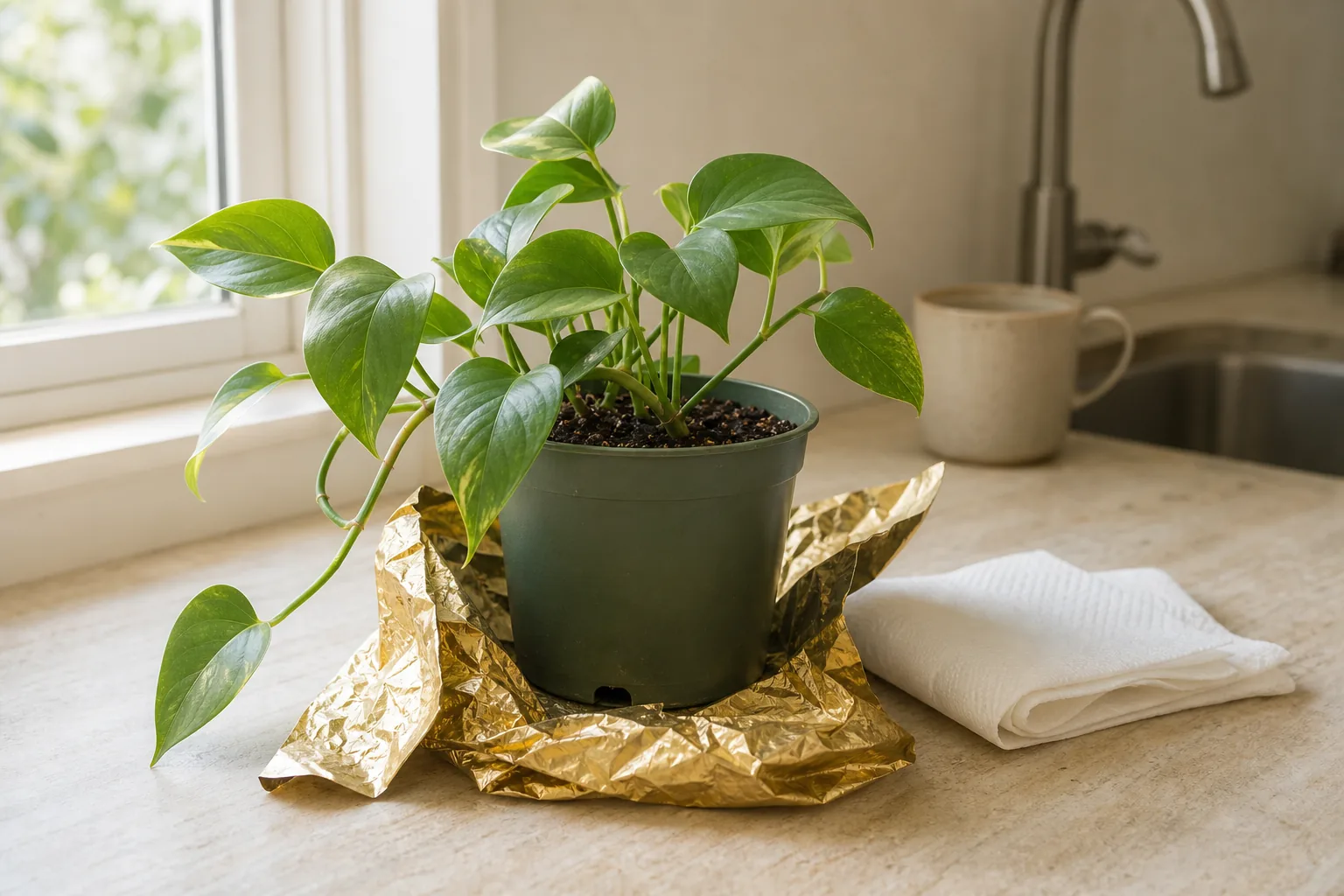
- Unwrap the foil, paper, or decorative sleeve so you can see the pot and let water drain.
- Look at the leaves, stems, soil, and pot before doing anything else.
- Place the plant in a stable spot with the brightest appropriate light your room offers.
- Skip repotting, fertilizing, and rearranging.
- Use the week to identify the plant and decide whether it is a long-lived houseplant or a short-lived florist plant.
The rest of this page walks through each step and the few situations that change what to expect.
A gift plant is just a new plant in your home
The reason this is worth saying out loud is that gift plants come with extra emotional weight. They were chosen for an occasion, by someone else, and the natural impulse is to do something to keep them alive right away. The opposite is closer to right. New plants need a quiet adjustment window, and gift plants often need it more than most because they have just come out of a heated shop, a delivery truck, or a florist’s cooler into a home with different light, humidity, and temperature. The full plan for that adjustment lives in our first-two-week acclimation guide, which is worth reading in full. The short version is below.
Step one: remove the foil, paper, or decorative outer sleeve
Most gift plants ship with the inner nursery pot wrapped in foil, set inside a basket, or seated in a tight decorative cachepot. The wrap looks like a finishing touch, but it is doing something unhelpful to the soil. Foil and tight outer sleeves seal the sides of the inner pot, slow evaporation, and trap any drainage water at the base. That pooled water is one of the most common early causes of yellowing leaves, sour-smelling soil, dark or mushy stem tissue at the soil line, and fungus gnats hovering around the wrapper.
Two practical options:
- Pull the inner pot out of the foil or sleeve entirely, water it over a sink, let it drain, and decide whether to put it back into the decorative outer pot later as a true cachepot, with no standing water at the base.
- Leave the wrap on for display but punch a few small drainage holes through the bottom and tip out any water that collects in the foil skirt after each watering.
Either works. The wrong move is to leave the wrapped pot sitting in a puddle you cannot see. Our pot and cachepot guide goes deeper on what the wrapper is doing to moisture.
Step two: read the pot, the soil, and the foliage before doing anything
Once the wrapper is off, spend a few minutes looking instead of doing.
Check the pot itself. Is there a drainage hole at the bottom? A heavy, dripping-wet pot the day you receive it has almost certainly been watered recently and probably does not need water yet. A light pot with bone-dry soil at the top is a cue to water soon. For a deeper look at how to read soil moisture and pot weight, see our guide to watering by observation.
Check the soil surface. Is it dry, damp, or soggy? Is there a white crust from mineral or fertilizer buildup, green moss, or a sour smell? Are roots growing out of the drainage hole? None of these need an answer in the first hour, but each is a data point for the days ahead.
Check the leaves and stems. Look at the tops, the undersides, and the place where the stem meets the soil. Live pests such as greenflies, whiteflies, fine webbing, sticky residue, or tiny dark specks are easier to spot now than later. Dark, soft, or collapsed stem tissue at the soil line is a more urgent warning sign that the root zone has been too wet for too long. A small amount of yellowing or leaf drop on a plant that has just moved is normal and is not by itself a death sentence. Brown, crispy leaf edges are a separate symptom with its own common causes, covered in our brown tips and crispy edges guide.
If you find anything concerning, keep the plant a few feet away from your other plants for at least two weeks and work through the inspection and quarantine guide before reintroducing it.
Step three: place it in a stable spot with the best light your room offers
The room you put the plant in was not chosen for it, so a quick honest look at the light is worth the minute it takes. Our guide to reading natural light indoors walks through how to judge what you actually have. The short version: most foliage houseplants do best near a bright window without direct sun burning the leaves; most succulents and cacti need the sunniest window you have; flowering gift plants generally want the brightest cool spot in the room, away from heating vents and cold drafts. The two practical mistakes are putting a plant in a dim corner and forgetting about it, or moving it between rooms every few days while you search for the right spot. Pick a place, leave it there, and read the foliage over the next week to confirm the choice.
Step four: identify what you actually have, and start from there if you cannot
Identification is a normal first-week task, not a failure. Most gift plants arrive with no tag, but the chain of information is usually shorter than it feels.
Start here:
- Look for a tag tucked under the foil, inside the sleeve, on the bottom of the pot, or pinned to the wrap.
- Ask the gift giver or the florist, nursery, or retailer that supplied it. Purchase records often have the species name.
- Photograph the whole plant, a single leaf close enough to show shape and venation, the stem and any nodes, and any flowers or buds. A plant-ID app or a plant-ID community can give you a starting point, but apps mis-identify look-alike species (philodendron versus pothos, several kalanchoe species, the two holiday cacti), so treat the result as a guess rather than a verdict.
- Confirm with a local independent nursery, a master gardener helpline through your state extension office, or a botanical garden before acting on the identification.
Once you know what you are growing, you can move to species-specific care rather than guessing. The room-fit logic in our guide to choosing a houseplant that fits your room applies just as well to a plant you received as to one you chose, once you have a name.
Three common gift-plant situations and what changes for each
The same first-week plan applies to all three. What changes is the realistic expectation of how long the plant will be part of your home.
A foliage houseplant
Pothos, philodendron, snake plant, schefflera, dracaena, and dieffenbachia are commonly given as gifts and are also genuinely long-lived indoor houseplants. Once you identify it and confirm that your light is reasonable, this category is the most likely to still be in your home in five years.
A blooming florist plant
Mini rose, kalanchoe, chrysanthemum, hydrangea, azalea, cyclamen, gloxinia, and poinsettia are typically sold for a bloom window of weeks to a few months rather than for multi-year indoor survival. Treat the bloom as the gift. Once flowers fade, the plant may continue as foliage, may go dormant, or may decline, depending on the species and your conditions. University extension publications group these as flowering gift plants, a separate category from year-round houseplants, and recommend cool nights, often in the 55 to 65°F range, along with consistent moisture, to extend the bloom.
A dish garden or succulent arrangement
These are usually finished display pieces that combine multiple plants in a single container, and that container often lacks drainage. The plants may have different water and light needs. Observation cues that suggest the arrangement is not working include one plant wilting while the others are fine, persistently soggy soil more than a day after watering, or one plant showing dark stem tissue while its neighbors look healthy. If you see those cues after a week or two, gently unpotting the arrangement and giving each plant its own drained container is reasonable. If the whole arrangement is wilting or drying together, watering rhythm or light is more likely the fix than separation.
What to skip during the first two weeks
The hardest part of a gift plant is often the list of things not to do.
- Do not repot into a prettier or larger container. The plant is already adjusting; a new pot is more stress, not less.
- Do not fertilize. Our houseplant fertilizer basics guide explains why. The short version is that fertilizer is for plants that are actively growing, and a plant in transit and acclimation usually is not. The University of Georgia, University of Missouri, and NC Cooperative Extension all make the same point: a plant that is not actively growing does not need fertilizer, and adding it can stress the roots.
- Do not prune, unless a stem is clearly dead or diseased.
- Do not move the plant between rooms while you search for the perfect spot. Pick a stable location and let it settle.
- Do not water on a fixed schedule. Water by observation, as described in our guide to watering without a schedule: pot weight, soil moisture at finger depth, and visible foliage cues.
When the gift plant may not be a long-term houseplant
If the gift is a miniature rose, a hydrangea, an azalea, or a chrysanthemum from a florist or grocery store, the honest framing is that these are outdoor plants being displayed indoors temporarily while they bloom. Miniature roses in particular are widely discussed in rose-growing and consumer horticulture sources as plants that decline quickly in dry indoor air, where spider mites and bud drop often follow within weeks. Cyclamen and florist chrysanthemums are commonly sold for a single cool-season bloom window and tend to struggle once indoor heating raises the temperature in fall and winter; poinsettia follows a similar seasonal rhythm. None of this means the plant was a bad gift. It means the gift was the bloom, and the rest depends on your conditions and how much effort you want to put in.
When to ask a local nursery or extension office
A few situations deserve a human in the loop rather than another article:
- You cannot identify the plant after a week of trying and are about to repot, fertilize, or prune it.
- You see pests spreading to other plants despite a two-week separation.
- The stem at the soil line has gone dark or mushy and the wrapper was holding water.
- You have pets and have not yet confirmed whether the species is safe to have in the home. Our pet-aware houseplant choices guide walks through a verification method using the ASPCA database; treat that as the starting point and confirm with a local source before relying on it.
Your state cooperative extension office, a master gardener helpline, or an independent local nursery can look at a photo, confirm an identification, and tell you whether what you are seeing is normal adjustment or a real problem. That local answer is almost always more useful than another generic search result.