Plant care
Echeveria care indoors: keeping the rosette compact
· Updated
An indoor echeveria stays compact only when it gets genuinely strong, direct sun for most of the day and a fast-draining mix in a small, breathable pot that is allowed to fully dry between deep waterings. If the rosette has already started to stretch, the stretched stem will not shorten back. The only path back to a tight shape is to move the plant into stronger light and, if you want a compact top again, behead the rosette and reroot it.
That is the whole answer in two sentences. The rest of this post walks through how to read your own plant, your window, and your watering rhythm so you can keep a rosette tight or recover one that has already opened up.
What a healthy indoor echeveria rosette actually looks like
Echeveria is a rosette-forming genus native to dry, sunny regions, and its natural habit is a tight, low clump of overlapping leaves with little or no visible stem between them. Cultivars vary widely in mature size, with species such as Echeveria subrigida reaching roughly eighteen inches in diameter, but the shape stays neat: leaves stacked so closely that the stem is hidden.
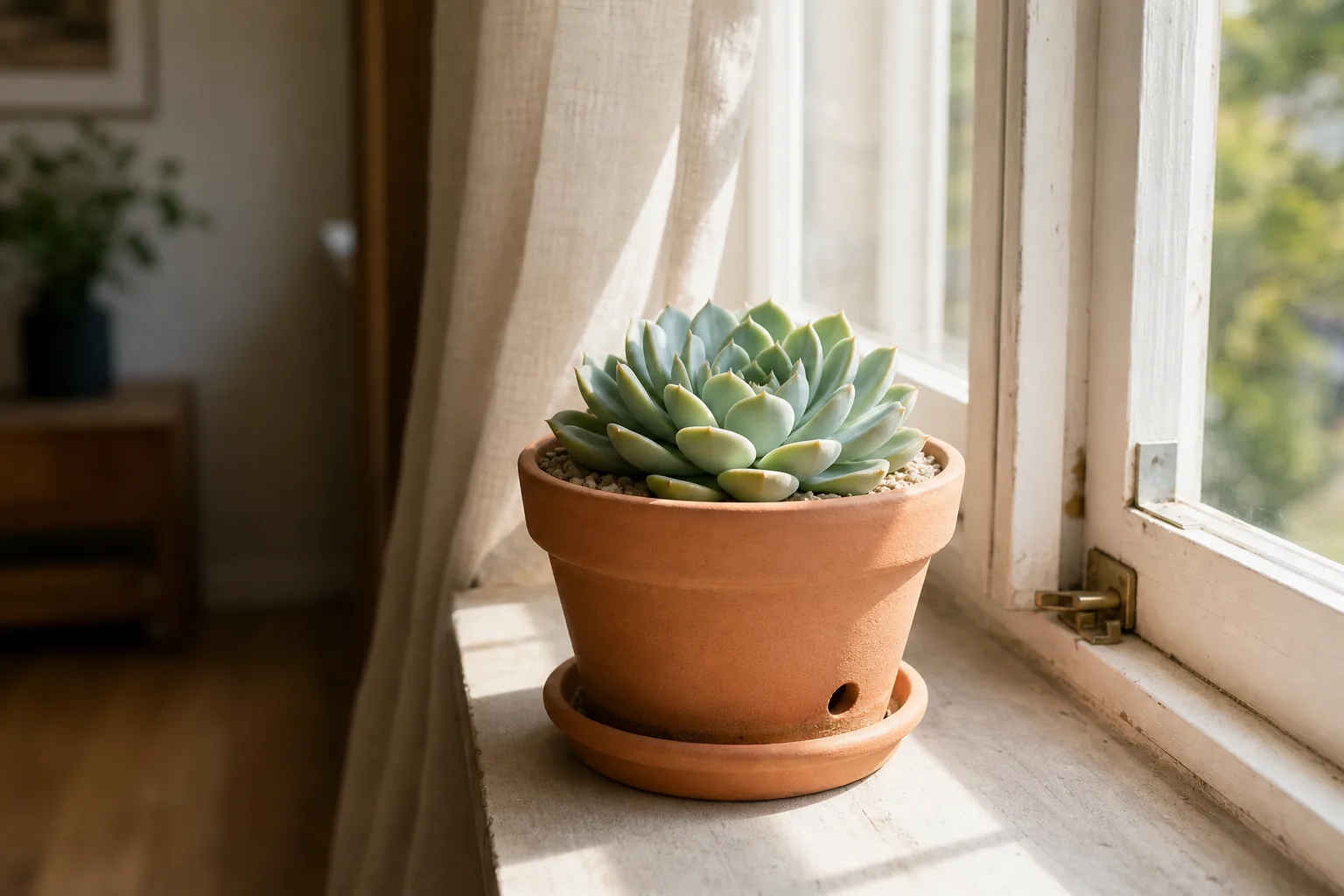
Indoors, a healthy echeveria should look much the same. New leaves appear from the center of the rosette and push older leaves outward. Color depends on the cultivar, but the leaves should look full rather than wrinkled, and the rosette should sit low in the pot rather than perched on a visible stem.
The first sign that something has shifted is usually a gap. New leaves get a little smaller than the ones below them. The center of the rosette may start to point upward, exposing more leaf surface to the available light. Eventually, a pale, slightly stretched section of stem appears between the older leaves and the newer ones. That is etiolation, and it is the single most common complaint about indoor echeveria.
Why echeverias stretch indoors: light is usually the cause, not watering
It is tempting to assume that a stretching rosette is a thirsty one or a hungry one, but the more common cause is light. UC Master Gardeners of Orange County notes that insufficient sunlight causes etiolation, which is the term for the leggy, pale, stretched growth that happens when a plant is reaching for more light than it is getting. Echeverias do this very visibly because their natural growth form is so compact that any departure from it stands out.
What is happening is simple. The plant is trying to grow toward the strongest light source it can find. It does this by lengthening the stem between leaves and by flattening or opening up the rosette to expose more leaf surface. Horticultural sources describe this behavior as a plant growing in the direction of greatest light, and in low light the rosette flattens and the stem stretches. For a broader look at this pattern across houseplants, see our post on leggy growth as a light signal.
Watering can make the symptom look worse, but it is rarely the root cause. A soggy, never-fully-dry soil will rot an echeveria faster than low light will stretch one, but it will not, on its own, produce a stretched stem. The honest answer is that you usually have two problems at once when an indoor echeveria looks leggy and soft: not enough light and too much water, in that order.
Reading your window: matching an echeveria to direct sun
Iowa State University Extension recommends at least six to eight hours of bright light for indoor succulents, with ten or more hours preferred, and the University of Minnesota Extension advises placing succulents in a bright, sunny window. Echeveria is a full-sun genus in its native range, so “bright sunny window” means a window that delivers direct sun on the plant for most of the day, not a window with bright ambient light a few feet back.
A south-facing window is the standard starting point in the northern hemisphere, with west-facing as a close second. East-facing windows deliver gentler morning sun, which can keep a rosette alive but often does not produce a tightly compact form. North-facing windows are not enough for an echeveria over the long run. For a more careful way to judge your specific spot, see our guide on how to read natural light in your room.
It is worth being honest here. A sunny windowsill indoors is usually weaker than outdoor full sun, so a compact indoor rosette may still be slightly looser than one grown outside in summer. That is normal, not a failure on your part. The goal indoors is a steady, compact shape, not a perfectly outdoor-grade specimen. If you do move an echeveria outside for the summer, ease it into brighter light over a week or two; our summer care for stronger sun post walks through the adjustment.
Pot choice: small, shallow, and breathable, with a drainage hole
Iowa State University Extension recommends clay or terracotta pots for indoor succulents because they are porous and allow the soil to dry more quickly. For an echeveria, the safer default is an unglazed terracotta pot with a drainage hole, sized so that the rosette nearly fills the top with about one to two centimeters of margin on each side. Our post on drainage and cachepot setup goes into the why of the drainage hole in more detail.
A too-large pot is one of the most common causes of rot. Excess soil volume holds moisture longer than a small echeveria root system can use, and the soil stays cool and damp in the middle long after the surface looks dry. Glazed ceramic holds moisture longer than unglazed terracotta, and plastic holds it longer still. None of these are forbidden, but each one asks for a more cautious watering rhythm.
Shallow, wider-than-deep pots are a common choice in general succulent-care practice because the echeveria root system is naturally shallow. A pot with a drainage hole lets the soil dry evenly without trapping moisture at the bottom.
Potting mix: gritty, fast-draining, low in fine peat
Echeveria wants a gritty, fast-draining mix rather than a moisture-retentive standard houseplant mix. A bag labeled cactus and succulent mix is a reasonable starting point. The principle is that water should run through the pot quickly and the soil should dry to the touch within a day or two of watering, not stay cool and damp for a week. For label-reading and DIY-grit logic, see our post on choosing a fast-draining potting mix.
A standard houseplant mix holds too much moisture for most indoor echeveria setups, especially in cool or humid rooms. If you want to mix your own, the goal is more grit and less fine peat: think coarse sand, perlite, or pumice, with just enough organic component to hold the plant in place. Avoid recipes that rely heavily on fine peat or coconut coir, because those hold water against the roots.
Watering by observation: a long soak, then a full dry-down
Iowa State University Extension suggests starting indoor succulents at about once every two or three weeks and adjusting based on observation. For an echeveria in a small unglazed terracotta pot in a normally warm, dry room, that is a reasonable starting point. For the same plant in a glazed or larger pot in a cool or humid room, the interval will be longer.
The rhythm is soak and dry, not little sips. Pour water through the pot until it runs out of the drainage hole, then let the soil dry fully before you water again. You can check by feel: stick a finger or a wooden skewer an inch or two into the mix. If it comes up cool or damp, wait. If it comes up dry and the pot feels light when you lift it, water. Our watering by observation post walks through pot-weight and soil-feel cues in more detail.
What does not work for echeveria is frequent light watering. A small splash every few days keeps the surface barely moist and the lower soil continuously damp, which is the recipe for a soft, brown stem and translucent leaves.
What a stretched echeveria is telling you, and what can recover
Once a section of stem has stretched and the leaves on that section are smaller and paler than the leaves below, that stretched section will not shorten back. The cells have already elongated. The only new growth that can be compact is what the plant produces after you move it into stronger light.
So the honest recovery has two parts. First, move the plant into the strongest direct light you can give it. Second, decide whether to behead the stretched rosette and reroot the top, leaving the parent stump in the same pot to produce offsets if it wants to. If you do nothing, the plant will continue to stretch from the top while the older, compact leaves stay at the bottom. Some readers prefer this look. Others prefer to start fresh with a tight rosette.
Beheading and rerooting: the honest recovery path
Beheading sounds dramatic, but it is a widely practiced recovery technique for an etiolated echeveria and the only way to get a tight rosette again on the same plant. Extension services do not publish a single canonical protocol for this, so the steps below reflect general succulent-care practice rather than a directly cited extension recommendation.
With a clean, sharp blade, cut the stem below the stretched section, leaving a short stem attached to the rosette. Set the cut rosette in dry air, out of direct sun, for several days until the cut end calluses over. Then place it on top of a dry, gritty mix and withhold water until roots form, which can take a few weeks. Light, occasional misting of the mix surface is fine; do not soak it.
The parent stump left in the original pot will often produce one or more offsets from the cut site, though it is not guaranteed. If you would rather not behead, you can simply move the plant into stronger light and accept that future growth will be tighter while the older stem stays stretched.
Other signals to watch: mushy leaves, soft stem, color changes, and winter rest
A few other observations help you read the plant.
Mushy or translucent leaves, especially lower leaves, usually mean overwatering or rot. Soft, dark stem at the soil line means the same and is a more urgent sign. Shriveling or puckering on lower leaves, while the upper leaves still look fine, usually means underwatering or root loss.
Color changes can be informative. NC State University notes that Echeveria leaf coloring improves with sunlight, and many cultivars do deepen in color, with reds, purples, or strong blues, when light is genuinely strong. Pale, washed-out green in a cultivar that is normally more colorful often appears alongside other light-starvation signals like flattening or upward-pointing leaves, rather than on its own as a single rule.
In winter, shorter days and cooler indoor temperatures slow growth in general succulent-care practice, so the soil dries more slowly and the plant needs less water. Skip fertilizer during this rest, or feed only very lightly during active growth in spring and summer. Individual sensitivities to echeveria sap exist, so wash your hands after handling or beheading, and keep the plant away from pets if you are unsure; our broader indoor succulent care post covers that topic more fully.
A simple first-month routine for a new echeveria indoors
If you have just brought an echeveria home, a calm first month looks like this. Place it in the sunniest window you have, ideally south- or west-facing, and leave it there. Water only when the soil is fully dry, pouring through the pot until water runs from the drainage hole. Do not water on a calendar. Do not move it to a different room to show it off, because every move costs the plant a few days of adjustment. Watch the rosette for two or three weeks before you decide whether the light is enough. If new leaves are getting smaller and a stem is appearing, the light is not enough, and the answer is more direct sun or a beheading, not more water.
That is the whole routine. The plant will tell you, over the next month, whether your window is up to the task.
Sources
- Iowa State University Extension — Growing Succulents Indoors: https://yardandgarden.extension.iastate.edu/how-to/growing-succulents-indoors
- University of Minnesota Extension — Cacti and Succulents: https://extension.umn.edu/gardening-minnesota/cacti-and-succulents
- NC State University Plant Toolbox — Echeveria: https://plants.ces.ncsu.edu/plants/echeveria/
- UC Master Gardeners of Orange County — Succulents: https://ucanr.edu/site/uc-master-gardeners-orange-county/succulents-orange-county
- Pacific Horticulture Society — Frilly Echeverias: https://pacifichorticulture.org/articles/frilly-echeverias-the-fairest-succulents-of-them-all/
- Gardenia.net — Echeveria genus guide: https://www.gardenia.net/genus/echeveria