Plant care
How to divide a snake plant pup without losing either plant
· Updated
The short answer
A snake plant pup is ready to separate when it has a visible rosette of its own, a short section of the underground rhizome that connects it to the mother, and a few inches of pale, firm roots. Division is a single clean cut through that connecting rhizome, a brief air-dry until the cut surface feels dry, and a small pot of fast-draining mix for the pup. The mother plant is repotted at the same time into refreshed mix, not slid back into a hole. Both plants then need a slower, drier rhythm than a settled snake plant for the next two to three weeks, with no fertilizer until you see active growth.
The article below assumes your baseline care is already working; if not, the snake plant care guide is the place to start.
What a snake plant pup actually is
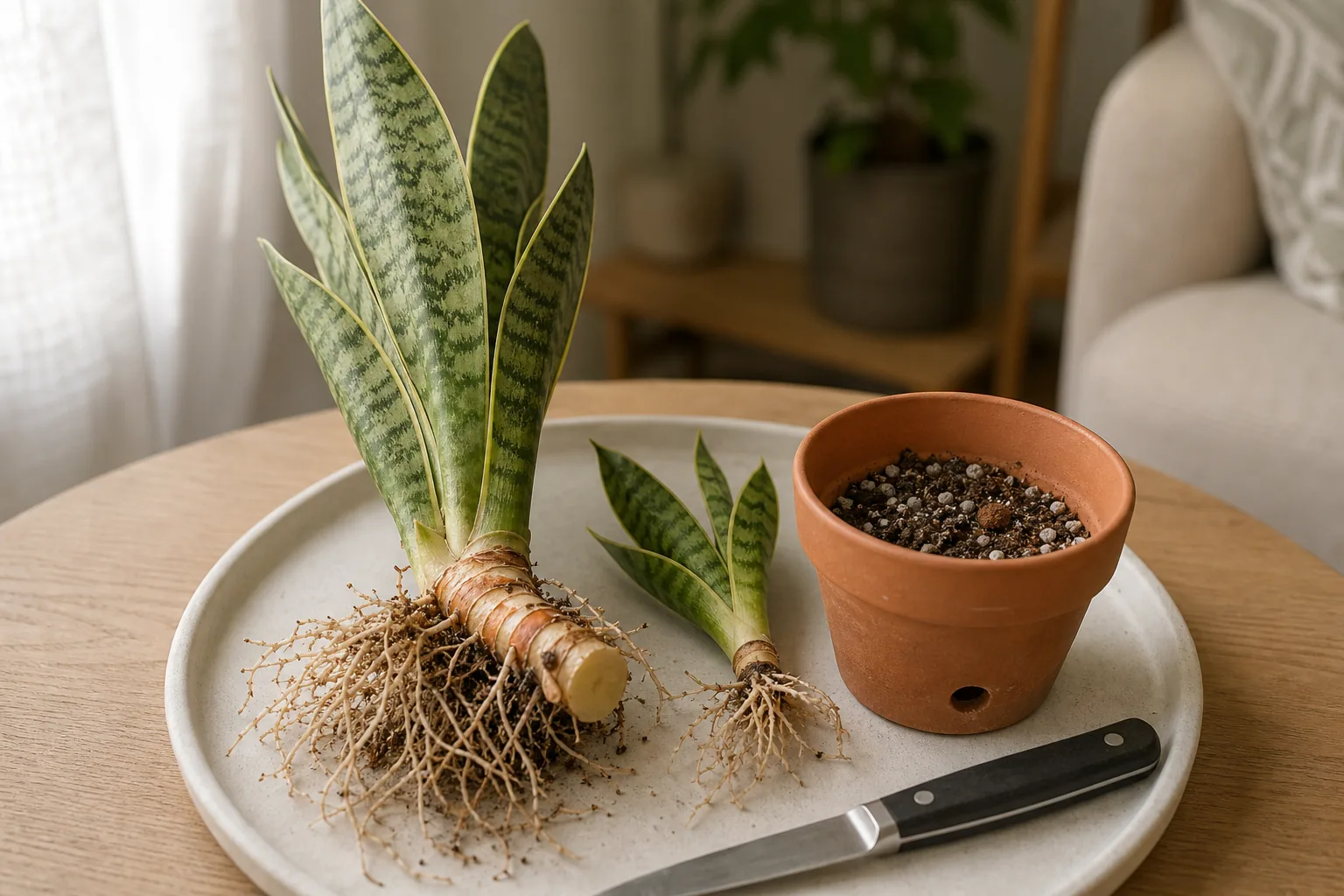
Snake plant, currently accepted as Dracaena trifasciata but still sold under its older name Sansevieria trifasciata by many retailers, spreads underground. New rosettes grow from a thick, whitish-to-orange horizontal stem called a rhizome. Each new rosette stays connected to the mother through that rhizome until either the gardener cuts it apart or the rhizome naturally breaks down. The fine, pale feeder roots emerge from the rhizome, not directly from the leaves, which matters when you cut.
A few small green shoots next to the main plant are not automatically pups with a future. A very young shoot may still be entirely dependent on the mother plant’s rhizome and have no roots of its own yet. Those are not the ones to divide. The ones worth separating are the ones that have started behaving like their own small plant.
Should you divide at all? When leaving the pup attached is the better call
Division is not mandatory. A pup can live attached to the mother for the entire life of the pot, and there are several cases where leaving it is the more sensible choice.
- The mother plant is struggling. If leaves are yellowing, the rhizome is soft, or you have been overwatering, a division now adds stress to a stressed plant. Fix the watering and the mix first, then revisit division later. The overwatered vs. underwatered triage guide is a useful starting point if you are not sure which side of that line you are on.
- There is only one pup and the pot is not crowded. A single pup in a roomy pot does not need its own container.
- The mother is root-bound and an upsize is overdue. Crowded roots are a separate problem; the root-bound signals guide walks through how to read the pot before you commit.
- It is winter. Indoor snake plants slow down in lower light and cooler rooms. Wounds heal more slowly when the plant is not actively growing.
- You would have to upsize the mother plant into a pot you do not have room for. Division and an upsizing at the same time doubles the disturbance; the general repotting signals guide helps you decide whether both are actually needed at once.
If none of those apply and you want a second plant, division is reasonable.
Division is the most reliable way to propagate a snake plant. Penn State Extension describes it as the easiest route, and the result is a clone identical to the mother, including any variegation. NC State Extension also documents leaf-section propagation for snake plant, where a leaf is cut into pieces and rooted in a moist medium. That alternative is slower, often takes months to send up a new shoot, and typically reverts variegated cultivars to plain green. The steps below focus on division.
Signs a snake plant pup is ready to be separated
Use this as a checklist rather than a rule. A pup that meets most of these has better odds of establishing itself on its own.
- A visible rosette of leaves. The shoot is not just a single spear emerging from the soil; it has begun to fan out into its own cluster of leaves.
- A small section of rhizome. When you brush soil away from the base of the pup, you can see a short piece of the connecting stem on its side, separate from the mother’s main rhizome.
- A few inches of pale, firm roots. These should look similar to the mother’s roots, just less of them.
- Size relative to the mother. A pup roughly a third or more of the mother’s height has had more time to build its own reserves. This is a rough heuristic from horticultural experience rather than a fixed threshold.
If the pup has only leaves and no visible roots of its own, the odds of survival drop sharply. Frame that as a probability, not a guarantee in either direction.
Best time of year to divide a snake plant
Active growth is the safer window. For most indoor snake plants in the northern hemisphere, that runs from spring through early summer, when days are longer and the room is warmer. Indoor conditions shift the calendar; a snake plant sitting under a bright window in a warm room may behave like spring well before April, and one in a dim north-facing room may still be coasting in May.
The point is to avoid dividing when the plant is barely moving. A plant that is actively pushing new leaves has more energy to heal a cut and re-establish roots.
What to prepare
Set everything out before you unpot anything.
- A clean, sharp knife or a pair of pruners. Sharpness matters more than brand. A clean cut crushes less of the rhizome than a dull one. Wipe the blade before you start; you do not need a specific disinfectant ratio, just a clean surface.
- A small pot with a drainage hole. Snug, just larger than the pup’s root mass. Excess mix holds water a small root system cannot use.
- A same-size or one-size-up pot for the mother. If the mother has been pushing roots out of its current pot, this is the moment to upsize. If it has not, the same pot with refreshed mix is fine.
- A fast-draining mix. A cactus and succulent blend, or an aroid mix with extra perlite or pumice, is the usual route. The mix-choice guide walks through how to read a bag.
- A tray or sheet to catch loose soil.
Do not plan to apply any wound sealant. Extension guidance on cuttings, including Purdue’s general material on handling fresh wounds, does not call for cinnamon, sulfur, or hydrogen peroxide on cuts. A clean cut and a brief air-dry is the standard approach.
Step-by-step: how to divide a snake plant pup
- Water the day before, lightly. Damp soil holds together when you unpot and reduces root tear. Do not soak the plant the morning of; you want the soil damp, not soggy. In practice, gardeners often use this as a habit; it is not a sourced rule.
- Tip the entire plant out of its pot. Slide it out rather than yanking. If it is root-bound, work your fingers around the outside to loosen it.
- Brush or rinse the soil away from the rhizome. This is the part most readers skip, and it is the part that makes the cut safer. You need to see the connection.
- Find the connecting rhizome. Follow the pup’s leaf bases down to where its own short rhizome piece joins the mother’s main rhizome. Each side of the cut should keep some pale feeder roots and some rhizome.
- Make one clean cut through the rhizome. Not a saw, not multiple cuts. One steady cut, perpendicular to the rhizome, with the blade you prepared.
- Set both pieces on the tray. Resist the urge to fuss with the cut. Check that each side has roots. If one side has none, that side will struggle; consider keeping it attached or accepting the risk.
- Let the cut surfaces air-dry briefly. Set them on the tray out of direct sun until the cut feels dry to the touch. The retrieved extension sources do not give a snake-plant-specific callus timer. The broader succulent and cactus cutting guidance from University of Illinois Extension points to a dry-down before insertion rather than a fixed hour count; for a rhizome cut, a brief air-dry until the surface no longer feels wet is the working principle.
Potting the pup and the mother plant
Pot the pup first. Hold it at the depth the leaves were at before, fill around the roots with the fast-draining mix, and tap the pot to settle. Do not bury the leaves deeper than they were; the rhizome wants to sit at or just below the surface, not deep.
Pot the mother into the same size pot with refreshed mix, or one size up if roots were circling. Use the same depth it was at. Tease out the old compacted mix from the outer roots, but do not bare-root it; the goal is a light refresh, not a full soil replacement.
Both pots get the same bright indirect light the mother was already enjoying. The deeper details of after-repotting care, including when to resume fertilizer and how to read the first few weeks, are in the post-repotting guide.
The first two to three weeks after division
Treat the pup and the mother as two different patients.
The pup has a small root system and a fresh wound. It wants to dry out more between waterings than a settled plant. Moisten the mix lightly at potting so the roots have contact with the medium, then let it dry more than usual before the next watering. Do not fertilize until you see new leaf growth. Some softening or slight wrinkling of the pup’s oldest leaves is normal while new roots form.
The mother is established but has just had its roots handled. It can return closer to a normal watering rhythm, but not immediately. The post-repotting care routine applies: water when the mix is dry to the depth of a finger, hold the fertilizer, and watch for signs of stress.
Both plants want bright indirect light and steady room temperature. Avoid cold windowsills and hot radiators for the first few weeks.
What can go wrong, and how to tell
The main risk after division is rot at the cut surface, and the warning pattern is specific.
- Soft, mushy rhizome at the cut, often with a foul smell. This pattern suggests rot. Rot tends to worsen in mix that stays wet, and it tends to spread from soft tissue into firmer tissue and from the cut into the leaves. If you see it, the overwatered vs. underwatered guide helps you read the moisture side of the problem, and a soft, smelly rhizome that is not improving is a good reason to stop home treatment and contact a local nursery or regional extension office.
- Persistent leaf softening across the whole pup, not just the oldest leaf, with no new growth after several weeks. Often a sign that the pup did not keep enough roots, or the mix stayed too wet.
- Shriveling leaves with bone-dry mix and no new growth. The opposite problem: the pup’s few roots are not finding water. Lightly moisten and watch.
- The mother plant pushing out mushy leaves or refusing to stabilize after a few weeks. Same triage logic as the pup, plus a check that the pot is draining.
None of this is a substitute for a look at the actual plant, and a soft, smelly rhizome is a good reason to bring a sample to a local nursery or contact your regional extension office rather than to keep guessing.
A note on naming
You will see this plant labeled both Sansevieria trifasciata and Dracaena trifasciata. Both refer to the same plant. Royal Botanic Gardens, Kew publishes the currently accepted name Dracaena trifasciata, dating to a 2017 reclassification, and University of Georgia Extension notes that retailers have not fully adopted the change. Use whichever name you already use; the plant does not care.
A note on pets
Snake plant is widely listed as mildly toxic to cats and dogs if chewed. If you have a pet that investigates pots, the ASPCA’s plant database or a quick conversation with your veterinarian is the most reliable next step before deciding where the new pup will live.
When to ask a local source for help
Division is a low-risk propagation method, but it is not zero risk. Reach out to a local independent nursery, a master gardener program, or your regional extension office if any of the following show up after division.
- A soft, smelly rhizome that does not respond to a brief dry-down
- Both plants declining at the same time
- Pests you cannot identify on the rhizome or in the mix. A brief inspection and quarantine habit before reintroducing the pup to a room with other plants is worth the few minutes.
- Anything that looks like a spreading lesion on the leaves
A picture and a short description of what you did are usually enough for a knowledgeable local source to point you in a useful direction.
Sources
- Penn State Extension, Snake plant: a forgiving, low-maintenance houseplant
- Royal Botanic Gardens, Kew, Snake plant (Dracaena trifasciata)
- University of Georgia Extension, Snake plant: a striking and durable houseplant
- University of Illinois Extension, Propagating succulents and cacti
- NC State Extension, Extension Gardener Handbook, Chapter 13: Propagation
- Purdue Extension, New plants from cuttings (HO-37-W)
- Sunset, How to pot up snake plant pups