Plant care
How to divide a houseplant without killing the original
· Updated
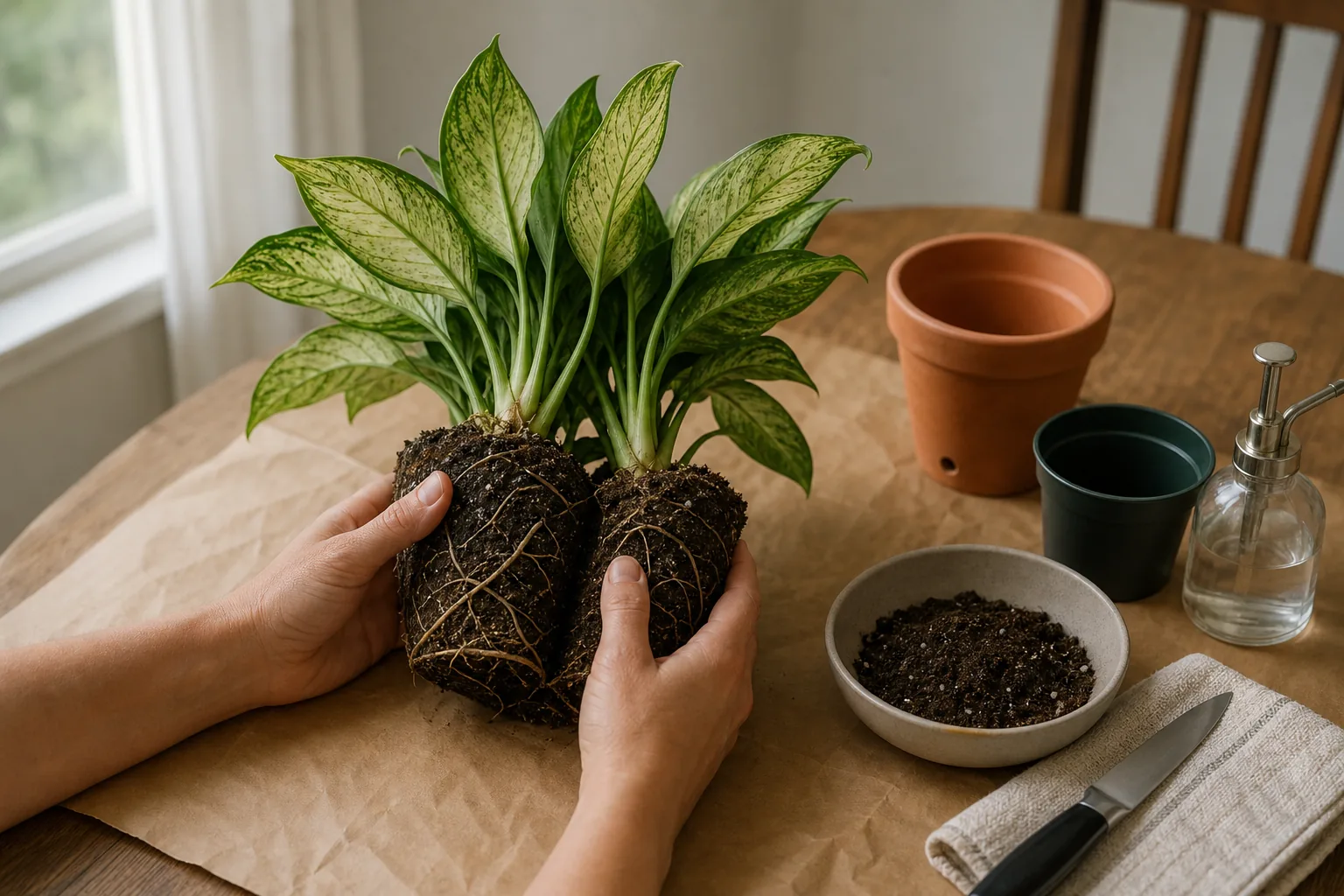
Division only works on houseplants that naturally form clumps, multiple crowns, or offsets from one shared root system, and even then it is more invasive than a routine repotting. Water the plant the day before so the root mass holds together. Tip it out of the pot, read the root mass for natural separation points, and pull apart by hand where possible, or use a clean, sharp knife or small saw at a natural break point rather than forcing through solid root tissue. Trim only obviously torn or dead material, pot each piece in fresh mix in a container only one size larger than its new root mass, and treat the next two to four weeks like a post-repotting recovery window: bright indirect light, watering by feel rather than schedule, and no fertilizer until new growth appears.
What dividing a houseplant actually means, and how it differs from repotting
Division is the act of splitting one plant into two or more pieces, each with its own share of leaves, stems, roots, and a growing point. The result is a new plant that already has roots and shoots in place, which is the main difference from a stem or leaf cutting that has to grow new roots from scratch.
A routine repotting moves the same plant into a new container with refreshed soil. It does not remove living tissue on purpose. Division does. It is closer to a small surgery than to a move, and the aftercare reflects that. Each new piece has fewer roots than the parent had, so it needs a gentler recovery window than a freshly repotted plant.
If you are still weighing the options, the guide on deciding whether a houseplant actually needs a new pot walks through when moving up a pot size is enough and when a more invasive step is worth considering.
Which houseplants can be divided and which cannot
Division is appropriate for plants that physically have something to separate. If the plant forms multiple crowns, clumps, rhizomes, tubers, or offsets from a shared base, it is a candidate. Common indoor species that fit this description include:
- Peace lily (Spathiphyllum)
- Snake plant (Dracaena trifasciata, formerly Sansevieria)
- Spider plant (Chlorophytum comosum), a familiar example covered in the spider plant care guide
- Calathea and close relatives
- ZZ plant (Zamioculcas zamiifolia)
- Aglaonema, often sold as Chinese evergreen
- Pilea, including the popular Chinese money plant
- Aloe and other offset-producing succulents
- Asparagus fern
Plants that do not divide well include single-stem specimens with one growing point, such as many hoyas, a single-trunk plant like a young ponytail palm, or any plant with only one central rosette. For those, other propagation methods such as stem or leaf cuttings are the standard route, and division is more likely to damage the parent than to produce a viable new plant.
This list is representative, not a guarantee. Individual plants vary, and a specimen that looks crowded may still only have one crown. The only reliable test is to remove it from its pot and look at the root mass.
When division makes sense: plant cues, calendar cues, and the honest limits
The strongest cue is structural. If you can see multiple distinct stems or rosettes emerging from the soil, or offsets visible at the soil line or on stolons, the plant has something to divide. Crowding alone, without those structures, is not a reason on its own. A root-bound plant that still has one crown is a candidate for a larger pot, not for division. The guide on signs a houseplant is root bound goes deeper on what crowding actually looks like and what to do about it.
The next cue is timing. Most indoor plants do their visible growing in the warmer, brighter months of the year. In the temperate Northern Hemisphere, that runs roughly from spring into early fall. In stable indoor climates or in the Southern Hemisphere, the calendar shifts, but the principle is the same: divide when the plant is actively pushing out new leaves, not when it is sitting still. Winter is a slowdown for most houseplants, and invasive work during that period is harder to recover from.
The honest limits matter as well. Division is a poor choice if the plant is severely stressed, dehydrated, dormant, suffering from root rot, or carrying a pest infestation in the root zone. In any of those cases, the priority is to get the parent plant stable first. A sick plant divided into smaller sick plants is not progress.
Preparing the plant, the workspace, and yourself
A day or two before dividing, water the plant so the root mass is moist but not dripping. Soil that holds together as a single block is easier to separate cleanly than soil that is bone-dry and falls apart, or soil that is soggy and slumps into mud.
Lay out a covered surface, such as newspaper over a table or a potting mat, because division tends to scatter soil and root fragments. Have ready:
- A clean, sharp knife and, for dense or woody root masses, a small handsaw
- A fork or similar blunt tool for teasing roots apart
- Fresh potting mix matched to the species
- Clean pots with drainage, each only one size up from the division it will hold
- A watering can and a gentle spray bottle
A clean, sharp tool is the standard phrasing. Sterile is a stronger word than the situation usually warrants, and ordinary household cleaning is enough.
Removing the plant from its pot without tearing roots
Tip the pot on its side, support the base of the plant with one hand, and work it loose. If the root mass is stuck, run a clean knife around the inside edge of the pot rather than yanking on the stems. Squeezing a flexible plastic pot is often enough. For a heavy root-bound specimen that refuses to budge, accept that the pot may not survive the extraction; the plant matters more than the pot.
Once the plant is out, shake or brush off loose soil so you can see the structure of the root mass. You are looking for where crowns or growth points already divide on their own. Those natural lines are where the plant wants to come apart, and following them does less damage than forcing a separation through solid root tissue.
Reading the root mass and finding natural division points
Before reaching for a blade, take a minute to look. In most species, healthy roots feel firm and look pale, while damaged roots turn dark, mushy, sour-smelling, or papery. Either extreme is a sign to slow down and reassess.
A natural division point looks like a place where one set of stems or one crown already separates from another, with a visible seam in the root mass between them. In a clump-forming plant, this often shows as a slight gap. In a rhizome-based plant such as a snake plant, it shows as a section of rhizome between two fans of leaves. In an offset like a spider plant plantlet, it shows as the connection point on the stolon.
If the natural points are obvious, division is mostly a matter of working along them. If the root mass is a single tightly bound block with no visible separation, division may not be the right method for this plant at this time.
Separating by hand, by fork, by knife, or by saw: matching the tool to the root
Hand separation is the gentlest option and is enough for many clump-formers. Hold the root mass in both hands and gently pull the crowns apart, working from the outside in. A blunt fork or two forks back-to-back can tease tightly woven roots loose without cutting.
A clean, sharp knife comes in when the roots are too intertwined to tease apart without tearing. Slice downward at a natural break point, following the seam between two crowns rather than cutting through the middle of a healthy root cluster. A small handsaw is the right tool for dense, woody, or rhizome-heavy masses where a knife blade would twist or crush.
The principle is the same in every case: let the plant’s structure decide where the cut goes, not the reader’s impatience.
Trimming damaged roots and wounded tissue without going further than needed
Once a piece is separated, look it over. Trim only what is obviously torn, crushed, mushy, or dead. Long straggling roots can be shortened so each new piece has a compact, manageable root system rather than a tangle, but heavy pruning of healthy roots is not part of the standard approach. The plant needs those roots to absorb water while it recovers.
Wound sealants, antifungal powders, and rooting hormones are sometimes sold for this step. They are not required by any of the major extension or botanical garden resources, and they are best treated as optional rather than necessary.
Potting up each division: size, mix, drainage, and depth
Each piece goes into its own clean pot with drainage, only one size up from its new root mass. A reduced root system in an oversized volume of fresh mix stays wet longer than the small root mass can absorb, which raises the risk of rot. The piece on houseplant pot drainage and cachepot setup explains why drainage matters more for a freshly potted piece than for an established plant, and the guide on choosing a potting mix for the new divisions walks through matching the mix to the species.
Set the division at the same depth it was growing before, backfill gently with fresh mix, and water in lightly to settle the soil around the roots. Do not tamp the mix down hard; a firm but not compacted fill lets new roots move into it.
Aftercare: the two to four week window that mirrors repotting
Treat the next two to four weeks as a recovery period. Place each new division in bright, indirect light at the temperature range most houseplants prefer, commonly around 65 to 75°F during the day and 55 to 65°F at night. Water by feel rather than on a fixed schedule, allowing the surface of the mix to begin drying without letting the whole pot go bone-dry. A division with fewer roots than the parent can dry out faster, so check in more often than you would for an established plant.
Hold off on fertilizer until you see new growth. Roots that are still settling in cannot use fertilizer well, and feeding too early can burn tender new tissue. The routine covered in what to do after repotting a houseplant applies almost word-for-word to a freshly potted division.
A division that came away with a strong share of healthy roots usually rebounds faster than one that came away with very few. Some wilting, some leaf drop, and a pause in visible growth are all normal during the recovery window and do not mean the division has failed. This adjustment is similar to what a newly bought houseplant goes through in its first two weeks, where gentle conditions, observation, and patience do most of the work.
The honest expectation is recovery measured in weeks, with new growth as the cue that the piece has re-established.
When to stop, wait, or ask a local expert instead
Some situations are better handled by a local nursery, a master gardener program, or a county extension office. These include:
- A large, valuable, or unfamiliar specimen where a mistake is costly
- A severely degraded, compacted, or pest-infested root mass
- A plant where you cannot identify any natural separation points after removing it from the pot
- A plant that is clearly stressed, dormant, or sick in a way that suggests the priority is recovery, not propagation
Division is a useful tool, but it is not the right tool for every plant or every situation. The point of this guide is not to convince you to divide anything; it is to help you decide whether division fits what you are actually holding in your hands.
Sources
- Iowa State University Extension and Outreach: How to propagate houseplants by division and offsets
- Colorado State University Extension: Simple plant propagation - how to divide plants
- New York Botanical Garden: Houseplant basics
- NC State Cooperative Extension: Winter considerations for houseplants
- BBC Gardeners’ World: How to divide a house plant