Plant care
How to clean houseplant leaves
· Updated
Dust on indoor plant leaves is mostly a light-management and cosmetic issue, not a plant-killing one. In most homes it builds up on broad, glossy leaves like those of a rubber plant, fiddle leaf fig, or monstera, where it can quietly reduce how much light reaches the surface and, over time, interfere with the leaf’s gas exchange. Cleaning is routine upkeep, the plant-care equivalent of dusting a shelf, not a rescue operation. The simplest rule is to match the method to the leaf: smooth, broad leaves can be wiped or rinsed; fuzzy or pubescent leaves should not be wiped wet; and home recipes like milk, oil, mayonnaise, and banana peel are not endorsed by university extension services and are best left in the kitchen.
This guide walks through each leaf type, what to use, what to skip, and when to leave the plant alone. If you already have a simple weekly houseplant care routine, leaf cleaning fits inside that 10–15 minute look-over rather than becoming a separate chore.
What dust actually does on a houseplant (and what it does not)
A thin film of household dust does two things to a leaf. It sits between the leaf and the light, and it can settle into the small pores (stomata) the leaf uses to breathe. Peer-reviewed work on indoor foliage has found that dust accumulation may interfere with stomatal function and reduce the light available for photosynthesis. The practical effect is most visible on broad, dark, glossy leaves, where a thin film shows up first and where light is most easily blocked.
In practice, this rarely shows up as dramatic decline. Extension services describe dust as a modest, mostly cosmetic concern that becomes more meaningful in dustier rooms, near open windows, on low shelves where air does not move, or where forced-air heating runs all winter. The plants most often associated with visible dust, rubber plants, fiddle leaf figs, and monsteras, are also the ones where cleaning has the most visible payoff, because the dust is the first thing you see.
If you want to read the dust question in reverse, read the natural light in the room the plant actually receives. A bright window and a slow build-up of dust are a normal pairing. A dark corner and dust together are a sign that the plant is fighting on two fronts, and light is the bigger problem to solve.
Look at the leaf first: a 60-second decision
Before you reach for a cloth, look at the leaf surface. Most cleaning mistakes come from using one method on every plant. Spend a minute grouping your collection by texture:
- Smooth and broad: rubber plant, fiddle leaf fig, monstera, philodendron, pothos
- Narrow or grass-like: spider plant, dracaena, peace lily
- Fuzzy or pubescent: African violet, rex begonia, succulents with farina, dusty miller
- Waxy succulent: echeveria, jade, snake plant leaves
- Spiny: cacti and certain euphorbias
Each of these wants a slightly different approach. The rest of the guide is a reference, not a linear procedure.
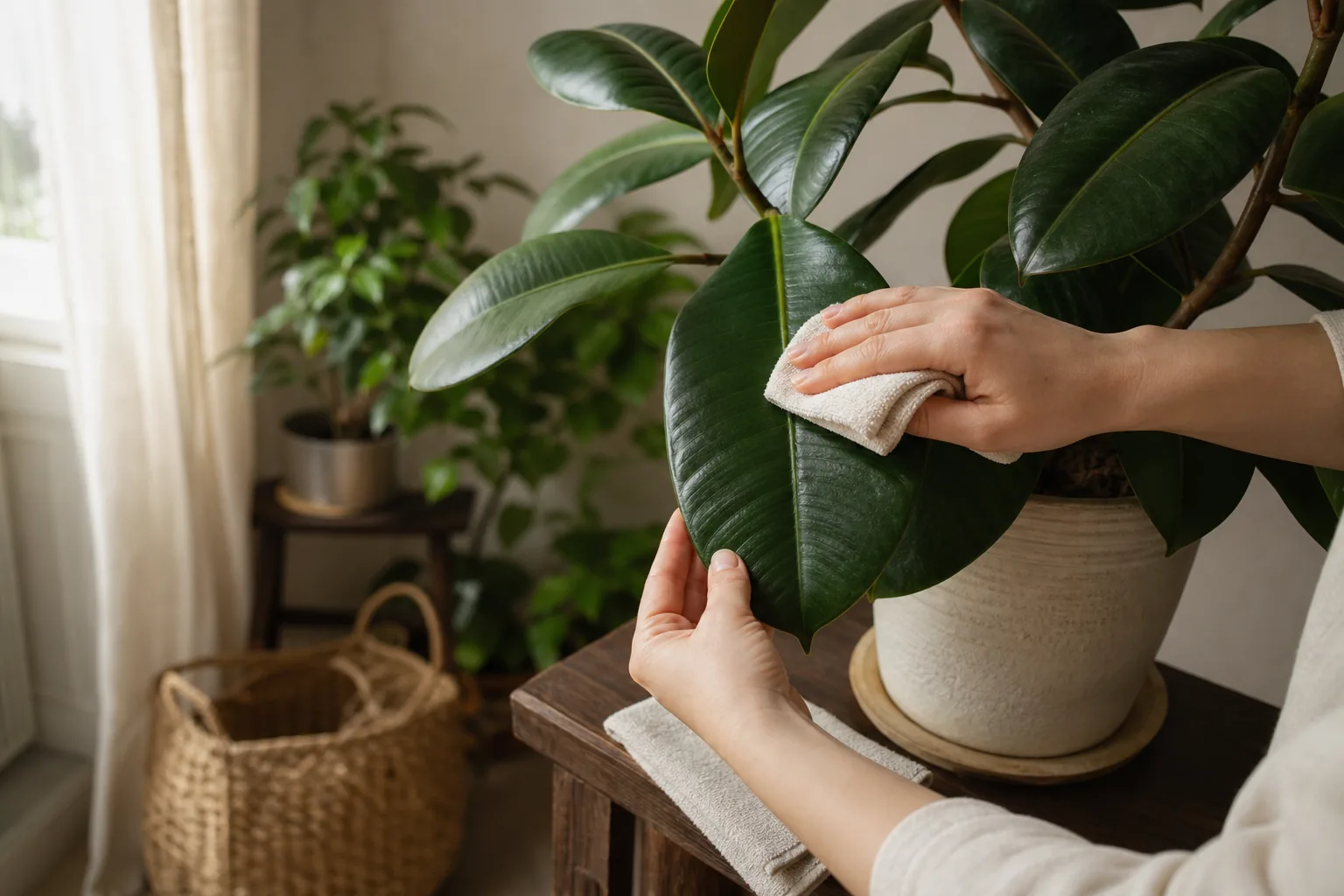
Smooth, broad leaves: damp cloth, shower, or both
For smooth, broad leaves, the method that most university extension services converge on is simple: a soft cloth dampened with lukewarm water, used to wipe both the upper and lower surfaces of each leaf. The University of Florida IFAS, Clemson Home & Garden Information Center, and University of Minnesota Extension all describe some version of this approach. It is the default because it gives you control, lets you support the leaf from underneath with your free hand, and removes dust from both sides of the leaf where pests like to start.
A practical sequence:
- Use a clean microfiber cloth. Paper towels can leave fibers, and old rags may carry soap residue.
- Dampen it with lukewarm water and wring it out so it is damp, not dripping.
- Support the leaf from below with one hand. Wipe along the leaf, not across it; on softer or more delicate foliage this is gentler on the surface.
- Flip the leaf or rotate the plant and wipe the underside, where dust, spider mites, and aphids like to settle.
- For a plant with many large leaves, work from the top down so you are not knocking dust onto leaves you have already cleaned.
A short shower or sink rinse is a faster alternative for plants that are easy to move. University of Minnesota Extension describes a quick rinse as appropriate for sturdier varieties. Hold the pot on its side or cover the soil with one hand, use lukewarm water at low pressure, and let the plant dry in bright indirect light rather than in strong direct sun. If you do this regularly, every few weeks is plenty for most homes.
Narrow or grass-like leaves: gentle shake, soft brush, or short rinse
Wiping narrow or arching leaves one by one is tedious and easy to do badly, because the leaves bend or snap. For plants like spider plants, dracaenas, ponytail palms, or peace lilies, a soft brush or a short rinse works better.
- A clean, soft paintbrush or makeup brush swept along the leaf lifts dust without bending it.
- A hair dryer on the cool, low setting, held at a distance, blows dust off without touching the leaf.
- A brief sink or shower rinse, again with lukewarm water and the soil covered, is fine for sturdy plants like spider plants.
Whichever method you pick, the goal is the same: remove the visible dust without forcing the leaf to flex or tear.
Fuzzy or pubescent leaves: do not get them wet
This is the one rule most worth memorizing. African violets, rex begonias, succulents with a powdery farina coating, and other fuzzy-leaved plants have tiny hairs (trichomes) on their leaves that do not handle water well. The University of Florida IFAS is direct about this: hairy-leaved plants like African violets should not get wet, while the rest of the foliage can be wiped with a moist soft cloth. Specialist care sites reinforce the same point for fuzzy plants in general.
The safer approach is mechanical, not wet:
- Use a clean, soft brush — a small artist’s brush, a clean soft-bristled makeup brush, or a soft toothbrush — and sweep dust off gently.
- A hair dryer on cool, low, held at a distance, can lift stubborn dust.
- If a fuzzy leaf is genuinely dirty from a spill or sticky residue, dab rather than wipe, and use as little water as possible, then let it air-dry out of direct sun.
Commercial leaf-shine sprays are covered separately; for fuzzy leaves, the soft brush is the safer default.
Succulents and cacti: dry brush first, short rinse when needed
Waxy succulents like echeveria carry a powdery farina that should not be rubbed off with a wet cloth, and spiny cacti make cloth-wiping both impractical and a small safety risk. The default here is a dry soft brush, the same kind of soft paintbrush used for fuzzy leaves.
A short rinse is reasonable for succulents when the soil is dry and the plant can dry within a few hours in bright indirect light. Cover the soil, use lukewarm water, and tip the pot to drain thoroughly. Cacti can be brushed with a soft brush while keeping fingers and eyes clear of spines; rinsing is rarely necessary, and a damp cloth tends to snag.
How often, and when to skip
Extension services do not give a fixed schedule, because the right cadence depends on the room. A working rhythm that holds up in most homes:
- Every few weeks for broad, glossy leaves in rooms with open windows, forced-air heat, or visible dust.
- Once a month or less for plants in low-traffic rooms or behind glass.
- Less often, or not at all, for fuzzy-leaved plants, where any unnecessary contact is a small risk.
There are also times to skip cleaning entirely:
- A plant that was just brought home, repotted, or moved. Let it settle for a couple of weeks first.
- A plant that is wilting, dropping leaves, or showing new spots. Diagnose before you handle it. If you are unsure what the spots mean, triage leaf spots before treating.
- A plant sitting in strong midday sun. Water droplets on leaves in direct sun can scorch some species depending on light intensity; a south- or west-facing window at midday is the riskiest time. Clean in the morning or evening, or move the plant into bright indirect light while it dries.
What not to use on houseplant leaves
University extension sources do not endorse milk, mayonnaise, mineral oil, olive oil, banana peel, or undiluted vinegar as leaf cleaners. These are commonly cited reasons to avoid them: oils may interfere with gas exchange and can leave a film that attracts more dust, milk and other sugary residues can encourage surface mold, and undiluted vinegar can damage foliage. None of these is recommended for routine care, and skipping them keeps the routine simple.
Commercial leaf-shine sprays are a separate topic with their own trade-offs; if you are weighing one, look for a guide that compares them on their own terms rather than as part of routine dusting.
Hard-water spotting is the other common cosmetic issue. If your tap water leaves white mineral marks on dark, waxy leaves, switch to filtered or distilled water for the rinse, or wipe the leaves dry after rinsing. The spots are not harmful to the plant, but they are visible on rubber plants and fiddle leaf figs.
When to stop and ask a local expert
Cleaning is also a good moment to look closely. If you notice sticky residue, fine webbing, tiny moving specks, or unexplained spotting, you are looking at a different problem than dust, and the right next step is identification rather than more cleaning. Local independent nurseries, university extension offices, and master gardener hotlines can confirm what you are seeing. Houseplant care is also not a substitute for medical or veterinary advice if a child or pet has eaten part of a plant; contact a qualified local or emergency resource in that case.
A small, slow routine is what keeps this from becoming a chore. One soft cloth, lukewarm water, a soft brush in a drawer, and a few minutes during the weekly look-over is enough to keep the dust from becoming a problem in the first place.
Sources
- Caring for Houseplants — University of Florida IFAS Gardening Solutions
- Indoor Plants — Cleaning, Fertilizing, Containers & Light Requirements — Clemson HGIC
- Spring into houseplant care — University of Minnesota Extension
- How to Clean Fuzzy-Leaved Houseplants Safely — Healthy Houseplants
- Assessment of Atmospheric Leaf Dust Accumulation of Indoor Plants — Dinesh Kumar et al., Biofronteira