Plant care
White fuzzy growth on houseplant soil: what it is and what to do
· Updated
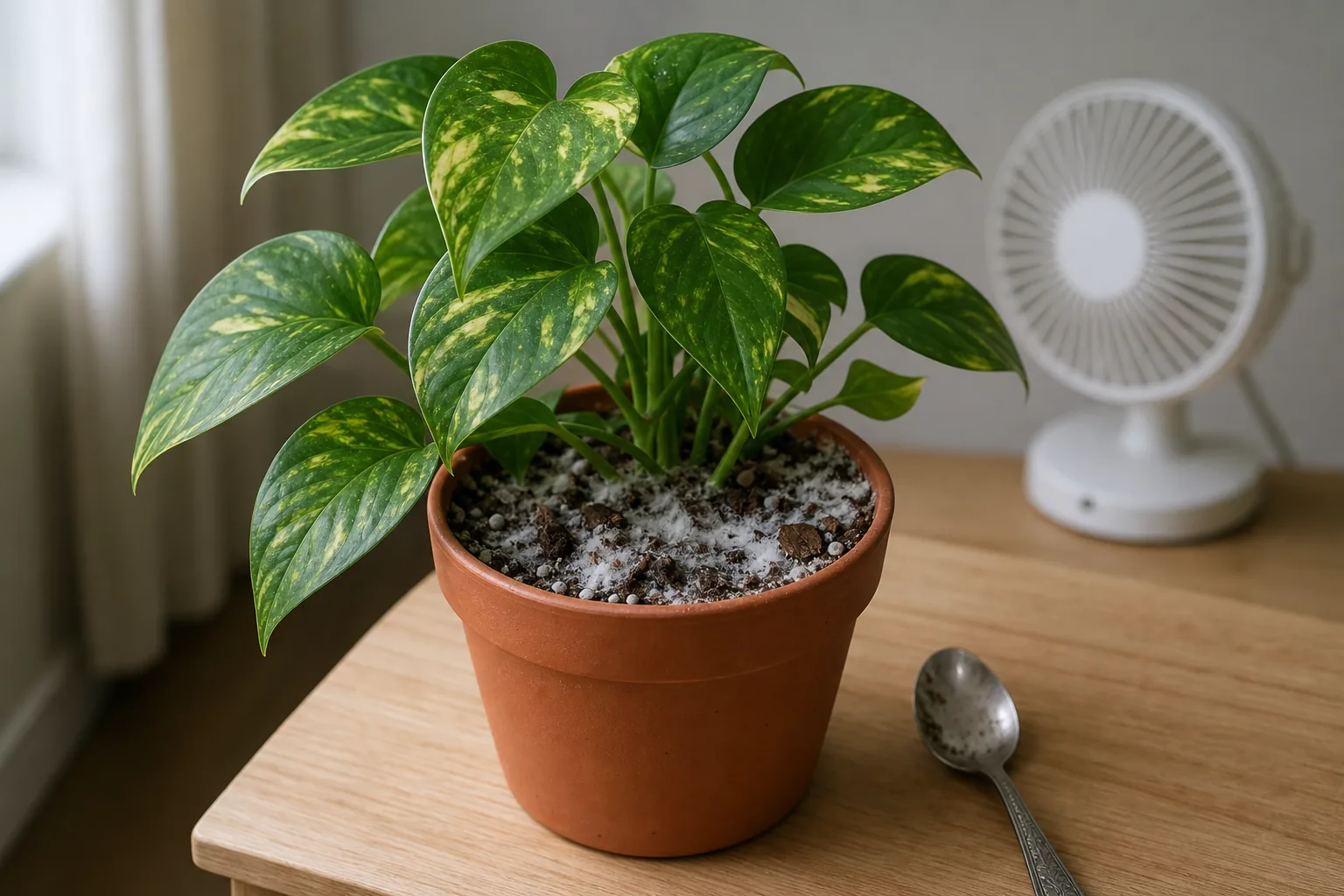
The white, fuzzy growth on the surface of houseplant potting mix is almost always the visible mycelium of saprophytic fungi. These organisms feed on dead organic matter in the mix, not on living plant tissue, and they are not the same thing as the “black mold” people worry about indoors. The growth is a moisture and airflow signal, not a plant disease diagnosis.
What the white fuzzy growth on houseplant soil usually is
The cottony film, cobweb-like strands, or powdery white fuzz sitting on top of your potting mix is most often fungal mycelium. Mycelium is the thread-like body of a fungus, the part that grows before any visible mushroom or spore structure appears. The UC ANR Master Gardener column notes that most soil fungi and bacteria are saprotrophs, meaning they digest only dead matter.
A few things feed the appearance at the same time:
- A potting mix rich in organic matter, which is what most peat-based mixes are designed to be
- A surface that stays damp for long stretches between waterings
- Limited airflow around the pot, especially in a still corner or a closed room
- Surface debris such as dropped leaves, shed flower petals, or bark fragments that the fungus can colonize first
Extension sources list high moisture, high humidity, poor drainage, and high organic matter as the conditions that favor fungal growth in potting soil. Most packaged potting soils are sterilized before sale, so visible surface fungi most often appear after the substrate has been kept too wet at the surface. Over the long term, switching to an airy, well-drained mix reduces how often the surface stays wet enough for spores to germinate.
How to tell it from the common look-alikes
Not every white thing on houseplant soil is fungal mycelium. Three look-alikes come up often, and each one points to a different response.
- Mineral salt crust. Hard, crystalline, and crusty to the touch, often concentrated at the rim of the pot where water evaporates. It does not rub off as a fibrous mat. This is the look-alike covered in our guide on reading the white crust on houseplant soil.
- Perlite. Hard, lightweight white granules mixed through the soil. Perlite is an intentional ingredient, not a problem, and it does not grow, spread, or change shape over time.
- Mealybugs. Soft-bodied insects with a waxy, cottony coating, described by Wisconsin Horticulture Extension as fluffy white blobs on houseplants. Mealybugs move when disturbed, may show a faint body shape, and often appear on stems and leaf joints as well as on the soil.
A useful test is the touch test. Surface mycelium scrapes up as a fine, dusty mat of fibers. Mineral crust does not. Perlite stays in hard pieces. A mealybug leaves waxy residue on a cotton swab and may crawl away within a few seconds.
Whether “white mold” actually harms the houseplant
In most cases, surface mycelium is not attacking the plant itself. Saprophytic fungi feed on dead organic matter in the mix, while plant pathogenic fungi attack living host tissue. Extension plant disease references note that saprophytic fungi may live their entire lives on decaying organic matter, and that the two lifestyles are biologically different.
There is an honest caveat. Ohio State Extension’s fact sheet on fungal diseases describes a third category, the facultative saprophyte, which usually lives as a parasite but can shift to dead organic matter when conditions allow. That is why the practical response below treats persistent surface growth as a moisture signal worth addressing rather than a verdict that the plant is safe or unsafe.
Surface presence alone is not a diagnosis of root rot, and it is not a sign of a toxic indoor mold problem. Extension publications do not describe it that way, and the proportionate response is observation and cultural change, not a chemical first strike.
Common conditions that let surface fungi appear
The explanation is consistent across the extension sources cited at the bottom of this article.
- The top of the mix stays wet for too long after watering.
- Air is not moving around the pot.
- The mix itself is fine and organic-rich, which holds moisture.
- Surface debris, such as dropped leaves and old flower petals, is left to break down in place.
If more than one of these is true for a given pot, the surface is offering the warmth, moisture, and food that fungal spores need to germinate. Two plants in the same room can behave differently because of mix, pot size, airflow, and watering rhythm, which is why it helps to compare similar pots side by side before deciding which one needs to change.
A proportionate, indoor-safe response
The home response is layered and low risk. The aim is to remove the visible growth, change the conditions that let it appear, and watch whether it returns.
Scoop off the visible growth. A spoon or a gloved finger lifts the top half inch of mix or just the fibrous mat itself, depending on how thick it is. Bag it and throw it away rather than composting it indoors.
Let the top inch of mix dry between waterings. UMD Extension is the clearest source here, recommending that the surface of indoor plant media be allowed to dry between waterings to prevent algae and fungal growth. Our guide on watering by observation rather than on a calendar goes deeper on the dry-down rhythm that prevents this kind of surface growth from coming back.
Improve airflow. A small fan set on low, or simply moving the pot a few feet away from a still corner, reduces the humid microclimate that sits right above the soil. Most houseplants tolerate gentle air movement well.
Clear surface debris. Standard indoor plant hygiene is to keep the soil surface free of dead leaves, stems, and flowers, which removes the food source the surface fungi colonize first.
What the layered response does not include is a drench of hydrogen peroxide, cinnamon, baking soda, vinegar, or a brand-name fungicide. None of the extension sources cited below recommend these as a primary treatment for surface fungi on houseplant soil, and a chemical-first approach can get in the way of the much simpler moisture-and-airflow fix.
When the appearance points to a broader overwatering problem
Surface fungal growth is a moisture signal at the soil surface. It is not, by itself, proof of root trouble. It is worth treating the appearance as a broader overwatering signal if any of the following is also true:
- The growth keeps returning within days of being scraped off
- The mix smells sour or stagnant rather than earthy
- The pot stays heavy for many days after watering, which suggests the whole root zone is wet
- The plant is showing yellowing lower leaves, soft stems at the soil line, or other decline
If those signs appear together, our guide on telling overwatered from underwatered houseplants before you change anything walks through the ordered inspection. Drainage and how long a pot stays wet is often part of that picture, since a pot without a clear path for water to escape keeps the whole root zone damp. Repotting is a downstream step to consider only if the root zone itself is staying wet and the plant is not recovering with surface changes alone.
When to ask a local nursery or extension office
A local resource is the right next stop if any of these apply:
- You are not sure whether what you are seeing is mycelium, mineral salts, perlite, or mealybugs, and you would like a second set of eyes
- The plant is also declining, with wilting, leaf drop, or stem rot at the soil line
- The growth returns immediately after every scrape, even after moisture and airflow changes
- You suspect a pest as well as fungal growth, since mealybugs at the soil line need their own treatment
A local nursery, a master gardener program, or a university extension office can look at a sample or a clear photo and tell you what you are actually seeing. If pets or people have eaten any part of an affected plant, contact a qualified local or emergency resource rather than relying on a blog post.
A short checklist for today
- Pause and identify. Is the white growth fibrous (mycelium), crusty (mineral salts), granular (perlite), or cottony and moving (mealybugs)?
- Scoop off the visible growth and bag it.
- Let the top inch of mix dry before the next watering.
- Move the pot to a spot with gentle air movement, or set up a small fan.
- Clear any dropped leaves, stems, or flower petals from the soil surface.
- Revisit in a week. If the growth returns, treat it as a moisture-and-airflow problem and check the broader overwatering signals.
Surface white fuzz on houseplant soil is a common, almost always harmless signal that the top of the mix is staying too wet and the air is too still. A few low-risk changes to airflow and watering rhythm are usually enough to keep it from coming back.
Sources
- Algae and Fungal Growth on the Soil of Indoor Plants — University of Maryland Extension
- Fungi in Your Garden — UC ANR Napa Master Gardener Column
- A Basic Guide to Mushrooms Commonly Encountered in Potting Soils — University of Florida IFAS Extension
- Mealybugs — University of Wisconsin Horticulture Extension
- Fungal and Fungal-like Diseases of Plants — Ohio State University Extension