Plant care
Why water runs straight through houseplant soil, and how to fix it
· Updated
When water runs straight through a houseplant pot and the leaves stay droopy or crispy an hour later, the most common cause is a dried-out, hydrophobic root ball. The potting medium has pulled away from the pot, the organic particles have dried so far that they shed water instead of absorbing it, and your routine pour is essentially running down the sides and out the bottom without wetting the middle.
This usually happens after a long gap between waterings, after a heat wave or a dry indoor winter, or in a pot that has been allowed to dry fully for a week or more. The good news is that it is normally fixable without repotting, and the fix is rarely more water poured faster.
Quick checks before you rehydrate
Fast drainage is not always a problem. Before treating anything, rule out three other explanations:
- The mix is coarse by design. Orchid bark blends, cactus mixes, perlite-heavy aroid mixes, and most fresh bagged mixes for plants that like airflow drain quickly even when properly moist. Lift the pot right after watering. If it feels meaningfully heavier than before and the foliage looks fine, the medium is doing its job.
- The mix is newly repotted. A fresh mix can take a few waterings to settle and hold moisture evenly, and in practice a second slow pour a few minutes after the first often helps.
- The drainage holes are partially blocked, or the pot is sitting in standing water that has nowhere to go. Lift the pot and look. If the saucer is permanently full, that is a different problem (overwatering), not a hydrophobic one.
To confirm a hydrophobic root ball specifically, push a chopstick or your finger into the center of the pot after a normal watering. If it comes out dry and dusty in the middle while the surface looks wet, the water channeled around the outside. You may also see the medium visibly pulled away from the pot wall, leaving a gap you can feel with a finger.
If you are unsure whether the symptoms you are seeing are actually drought or could be soggy roots, the comparison of overwatered and underwatered houseplants walks through both sets of signs so you can be sure before adding more water.
Rehydrating a dry root ball step by step
Work through these in order. Most plants respond to the first one or two; the third is a last resort.
Slow top-watering for mild cases
Pour a small amount of room-temperature water over the surface, pause for a minute, then pour a little more. Repeat until water begins to exit the drainage holes. The pause gives the medium time to absorb instead of letting water run straight down the channel between the dry mix and the pot wall. This works for moderately dried pots and is the least disruptive option.
Bottom soaking for most cases
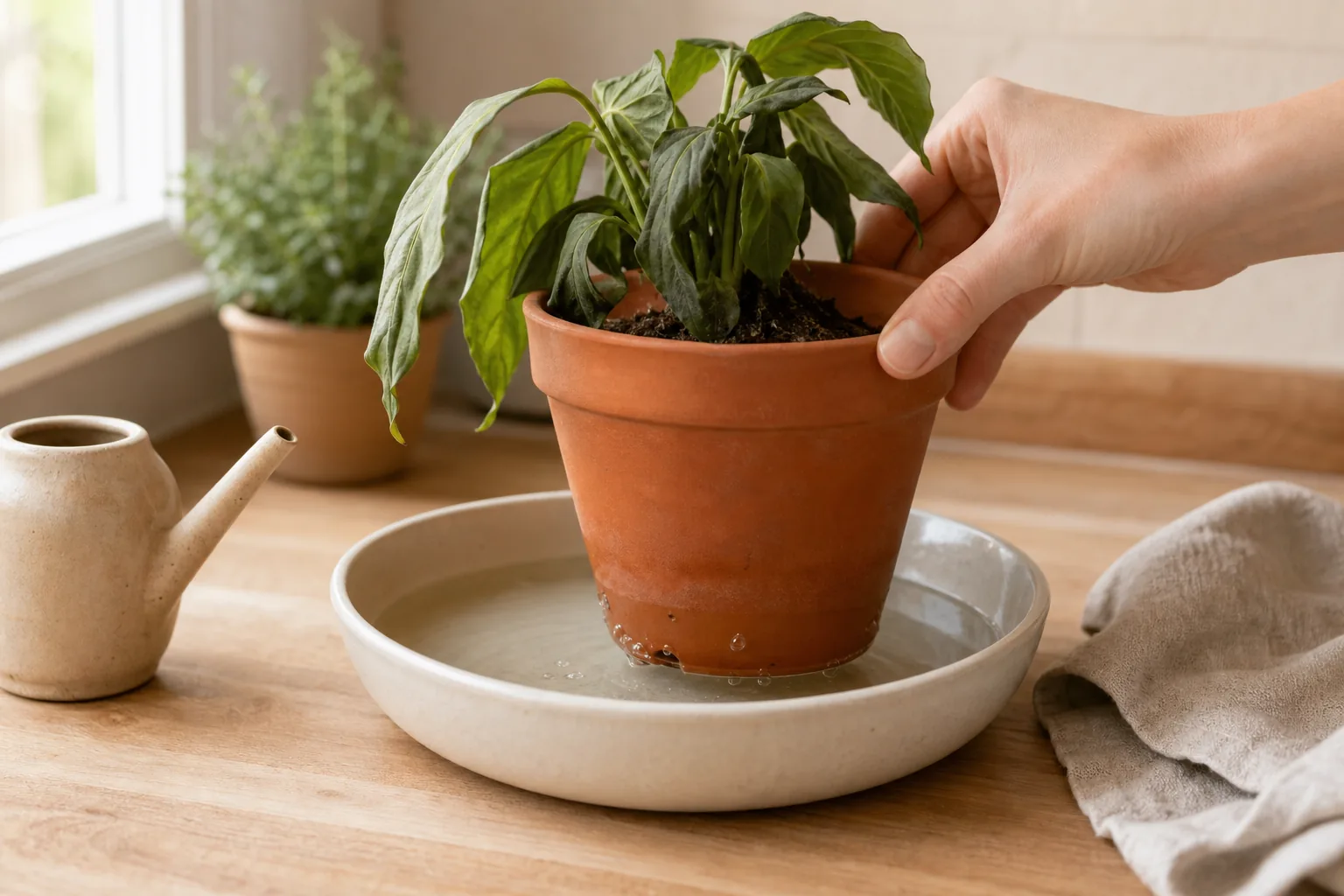
Set the pot into a tray, bowl, or sink filled with a few centimeters of room-temperature water. Let the medium wick moisture up from below. The UC Master Gardeners of Santa Clara County specifically recommend bottom watering for hydrophobic soil because it bypasses the channeling problem entirely. A small pot usually wicks through in 10 to 30 minutes; a larger or very dry pot may need 30 to 60 minutes. The visual cue is the top of the medium becoming visibly damp. Lift the pot to feel the weight before and after — a noticeably heavier pot confirms the soak worked.
Full submerge of the pot for severe cases
If the center of the root ball is still dry after a bottom soak, lower the entire pot into a bucket of room-temperature water until the waterline reaches just below the pot rim. Hold it down so it does not float. Wait until bubbles stop rising, then leave it submerged for a few more minutes so the center of the root ball becomes saturated. Lift the pot out and let excess drain freely for at least 10 to 15 minutes before returning it to its saucer. Proven Winners uses this approach when a pot has visibly pulled away from the sides and the medium has lost contact with itself.
Use room-temperature water throughout. Cold water can shock roots, especially in tropical foliage plants, and is widely discouraged. After any method, let the pot drain freely. Do not leave the pot sitting in standing water for more than about an hour, since roots need oxygen as well as moisture.
When one rehydration is not enough
Some root balls need a second pass. If the foliage looks unchanged a day after the first soak, repeat the bottom soak or submerge once more, then wait. If two full soaks do not produce visible improvement and the medium still feels light and dry in the middle, the problem is likely the medium itself or a tightly root-bound mass. That is when to escalate to a mix refresh or repot.
Aftercare for the next one to two weeks
Rehydration is not instant. Expect to see new growth and more upright leaf posture over roughly one to two weeks if the root system is healthy. Existing damage — brown leaf tips, crisped edges, fully yellowed leaves — will not reverse. Those tissues are gone, and only new leaves will reflect improved conditions.
During the recovery window:
- Water again when the top 2 to 3 cm of medium feels dry, not on a fixed schedule.
- As a rule of thumb, hold off on fertilizing for a few weeks while the plant recovers — stressed roots can react badly to nutrient salts.
- If you have been bottom-watering regularly, top-water once every few months to flush accumulated salts from the root zone. Missouri Botanical Garden recommends this every 3 to 4 months for plants that are usually bottom-watered.
When a potting mix refresh or repot is the better answer
Soaking works while the medium still has structure. It stops working when the mix itself has failed. Repot or top-dress with fresh mix when you see:
- A compacted, hard-to-penetrate center that does not fluff up after soaking
- Medium that breaks down into fine dust or stays soggy long after watering
- Roots circling the bottom of the pot or visible at the surface
- Repeated dry-outs within days, even with attentive watering
A tightly root-bound mass channels water around the outside of the root ball in much the same way a hydrophobic mix does, but the cause is structural and a soak will not last. The guide on when to refresh houseplant potting mix covers aged or compacted media in more depth, and our page on signs a houseplant is root bound covers the root-bound side separately so you can tell which problem you are actually dealing with.
Preventing the next dry-out
Three habits reduce the chance of ending up here again:
- A mix that retains moisture without compacting. Peat-based mixes turn hydrophobic more easily when they dry out completely. Components like coco coir, compost, and fine bark hold moisture while still letting air in. The guide on choosing a houseplant potting mix walks through the trade-offs.
- A pot matched to the root mass. Oversized pots hold more moisture than the plant can use; undersized pots dry out faster than the roots can keep up. Repot up only one or two centimeters at a time.
- A steadier watering rhythm. Containers dry out faster than in-ground plants because their root volume is limited. University extension services consistently flag container plants as needing more attentive watering, especially during heat and low humidity. For a baseline check that helps you decide whether to water at all, the guide on how to tell when a houseplant actually needs water is a useful starting point.
Common questions about water running through houseplant soil
Why does peat-based potting mix become hydrophobic? Peat-based media shrink and dry out so completely that they shed water instead of absorbing it. Coco coir is generally described as more resistant to this than peat, though that comparison comes mostly from grower and supplier sources rather than independent university trials. Any organic medium left dry for long enough can become hard to rewet from the surface.
Is bottom watering better than top watering? It is not universally better — both work for plants in good condition. Bottom watering is the more reliable option when the surface has dried and pulled away from the pot, because it lets the medium wick from below instead of relying on the surface to absorb.
Can I add dish soap or hydrogen peroxide to help water soak in? No home remedy is needed for a typical hydrophobic root ball. Soaking and time are enough for most plants. If you do choose to use a surfactant or wetting agent, follow the product label and consider pets and surfaces, since these products are not uniformly endorsed for indoor ornamentals.
How do I know if the medium itself has failed and needs to be replaced? If the center of the root ball stays dry after two full soaks, if the mix has compacted or broken down into dust, or if the plant is severely root-bound, refresh or repot rather than continuing to soak.
How long does it take a plant to recover? New growth and improved leaf posture usually appear within one to two weeks if the roots are healthy. Brown, yellowed, or crisped leaves will not recover — only new growth will reflect the improved care.
Sources
- Watering hydrophobic soil — UC Master Gardeners of Santa Clara County
- How to water indoor plants — Missouri Botanical Garden
- How to water plants in pots — Proven Winners
- Keeping your plants hydrated, responsibly — University of Vermont Extension
- How to water indoor plants wisely — Des Moines Botanical Garden