Plant care
How to water a large indoor plant without lifting the pot
· Updated
Most watering problems with large floor plants are not really about watering. They are about logistics. A 12 or 14 inch nursery pot filled with a mature Monstera, Ficus, Dracaena, or fiddle leaf fig is awkward to move, heavy when dry, and heavier still when wet. The surface area is wide enough that a single fast pour tends to run down the inside edge and out the drainage hole before the middle of the root ball has seen any water. The room around the pot is rarely built for spills.
The good news is that almost every large houseplant can be watered well in place. The trick is to slow the pour down, distribute it around the whole surface, give the mix a few minutes to absorb between passes, and let the pot drain freely into a deep saucer. The other trick, and the one most readers with large plants do not have a name for, is a hand-tilt weight check: a partial tip of the pot, just enough to feel whether it has gained weight, is enough to confirm a successful watering without lifting the whole thing off the floor.
This article focuses on the how. If you are not yet sure whether the plant is ready for water, the practical starting point is in our guide on how to tell a large houseplant actually needs water.
Why large houseplants are awkward to water
A 10 inch or larger nursery pot holds a lot of potting mix. The wider the surface and the deeper the column, the more water it takes to wet the whole root ball, and the longer that root ball takes to dry out again. University extension guidance is consistent on this point: larger containers do not dry as fast and need less frequent watering, but when you do water, you need to wet the whole column through to the drainage holes (NC State Extension).
The practical snag is the moment between “dry” and “wet.” When a potting mix dries, it shrinks slightly and pulls away from the inside wall of the pot. That gap becomes a channel. If you pour a full can of water quickly into a very dry large pot, much of it will take the path of least resistance down those side channels and exit the drainage hole, while the middle of the root ball stays closer to dry (Grow Tropicals). The result looks like a successful watering because the saucer filled up, but the plant still has dry roots in the middle.
A second snag is the room. Hardwood, tile, and low-pile carpet do not love a flood. A standard nursery-pot saucer is often too small or too shallow to hold the runoff from a generous pour on a big pot, and an under-sized saucer is a common cause of floor damage that has nothing to do with the plant.
Decide where the water will happen: in place or moved
For most large plants, in-place watering is the default. The pot stays where it lives, the saucer catches the runoff, and the reader does not have to lift anything they cannot comfortably lift.
The move-to-tub, move-to-shower, or move-outdoors option is for occasional use: a deep rescue soak for a plant that has gone severely dry, a refresh of a very root-bound or compacted root ball, or simply a convenient watering on a covered porch in warm weather. A wet nursery pot is noticeably heavier than a dry one, and a tall plant on a wet pot is also more top-heavy and easier to tip. If moving the plant feels like a strain, treat it as a sign to keep the watering in place and use the methods below.
Plant dollies and rolling saucers sit in between. They are a tool category worth knowing about for readers who can manage one safely in their home. They do not remove the wet-weight problem, and a tall, leafy plant on a rolling stand loaded with runoff is a stability concern, so use them with the same caution you would use to roll any heavy object across a floor.
In-place watering: a slow, repeated pour
This is the everyday method for a large floor plant. It is also the method that extension services are pointing at when they say to apply enough water to reach the bottom of the container and let the excess drain out (Illinois Extension; UConn Soil Testing Lab).
The shape of the method looks like this:
- Use a watering can with a long spout, so you can reach the soil surface without leaning into the foliage or knocking the pot.
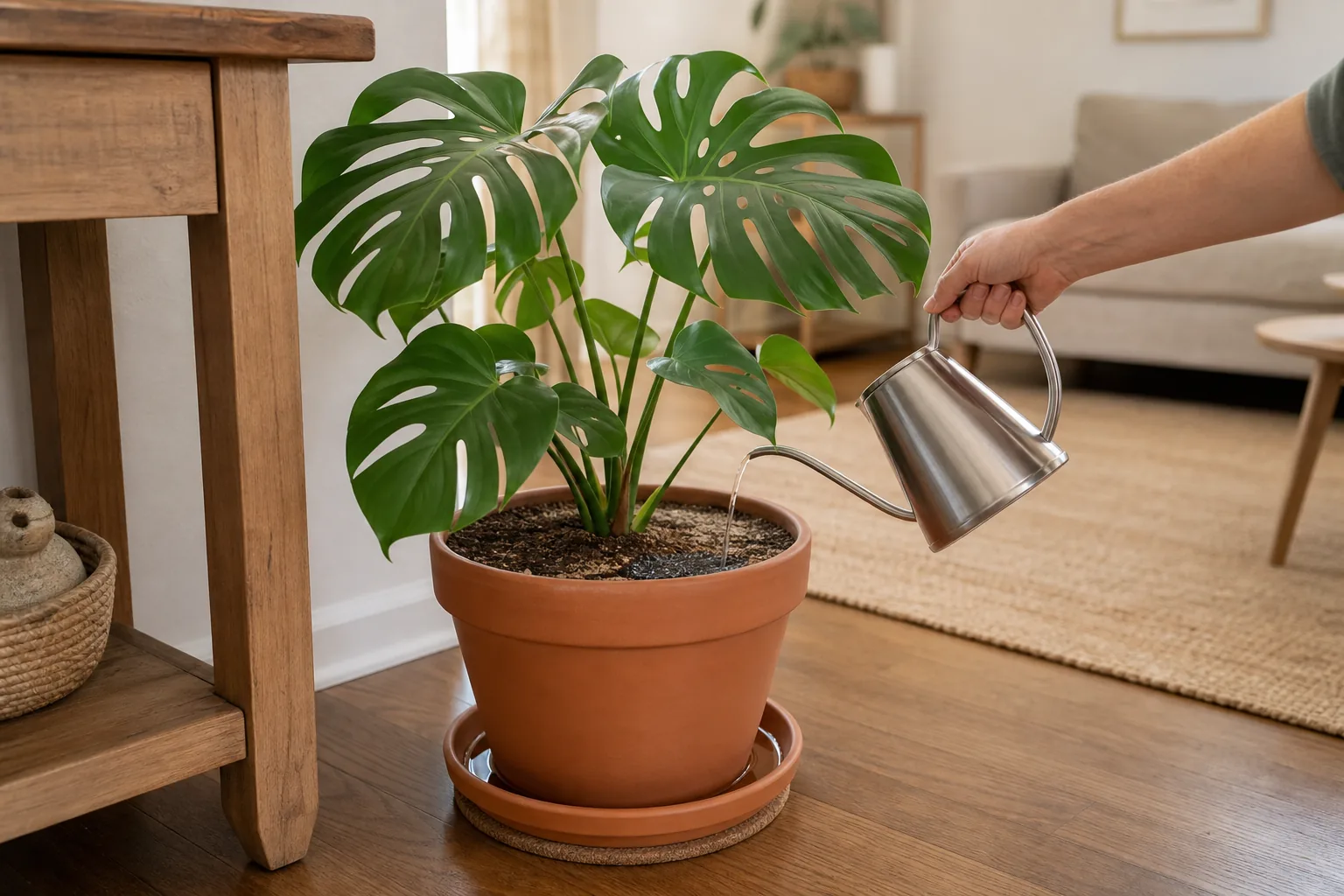
- Pour slowly, in a circle, around the entire surface of the soil, not just over the spot directly under the spout. The goal is to rewet the whole top layer before any of it can run down a side channel.
- Pause when you see water reach the saucer. Give the mix a minute or two to absorb what is already there, then pour another slow pass.
- Stop when the saucer fills at a steady, gentle pace rather than a gush, and the surface of the mix looks evenly darker all the way to the pot edge.
The pause-and-rewet idea is the heart of the technique. It is what stops the channeling problem that makes fast-poured water exit the drainage hole almost immediately. If you pour in a hurry, you are mostly just refilling the saucer.
In-place watering: saucer and tray absorption
A deep saucer is mostly a runoff-management tool, not a watering tool on its own. Used briefly, it has a real job. The distinction is between a short absorption window and a pot that sits in standing water for days.
A short absorption window looks like this: you finish a slow pour, the saucer fills, and the pot sits in that runoff for roughly 10 to 20 minutes so the lower root zone can wick up the last of the water. Then you empty the saucer. This is a reasonable way to finish a routine watering for a plant that responds well to it, and it is also a gentle way to rewet a very dry large pot without lifting it.
The other situation, a pot left sitting in a saucer of standing water for days, is different. The lower root zone stays saturated, the air space in the mix shrinks, and the plant is exposed to the conditions that lead to root rot. Extension and consumer sources treat prolonged standing water as a real risk, and a saucer that is too small just makes the situation worse by overflowing onto the floor.
For the cachepot and saucer decisions that shape all of this, the practical guide is in our piece on how the pot and cachepot setup changes runoff.
In-place watering: a controlled bottom-up soak
For a very dry, root-bound, or hydrophobic large pot, a slow top-down pour can be a fight. The mix is so dry that the side channels reopen as fast as you fill them, and you can end up pouring for a long time without the middle of the root ball actually accepting much water. University extension services recommend bottom-watering in this situation: setting the pot in a shallow container of water and letting the soil wick up through the drainage hole (UC Master Gardeners of Santa Clara County).
For a large floor plant, the practical version of this is a controlled soak in a deep tray, a bathtub, or a shallow storage tub. A few inches of water in the container, the pot set in it, and a long wait. A normal pot typically takes roughly 10 to 20 minutes to wick up enough water; a large or very dry pot can take significantly longer, often 30 minutes or more, and the time is best treated as a range rather than a fixed rule.
The cues that the soak is done are observational, not clock-based:
- The soil surface has darkened evenly all the way to the pot edge, not in patches.
- The pot feels distinctly heavier on a hand-tilt than it did at the start.
- The top of the mix is damp to a finger pressed about an inch below the surface, which is the standard moisture check extension services describe (UConn Soil Testing Lab).
Two caveats are worth keeping in mind. First, bottom watering does not flush dissolved minerals and salts from the upper soil the way a top-down watering does, so it should not be the only method used long term (Foliage Factory). Second, a soaked pot is at its heaviest during the move back to its spot. This is one of the situations where a hand-tilt before the full lift is genuinely useful, and one where a plant dolly, if you already use one, earns its keep.
Managing runoff and protecting the floor
The floor-protection part of large-plant watering is unglamorous but real.
- A deep saucer that fully covers the base of the pot, with a small lip, holds a meaningful volume of runoff and keeps it from creeping under the pot onto the floor.
- A plant tray with a raised edge does a similar job and is easier to slide out from under a heavy pot to empty it.
- A square of cork, a waterproof mat, or a small boot tray under the saucer catches splash and any overflow that escapes the saucer during a long pour.
- Empty the saucer not long after the watering is done, typically within half an hour or so, so the pot is not sitting back in pooled water for the rest of the week.
None of these are required, and the right combination depends on the pot, the saucer that came with it, and the floor. The point is to treat runoff as something to be caught and emptied, not something to be ignored.
How to tell the root ball actually got wet
This is the part of large-plant watering that does not have a good substitute. With a small pot, you can pick it up and feel the weight. With a large pot, you usually cannot, and the reader is left guessing.
Three observational checks together are usually enough to confirm a successful watering on a stationary pot:
- The surface has darkened evenly. Wetted potting mix shifts from a light tan or grey-brown to a noticeably darker, more uniform brown. Patchy darkening, with light spots near the rim and dark spots near the middle, is a visual clue that water is following old channels rather than soaking evenly through the root ball.
- Drainage appeared within a minute or two. In most mixes and room conditions, a slow pour should produce a steady but gentle flow into the saucer within roughly a minute or two. Water that exits the drainage hole almost immediately, especially after a long pause, is a sign that channels have reopened and the middle of the mix is still dry. This is the situation that calls for a pause, a second slow pass, or a brief bottom-up soak.
- The pot has gained weight on a hand-tilt. Tipping a large pot a few inches onto one edge, just enough to feel the strain in your hands and forearms, is enough to feel the difference between a recently watered pot and a dry one. A dry large pot feels noticeably lighter than the same pot right after a good watering. This is a partial lift, not a full carry, and is a personal decision based on what feels manageable. If a hand-tilt is too much, the even surface darkening and the finger test at an inch below the surface are the fallback checks.
Reading the result over the next 24 to 48 hours
A well-watered large plant should not sit soggy for days. The surface should dry back evenly over the following days rather than staying wet through the week, and the pot should still feel heavier on a hand-tilt than it did just before watering. Yellowing, drooping that does not recover after a watering, or a sour smell from the mix are signals worth checking rather than signals to water again. Our guide on how to tell if a large plant is overwatered or underwatered covers the symptom-reading side of this in more detail.
Adjusting for season, light, and room
The same large plant may need water somewhere in the range of once a week to once every few weeks, depending on the mix, the light, the pot size, and the season. Pots near a sunny window, a heating vent, or a cold draft dry unevenly, and the way the mix dries is a better cue than the calendar. The check that ties this together is the same one the rest of the article is built on: a hand-tilt of the pot, a finger at about an inch below the surface, and a look at how the surface color has shifted since the last watering.
For readers who want to understand why the same big pot can dry at very different rates from one spot to another, our piece on houseplant temperature, drafts, vents, and sun-heated glass walks through how room conditions shift a large pot’s dry-down.
For readers who want to fit this into a recurring check rather than a one-off project, the weekly houseplant care routine walks through what a realistic look-around actually involves.
Sources
- Watering, Illinois Extension – Container Gardens
- Plants Grown in Containers, NC State Extension Publications
- Watering Houseplants, UConn Soil Testing Lab
- Watering Hydrophobic Soil, UC Master Gardeners of Santa Clara County
- Why does water run straight through my pot without soaking in?, Grow Tropicals