Plant care
How to train a pothos to climb indoors
· Updated
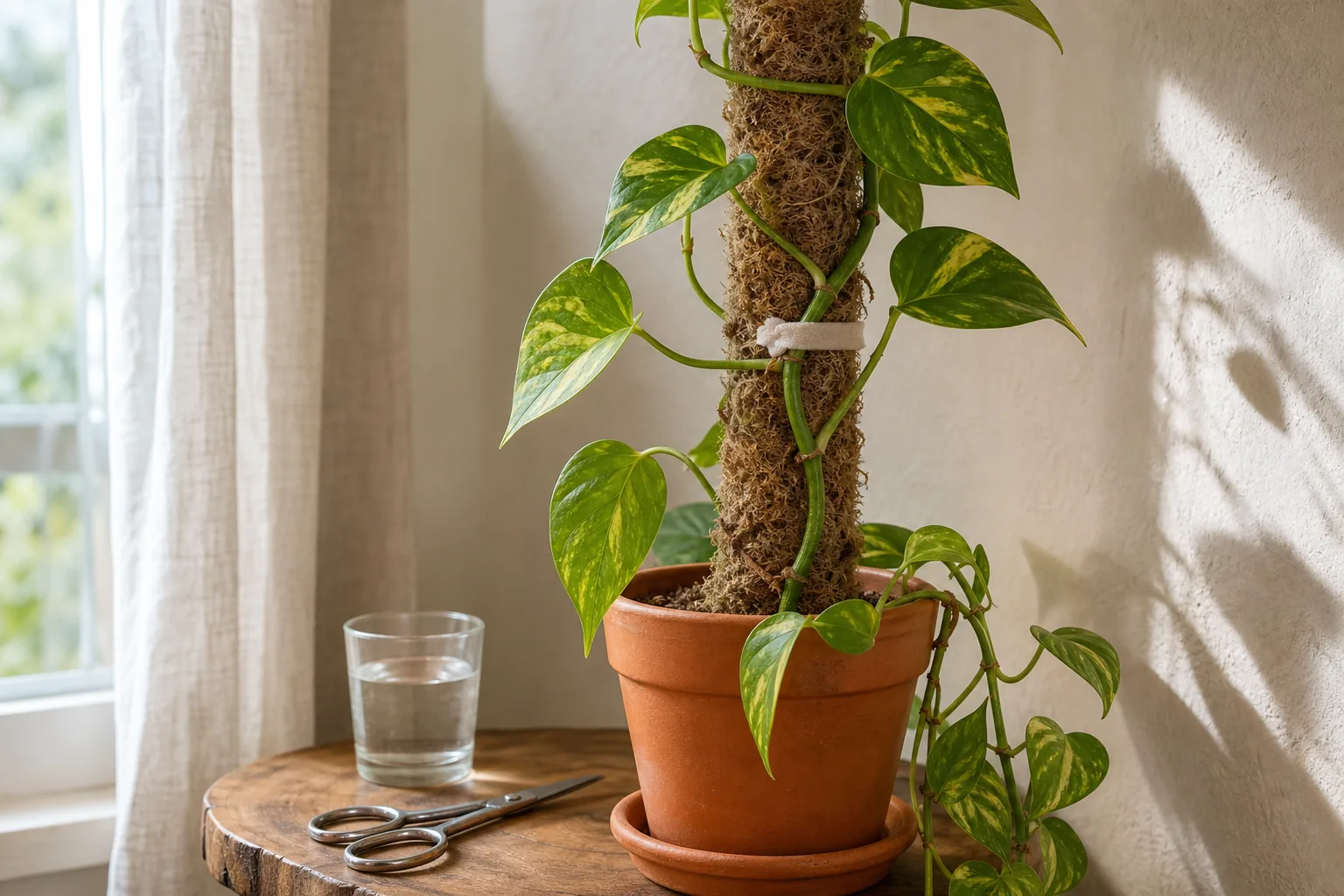
Training a pothos to climb indoors is mostly about anchoring existing stems at their nodes, the points where the leaves and small brown aerial root nubs already sit, onto a vertical support using soft, slack ties. The plant is a natural climber and does not need to be “taught” so much as redirected and held gently against a surface its aerial roots can grip. Light, support choice, and the tying method matter more than any single technique.
If you have a healthy trailing pothos and want to see it grow up instead of down, here is the method that usually works in a normal apartment: identify the node-and-nub pair on your vine, choose a support that matches the room and the light, attach the stem with a soft tie that has a finger-width of slack, and check the ties every few weeks as the stem thickens. The rest of this article walks through each step in order.
What “training a pothos to climb” actually means indoors
Indoor pothos (Epipremnum aureum) is a climbing aroid. In its native range it scrambles up tree trunks using the small brown aerial roots that grow along its stems. Indoors it does the same thing if you give it a surface to grip, which is why a healthy pothos on a shelf often sends out long vines that seem to be searching for something to hold.
“Training” the plant to climb, then, is not really training in the way you would train a pet. It is more like redirection: you place a vertical support next to the vine, lay the stem against it, and hold the stem in place at the right spots until the aerial roots do their own work. Most of what you are doing is removing the friction between the plant and a place to grow.
Realistically, what changes indoors is a denser top canopy and sometimes modestly larger leaves than a starved, long-trailing vine. What does not usually change is the dramatic, foot-long fenestrated leaves you see in social media photos. Those are almost always the product of sustained bright light and many months or years of growth, not just a pole.
Pothos anatomy that matters: nodes, internodes, and aerial root nubs
Before you start tying anything, look at a healthy section of vine. You will see three repeating parts.
- The leaf and its petiole, the little stem that connects the leaf blade to the main vine.
- A small joint on the main vine, just behind the petiole, where the leaf, a potential new shoot, and a small brown bump all meet. That joint is the node.
- A small brown bump on the opposite side of the vine from the leaf. That is the aerial root nub.
Between two nodes is a smooth section of stem called the internode.
The aerial root nub is the part that wants to grip a surface. Ties placed right at the node, with the nub pressed against the support, feel more secure and tend to stay put. Ties placed on the smooth internode, or on the leaf petiole itself, tend to slip and can damage the petiole when weighted down by a long vine.
If you have ever propagated a pothos in water, the node is the same point you would have cut just below. Once you can spot a node by eye, the rest of the process is much easier to plan.
Decide the climbing direction before you choose a support
The support should follow the light, not the other way around. A pothos kept upright in front of a bright window will grow faster and fuller than one climbing a dim wall, simply because more of the leaves end up in the useful light. Before you commit to a spot, the reading-natural-light guide is a useful way to check what category of light a wall or window actually delivers across the day, rather than guessing from one quick glance.
If the spot is near a south-, east-, or west-facing window, almost any vertical support will work. If the only space is a blank wall several feet from a window, a climbing pothos will survive but grow more slowly than a hanging one in the same spot, because the wall will shade the back of the vine.
Two practical room patterns to plan around:
- A floor or tabletop pot directly in front of a window. A pole in the pot is the easiest choice, because it moves with the plant and gives the aerial roots a continuous vertical surface.
- A wall behind or beside a piece of furniture. A trellis, a set of removable wall hooks, or a pole mounted in a separate base can all work, with the trade-offs described next.
Support options that fit ordinary rooms
There is no single right support. The honest answer is a trade-off.
- Sphagnum moss pole. Holds the most moisture, gives aerial roots an easy surface to grip, and looks natural. The downside is that it needs regular misting or soaking in dry indoor air, and a constantly wet pole in a cool room can grow surface mold. Dampen it when you water the plant rather than on a fixed schedule.
- Coir or coco-coir pole. Sturdier, cleaner, and drier than moss. Aerial roots will not grip it as readily, so you will need to use ties a bit longer. A good choice for renters or anyone who does not want to maintain a damp pole.
- Wooden or metal trellis. The sturdiest option if your pot is deep enough to anchor it. No moisture to maintain, but the flat plane often looks tidier than a round pole. Most readers will need to keep ties on the vine for the life of the plant.
- Removable wall hooks or adhesive cleats. Good for spreading a vine across a wall, and the only realistic option if the plant is not in a deep pot. The catch is that pothos aerial roots will grip paint, plaster, and drywall given enough time, and can pull off paint or leave marks when the vine is removed. Use removable hardware, expect to do some touch-up paint eventually, and check your lease if you rent.
For a deeper look at choosing and anchoring supports in a normal room, the general climbing-houseplant support guide goes through each option in more detail.
How to attach pothos stems without breaking them
The actual tying is the part that scares most readers, because a long pothos vine feels fragile. In practice the stem is tougher than it looks, and the leaf petioles are the part that snaps first.
A method that works on almost any indoor pothos:
- Lay the vine along the support with the aerial root nubs facing the support surface. You may need to gently rotate the stem.
- Pick a node roughly every 10 to 20 cm along the vine, depending on how long your support is and how straight you want the line.
- Hold the stem at the node, not at the internode, and not by the leaf.
- Loop a soft tie, such as Velcro plant tape, soft garden twine, or a strip of old fabric, around the support and the stem, and close it with a finger-width of slack. The stem should be held, not pinched.
- Skip every other node if the vine is long. Anchoring every other node is enough to keep the line tidy and lets the plant keep some natural movement.
Materials to avoid: wire twist ties, thin zip ties, rubber bands, and hair elastics. All of them concentrate pressure on a narrow line, and pothos stems swell as the vine matures. A tie that was loose in week one can girdle the stem by the end of the season, killing the section of vine beyond it.
Plan to revisit the ties every few weeks during the active growing months and loosen or reposition any that feel snug. The first sign of a too-tight tie is usually a slight indent in the stem, followed by yellowing leaves on the section beyond.
Light, water, and care after training
Once the plant is upright, the light it receives changes. The top of the vine is now closer to the brightest light in the room, and the base is often more shaded than it was on a shelf. A quarter-turn of the pot every week or two keeps growth even. The reading-natural-light guide is a useful reference if you are not sure how much light the new climbing position actually delivers compared with the old trailing one.
The root ball also dries differently. A pole in the pot shades the surface of the mix and can slow evaporation, while a vine spread across a wall behind a sunny window can pull moisture faster than a trailing vine would. The room-based pothos care guide covers the baseline for light, water, and feeding, and the watering-by-feel guide is the simplest way to keep the rhythm honest: check the top couple of centimetres of mix, water when it is dry, and adjust as the seasons change.
A new pole is also a good moment to do a quick pest check, especially for mealybugs, which like to settle into the tight spaces where new growth meets a support. Bunched growth against a pole is a common spot to find them, and the mealybug inspection routine walks through what to look for and how to respond without overreacting.
What tends to change, and what usually does not, when a pothos climbs
In a normal apartment, a pothos that has been trained onto a support for several months usually shows a denser top canopy, a fuller silhouette, and somewhat larger leaves than a long, starved trailing vine. Lower leaves on shaded sections of the vine may yellow and drop, which is normal and not a sign of a problem.
What you should not expect from training alone is the dramatic, fenestrated “mature form” you see online. Those leaves are real, but they are usually the product of strong, sustained light, sometimes higher humidity, and a long time on the support. If your room is on the dim side, do not chase that look by tightening ties or over-fertilizing. The indoor form is the form your plant will have, and that is fine.
When training does not work out: how to back out cleanly
A few things can go wrong, and almost all of them are recoverable.
- A stem pops off the support. The tie was probably on the internode, or it was too tight. Re-tie at the nearest node with a soft material and a finger-width of slack.
- A section of vine goes yellow or mushy right at a tie. The tie was too tight, or the stem was crushed. Cut back to the next healthy node with clean scissors and re-train from there.
- The plant looks thinner overall, not fuller. The spot may be too dark for a climbing pothos. Either move it closer to the window or accept that trailing is a better form for that corner.
If a lot of damage shows up at once, a local nursery or extension service can identify what is going on more accurately than a blog post can. Use your nearest independent shop as a starting point.
FAQ: training pothos to climb
Will my pothos get bigger leaves if it climbs? Somewhat, if the light is decent. Climbing alone does not unlock dramatic mature leaves indoors.
Can I attach a pothos to a wall without a pole? Yes, with removable hooks and the understanding that the aerial roots may mark the paint. A pole in the pot is easier to undo later.
My pothos keeps popping off the pole. The tie is probably on the smooth internode, or it is too tight. Re-tie at a node with slack and a soft material.
Is climbing better than trailing? It is a form choice. Both can produce a healthy plant. Climbing gives a vertical statement; trailing gives a cascade.
Sources
- Epic Gardening: Can I Train My Pothos Plant To Climb Walls or a Trellis?
- Our Houseplants: All About Moss Poles and Climbing Supports
- The Spruce: 5 Things to Know About Aerial Roots
- Mossify: Understanding Your Plant’s Support Needs
- The Plant Manual: Pothos Propagation — Where to Cut
- Foliage Factory: Epipremnum aureum — The Story of a Global Green Icon
- Nursery & Garden Supplies: Should My Pothos Climb or Hang?