Plant care
Will this succulent leaf actually grow a new plant?
· Updated
A succulent leaf can grow a new plant only when three things line up: it detached with a clean break where it joined the stem, it came from a genus whose leaves actually carry the growth tissue needed to regenerate, and it was kept dry enough at the base to callus before roots formed. If any of those three are missing, the leaf will almost certainly fail no matter what setup you give it. Even when all three are right, many leaves still don’t make it — so the goal here is to give the ones that have a real chance the best setup, and to recognize the rest as compost.
This post focuses on the leaf itself. For watering, light, and pot decisions on the mother plant, see our general indoor succulent care guide.
Why some succulent leaves grow new plants and others don’t
The single biggest reason a leaf fails isn’t water or light — it’s that the leaf didn’t bring the right tissue with it when it came off the plant.
At the base of each leaf, where it joins the stem, there’s a small zone of cells capable of producing new roots and a tiny plantlet. Botanists describe this as meristematic tissue sitting at the abscission zone — the natural separation point the plant uses to shed leaves. When a leaf detaches at exactly this zone, the tissue comes with it. When a leaf snaps higher up, or tears partway, that tissue is left behind on the stem, and the leaf has no way to regenerate.
That’s why a clean, complete pull is the one thing you can control that matters most.
The clean base: the single biggest predictor of success
Before you do anything else, look at the base of the leaf.
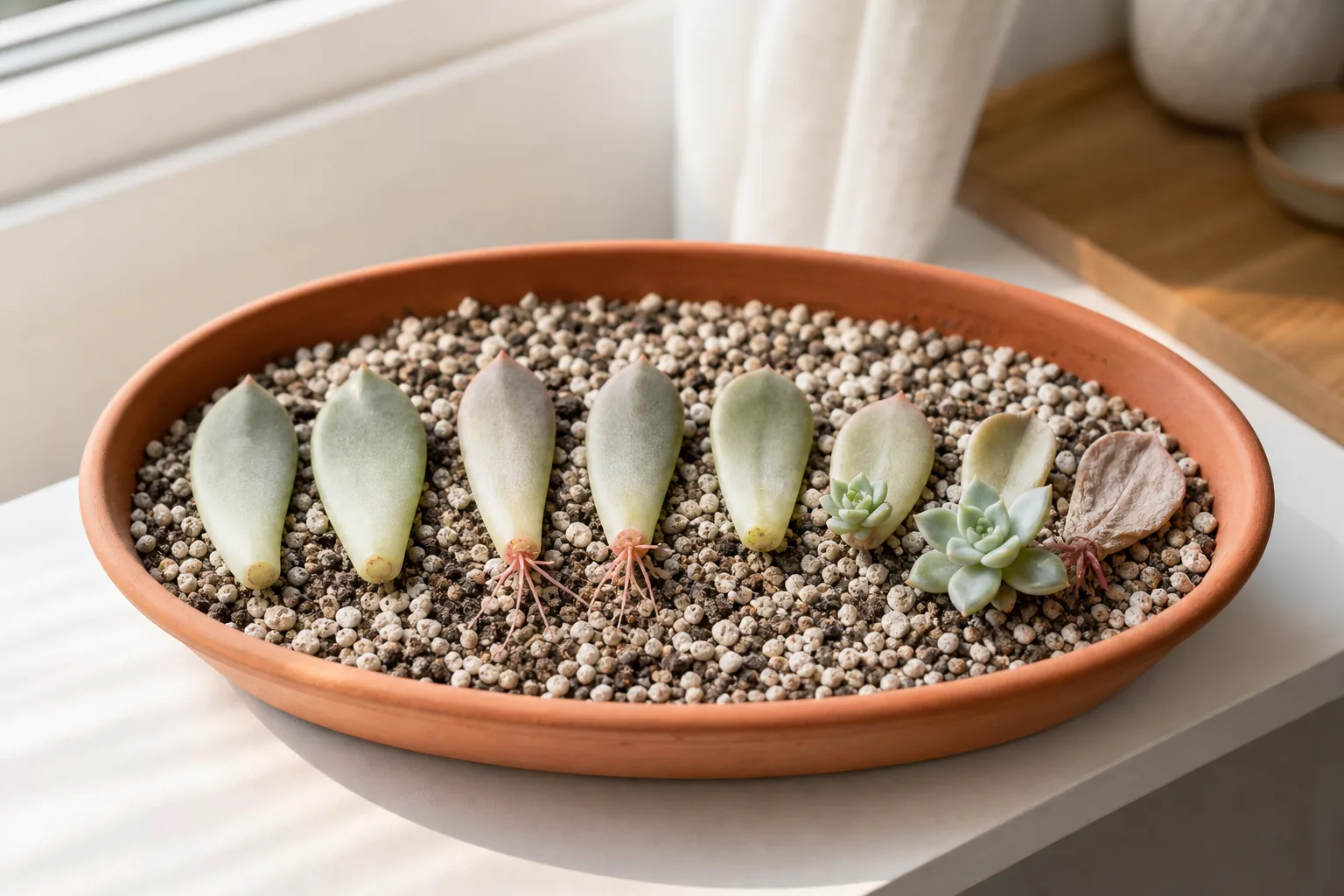
A clean break looks like a small, slightly U- or V-shaped end, sometimes with a tiny sliver of pale stem tissue still attached. The break happened right where the leaf meets the stem.
A bad break looks fibrous, jagged, or partial — a strip of green leaf tissue hanging off, or the break partway down the leaf rather than at the base.
If you have a choice — for example, a stretched rosette you were already planning to behead — pull leaves gently side to side at the base rather than yanking or cutting. The goal is to feel the leaf release cleanly at its base, not to tear it off.
Leaves that fell on their own are a coin flip. Some detach cleanly; others snap partway. Check each one individually and discard any with a torn or partial base.
Genera that usually do propagate from leaves
Across succulent care resources, the genera most often cited as reliable candidates for single-leaf propagation are:
- Echeveria (the classic rosette succulents most people picture)
- Graptopetalum
- Sedum, including many of the small-leaved trailing types
- Pachyphytum
- Some Crassula, including jade-type leaves
The general extension framing backs this up: WVU Extension’s guidance is that most varieties of succulents can be propagated by leaf and stem cuttings, with leaves taking longer to mature than stem cuttings. New York Botanical Garden’s published method describes leaves placed on a moistened, well-drained cactus and succulent mix without restricting to a specific genus, so the list above is horticultural consensus rather than something the lead botanical and extension sources spell out by name.
If your leaf is from one of these genera, is firm and plump, and detached cleanly, it has a realistic chance.
Genera that usually don’t, and why
Many popular indoor succulents are poor candidates for leaf propagation, even when the leaf looks perfect. Horticultural consensus across guides and community resources treats these as unreliable:
- Most cacti
- Agave
- Aloe
- Gasteria
- Haworthia
- Sansevieria, now classified as Dracaena
The biological reason is the same: the meristematic tissue that produces a plantlet isn’t reliably carried through the abscission zone in these genera, or the leaf doesn’t readily regenerate from it once detached. For these plants, the documented fallback is offsets (pups), division, or stem and cane cuttings — not single leaves.
If you’re not sure what genus your plant is, the practical test is the leaf itself: a firm, plump, cleanly detached leaf from a fleshy-leaved rosette or trailing plant is the most likely candidate.
Preparing the leaf: callus, medium, and light
Once you have a clean, firm leaf, the setup is minimal.
Let the base form a callus
Lay the leaf on a paper towel or a dry tray in a spot with bright, indirect light for a few days to about a week. You’ll see the cut or broken end dry to a slightly rough, sometimes pale film. That’s the callus. It’s the leaf sealing itself off, and it’s what protects the base from rotting when it eventually touches a moist medium.
Don’t confuse callus with rot. A callused end is dry and firm to the touch. A rotting end turns soft, translucent, sometimes brown, and may smell. If you see rot, the leaf is gone.
Pick a well-drained medium
New York Botanical Garden’s published method is to lay the callused leaf on the surface of a moistened, well-drained cactus and succulent mix, or to bury the detached end at a shallow depth. NC State Extension’s general propagation guidance reinforces that overly moisture-retentive media, like plain vermiculite, are a poor choice because they pack and hold too much water — the same principle applies here.
You don’t need a deep pot. A shallow tray or small pot with drainage is enough. For how to read a bag label and pick a mix that drains well, see our guide to choosing an airy, well-drained mix.
Use bright, indirect light
The same kind of spot where the mother plant was happy is usually right. Direct sun on a detached leaf is widely reported to dry it out before roots can form.
The waiting period: water timing, signs of progress, signs of failure
Once the leaf is on the medium, the impulse is to do something. Resist it.
Before roots appear
The medium should be just barely moist — not wet, not bone dry. Don’t mist the leaf itself, and don’t water again until the medium has dried out. Overwatering during this stage is the most common cause of failure: the base rots before roots can form. A propagation tray that stays damp for weeks is also a common trigger for fungus gnats, so if the medium feels wet for more than a day or two after each watering, see our guide to avoiding fungus gnats in a damp propagation tray.
After roots appear
Tiny pink or white roots emerging from the callused end are the first real sign the leaf is going to make it. At this point you can begin to water more deliberately, but still by observation rather than on a schedule — the same approach we cover in our guide to watering by observation rather than a schedule.
Plantlet formation
After roots, a tiny rosette usually appears at the base. Some leaves root and never form a plantlet; some form a plantlet without ever showing obvious roots. Both are possible.
How long this takes varies widely — weeks to months depending on genus, leaf condition, light, temperature, and season. There’s no fixed day count to wait for. Extension sources deliberately don’t give one because the range is too wide.
Potting the plantlet without breaking the new roots
When the plantlet is small but visibly established — usually when it has a few recognizable leaves of its own and the mother leaf has started to shrivel — it’s ready to move.
The mother leaf shriveling is normal and is actually a good sign. It’s been feeding the new plant. Don’t detach it prematurely; wait until it’s mostly dried up on its own.
To pot up:
- Use a small pot with drainage and a gritty cactus and succulent mix.
- Lift the plantlet with the mother leaf still attached if possible, keeping roots intact.
- Set it on the surface or in a shallow depression and settle the mix around the roots.
- Wait a day or two before watering so any small root breaks can heal.
After that, treat it as a young succulent: bright indirect light, water by observation, and no fertilizer early. For a conservative timeline on when to start feeding a new plantlet, the short answer is usually to wait until the plantlet has put on visible new growth in its own pot for at least a few weeks.
When leaf propagation isn’t the right method
Leaf propagation is the way to use individual leaves you’d otherwise throw away. It is not the fastest or most reliable route to a new plant. Three situations call for a different method:
- The plant has a stretched, leggy stem and you’re already thinking about beheading. Cut the top, let it callus, and root it as a stem cutting — WVU Extension notes directly that stem cuttings mature faster than leaf cuttings. Our post on why succulents stretch indoors covers why this happens and what to do with the top.
- The plant produces offsets or pups (Aloe, Gasteria, Haworthia, many cacti, Sansevieria). In practice, division of an offset is generally faster and more reliable than trying to root a single leaf from these genera.
- The leaf tore at the base or wasn’t healthy to begin with. Compost it and pick a better candidate.
The honest summary: leaf propagation works often enough to be worth trying with the right leaf in the right setup, but it isn’t magic, and it isn’t the right method for every succulent. Treat the leaves that have a real chance with patience, treat the rest as compost, and use beheading or division when the plant gives you a stem or a pup.