Plant care
South-facing windows and houseplants: how to place plants without leaf scorch
· Updated
A south-facing window is the brightest spot in most homes, and the spot where plant choice matters most. In winter, it can rescue a sun-loving plant from leggy, stretching growth. In summer, it can scorch the same plant in an afternoon. The fix is rarely more water. It is matching the plant to the window, or adjusting the window to the plant.
This guide is built around your specific window rather than a generic species list. Read the window first: hours of direct sun, glass temperature, what’s outside. Then sort plants into three tolerance groups and pick the smallest change that makes the spot workable. The patterns described here assume a northern-hemisphere home; south of the equator, the same logic applies to a north-facing window.
What a south-facing window actually delivers in a real room
In a typical northern-hemisphere home, a south-facing window receives the longest stretch of direct sun of any orientation. The New York Botanical Garden places direct sun within about 2 to 3 feet of the glass and bright, indirect sunlight up to about 5 feet from the window. The University of Arizona Cooperative Extension frames it slightly differently, with high light within 4 feet of a large south-facing window and medium light at 4 to 8 feet.
These numbers are useful starting points, not fixed rules. The actual intensity depends on the size of the window, the colour of the walls, and whether anything outside shades it. For a sense of scale, the University of Florida IFAS notes that outdoor light at noon in winter can already exceed 4,000 foot-candles; unobstructed sun through glass sits in that range or higher in summer.
Two things change through the year. In summer, the same window can become hot enough to stress plants, and the New York Botanical Garden specifically flags this and suggests airflow or a sheer curtain as remedies. In winter, even a south window in a northern latitude can deliver only a sliver of usable direct sun because of cloud cover, low sun angle, and short days, a pattern Michigan State University Extension describes as a low daily light integral.
How to observe your specific window before placing a plant
Before you pick a plant, watch the window. Two simple observations will tell you more than any species label.
First, the shadow test. Hold your hand a few inches above the spot where you plan to put the plant. A sharp-edged shadow means direct sun is reaching that spot. A soft-edged shadow means bright indirect light. No real shadow at all means the plant will be in ambient room light only.
Second, the glass temperature test. On a sunny afternoon in midsummer, put your hand flat on the inside of the glass. If it is too hot to hold comfortably, foliage pressed against it can scorch, and the soil in a small pot will dry quickly. The defensible concern is heat and trapped radiant load, not the popular idea that the glass itself amplifies light like a lens; the supplied botanical-garden and extension sources do not support a strong magnification claim.
Then look outside. A tree, a neighbouring building, an awning, or a deep overhang can turn a south window into a bright-indirect spot even at the glass. An unobstructed south window in an open landscape is a different environment from one tucked into a city block. This is why two people can have “a south window” and get very different results from the same plant.
Track direct sun across the day. Note when the beam first hits the glass, when it leaves, and which plants in the room it touches. The same window can deliver many hours of direct sun in late June and only a short daily window of direct sun in January; the difference varies with latitude, season, and any exterior shading.
For a fuller framework, see our guide to how to read the natural light in your room before you place a houseplant. For the specific concern of hot glass, our note on sun-heated glass and hot window microclimates covers what to watch for.
Plants that can sit in the direct sun at a south window
Some plants genuinely want the strongest spot in the house. These are species that evolved in open, sunny habitats and hold up under long, direct beams.
Common choices across houseplant references include:
- Succulents and cacti, including jade, aloe, echeveria, and haworthia
- Ponytail palm and other caudex-forming plants
- Snake plant, which is widely reported to tolerate a wide light range
- Herbs such as rosemary, thyme, and basil on a kitchen windowsill
- Croton, which keeps its colour in strong light and fades in shade
- Citrus, especially dwarf varieties grown for their glossy leaves and fragrant blooms
The University of Illinois Extension discusses several indoor foliage plants in the context of bright indoor lighting, including Monstera deliciosa, fiddle leaf fig, Norfolk Island pine, and bird of paradise. These tolerate bright conditions well once acclimated, though their tolerance for direct midday sun varies by species and by how they were grown before you brought them home.
For a worked example of a category that genuinely enjoys a south-facing window, our indoor succulents in a sunny window guide walks through how sun-loving plants behave at a sunny sill.
Plants that belong near the window but not in the beam
A second group likes bright light, but not the full beam. These do best one to a few feet back from a south window, where they receive bright indirect light all day without leaves touching hot glass.
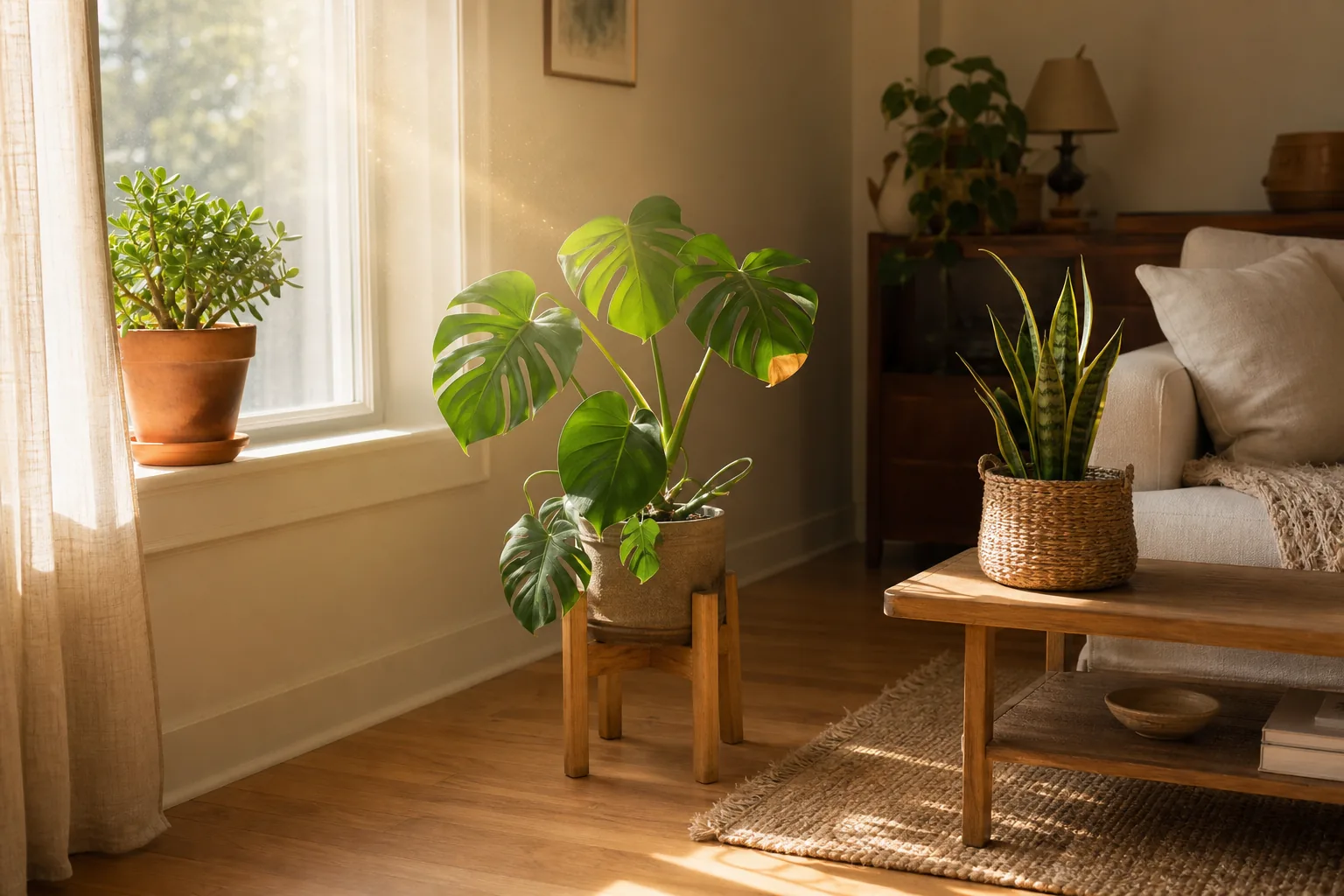
This group includes pothos, philodendron, monstera, peperomia, and most tropical foliage plants sold as bright indirect. They will not thrive in a dim corner, but they will scorch if you park them on the glass in midsummer.
For these plants, the goal is to find the brightest spot that does not put leaves in the direct beam for more than an hour or two. A plant stand one to three feet back from the window, or a side table at the edge of the beam’s path, often works better than a south-facing sill.
Plants that usually do not belong at a south window at all
Some popular houseplants react badly to direct south-window sun, especially in summer. The clearest extension-cited example is Pilea peperomioides, which the University of Illinois Extension specifically notes should avoid direct sun because it can scorch the plant.
The Royal Horticultural Society positions Phalaenopsis orchid light needs toward bright spaces with indirect light rather than direct sun, which functions as a soft caution against putting their leaves in a south-window beam. The same is true of Zygopetalum orchids.
Other categories that houseplant references widely flag for the same reason include calathea and prayer plant light needs, most ferns, peace lilies, and African violets. None of these are impossible at a south window in winter, when the sun is weak and the beam is shallow, but they all need to be set well back from the glass in summer.
If your heart is set on a south window for one of these plants, set it several feet into the room or filter the light with a sheer curtain rather than expecting the plant to adapt.
Three safe ways to soften the light without darkening the room
If your plant is in the wrong spot, three adjustments usually fix the problem. They are listed from least to most permanent.
A sheer curtain or light-filtering blind. The New York Botanical Garden recommends a sheer curtain as one of the standard remedies when a south-facing window becomes too hot in summer. A sheer layer diffuses the direct beam without dropping the room into low light, which is what most bright-indirect plants actually need.
A setback of a few feet. The University of Arizona Cooperative Extension places medium light at 4 to 8 feet from a south window. In many rooms, moving a plant a few feet back from the glass can shift it from the high-light band toward medium light, though the exact distance depends on the window’s size and what is outside it.
Better airflow in summer. A south window with the curtain drawn and no moving air can build up radiant heat even at moderate sun. A cracked-open window on the leeward side, or a small fan pointed away from the plant, often does as much for leaf condition as a sheer curtain does.
The third option, choosing a different plant for the spot, is the most permanent and often the most satisfying. A south window is high-value real estate for sun-loving species, and many of them will reward you more than a struggling bright-indirect plant will.
Acclimating a plant into a south-facing window
Even sun-loving plants can scorch if they move from a dim retail shelf to a hot south beam in one step. Acclimation is the difference between a plant that settles in and one that drops leaves for a month.
A calm order:
- Start the plant one to three feet back from the glass for one to two weeks.
- Move it to the edge of the beam for an hour or two on mild days, increasing by an hour at a time.
- Watch the leaves between moves. New bleached or brown patches, especially on the side facing the glass, mean the next step was too much.
- Rotate the pot a quarter turn each week so all sides acclimate evenly.
- Resume normal watering only after the plant shows steady new growth.
In winter, you can compress this because the sun is weaker. In midsummer, take it slower, especially if the window is unobstructed. For plants that belong further into the room, acclimation works in reverse: move them closer to the window in one-foot steps rather than jumping from a dim corner to the brightest spot in the house.
Signs the light is too much and what to check first
A common sign that the light is too much at a south window is leaf scorch. It usually shows up as bleached, papery, or brown patches on the side of the plant facing the glass, sometimes with crispy margins. Leaves that were already present when you bought the plant are the first to suffer, because they were grown in different conditions.
Before assuming sun scorch, rule out other causes. Cold drafts from a window left open in winter, low indoor humidity, overwatering, fertilizer burn, and pest damage can all produce similar-looking symptoms. If new growth is healthy and only older leaves show damage on the glass-facing side, sun is the more likely cause.
If the soil is also drying unusually fast, the window is probably receiving more hours of direct sun than your watering routine accounts for. Feel the soil an inch below the surface before watering. In a hot south window, the surface dries misleadingly fast while the root zone can still be damp.
A short checklist before you place, repot, or move a plant to this spot
Run through these questions before you commit a plant to the spot:
- How many hours of direct sun does the window actually receive today, in this season, at this latitude?
- Is anything outside already shading the window for part of the day?
- Does the glass get hot enough to hold a hand on in summer?
- Is the plant labelled for direct sun, bright indirect, or low light, and is the label consistent with what the plant looked like when you bought it?
- Would a one-foot setback, a sheer layer, or a different plant solve the problem more honestly than watering more often?
- If the plant is moving into the spot from a dimmer room, is there time to acclimate it gradually?
For a plant that genuinely wants the strongest spot in the house, the south-facing window is a gift. For one that does not, the answer is almost always a small, honest adjustment rather than a fight against the light.
Sources
- New York Botanical Garden — Houseplant Basics
- University of Florida IFAS Gardening Solutions — Light for Houseplants
- University of Arizona Cooperative Extension — Indoor Plant Selection and Care
- University of Illinois Extension — Houseplants and Indoor Lighting
- Royal Horticultural Society — Houseplants for Sunny Rooms
- Michigan State University Extension — Low daily light integrals in northern latitudes