Plant care
Softened water and houseplants: how to tell whether it is the problem
· Updated
Ion-exchange softened water is not the same thing as naturally soft water, and that distinction is where most of the confusion starts. A home water softener swaps the calcium and magnesium in your tap water for sodium (in most softeners) or potassium (in some). It does not remove minerals the way distillation or reverse osmosis does. So every time you water a houseplant with softened tap water, you are adding a small amount of salt to a small pot while removing the minerals the plant would actually use.
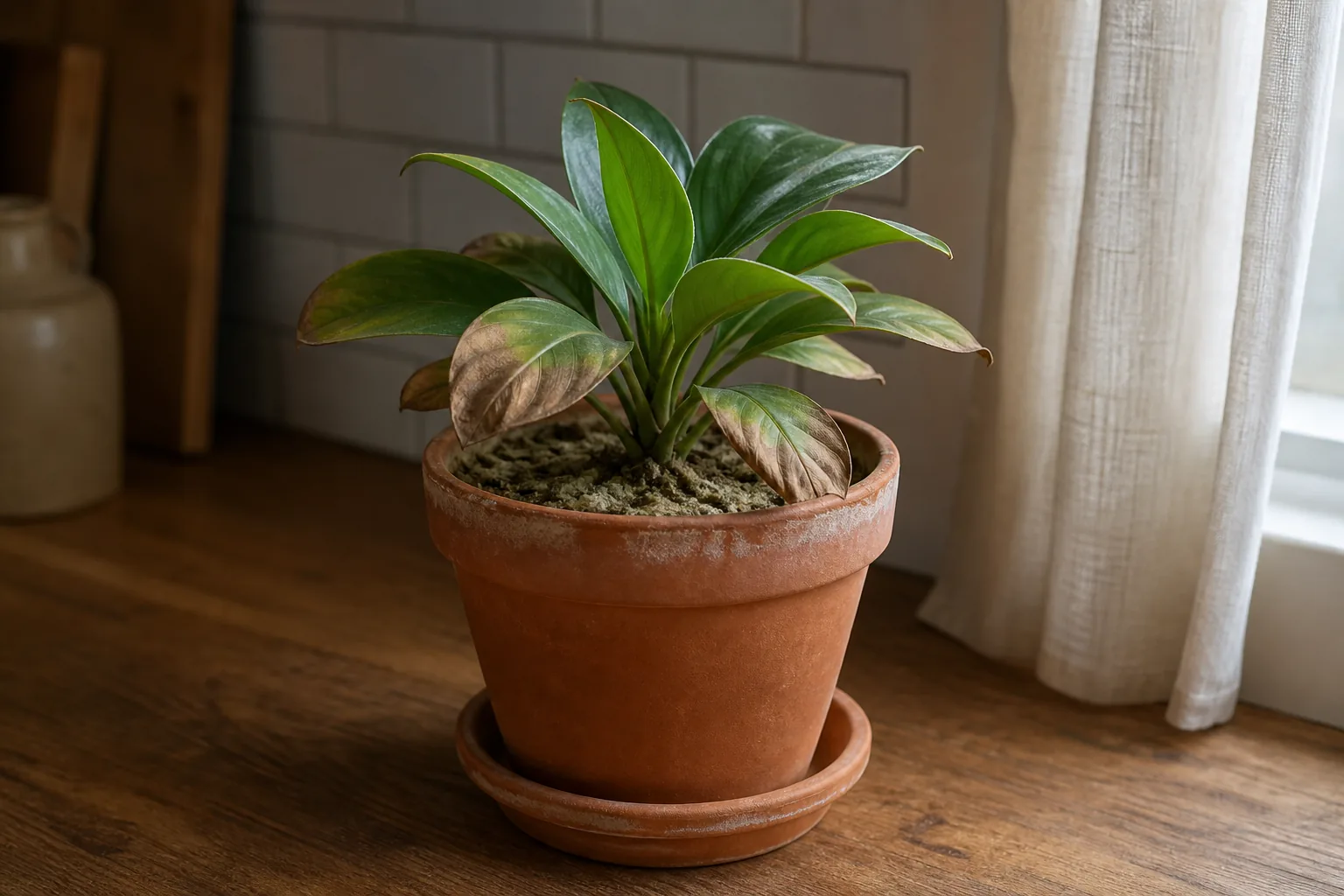
In a small indoor pot, with no rain to dilute and very limited soil volume, those salts accumulate over weeks to months. Many houseplants tolerate this for a while, but the more common pattern is a slow drift: a white crust forming on the soil surface or pot rim, brown leaf tips that progress, and growth that just feels slower than it should, even when watering rhythm and light seem reasonable. Salt-sensitive plants commonly show it sooner; tolerant plants may show little for a long time.
The good news is that you can confirm whether your softener is the cause without overhauling your whole routine. Three short steps will tell you most of what you need to know: identify the salt your softener uses, decide whether your indoor tap is downstream of the softener, and run a simple side-by-side watering comparison on one or two plants using an untreated source for a few weeks.
What “softened water” actually means in a home
When tap water enters a home ion-exchange softener, it passes through a tank of resin beads. Those beads grab calcium and magnesium, the two minerals that cause “hard” water, and release sodium (or potassium, depending on the model) into the water in their place. The water that leaves the tap has had its hardness minerals exchanged, not removed.
This matters because softened water still contains dissolved minerals. It just contains different ones. Naturally soft water — rainwater, distilled water, or water treated by reverse osmosis — has very low total dissolved solids. Ion-exchange softened water does not, and the two should not be treated as interchangeable. A reader who has heard that “soft water is fine for plants” can easily reach the wrong conclusion if “soft” here means softened tap water rather than rainwater or distilled water.
Why indoor houseplants are a different case than a lawn or garden
Softened water on an outdoor lawn or garden bed is generally a much softer problem, in the practical sense. Outdoor soil has a large volume, deep root systems, and rainfall that periodically leaches accumulated salts downward and away. A small indoor pot has none of those buffers. A typical small houseplant pot holds only a few cups of mix, gets watered more often relative to its volume, and has no rain to dilute what the water leaves behind. The choice of mix matters too: a faster-draining mix with less fine particulate tends to flush salts through more easily, while a denser or older mix concentrates them near the surface.
That is why extension services that give cautious outdoor advice often give stronger indoor advice. The University of Maryland Extension states plainly that softened water “should be avoided when watering houseplants,” and Penn State’s agricultural news service notes that excess sodium can damage soil quality around the root system and reduce drainage. The risk in a small pot is not dramatic damage from a single watering; it is the cumulative load over weeks and months.
Sodium-cycle versus potassium-cycle softeners: the distinction that matters
Most home softeners regenerate with sodium chloride — the same thing as table salt. The softened water leaving your tap carries that sodium into every pot you water.
Some softeners can be set up to regenerate with potassium chloride instead. Potassium is a plant nutrient, and a regional water utility notes that potassium is an essential mineral for plant growth while sodium can be harmful to plants. That is a real distinction, but it is not a complete fix. A potassium-cycle softener still strips calcium and magnesium from the water, still adds chloride-based salts, and still loads the pot over time. It is generally less of a concern for houseplants than a sodium-cycle softener, but it is not a free pass for long-term use.
How softened water tends to show up, slowly, on the plant and in the pot
The pattern is more subtle than a single dramatic failure, which is why it is easy to miss. Extension materials note that high levels of soluble salts can damage plant roots and cause a decline in growth, and UC IPM describes wilted foliage and stunted growth as a common result of root exposure to high sodium concentrations. UMass lists browning and scorched-looking leaf margins as recognizable salt-injury symptoms.
In practice, the sequence on a houseplant watered long-term with softened water tends to look like this:
- A faint white or yellowish crust begins to appear on the soil surface or around the inside rim of the pot.
- Brown tips and edges show up first on older leaves and progress slowly inward.
- New growth is smaller, slower, or simply less frequent than it used to be.
- The plant looks generally “thirsty” — slightly wilted or dull — even when the soil moisture is reasonable.
Each of these signs has other possible causes, from low humidity to fertilizer buildup to underwatering. That overlap is exactly why a side-by-side comparison, rather than guessing, is the more reliable way to find out whether the softener is the cause in your specific setup.
Before you change anything: a 60-second check of your own setup
You can answer most of the relevant questions without calling anyone or buying anything.
- Find the softener and look at the brine tank. The salt in use is usually labeled on the bag or block. Sodium chloride is by far the most common; potassium chloride is the less common alternative.
- Trace whether the indoor tap you water with is downstream of the softener. In many homes, the kitchen cold tap is softened, but the outdoor hose spigot is plumbed before the softener and is untreated. This varies house to house, so check locally — open the outdoor spigot and look at the softener’s activity, or ask the installer about the bypass valve.
- Note the pot size, mix, and watering frequency for any plant you are worried about. Smaller pots, faster-drying mixes, and brighter or warmer rooms accumulate salts faster simply because there are more watering events per cup of mix.
A simple observation test you can run at home
Pick one plant that has been watered with softened water and shows some of the signs above. Pick one or two similar plants of similar size and light. Continue watering the test plant as usual, and switch the comparison plants to an untreated source — the cold tap before the softener if you have one, the outdoor spigot if it bypasses the softener, or collected rainwater if neither is available.
Continue your normal observation-led watering rhythm on all of them. Over four to six weeks, the comparison plants may clearly improve or stay the same. If they improve while the softened-water plant continues the same slow decline, that is strong evidence that the water source is part of the problem in your home. This is not a controlled experiment — light, humidity, and individual plant variation are all in play — but for a small number of plants in the same room, it is usually informative enough to act on.
Practical responses, in order of effort
Start with the lowest-effort lever first. Watering deeply enough that a meaningful volume of water runs through the pot and out the drainage hole, and emptying the saucer so the plant never sits in runoff, helps flush soluble salts through the mix rather than letting them concentrate near the surface. It is also standard practice not to let a houseplant sit in excess runoff for any extended period. This is also the place where learning how to tell when a houseplant actually needs water matters: deep, less-frequent waterings that fully wet the root zone do more flushing than small, frequent sips.
If a plant has been on softened water for a long time and shows ongoing decline, a partial refresh of the top inch of mix, or a full repot into fresh mix, is the realistic next step. Flushing will only do so much once the mix has compacted or decomposed; at that point, recognizing when potting mix has aged out is what actually resets the salt load.
If you have an untreated water source reasonably available — a bypass spigot, the cold tap before the softener, or rainwater you can collect and store — use it for the plants that show symptoms. That is a more practical response than overhauling the entire watering setup, and it gives you a clearer signal in the A/B comparison above.
When this matters most, and when it may not
Small pots, fast-drying mixes, and plants with thinner, more delicate foliage — calathea and prayer plants, many ferns, and some small succulents in tight pots — commonly show the effects of softened water sooner. Larger pots that are watered deeply and infrequently can buffer the salt load for a long time, especially with tolerant species. The exact point at which softened water becomes a visible problem depends on pot size, mix, watering rhythm, light, and the plant itself. There is no single rule that covers all of them, which is why the observation test above is more useful than any hard threshold. The way you choose a potting mix for a houseplant also shifts how fast salts concentrate in the root zone.
A short checklist for this week
- Identify the salt type your softener uses by looking at the brine tank or the installer’s documentation.
- Trace whether the tap you water with is downstream of the softener, and look for an untreated outdoor spigot or bypass line.
- Pick one plant that has been watered with softened water as a comparison subject, and one or two similar plants for the side-by-side test.
- Continue watering by your existing observation-led routine rather than changing everything at once.
- If brown tips and crispy edges on houseplants or white crust on houseplant soil or pots are already showing up, treat the softener as one of several possible causes worth ruling out, not as a diagnosis.
A water softener is doing exactly what it is designed to do, and that is fine for plumbing, laundry, and showers. For a small indoor pot watered the same way for months, it can become a slow, quiet contributor to the symptoms most readers notice only after the fact. Confirming whether it is the cause in your home is mostly a matter of paying attention for a few weeks, not changing the whole system.
Sources
- University of Maryland Extension — Watering Indoor Plants: https://extension.umd.edu/resource/watering-indoor-plants
- Penn State News — Softened Water Can Cause Hard Times For Indoor Plants: https://www.psu.edu/news/agricultural-sciences/story/softened-water-can-cause-hard-times-indoor-plants
- University of Nebraska–Lincoln Extension — Drinking Water Treatment: Water Softening (Ion Exchange): https://extensionpublications.unl.edu/assets/html/g1491/build/g1491.htm
- University of California IPM — Nutrient and Mineral Excesses, Salinity, and Salt Toxicity: https://ipm.ucanr.edu/PMG/GARDEN/ENVIRON/salttoxicity.html
- University of Massachusetts Center for Agriculture, Food and the Environment — The Impact of Salts on Plants and How to Reduce Plant Injury from Winter Salt Applications: https://www.umass.edu/agriculture-food-environment/landscape/fact-sheets/impact-of-salts-on-plants-how-to-reduce-plant-injury-from-winter-salt-applications