Plant care
Can you reuse potting mix for houseplants?
· Updated
You can sometimes reuse potting mix, and sometimes it is a bad idea. The right call depends on three things: why the mix came out of the previous pot, how it has been stored since, and which plant it is going into. Treat it as a per-pot decision rather than a blanket rule.
University extension services are consistent on this point. Oklahoma State Extension notes that reuse is generally acceptable when previous plants were healthy, and advises against it when there were problems with disease, weeds, or insects, because viruses, fungi, and certain pathogens can persist in old mix. LSU AgCenter makes the same distinction, recommending that you do not reuse mix from plants that died of bacterial, fungal, or viral disease. So the goal is not to find a universal rule, but to run a short, pest- and pathogen-aware checklist before you commit the mix to a new pot.
What actually changes in old or stored potting mix
Fresh, sealed bagged mix is formulated to be free of weed seeds, insects, and disease organisms when it leaves the production line. Once a bag is opened or its contents are used to support a plant, that baseline drifts.
Over time, a few things change at once. The structure of the mix breaks down as organic components decompose, so the airy, fast-draining texture that roots rely on gets tighter. Nutrients get used up. Microbial communities shift, sometimes toward organisms that are less helpful. If the mix has stayed damp, fungus gnat larvae can colonize it. And if the previous plant had any pest or disease issue, the mix can carry eggs, spores, or resting structures from one pot to the next.
Mix that has been stored dry in a sealed bag, away from heat and direct sun, is the lowest-risk case for reuse. Mix that came out of a chronically overwatered pot or a plant that died from root rot is the highest-risk case and is generally not recommended for reuse in a fresh pot.
Six checks to run before you reuse the mix
Treat these as gates. If any one of them fails, the safer call is fresh mix or, where helpful, a closer look at when old potting mix has aged out.
Was the previous plant healthy?
Healthy, actively growing plants leave behind mix that is generally reasonable to reuse. Plants that declined for unclear reasons, that died from root rot, or that showed signs of fungal or bacterial disease are a different story. The pathogens involved can persist in mix even after the plant is gone, which is exactly why Oklahoma State and Louisiana State University both recommend skipping reuse in that case.
Was there a pest history?
Fungus gnats are the most realistic pest concern for reused mix, especially mix that has stayed damp. UC IPM notes that fungus gnat larvae feed on fungi, organic matter, and the fine roots of potted plants, and that infestations are common in moist potting media. Colorado State Extension adds that larvae thrive in damp organic media and can chew on roots, weakening young or stressed plants. Fungus gnat eggs and some pathogen structures can survive drying and revive once a pot is watered again. If the prior plant had recurring pests, treat the mix like a potential carrier and route it somewhere other than a fresh pot. For a closer look at what healthy fungus gnat prevention looks like going forward, the dedicated guide is the next step.
What is the moisture history?
Dry mix is a much safer bet than mix that has been wet for weeks. Moisture is what allows fungus gnat larvae to develop and water-mold pathogens such as Pythium to establish, so a chronically overwatered pot is a strong signal to replace, not reuse.
What is the salt and crust story?
If the surface or rim of the old pot shows a white crust, that is soluble salt buildup from prior fertilization or hard water. A heavy crust usually means the mix is depleted and is worth refreshing or replacing rather than reusing as-is. The full picture of what mineral buildup on soil and pot surfaces can mean is worth a separate read.
How was it stored?
Sealed, dry, cool storage keeps mix closest to its original state. Mix that has sat open in a humid corner, in a garage that swings in temperature, or in a bag with a damp corner is a higher-risk case. Open bagged mix is generally usable for somewhere around six months to a year under decent storage, and unopened bags hold up roughly twice that long, though the practical test is still the next check.
Does it look and smell like a good growing medium?
Scoop some up. Loose texture with visible peat, coir, perlite, or bark suggests the structure is still workable. A sour or rotten smell, waterlogged clumps that do not break apart, white fungal growth on the surface, or any visible insect activity are reasons to replace it.
When reuse is reasonable
Reuse is reasonable when the prior plant was healthy, the mix has been kept dry, and the destination plant is a tolerant, established houseplant rather than something rare, recently acquired, or visibly stressed. Sealed leftover bagged mix, opened bagged mix that has been stored dry, and old mix from a vigorous plant after a refresh, sifting out old roots and blending with fresh mix, compost, or a structure amendment like perlite or coconut coir, all qualify as workable starting points.
When to skip reuse
Skip reuse for mix that came out of a plant that died from suspected bacterial, fungal, or viral disease, or from chronic overwatering and root rot. Skip it for mix that has stayed damp and developed fungus gnat activity. Skip it for mix with heavy soluble salt buildup that does not respond to a flushing pass with plain water. And skip it as a destination for a sensitive or newly acquired plant, which is why inspecting and isolating a plant that may be carrying pests is so important. In that case, treat the new plant, not just the mix, as a potential carrier. When you do reach for fresh mix, the guide to choosing a new potting mix can help match a replacement to the plant in front of you.
Storage and handling if you do reuse
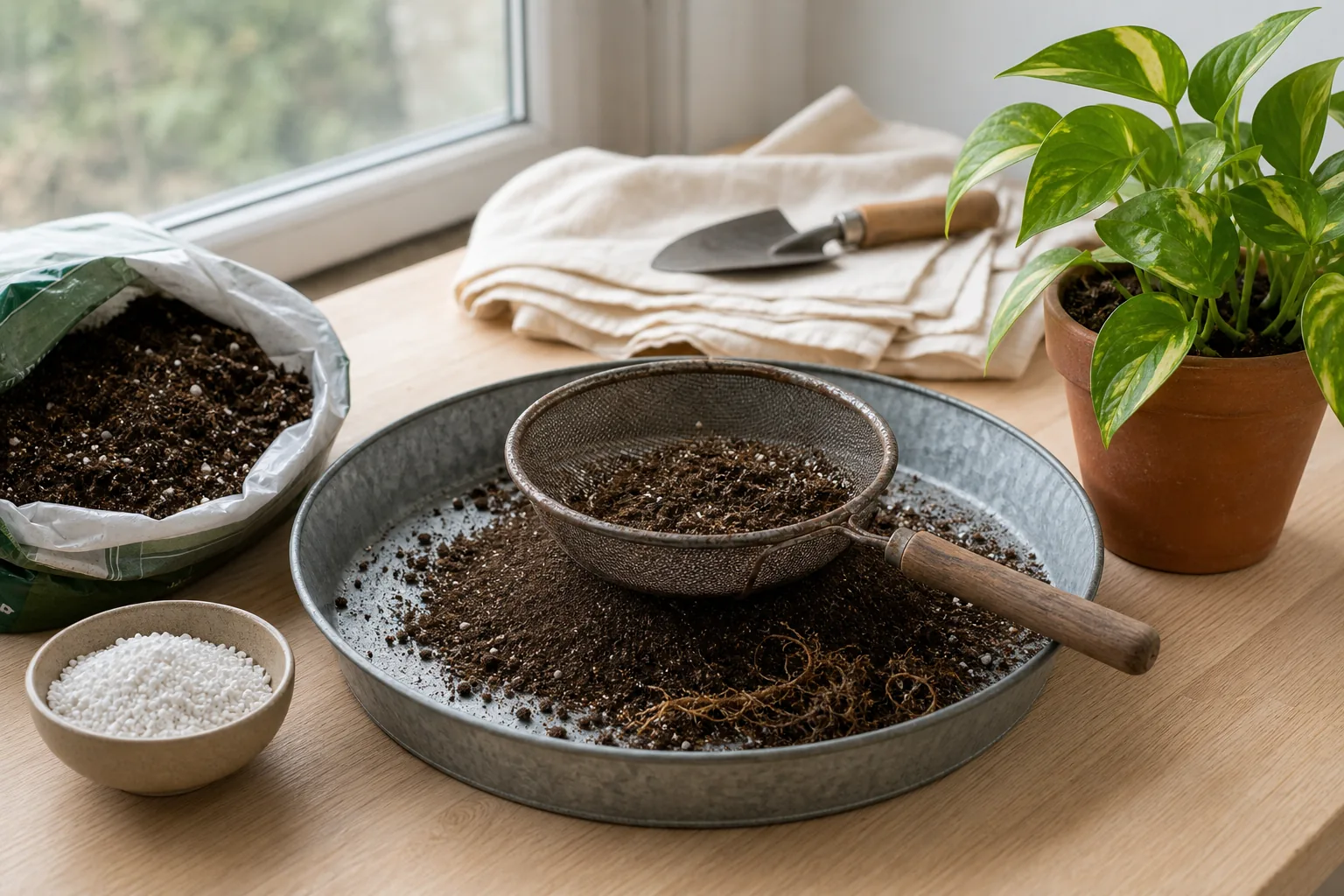
Spread the mix out on a clean tarp or in a wide bin and let it dry thoroughly before storing it. Sift out old roots and large debris. Extension services consistently point to physical sanitation as the first defense in managing pests and pathogens in containers; pulling out old roots and leaf litter is the simplest version of that step. A coarse kitchen sieve or a piece of hardware cloth works well for this. Store the mix in a clean container with a loose lid, or in a bag with the top rolled shut, somewhere cool and dry away from direct sun. Avoid airtight plastic bins if the mix is even slightly damp, since trapped moisture can restart fungus gnat problems.
Home sterilization: what it fixes and what it does not
Some sources recommend oven, microwave, or solarization treatments as a way to clean reused mix. Used carefully, heat can reduce a meaningful share of organisms in the mix. UC Davis notes that heat treatment targets pathogen kill thresholds and that Phytophthora, the water mold behind many container root rots, is relatively heat-sensitive compared to some other pathogens.
A few honest limits are worth naming. Home oven and microwave methods have real safety considerations, including uneven heating, off-gassing from organic components, and the risk of overheating in a kitchen appliance. Solarization works by trapping solar heat under clear plastic and is only practical in warm, sunny outdoor conditions. And no home method reliably produces mix that is sterile the way fresh commercial mix is sterile on the production line; it is best understood as a reduction, not a reset. For most indoor situations, sifting, drying, and refresh-amending are a safer and easier first step than any sterilization attempt.
Decide per pot
Two pots at once can land in different categories. A pothos in the corner whose roots have happily filled the same soil for two years is a candidate for refresh and reuse. A new fiddle-leaf fig you just brought home is not. A general rule that respects this difference is to match the risk of the mix to the tolerance of the new plant: tolerant, established plants first, and any sensitive, rare, or recently acquired plant gets fresh mix you can trust. Whichever path you take, the weeks after a move into a new pot come with their own quirks, so it helps to know what care after repotting typically looks like.
When to ask a local nursery or extension service for guidance
Reuse gets easier to decide once you have some experience with your own conditions, but a few situations deserve a second opinion in person. If a plant has died of an unidentified disease, if multiple pots in the same room are showing similar symptoms, or if you are about to reuse mix in a high-value specimen, a local independent nursery or your regional cooperative extension service can look at the actual plant and the actual conditions and give you a more specific answer than any general article can.
Sources
- Oklahoma State University Extension: Reusing potting soil
- LSU AgCenter: Can you reuse your potting soil?
- University of California IPM: Fungus gnats
- Colorado State University Extension: Fungus gnats as houseplant and indoor pests
- UC Davis AIR Nursery: Heat treatment