Plant care
Do pebble trays actually work for houseplant humidity?
· Updated
A pebble tray can raise humidity a little, in a small zone right above the water. It is not a substitute for room-level humidity management, and it is not a fix for brown tips or leaf curl on its own. The honest answer is that pebble trays are a low-cost, low-effort option worth using when you already have a tray and pebbles on hand, but they should not be sold as more than a small nudge around the foliage.
That framing is consistent with what university extension services say. University of New Hampshire Extension describes pebble trays as helping “a little” to add moisture to the air, and the University of Nebraska–Lincoln Extension (Lancaster County) says water evaporating from a pebble tray increases humidity around a plant’s foliage and that water should be replenished as needed. Neither source quotes a specific humidity-percentage gain. That matters, because the most-cited numbers online come from a single home experiment rather than from extension or peer-reviewed work.
If you are deciding whether to set one up, this article walks through what a pebble tray physically does, the setup details that change how much it does, and where it fits alongside other humidity options you may be weighing. For a broader look at when humidity actually matters in a home, our guide to indoor humidity for houseplants covers the room-level reading.
What a pebble tray actually is
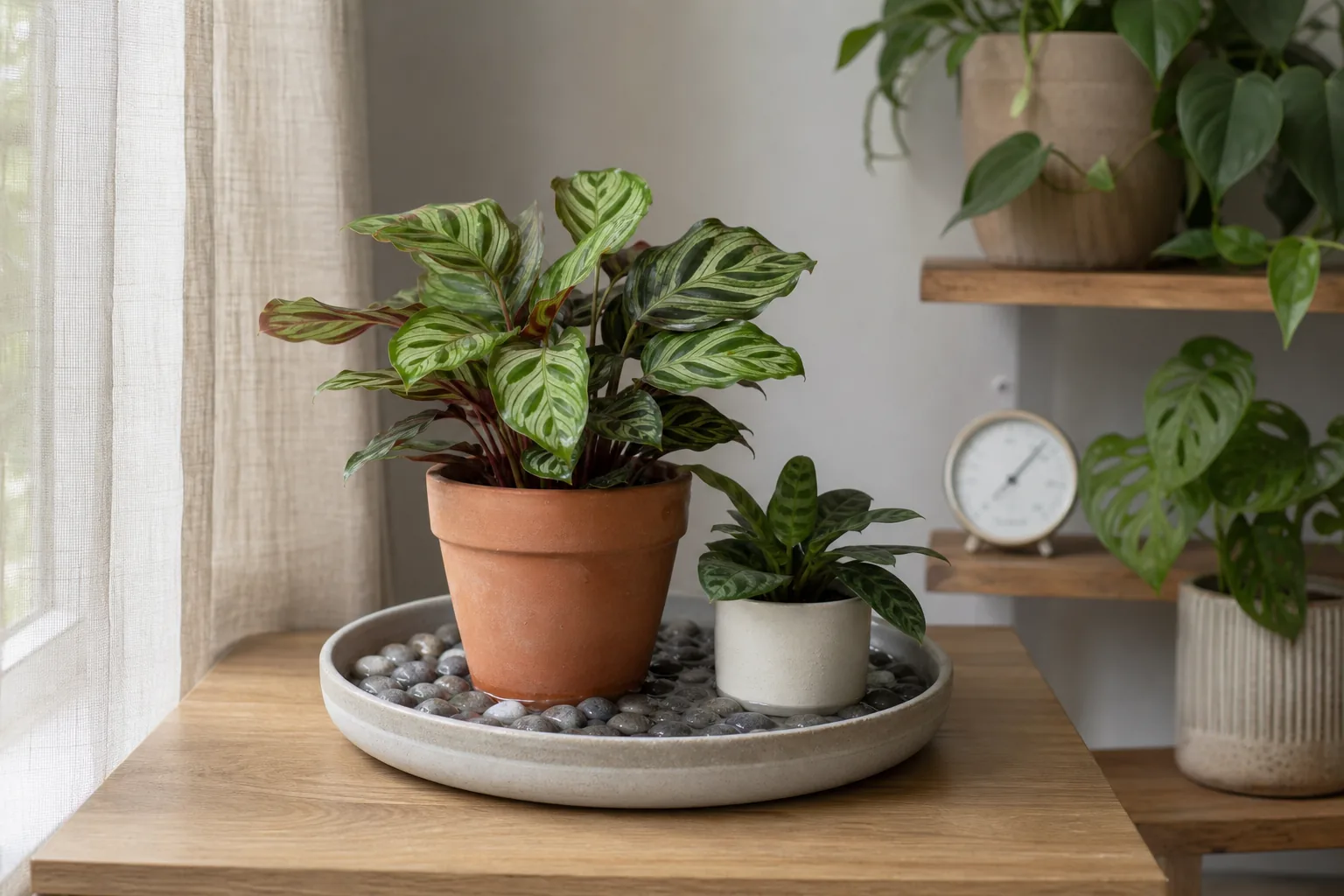
A pebble tray is a shallow tray or saucer filled with a layer of clean pebbles, gravel, or similar stones, topped up with water. The plant pot sits on top of the pebbles, above the water line, so the base of the pot is not in standing water.
That is the entire setup. It is also different from a drainage saucer. A drainage saucer catches water that runs out of the pot after you water the plant; it is not meant to sit full of water under the pot for days at a time. Treating a saucer as a pebble tray is one of the more common setup mistakes, and it is the kind of mistake that can leave the pot base sitting in water for longer than the plant wants. Our practical guide to pot drainage and cachepots walks through that distinction in more detail.
Most extension guidance is agnostic about the type of stone. Smooth river pebbles, aquarium gravel, and decorative glass all appear in consumer instructions. The functional requirements are that the stones hold the pot above the water and that the tray is wide enough to give the water room to evaporate.
How a pebble tray is supposed to raise humidity
The mechanism is straightforward. Water in the tray evaporates into the air immediately above it. The closer to the water surface the air is, the more of that added moisture it picks up. The further away, the more it mixes with the rest of the room air and dilutes.
That is why the effect is local rather than room-wide. A pebble tray the size of a small saucer, sitting under a single six-inch pot, has a modest evaporative surface area. It can slightly raise the relative humidity in the small pocket of air right above the tray, but it is not moving enough water to change the reading across a whole room.
This is also why a wider tray with several pots grouped on it tends to do more than a single small tray under one pot. More surface area means more evaporation, and grouping plants together keeps the slightly more humid air around the foliage rather than letting it drift away.
How much humidity a pebble tray can realistically add
The honest answer is: a small amount, in a small area, and only while the water is actively evaporating.
The two extension sources in our research frame this in qualitative terms. UNH says the trays “help a little.” UNL says humidity rises around the plant’s foliage. Better Homes & Gardens is more direct, stating that pebble trays only raise humidity in the immediate vicinity of the plant and that a humidifier is the option for larger-area humidity change.
You will find more specific numbers online, typically based on a single home experiment rather than on extension or peer-reviewed work. The pattern those tests describe is consistent with the qualitative extension framing: a very small bump right above the tray, fading to nothing within a foot or two. Treat any percentage figure you see attached to pebble trays with caution, since none of it comes from a replicated study.
What you can reasonably expect:
- A slight bump in humidity in the air right above the tray and around the lower leaves of the plant.
- That bump fading within a foot or two of the tray, depending on airflow.
- The tray doing nothing for the room’s overall humidity reading.
- The effect stopping entirely once the water has evaporated and the tray sits empty.
If you want a steady, room-wide change, a pebble tray is the wrong tool. For genuinely humidity-sensitive plants in a dry heated room, our calathea and prayer plant care guide describes the conditions these plants actually need and what it takes to provide them in an ordinary home. For the seasonal conditions that often drive this question, our winter houseplant care guide walks through how lower light and dry indoor air interact.
Setup details that change the result
The pebble tray itself is simple. Getting it to do its modest job well is a matter of a few details.
- Water level. This is the most important rule. Keep the water below the top of the pebbles so the pot base sits on damp pebbles, not in standing water. Sources agree on this point, and it is also the detail that prevents the tray from turning into an accidental soak for the pot.
- Tray width. A tray noticeably wider than the pot gives the water more evaporative surface around the plant base, not just under it.
- Grouping. Putting several pots on one large tray enlarges the humid pocket. This is also where grouping plants for humidity overlaps directly with the pebble tray.
- Pebble cleanliness. Rinsed pebbles are fine. Pebbles already coated in hard-water mineral deposits or organic debris can support algae over time, especially in a bright window.
- Water refresh. UNL Extension recommends replenishing water as it evaporates. Topping off when the tray is empty is the standard cadence.
- Placement. A tray in a draft or in direct sun from a hot window will evaporate faster than the plant can benefit from, and may heat the water uncomfortably.
There is no widely cited guidance on water temperature or on the precise ideal tray width relative to canopy. Sources tend to point at the variables above and leave the rest to the reader’s setup.
When a pebble tray is a reasonable choice
A pebble tray is reasonable when the cost and effort are low and the plant in question does not need dramatic humidity change.
Concrete cases where it is worth setting up:
- A shelf or windowsill with several small tropicals grouped together. The shared tray enlarges the local humidity pocket.
- A room that is mildly dry in winter but not extreme. Seasonal heating is one of the most common reasons indoor air drops, and a pebble tray is one small part of addressing that.
- A reader who already has a tray and a bag of pebbles on hand. The marginal effort is small.
- A reader who wants one piece of a broader humidity plan, alongside grouping plants and managing the room’s heat sources.
When a pebble tray is probably not the answer
There are situations where a pebble tray either will not help or will mask a different problem.
- The plant is in a very dry heated room, or it is a genuinely humidity-sensitive species like many calatheas. In those cases, the modest local effect of a tray will not be enough. A humidifier, a bathroom with appropriate light, or a different plant choice is more realistic.
- The visible symptom is brown leaf tips or crispy edges. Humidity is one possible cause, but our guide to diagnosing brown tips walks through the other usual suspects: water quality, watering rhythm, light, and root condition. Adding a pebble tray without checking those will not necessarily change anything.
- The pot has been in the same container for a long time and the substrate is breaking down. Before adding another tool, it is worth checking whether the plant actually needs a new pot; our repotting guide walks through that decision.
- The expectation is whole-room humidity change. A single tray under one pot will not deliver that.
How to tell if your pebble tray is doing anything
The honest answer is that you may not be able to tell at all. The effect is small, slow, and easy to drown out in other variables. A few observational habits help.
- Watch the leaf edges and new growth over weeks, not days. Any change, if it happens, will be gradual.
- Try a side-by-side. Two similar plants in similar light, one on a tray and one not, is the cheapest experiment you can run. If you can see a difference after a few weeks, the tray is helping. If you cannot, it probably is not doing much for that plant.
- Use a simple humidity meter if you want a number. Place it at leaf height, just above the tray, and check whether the reading moves at all when the tray is full versus empty.
The point of these habits is to keep expectations grounded. Pebble trays are a nudge, not a fix.
Common setup mistakes to avoid
A short list of the errors that show up most often in practice.
- Pot sitting in water. Water should sit below the top of the pebbles, not up to the pot base.
- Using a drainage saucer as a pebble tray. The saucer is meant to catch runoff, not to evaporate continuously with the pot above it.
- Never refreshing the water. Topping off indefinitely lets minerals build up and, in a bright location, can encourage algae on the pebbles. Illinois Extension makes this point about standing water in container water gardens, which are larger and more nutrient-rich than a pebble tray, but the underlying principle still applies. The practical response is to rinse the pebbles and the tray and start over.
- Placing the tray in direct, hot sun. The water heats up and evaporates before the plant benefits, and the pot base can sit in warm water.
- Treating the tray as a cure for brown tips. Brown tips have several usual causes, and humidity is only one of them.
- Expecting whole-room humidity change. A single tray under one pot will not move the room’s reading in any meaningful way.
The pebble tray is at its best when it costs almost nothing, sits under a plant that does not need dramatic humidity change, and is part of a broader setup that already accounts for light, water, pot, and root health. Used that way, it is a quiet, useful tool. Used as a stand-alone fix, it almost always disappoints.
Sources
- University of New Hampshire Extension: How can I increase the humidity indoors for my houseplants?
- University of Nebraska–Lincoln Extension (Lancaster County): Success with houseplants – humidity
- University of Illinois Extension: Container gardens – algae and mosquitoes
- Better Homes & Gardens: Do pebble trays actually work? A plant pro weighs in
- Homes and Gardens: Pebble tray for plants vs plant mister
- The Spruce: How to make a pebble tray for plants