Plant care
Moving with houseplants: a calm, observation-first guide
· Updated
A residential move is not just a single change for a houseplant. It is several changes stacked in a short window: different light, different air, different drafts, jostled roots, a tipped pot, sometimes a different climate on the way over. Plan for the move as a two-to-six-week project rather than a one-day packing job, and most plants will arrive tired but recoverable. Plants taken in a personal vehicle, kept upright and out of extreme temperatures, and then placed in a stable spot without repotting or fertilizing usually settle within a few weeks. Treating leaf drop or yellowing in that window as information rather than failure is the most useful habit.
Why a residential move is harder on a houseplant than a single change
Most adjustments a houseplant survives — a new windowsill, a new pot, a different room — change one or two things at a time. A move usually changes several at once. Oregon State University Extension lists light, temperature, water, humidity, and nutrition as the main environmental factors affecting plant growth, and a move can shift all five in the same week.
Add to that mechanical stress: a pot tipped on its side, soil compacted by vibration, foliage pressed against a car door, a root ball that went from moist to bone-dry or saturated during the trip. Each of these alone is recoverable. Stacked, they push a plant into the kind of adjustment period you can read in dropping leaves, slowed growth, and a general look of fatigue for the first few weeks.
The opposite mistake is to read that fatigue as failure and start treating aggressively. Most plants settle if they get a stable spot, normal watering, and time.
Four to two weeks before moving day: assess the collection
Three or four weeks out, walk through the collection with a notebook or your phone camera. For each plant, you are answering four questions: Is it healthy enough to move? Is the pot going to cause problems through weight or breakage? Does it have pests that will spread in a moving truck? And is it going with you at all?
Pest inspection matters most if you are combining plants with others or moving them somewhere they could contaminate new arrivals. University of Maryland Extension treats inspection for aphids, spider mites, and scale as standard practice before relocating plants. Treat the move the same way. If you find pests, isolate that plant until the issue is resolved before packing it with the rest.
If a plant is in a heavy ceramic or terra cotta pot, consider switching it into a lighter plastic nursery pot for the move. This is practical, not horticultural. The same plant in a lighter pot is easier to carry, less likely to break, and less likely to injure you. The switch should happen a few weeks ahead so the plant has time to settle into the new container before the actual move.
The week before the move: water timing and a final check
A few days before moving day, water each plant so the root ball is evenly moist but not soaking wet. Cornell Cooperative Extension of Tompkins County emphasizes watering decisions based on actual soil moisture rather than a fixed schedule, and that applies here too. Lift the pot. Stick a finger an inch into the soil. The goal is a moist, not wet, root ball on moving day.
Saturated soil that has been jostled in transit tends to compact and stay wet longer, which is a stress many common houseplants are sensitive to. Bone-dry soil means the plant is already stressed before the trip starts. Either extreme is avoidable by checking the day before.
This is also the time for a light cleanup. Remove clearly dead or damaged leaves and stems. Trim back long, floppy growth that is likely to snap in a box or a car seat. Light pruning a few weeks ahead to reduce bulk and broken stems is a common horticultural practice. Do not reshape the plant. The aim is fewer points of mechanical failure, not a haircut.
Packing plants for transport
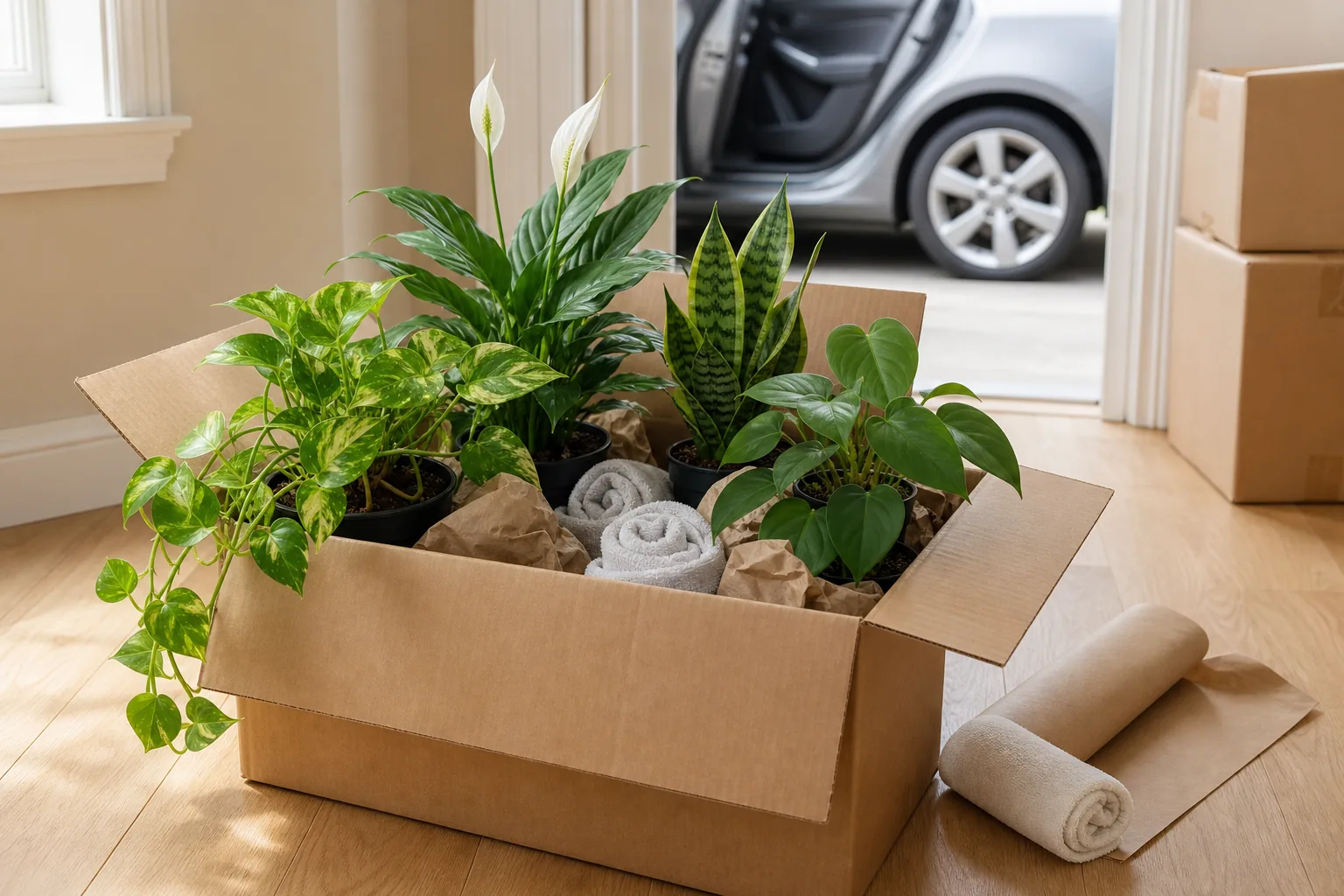
The packing goal is simple: keep the pot stable and the plant upright. Everything else follows from that. Preventing crushed foliage and tipping matters more than any specific container choice.
For shorter plants, an open cardboard box with the pot wedged in place using rolled towels or packing paper works well. For taller plants, an open box or even a tall paper bag keeps the pot stable while letting the foliage stick out the top. Keeping the soil and root ball intact is the lower-risk default for a residential move. Bare-root wrapping in damp paper is a more aggressive intervention that some commercial guides suggest for very tall growers, but it is not the usual choice for a household move.
Do not seal plants into plastic bags for hours at a time. Enclosed spaces can trap ethylene, a plant hormone that accumulates in confined environments and causes damage depending on species sensitivity, concentration, and duration, according to Cornell Greenhouse. The same warning applies to fully taped-up boxes. Airflow, even minimal, is part of the plan.
In the vehicle
A personal vehicle gives you the most control over a residential move. You can keep the temperature steady with the HVAC, place plants where they will not tip, stop and check on them, and pull into a garage rather than leave them in a parked car. Most plants travel best on the floor of the car or in a flat trunk area, wedged so they will not slide, out of direct sun through a window that can heat up like a greenhouse.
A closed, parked vehicle is one of the riskiest places for a plant, in either hot or cold weather. The interior can exceed outside temperatures quickly in summer and drop toward them in winter, and it can accumulate ethylene from anything else inside that can off-gas, including other plants. Do not load the car and leave it running in the driveway while you finish packing. Do not leave plants in the car during a stop. Treat the plants as passengers, not cargo in a hot trunk.
For taller or wider plants, a single seat works better than stacking boxes around them. The goal is to keep the canopy intact and the pot level.
Long-distance moves and shipping
A multi-day move compounds everything: longer dark time, more temperature swings, more vibration, and more opportunity for a tip-over. State regulations may also apply. Ask Extension notes that you should water plants in advance, minimize heat stress during travel, and check state-specific rules when crossing state lines. The California Department of Food and Agriculture publishes one example of how destinations may require declarations or inspections for privately owned house plants, but the rules are state-specific. Check with your destination’s department of agriculture before you load the car.
Professional moving companies often restrict or exclude plants entirely. Some limit plants to shorter distances or durations, others decline cross-state movement, and policies vary by contract. Do not assume your mover will take the collection. Ask, and read your contract.
If plants will travel in a personal vehicle for more than a day, the same principles apply, just stretched out: keep them upright, give them light when you stop overnight in a hotel, and do not leave them in the car.
The first 48 hours in the new home
In the new home, resist the urge to give every plant a new pot, fresh soil, and fertilizer the first day. Repotting and fertilizing are interventions, not rescues, and they add stress on top of an already stressed plant. The mainstream horticultural recommendation is to wait and observe rather than act.
What to do instead: pick a stable spot with light similar to the plant’s old spot. Use the same observation-first method you would for a newly purchased houseplant, described in our guide to acclimating a new houseplant. Read the room’s light, drafts, and sun-heated glass before committing to a permanent location. An observation-first method for reading the new room’s light walks through the shadow-test approach. For drafts, vents, and hot or cold glass, reading drafts, vents, and sun-heated glass in the new room is the relevant companion.
This is also a good moment to inspect for hitchhiking pests that may have arrived from the old home or any new plants you picked up along the way. A short isolation period for new or returning acquisitions is the same habit we describe in our guide to inspecting and isolating a new houseplant, and it fits a move-in routine as well as it fits a single new purchase.
Two to six weeks after the move
The first few weeks are where most readers panic. A pothos drops a handful of leaves. A peace lily yellows at the base. A fiddle leaf fig goes theatrical and loses half its canopy. None of these is automatically a death sentence. Why your houseplant is dropping leaves after a move or change walks through the patterns that count as adjustment rather than decline.
What to watch for instead: new growth at the tips or from the soil line, firm stems, and soil that dries at roughly the pace it used to. If those are present, the plant is settling. Keep your routine — a short weekly check that fits a moving-in routine is usually enough — hold off on fertilizing, and let it work through the transition.
What warrants more attention: soft, black stems, soil that stays wet for weeks, a strong sour or rotten smell from the pot, or pest populations that grow rather than fade. These are not diagnoses to make at the kitchen table. They are reasons to bring the plant, or a clear photo, to a local nursery or your regional extension service for a closer look.
When to ask a local nursery or extension service for help
A residential move concentrates decisions about light, water, timing, and species tolerance that are hard to make from a checklist. A local independent nursery can look at the actual plant and the actual room. A regional extension office can answer questions about state-specific plant transport rules and species that may not travel well in your climate. Use them.
The plan stays the same: prepare in the weeks before, transport with the plant upright and the climate steady, settle in a stable spot without intervening, and watch for the difference between settling and declining. That is the whole move, in observation-first form.
Sources
- Moving Indoor Plants Outside — University of Maryland Extension
- Environmental factors affecting plant growth — Oregon State University Extension
- Watering Guidelines Q&A — Cornell Cooperative Extension of Tompkins County
- Ethylene in the Greenhouse: Symptoms, Detection & Prevention — Cornell University Greenhouse
- Transporting plants across state lines #256636 — Ask Extension
- Frequently Asked Questions Transport of Privately-Owned House Plants — California Department of Food and Agriculture