Plant care
Why your monstera leaves aren't splitting
· Updated
A Monstera that produces only whole, unlobed leaves is one of the most common concerns new indoor growers bring to a care conversation. The short answer: most often, the plant is either still a juvenile, isn’t getting enough usable light, or is growing as a trailer without vertical support. Mature, split (fenestrated) leaves are a response that depends on age plus sustained bright, indirect light plus something to climb. Even with all three in place, indoor Monsteras usually split less dramatically than greenhouse-grown or outdoor specimens. So the goal here is to help you figure out which of these is most likely true for your plant, in observation-first order, and to set realistic expectations before you start changing things.
For a full overview of placement, watering, and routine care, see the broader Monstera care guide. This article stays focused on the specific question of why the splits aren’t appearing.
What split leaves actually are, and why Monsteras grow them
Fenestration is the botanical term for the splits and holes that appear in mature Monstera deliciosa leaves. On a young or small plant, every leaf is a small, whole, heart-shaped blade with no cuts at all. As the plant matures and climbs, each new leaf tends to come in larger and to develop the deep indentations along the edge, and eventually the oval holes inside the blade, that people associate with a “Swiss cheese plant.” Fenestration is a normal mature-form morphology, not a stand-alone measure of how well you are caring for the plant. It is the form a rainforest-climbing aroid takes once a certain combination of age, light, and structure is in place.
Two different situations: never split vs stopped splitting
Before changing anything, it helps to decide which problem you actually have.
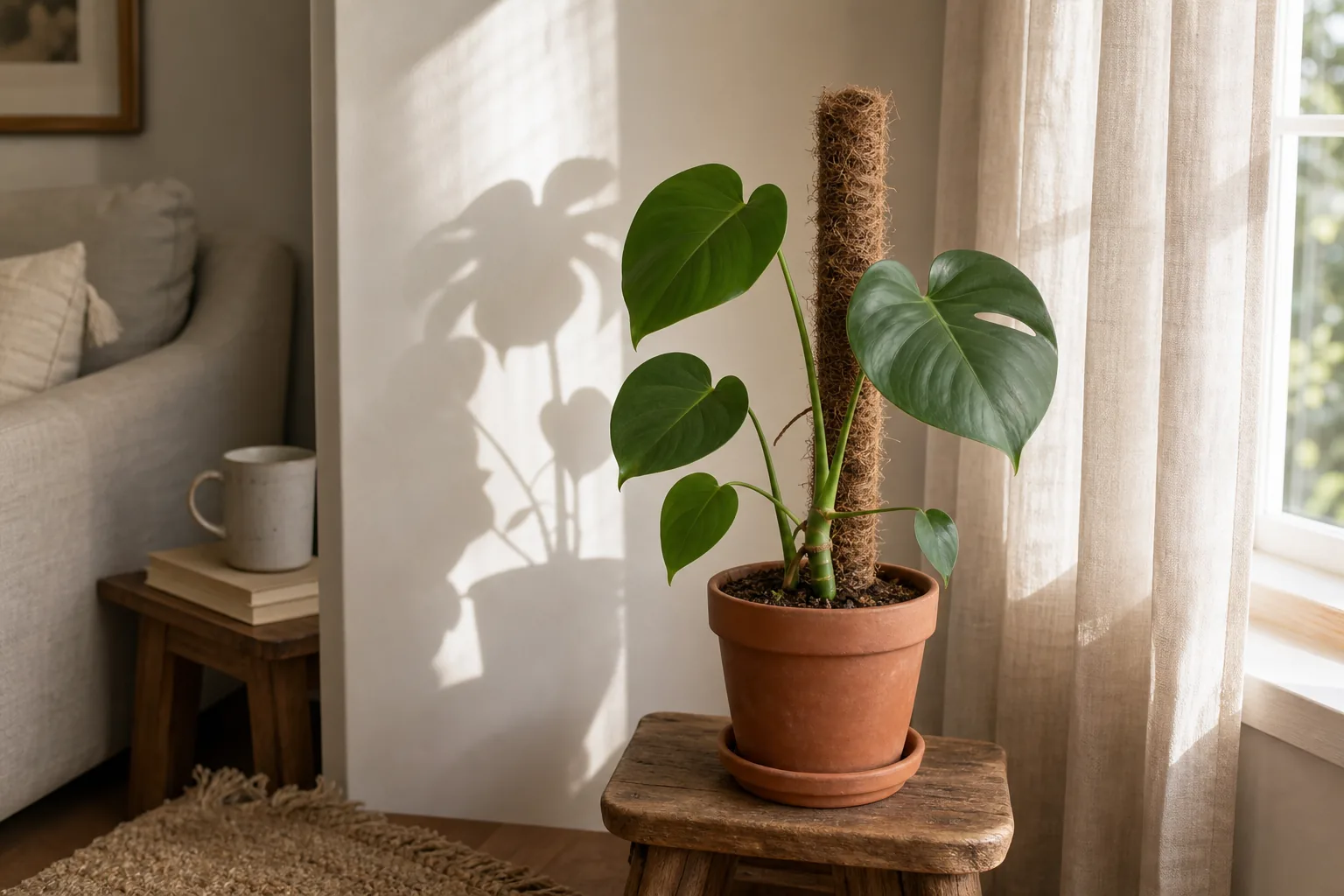
If your Monstera has never produced a split leaf and is also small, with short stems and leaves well under the size of your palm, the plant is most likely still a juvenile. In that case, the main task is to give it time and the conditions described below. There may not be much to “fix.”
If your Monstera is a few years old and several feet of stem long, but the newest leaves are coming in smaller, smoother, and less cut than the leaves it made last summer, something has changed in its conditions. The common suspects are a move to a less bright spot, the loss of a pole or trellis, a season change, a compacted or overwatered potting mix, or a recent repot into a much larger pot.
Age and size: most indoor Monsteras split later than people expect
University extension sources confirm that Monstera deliciosa produces small, whole, heart-shaped leaves as a juvenile and develops fenestrated leaves only as it matures and climbs, but they do not give a specific node count or height at which this reliably begins. General horticultural sources commonly cite roughly 2–3 years of age or around 8+ nodes as a typical point, but those numbers are observational, vary across sources, and shouldn’t be treated as a hard threshold. The honest framing is that an indoor Monstera can easily take years and several meters of stem growth before reliably producing large, fenestrated leaves, and that is normal for the conditions of a typical room.
Light: the most common reason split leaves stall
If age is the first suspect, usable light is the second. Penn State Extension recommends bright, indirect light for indoor Monstera, and broader indoor-plant guidance from University of Maryland Extension and University of Missouri Extension treats light intensity and duration as one of the most limiting factors for indoor growth. None of these extension sources tie a specific foot-candle, lux, or PPFD value to fenestration specifically, so it is better to read the light in your room qualitatively. A practical method is in our guide to how to read the actual light in your room: look at the shadow a hand casts at the spot where the plant sits, and note how the shadow changes across the day and across the year. A short, soft-edged shadow that drifts in and out tends to read as medium indirect. A defined shadow that holds for several hours at midday reads as bright indirect. A sharp, dark shadow right at midday generally reads as direct sun, which is usually too intense for a Monstera and tends to bleach or scorch the leaves rather than encourage splits.
Two visible clues often travel with insufficient light: long internodes (the gaps between leaves on the stem) and small new leaves, even when older leaves look fine. This is the same response discussed in our guide to long internodes that often read as leggy. If you can see those signals, a move to a brighter, indirect spot is the change most likely to matter.
Climbing support: how growing up changes the leaves a Monstera makes
Monsteras are climbing hemiepiphytes. In the wild, they grip tree trunks with their aerial roots, and the leaves they produce at canopy height are noticeably larger and more cut than the juvenile leaves they made on the forest floor. Aerial roots are functional organs that anchor the plant and absorb small amounts of water and nutrients from the surfaces they contact; they are not cosmetic features to prune. When a Monstera is grown as a trailer in a hanging pot, those aerial roots hang in the air, and the plant tends to keep producing smaller, less fenestrated leaves than it would if it had something vertical to grip.
Adding a moss pole, coir pole, plank, or sturdy trellis and gently guiding the stem and aerial roots onto it is one input toward mature-form growth. It is not, on its own, a guarantee of splits. Penn State Extension describes vertical support as part of appropriate Monstera care, and observational sources commonly associate climbing with larger, more cut leaves once age and light are also in place. The change is slow, typically on the order of months to seasons, not days. For options and a step-by-step on how to add climbing support without damaging the plant, that guide walks through pole, trellis, and plank choices.
Water, roots, and pot size: what to rule out before anything else
Before chasing fenestration directly, it is worth ruling out the conditions that slow any indoor plant down. A Monstera in a potting mix that stays wet long after a thorough watering rather than drying over the course of about a week is a plant whose roots are not functioning well, and stalled root function usually shows up as stalled new growth rather than crisper leaves. Equally, a Monstera that has filled its pot and is sending roots out of the drainage holes may keep producing small leaves simply because it has no room to grow into. A pot that is much larger than the root ball, on the other hand, holds water the roots cannot reach and can keep the mix soggy for weeks. Our guide on how to tell whether a Monstera actually needs a new pot walks through the visual cues that distinguish a crowded pot from one that has simply been in place a long time.
The deciding factor is the size trend of the new leaves over several months, not a single leaf, together with the visual cues in the pot and the mix.
Fertilizer and season: why adding fertilizer rarely fixes the problem
The instinct when a Monstera isn’t splitting is to feed it more. No reliable indoor-plant guidance ties a specific fertilizer strength or N-P-K ratio to fenestration. Fertilizer supports overall vigor, but more feeding is rarely the missing input for splits. A modest, balanced approach in the active growing season is reasonable; over-fertilizing a plant that is otherwise healthy is a common indoor mistake that can show up as leaf burn or as persistently damp soil. Winter light drops in temperate climates also slow or pause new growth and fenestration, which often looks like a setback but is really the plant waiting for brighter days. More on how to think about feeding an indoor plant is in the fertilizer basics guide, but the main point is that adding fertilizer to a Monstera that is not splitting usually does not produce splits.
Cultivar and species differences: not every Monstera splits the same way
A reader who owns ‘Thai Constellation’ or ‘Albo Variegata’ is not working with the same plant as a standard Monstera deliciosa. Variegated tissue carries reduced chlorophyll, which limits the energy each leaf can capture, and variegated cultivars are generally observed to produce smaller leaves and less dramatic fenestration than standard M. deliciosa, and to grow more slowly. Other species in the genus have their own mature forms: Monstera adansonii develops smaller leaves with natural oval holes rather than the deep lobes of mature M. deliciosa, and its “split” pattern looks different from the start. If your plant is a variegated cultivar or a different Monstera species, the realistic comparison is other well-grown specimens of that same plant, not the most dramatic M. deliciosa photos you see online.
Realistic expectations for an indoor Monstera
Most of the very large, deeply cut, hole-filled Monstera leaves that circulate online are from greenhouse or outdoor specimens, where sustained light, humidity, root run, and pole height combine without the limits of a typical room. Indoor Monsteras can absolutely produce split leaves, but they usually do so on a smaller scale, with smaller leaves and fewer holes per leaf than the greenhouse images suggest. Treat the goal as getting your plant to its mature-form expression for the conditions you have, rather than matching a photograph.
A short observation checklist
Before changing anything, take a quiet look at the plant over a week or two:
- Estimate age and size. A small juvenile is on schedule; a mature plant with shrinking leaves has had a change.
- Read the room’s light. Note how the shadow at the plant’s spot changes across the day.
- Look at the stem. Long gaps between leaves mean the plant is reaching; aerial roots hanging in air mean there is nothing to climb.
- Check the pot. Roots filling the pot or circling the drainage holes suggest a slightly larger container; a very heavy, slow-drying pot suggests the opposite problem.
- Look back over several months. A pattern across the last 3–5 new leaves, not a single leaf, is what tells you whether conditions have shifted.
A Monstera that is mature, sits in bright indirect light, has something to climb, is potted in a mix that dries on a reasonable schedule, and is not being heavily fed is, by the standard care guidance, in an appropriate position to express its mature form. The actual leaves it produces will still be its own answer to those conditions, on its own timeline.
Sources
- Penn State Extension – Monstera as a Houseplant
- University of Maryland Extension – Lighting for Indoor Plants
- University of Missouri Extension – Lighting Indoor Houseplants (G6515)
- The Spruce – All About Monstera Leaves: Holes, Yellowing, and More
- The Spruce – Monstera Aerial Roots: 7 Things to Know
- Gardening Know How – Why Is My Monstera Not Growing Split Leaves