Plant care
What to do with Monstera and aroid aerial roots
· Updated
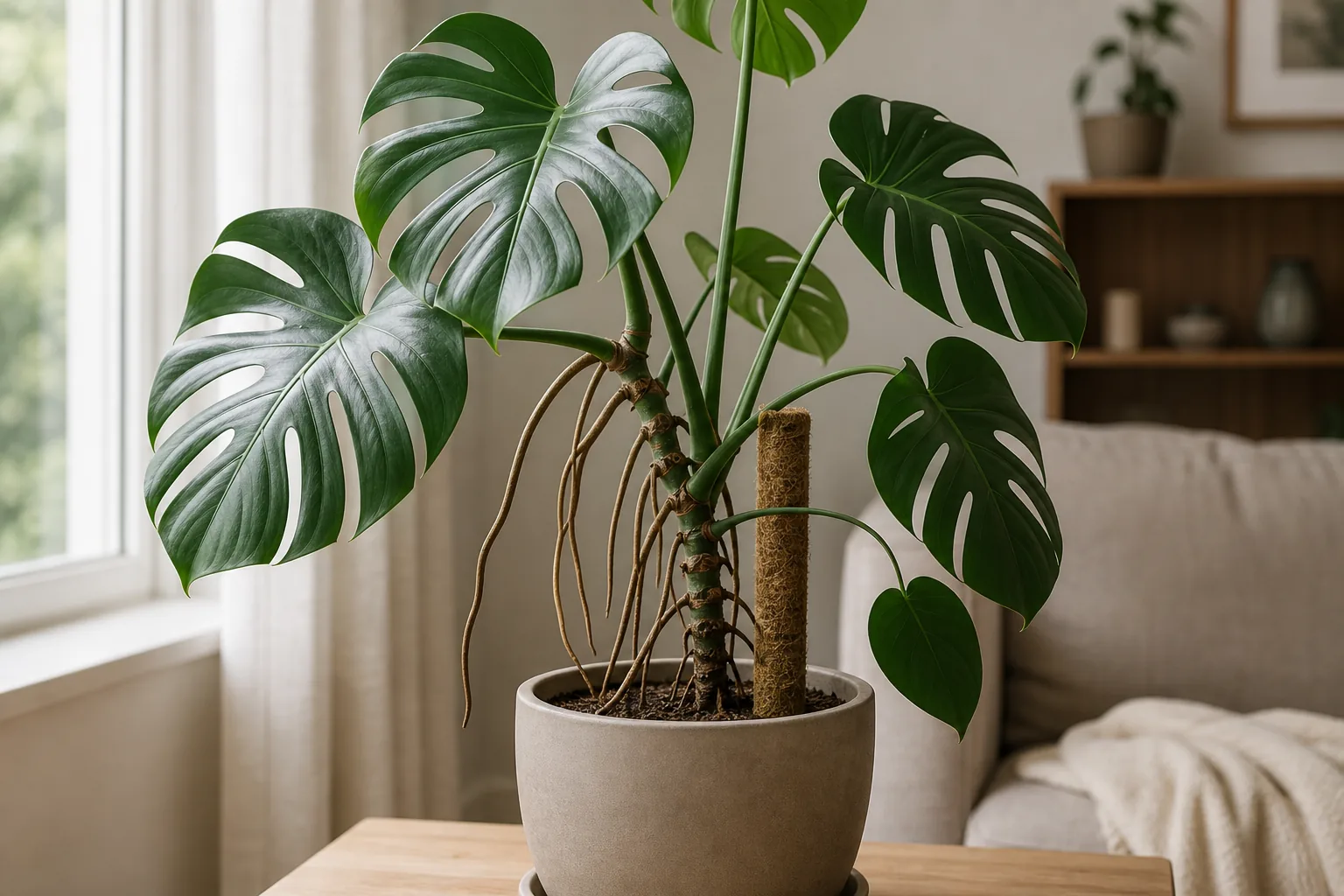
Aerial roots are a normal feature of climbing aroids like Monstera, philodendron, and pothos. They are not a problem to solve, and they do not mean the plant is unhappy. If your Monstera or philodendron is putting out long, brown, woody roots from the stem above the soil, you have four realistic indoor options: leave them alone, gently tuck them back into the potting mix, guide them onto a moss pole or other support, or trim them with clean tools close to the stem. None of these is required, and the right choice depends on the size of the plant, whether it has something to climb, and how much you want to interact with it.
The rest of this guide walks through each option, what it actually does for the plant, and the tradeoffs involved.
What aerial roots actually are on a Monstera and other aroids
Aerial roots are adventitious roots, which is the technical term for any root that does not grow from the plant’s primary seedling root. On a Monstera, philodendron, pothos, or similar aroid, they emerge from the stem itself, usually at a node, often near where a leaf stalk (the petiole) attaches.
You can identify them by a few simple cues:
- They grow out of the brown, woody stem above the soil line, not from the potting mix.
- They tend to appear near a petiole rather than randomly along the stem.
- New ones start as short, pale green or tan nubs and darken to brown or gray as they thicken and lengthen.
- Mature aerial roots are firm to the touch, not soft like new growth.
Monstera deliciosa belongs to the family Araceae, and other common houseplants in that same family, including heartleaf and other vining philodendrons and golden or marble pothos, all produce the same kind of root. The main visual difference is thickness: Monstera aerial roots tend to be noticeably thicker and woodier than the finer, more numerous aerial roots on philodendron and pothos.
What aerial roots do in the wild, and what that means indoors
In their native range, climbing aroids use aerial roots to anchor themselves to tree trunks, rocks, and other surfaces as they climb toward brighter light. The same roots also pick up moisture and dissolved nutrients from the air, the bark they cling to, and the thin layer of debris that collects on those surfaces. So in the wild, one root system does three jobs at once: hold the plant up, drink from the air, and feed from the surrounding surface.
Indoors, only one of those jobs really scales up. The soil root system in the pot is doing the heavy lifting for water and nutrients. Aerial roots inside a dry room have very little surface moisture and very little to absorb from, so their contribution to the plant’s overall water and nutrient uptake is supplemental rather than primary. The anchoring function, however, still works exactly the same way as long as the plant has something textured to grip.
This is why your plant keeps producing aerial roots even when it sits in a perfectly watered pot with no pole. It is built to climb, regardless of whether the room offers something to climb on.
Read your plant first: where the roots are growing from and how the plant is behaving
Before picking an option, take a minute to look at your specific plant. A few observations will point you toward the right choice:
- Where on the stem are the aerial roots forming? Lower, closer to the soil, are easy to tuck back in. Higher up, on a long stem, are more often redirected to a pole or trimmed.
- Are the roots still short and flexible, or long, woody, and stiff? Flexible roots can be moved; woody ones are brittle and tend to snap if forced.
- Is the plant upright and stable, or leaning and top-heavy? A leaning plant with many aerial roots is usually asking for a support, not a trim.
- Is the stem healthy and firm where the root emerges, or soft, mushy, or discolored? If the area around the aerial root looks off, the issue is the stem, not the root, and trimming will not fix it.
If the plant is otherwise healthy and putting out normal leaves at a normal rate, the aerial roots themselves are not a problem and you have time to decide what to do with them.
Option 1: Leave the aerial roots alone
Leaving the roots as they are is a perfectly valid choice and the lowest-effort one. An unattached aerial root on a stem is not draining the plant, signalling distress, or asking to be fixed. Many indoor aroids grow well for years with their aerial roots simply hanging in the air, especially when the plant is otherwise getting adequate light, water, and the occasional refresh of potting mix.
This is the right option when the plant is small, stable in its pot, and you do not mind the look of a few extra brown roots.
Option 2: Tuck them back into the potting mix
If you would rather the roots were not hanging loose, you can guide newer, still-flexible aerial roots down into the potting mix. Once the root makes contact with the mix, it slows its growth, develops root hairs, and behaves more like a soil root over time, which can give the plant a small extra anchor at the base.
Two practical notes:
- This is much easier with short, new roots than with long, woody ones. Mature aerial roots snap rather than bend, so trying to push an old one into the pot often just breaks it off at the stem.
- Bury the root in a mix that drains and dries at a normal rate. Pushing it into a soggy pocket of saturated mix is widely thought to raise the risk of stem or root rot, so a well-draining mix is worth getting right. The guide on how to choose a potting mix for houseplants walks through that decision.
Option 3: Guide them onto a moss pole or other support
For a tall or top-heavy Monstera or philodendron, redirection onto a support is usually the most useful long-term answer. A textured pole gives the aerial roots something to grip, which stabilizes the plant and lets it keep climbing rather than leaning. Roots that contact a damp pole can grow into the surface, branch, and behave more like they would on a tree trunk outdoors.
This is most easily done while the aerial roots are still short. Once a long aerial root has hardened off or attached itself to a wall, piece of trim, or the side of a piece of furniture, removing it can damage the underlying surface or the stem. So if you plan to add a pole, it is worth doing it before the roots get too long. The climbing-support guide walks through pole, plank, and trellis choices without damaging the stems.
Option 4: Trim them cleanly near the stem
Trimming is the practical answer when the plant has no support, when an aerial root is growing into a wall, window frame, or piece of furniture, or when you simply prefer the look of a tidier stem. On a healthy plant with adequate light, cutting mature aerial roots close to the stem is generally well tolerated. The plant continues to grow normally and will produce new aerial roots at later nodes as the stem extends.
Two things to keep in mind:
- Cut flush with the stem, not partway along the root. Leaving a long stub does not help the plant and the stub can die back along its length in an untidy way.
- Use clean, sharp scissors or pruners so the cut is a single clean slice rather than a crush.
If you find yourself trimming the same plant repeatedly because new aerial roots keep appearing, that is usually a sign the plant wants something to climb rather than a sign you are doing something wrong.
A quick comparison of the four options
Here is how the four options stack up against each other:
- Leave alone: zero effort, no effect on the plant, best for small or stable plants, looks the same as it did.
- Tuck into the mix: small effort, gives the plant a bonus anchor, works only on flexible young roots, requires a mix that drains well.
- Redirect to a support: medium effort, stabilizes tall plants, encourages climbing growth and larger leaves, easiest while roots are short.
- Trim close to the stem: small effort, tidy look, well tolerated on healthy plants, may need repeating as new roots form.
These are not mutually exclusive. A common combination is to redirect some roots to a moss pole and trim a few that keep growing into a wall.
What aerial roots are not: a sign of stress, a watering problem, or a reason to repot
Because aerial roots show up at the same time as other concerns (a leaning plant, slower leaf growth, exposed soil at the top of the pot), it is easy to assume the roots themselves are causing the issue. In a healthy aroid they are usually not. A few things that look connected but are not:
- Aerial roots are not by themselves a sign that the plant is root-bound. You can have a plant that is nowhere near needing a new pot but is producing plenty of aerial roots. If you are unsure, the guide on when a houseplant actually needs a new pot walks through the cues to look at.
- Aerial roots are not a reliable sign of underwatering on their own, and misting them does not substitute for watering the potting mix.
- Aerial roots are not a sign of low humidity in themselves, although the indoor environment does limit how much they can absorb from the air. If your plant is also showing crisp leaf edges or very slow growth, the answer is more likely the room conditions than the roots.
If you have noticed a lot of aerial roots at the same time as long, stretched internodes between leaves, that combination is often a light issue worth checking rather than a root issue. The guide on leggy houseplant growth explains what that looks like and what to do about it.
For the broader Monstera care picture, including placement, watering rhythm, and how to read the leaves, the Monstera care guide covers the rest of what to look at once the root question is settled.
Sources
- Morphogenesis of Aerial and Subterranean Roots of Monstera (JSTOR)
- Monstera Aerial Roots: 7 Things to Know About Them (The Spruce)
- 5 Things to Know About Aerial Roots (The Spruce)
- Monstera Aerial Roots: What They Are and What To Do With Them (Joy Us Garden)
- Aerial Roots on Houseplants: What They Are and How to Support Them (Urban Eight)
- Aerial Roots: Can I Cut Them? (Houseplant Journal)
- What Are Aerial Roots and What Should I Do With Them? (Grow Tropicals)
- Monstera Aerial Roots: The Complete Guide (Planethouseplant)