Plant care
Are leaf shine products worth buying for houseplants?
· Updated
The short answer
Commercial leaf shine is an optional cosmetic product, not a step in plant care. For most broadleaf houseplants, gently wiping the leaves with a soft damp microfiber cloth (or giving the plant a brief lukewarm shower rinse) produces the same glossy look without leaving anything behind on the leaf. University extension publications on indoor plant care cover light, water, humidity, soil, and nutrition, and they do not address leaf shine as a recommended category. Coatings are also widely flagged as a poor fit on fuzzy-leaved plants such as African violets and on many succulents whose natural waxy bloom is part of how the plant manages sun and water.
Whether to use one is a judgment call, not a care requirement.
What leaf shine actually is, and why it is different from cleaning dust
Cleaning dust off a leaf removes what has settled on the surface. Applying leaf shine adds something. The product leaves a thin film of oil, silicone, or wax that smooths the appearance of the cuticle and reflects light, which is what the eye reads as a glossy leaf.
That distinction matters because the two tasks can pull in opposite directions. A damp cloth lifts dust away and leaves the leaf’s natural cuticle intact. A shine product can seal existing dust underneath the film, and the next round of dust tends to stick to the coating more visibly than it did to a plain leaf. Several plant-care retailers describe this dust-magnet effect as the most common everyday complaint with the product class, even before any talk of plant health.
If you are trying to decide between the two, the question to ask is whether the leaf is dull because of dust or dull because the plant itself is struggling. Dust is a surface problem and cleaning resolves it. A struggling plant is a light, water, humidity, or nutrition problem and a shine product does not address it. Our guide on reading the natural light in your room walks through how to tell which signal you are looking at.
What these products typically contain
The shelves tend to show three formulation families, and you can usually tell which one you are looking at from the label and the texture on the leaf:
- Mineral or paraffin oils. These are refined petroleum oils, often packaged as aerosols. They leave a clear, slightly oily film and a deep gloss. They are also the formulation family most often associated with the dust-attraction concern.
- Silicone emulsions. These use silicone-based polymers to create a smoother, more uniform film. They tend to feel drier to the touch than oil-based products.
- Plant-oil blends. Marketed as natural or plant-based, these often combine a carrier oil with a small amount of neem or essential oils. Neem oil is, strictly speaking, a horticultural pest-management product, so a single bottle can blur the line between cosmetic shine and pest treatment. Read the label.
Aerosol propellants are common in spray formats, which is part of why some retailers recommend applying to a cloth rather than spraying directly onto the leaf, especially in a room with finished surfaces or near pets.
The term natural on a leaf shine bottle is not a regulated horticultural claim. It usually means the active ingredient is a plant-derived oil rather than a mineral or silicone product. It does not mean the formula has been independently tested, certified, or peer-reviewed.
What extension and botanical-garden sources actually say
This is the part that may surprise readers who have seen forceful claims online in either direction. Searches across major university extension publications (including the University of Georgia Cooperative Extension’s indoor plant care guide, B1318) and botanical-garden consumer materials return general care frameworks built around light, temperature, humidity, water, nutrition, and soil. None of the indoor-care frameworks reviewed include leaf-surface coatings as a recommended step.
That quiet absence is itself a useful signal. Plant-care products with strong, evidence-backed indoor use tend to show up in extension fact sheets, often with application rates and species-specific notes. Leaf shine does not. The closest product-related caution in the reviewed sources comes from product labels and informed plant retailers, who warn against use on fuzzy-leaved plants.
Peer-reviewed plant physiology work does establish that stomata (the small pores on a leaf) regulate gas exchange and transpiration. What it does not do, on the evidence reviewed, is test commercial leaf shine products on houseplant gas exchange. The popular claim that leaf shine clogs stomata and suffocates plants circulates widely in gardening blogs and social media, but a species-specific study backing it up for the houseplant products sold today does not appear in the literature reviewed. Treat the claim as plausible-sounding folklore rather than established science.
Plants where coatings are usually a poor fit
Two plant groups come up consistently in product labels and in plant-care retailer guidance as poor candidates for any shine product. It is worth keeping them separate, because the reason is different in each case.
Fuzzy or hairy-leaved plants. African violets, many begonias, and similar species carry fine trichomes (the tiny hairs that give the leaf its velvet texture). Oils and silicones lodge in those hairs and leave visible spotting that is hard to reverse. Most product labels explicitly warn against use on this group, and retailers echo the warning. A soft dry brush is usually the safer routine here.
Succulents with natural farina. Echeveria, Pachyphytum, and several Sedum species carry a powdery waxy bloom on the leaf surface called farina. This bloom is part of how the plant reflects sunlight and manages water loss. Popular succulent-care sources consistently advise against touching, misting, or coating it. Once it is wiped off, the plant produces it again slowly, and the underlying leaf can show marks. Our indoor succulent care guide goes deeper into how this works.
A third group, plants with naturally waxy leaves such as Hoya and Jade (Crassula), does not need a coating product at all. Their cuticle is already glossy when the leaf is clean and dust-free, which is one reason they often look good with no intervention. If you grow a Hoya and want to keep it that way, our Hoya care guide covers routine leaf handling.
Carnivorous plants and most ferns are plausible candidates for the same caution by analogy, but extension or botanical-garden sources reviewed do not address them directly. Treat that as a gap rather than a confirmed warning.
When simple cleaning does the same job
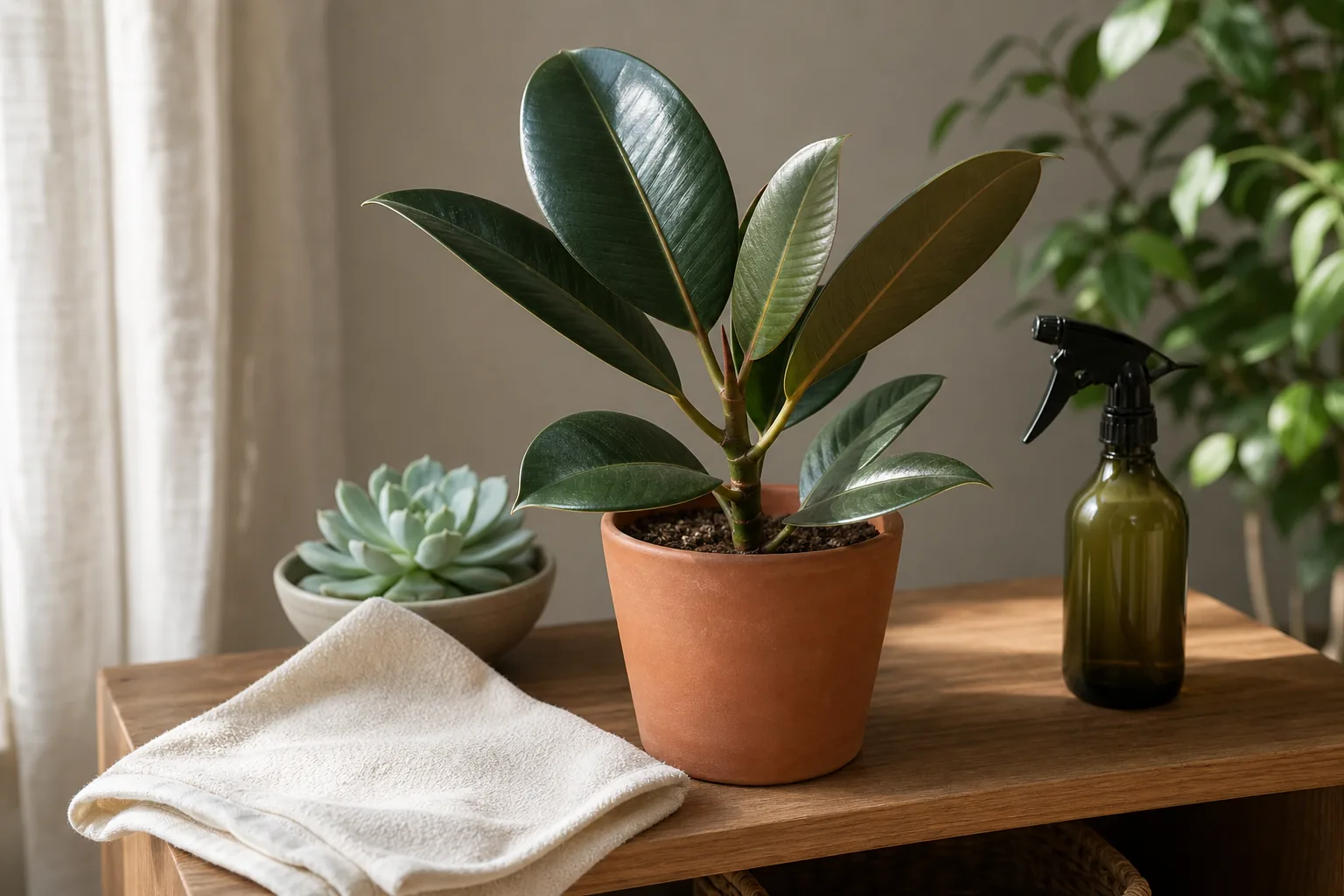
For a glossy broadleaf houseplant, such as a rubber plant, snake plant, philodendron, monstera, or pothos, the routine that most retailers and podcasts recommend is short and inexpensive. Support the underside of the leaf with one hand, wipe the top surface with a soft damp microfiber cloth, and rotate to a fresh section of cloth as dust accumulates. If the plant is small enough to move, a brief lukewarm shower rinse in a sink or bathtub cleans both surfaces at once and reaches undersides where pests often start. Let the plant drain before returning it to its cachepot.
If you find that plain water leaves a faint film (sometimes the case with hard tap water), a half teaspoon of distilled white vinegar in a quart of warm water is a commonly cited option among plant-care writers. A few drops of castile soap in water is the next step up, well diluted, then rinsed. Both options should be kept off fuzzy leaves and farina-coated succulents.
For a rubber plant in particular, where dust is very visible on those wide, dark leaves, the rubber plant care guide treats this kind of routine wipe as part of normal care rather than a special task.
Home remedies like olive oil or milk
Searches for olive oil, milk, mayonnaise, and banana peel on plant leaves return a steady stream of videos, forum posts, and DIY recipes. What they do not return is coverage in university extension publications or botanical-garden consumer materials.
That does not mean a kitchen oil applied sparingly to a glossy broadleaf leaf is automatically harmful. It does mean these are unstudied popular practices rather than documented techniques. A few practical notes:
- Some plant-care writers worry that kitchen oils can oxidize slowly on a warm room leaf and pick up dust visibly, though this has not been formally tested on houseplants.
- Some plant-care writers are wary of the sugars and proteins in milk and mayonnaise lingering on leaf surfaces in humid rooms; that concern has not been formally tested either.
- Banana peel rubbed on a leaf is folklore rather than a documented technique and is not endorsed by reputable sources.
If you want a homemade approach that reputable consumer sources do describe, it is the diluted vinegar or castile-soap routine above, used as a cleaner rather than a coating.
If you already use a leaf shine product
There is no reason to panic if a leaf shine product is already part of your routine. Several plant-care retailers describe the category as acceptable for occasional cosmetic use, particularly before guests or for photographs, and unnecessary as routine care. A few practical observations can tell you whether the product is earning its place:
- Does dust seem to accumulate faster than it did before you started using it? That is a common visible signal that the coating is attracting particulates.
- Are leaves that were previously glossy starting to look dull even after wiping? A residue buildup under the film is a possible explanation, and a more thorough clean with plain water may be needed.
- Is the plant showing other symptoms, such as yellowing, drooping, or slowed growth? Those are care issues rather than surface issues and are worth investigating on their own.
If you want to stop using the product, the transition is simple. Wipe leaves with a damp microfiber cloth every few weeks, follow with a plain-water rinse if needed, and let the plant return to its natural cuticle on its own timeline.
A short decision frame
The clearest way to decide is to separate the question from the marketing.
For most broadleaf houseplants, a damp cloth or a shower rinse does the same cosmetic job as a leaf shine product, and it leaves nothing behind. That is the default.
A leaf shine product becomes a judgment call when you specifically want a longer-lasting gloss for an occasion, when the plant is in a drafty or particularly dusty room, or when a glossy-leaved species has a brief cosmetic event in mind. Even then, avoid fuzzy-leaved plants and succulents with farina.
A leaf shine product is probably not the answer when the underlying question is whether your plant is healthy. Dull leaves paired with yellowing, drooping, or slowed growth are usually a light, water, humidity, or nutrition signal, not a surface signal. Solve those first, and the leaves usually take care of themselves.
For more on diagnosing what your plant is actually telling you, our guide on triaging spots on houseplant leaves walks through how to read leaf-level signals before reaching for any product.