Plant care
Hydrogen peroxide for houseplant root rot: does it actually help?
· Updated
If your houseplant is wilting in soil that is still wet and you have searched for a quick fix, you have probably seen the hydrogen peroxide recipe. Brown bottle, a few tablespoons in a cup of water, pour it through. The pitch is that it kills the rot and adds oxygen to suffocating roots. Both halves of that pitch are worth slowing down to look at, because root rot in houseplants is almost always a structural problem, and the chemistry of peroxide does not match the story.
Here is the honest short version: at the dilutions commonly recommended for houseplants, hydrogen peroxide is a brief, surface-level oxidizer that does not reliably reverse root rot and can damage the tender new roots a plant needs to recover. The response that actually helps is unpotting, inspecting the roots, removing the soft black tissue, and correcting the substrate, pot, and watering rhythm that caused the problem in the first place.
Why hydrogen peroxide comes up whenever root rot is mentioned
The recipe has been recycled on plant blogs and social media for years. The usual form is a tablespoon or two of 3% hydrogen peroxide in a cup of water, poured through the pot or used as a brief root soak during repotting. The implied promises are familiar: it disinfects the soil, it kills the fungus, it oxygenates the roots.
It is an appealing idea because the bottle is cheap and already in the bathroom cabinet, and because root rot feels like an emergency where you want to do something today. The trouble is that none of those promises hold up well at the doses most people actually use, and the underlying problem is structural rather than chemical.
If you are staring at a wilting plant right now, step one is the same as it would be without any chemical: confirm that the problem really is wet-soil wilt and not something else, and start the inspection before you add anything to the pot. Our piece on why a houseplant wilts in wet soil walks through that order, and the broader question of telling overwatered from underwatered houseplants is worth a look if you are still deciding which direction the problem runs.
What hydrogen peroxide actually is and what it does in wet soil
The brown bottle on the shelf is a 3% aqueous solution of hydrogen peroxide. Above all else, peroxide is an oxidizer. It breaks down into water and oxygen, and on the way it reacts with anything biologically reactive that it touches. In a moist potting mix, that breakdown happens quickly. Transition metals in the substrate, organic matter, and microbial enzymes all catalyze the decomposition, which is also why you hear the fizz when you pour it in. The EPA’s pesticide clearance review for hydrogen peroxide describes rapid degradation in soil, and that rapid degradation is the key fact behind every claim about the recipe.
Two consequences follow.
First, any oxidizing action is brief and limited to whatever the liquid directly contacts. The fizz is doing the work, and once the fizz stops, most of the peroxide is already gone. A single pour through the root zone is not a sustained treatment.
Second, the oxygen that peroxide releases as it decomposes does not fix the underlying problem in a saturated mix. In waterlogged soil, the pore space between particles is filled with water rather than air. Gas exchange is limited by soil structure, not by whether oxygen molecules are present nearby. A small, transient burst of oxygen released into pore water that cannot off-gas does not change the structure of the substrate. The plant is not drowning because the air disappeared; it is drowning because the soil structure will not let gases move.
What root rot really is in a houseplant
Root rot is a syndrome, not a single disease. The most common organisms behind it in container plants are the oomycetes Pythium and Phytophthora, sometimes called water molds, along with true fungi such as Rhizoctonia and Fusarium. Wisconsin horticulture, University of Maryland Extension, and Iowa State Extension all describe that same short list. What unifies them is a preference for saturated, low-oxygen conditions in the root zone.
That preference matters. The water molds are called water molds because free water is where they thrive. The conditions you see in the pot (slow-drying mix, a cool room, a heavy container with no drainage) are exactly the conditions these organisms exploit. Several extension publications explicitly tie losses to Phytophthora and Pythium back to drainage and irrigation management. Hydrogen peroxide does not change drainage.
Most of the time, household root rot is a cultural problem in a small pot rather than a pathogen problem that arrived out of nowhere. If you want to look at the structural setup, our piece on drainage and cachepot setup catalogs the usual suspects.
The gap between the internet recipe and the chemistry
Recipes vary enough that the inconsistency is itself part of the story. Some sources recommend a few drops of 3% peroxide per cup of water. Others call for a tablespoon per cup. A few suggest brief root dips using 3% peroxide diluted one-to-one or one-to-two. A handful recommend stronger food-grade peroxide diluted further for soil sterilization. None of these are standard horticultural rates. None of the supplied university extension publications recommend any of them.
What the chemistry predicts is that the lower end of that range will not deliver enough oxidizer to matter, and the higher end will deliver a brief, surface-level dose that does not penetrate organic matter very far. Either way, the saturated mix that caused the rot is still saturated after the fizz stops, and the dead tissue in the root ball is still there.
This is also why peroxide cannot sterilize a potting mix the way a hot oven or a sterilizer can. Even at higher concentrations, contact time and penetration through damp organic matter limit the effect. Treating peroxide as a soil sanitizer that also happens to help roots is doing two jobs with one tool that is good at neither.
What hydrogen peroxide can do to already-stressed roots
Hydrogen peroxide does not discriminate between pathogen cells and plant cells. It is a non-selective oxidizer, and the same chemistry that reacts with microbial membranes also reacts with the delicate tissue on the tip of a living root. In the supplied extension sources, the safe statement is the general one: at higher concentrations or with repeated applications, peroxide can damage tender new feeder roots, and that damage is the opposite of what a plant trying to recover from root rot needs.
You will not find a specific houseplant-safe ceiling in the published extension guidance. The honest read of the evidence is that occasional, dilute applications are likely less risky than regular or concentrated ones, but they are also less likely to do anything useful. Most plants in active root rot do not have a large margin of feeder roots to spare.
What actually helps a plant with root rot recover
What reliably helps is the slower, less satisfying version of the fix. The load-bearing steps are cultural, and they line up across the extension publications.
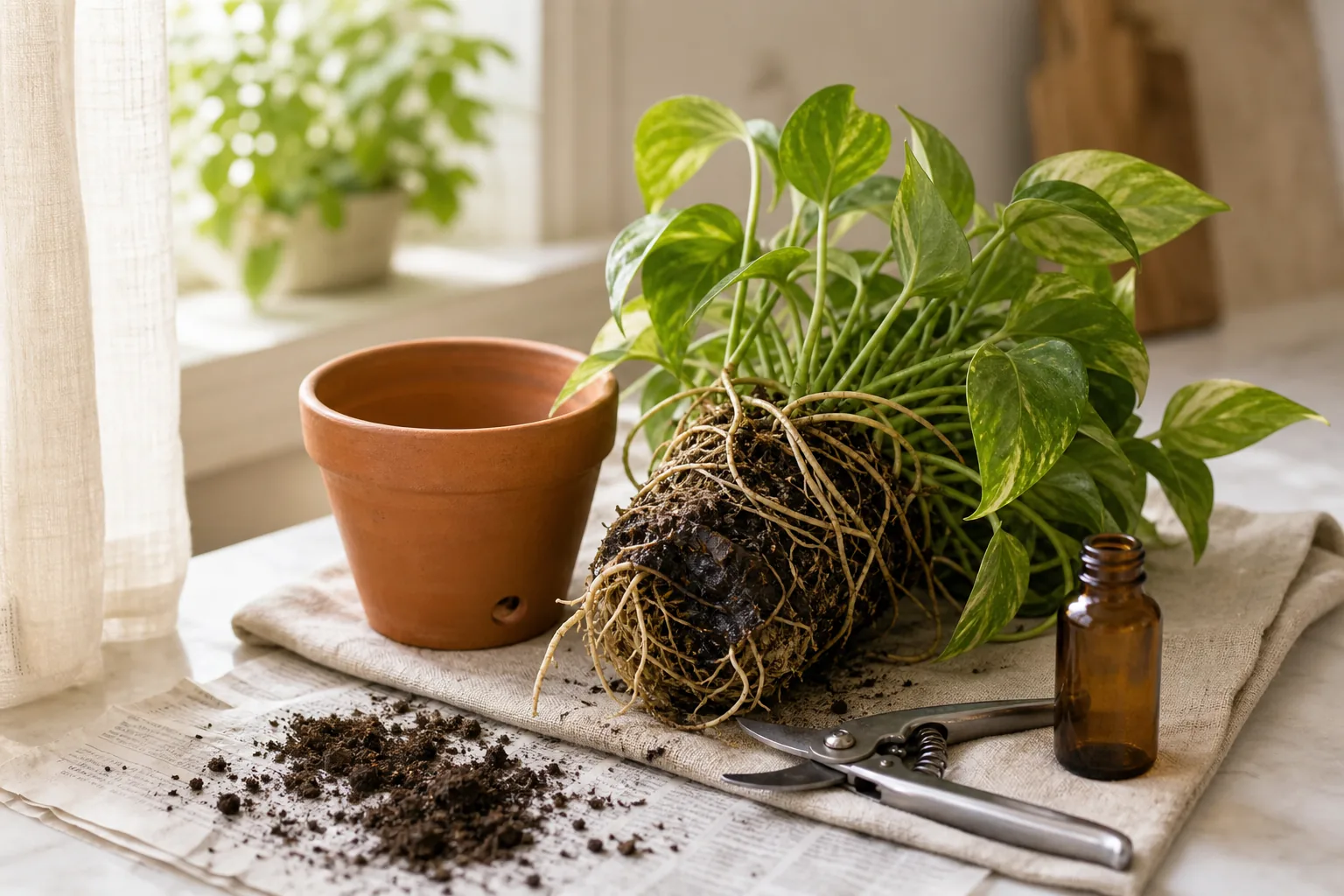
Unpot and look at the roots. Squeeze the sides of the pot, slide the plant out while the mix is just damp, and shake or rinse the root ball gently so you can see what you are working with. Healthy roots are firm and light in color (white, cream, or tan, depending on species) and may smell earthy. Rotted roots are dark, soft, slimy or papery, and may smell sour or of decay.
Trim back to firm tissue. Use clean pruners (wiped between cuts with isopropyl alcohol or a dilute bleach rinse) and cut soft, blackened, or hollow roots back to tissue that is firm and pale. Leaving mushy tissue in the pot is leaving the medium the pathogens grew in.
Repot into a clean pot with drainage, in a mix that dries at a sensible pace for the species. Choose a substrate matched to the plant rather than a generic dense “potting soil,” and size the pot to the root ball you have left rather than to the plant you would like to have. Our piece on choosing a houseplant potting mix goes into how to read a mix label.
Adjust the watering rhythm. Water based on how fast the actual mix in the actual pot is drying, not on a calendar. If the pot still feels heavy a week after watering, the mix is staying wet too long for that combination of substrate, pot size, and light.
Set realistic expectations. If most of the root mass was mushy, recovery odds drop sharply, and no drench, peroxide or otherwise, changes that. Plants with enough remaining healthy root to push out new growth can recover in a fresh setup. Plants that have lost nearly all of it usually cannot, regardless of intervention.
If you do end up repotting, plan the weeks afterward on purpose: bright indirect light, no fertilizer until you see active new growth, and a watering cadence matched to the new mix. Our notes on after-repotting houseplant care cover the recovery routine in more detail.
When the problem is bigger than one plant
A mild case in a single pot is one thing. A plant that has gone through a full collapse and is sitting in a soupy mix that smells of rot is a different problem. If you have a recurring pattern of plants wilting in wet soil across several pots, the common factor is almost always substrate, drainage, or watering rhythm rather than any pathogen that the peroxide recipe can fix.
This is also a good moment to take stock of conditions that quietly push root rot risk up: low indoor light that slows water use, cool rooms that slow drying, decorative cachepots with standing water at the bottom, and oversized pots that hold a reservoir of damp mix the roots cannot reach. Each of those on its own is fine. Several of them together is the setup where root rot starts showing up after every watering. A short weekly check is the simplest way to catch the pattern before it catches another plant, and a simple weekly houseplant routine is a reasonable place to anchor that habit.
When to ask a local expert instead of trying another home remedy
If you have inspected the roots and the answer is “mostly mushy,” the plant is likely beyond what any home intervention can rescue, and continuing to pour things through the pot delays the decision. A local independent nursery, a county extension office, or a master gardener clinic can look at the plant in person and tell you whether recovery is realistic, and they will usually point you at the substrate or pot choice that caused the issue. If a plant has sentimental or financial value and the diagnosis is unclear, that in-person look matters more than another dose of anything. Horticultural questions like these sit well outside what Houseplant Supplies can diagnose, and a local expert is the right resource when the situation stops being a quick experiment.