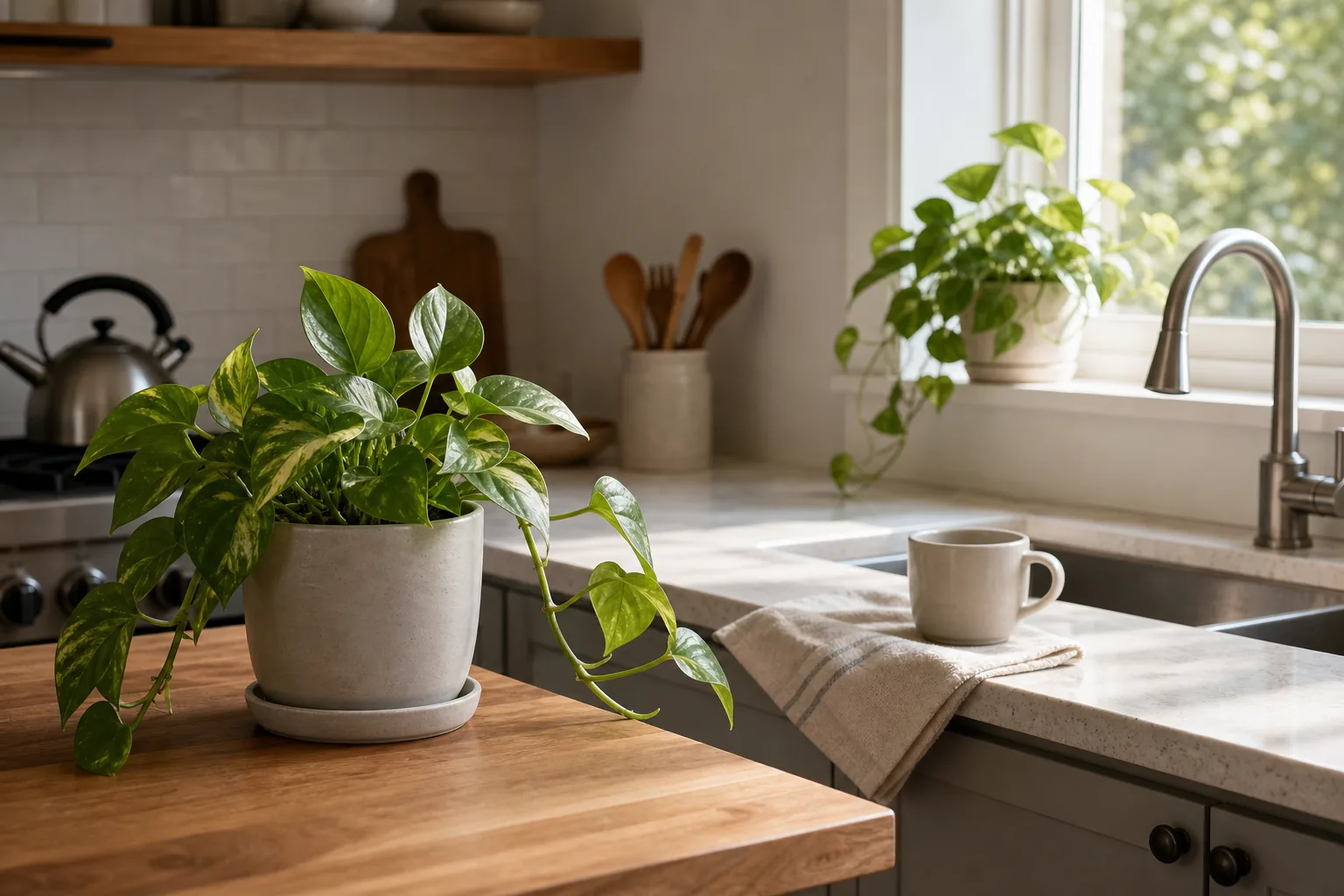
Plant care
How to match houseplants to a real kitchen
· Updated
A kitchen is several different rooms stacked in one, and that is the first thing to take in before choosing a plant for it. A pothos by the fridge and a pothos a foot from a hot burner are not the same situation; the same plant on a sunny sill above the sink and on a dim counter six feet away are not the same situation either. Match the plant to the zone, not the zone to a generic list.
A kitchen is several different rooms stacked in one
Most “best plants for your kitchen” articles treat the kitchen as one room. The kitchen you actually cook in is closer to five:
- A window over the sink, usually the brightest, hottest, splashiest zone
- A stove and oven side, with radiant heat, brief cooking humidity, and grease aerosols
- A counter run, with traffic, splashes, and limited light the further it sits from the window
- A fridge top or cabinet top, warm, sometimes vibrating, and hard to water without a step stool
- A pantry corner or interior wall with very little usable light for most species
Each zone behaves differently for a plant. Treating your kitchen as a stack of small rooms is the more accurate starting point than picking from a list.
Read your kitchen window honestly
Before you choose a species, decide what kind of light your kitchen window actually receives. Window direction, season, neighboring buildings, and window glass type all change the answer. Our guide on how to read the light at your kitchen window walks through the shadow test and the directional basics; the short version is that light drops off quickly as you move into the room, so a plant on the sill is in a different world than a plant six feet back.
Two kitchen-specific cases worth naming:
- The above-sink window gets the most direct light and the most splashes. Leaves pressed to the glass on a sunny day can scorch.
- A north-facing galley window with no direct sun can still be bright indirect light if it is large, while a small east-facing window with morning sun can be the only direct sun a plant sees all day.
If your best window is two rooms away, you do not have a sunny kitchen; you have a dim kitchen with a sunny living room.
What cooking actually changes: humidity, heat, grease, and splashes
The three variables extension services consistently name first for indoor plant placement are light, temperature, and humidity. Kitchens interact with all three, but in ways that are easy to misread.
Cooking humidity is real but it is brief. Water simmering on a stove, a kettle boiling, or a dishwasher running pushes humidity up while the event is happening, then it falls back to baseline. Most homes sit around 40 to 50 percent relative humidity on average, while many tropical houseplants prefer closer to 50 to 60 percent. A steamy moment at the stove does not reset the day’s average, and misting leaves does not close that gap either; misting is generally understood to produce only a brief surface moisture spike rather than a meaningful rise in ambient humidity. Kitchens are not a substitute for a humidifier, and a tropical in a kitchen is usually still below its preferred range. Our piece on what cooking humidity actually does to indoor air covers this in more detail.
Heat comes in two forms. Burners radiate heat to the air and surfaces within arm’s length while they are on, and an oven door can warm a counter directly in front of it during long bakes. Sun through a kitchen window is the second heat source: window glass in direct sun can run noticeably hotter than the room air, and that heat travels into leaves that are touching or very near the pane. The post on microclimates around stoves, ovens, and windows takes a closer look at how that works in other rooms; the kitchen applies the same principles.
Grease and splashes are the easy-to-forget third variable. Cooking releases fine aerosols that settle on leaves over weeks and dull them, and a plant above the sink will get hit with soap residue and water spots on top of its regular watering. Neither kills a plant quickly, but both matter over time.
Counter space, drainage, and safety
A counter plant has to survive the room it sits in, not just the spot. A few practical things matter:
- A heavy ceramic pot on a counter edge is a real risk around elbow traffic during cooking.
- A pot without a saucer will leave a ring on the counter or wet the surface each time you water.
- Watering above a sink is awkward for any plant with broad leaves or a shape that does not tilt cleanly. A narrow-spouted watering can or sliding the plant briefly to the sink makes a measurable difference.
- Plants above the fridge see heat rising from the appliance plus a low hum of vibration; over months that is harder on foliage plants than people expect.
If a counter plant is going to fail for a non-plant reason, it is usually one of these.
Plants that tend to settle into a real kitchen
Most kitchen plant lists rank species as if all kitchens were the same. Grouping by zone is the more useful structure. The species below are widely covered on this site through their own care guides; we are not inventing recommendations, just matching them to kitchen zones.
Bright kitchen window (direct sun for part of the day, or very bright indirect)
- Pothos tolerates a bright-window sill and grows more actively in brighter light. In dimmer spots it slows down and stretches, with more stem between leaves, which is a survival pattern, not a failure. Our pothos care guide covers the light-by-leaf-cue approach.
- Spider plant holds its shape and tends to look fuller in brighter light; the spider plant care guide explains how its watering rhythm changes with light.
Medium light (bright window across the room, no direct sun on the plant)
- Pothos adapts to this light band; it grows more slowly and may show longer stretches between leaves, which is normal rather than a sign of failure.
- Philodendron in many of its common forms handles this light band well.
- Snake plant is one of the few species a university extension service specifically describes as forgiving across a wide light range and forgiving with irregular watering; Penn State Extension’s snake plant care page ties it to well-drained soil and watering only when the soil is dry.
Dim kitchen corner or pantry (low usable light)
- Snake plant is the species most often recommended in the dimmest indoor spots, with the same watering caution above.
- Most other kitchen “favorites” will hold for a while and then quietly decline here; if the corner is the only spot, match the species to the light instead of fighting it.
A few species that recur on kitchen lists deserve an honest expectation. Pothos in a dim corner survives rather than thrives. Peace lily can work in a kitchen but tends to be less forgiving than pothos or snake plant when watering is irregular or the air runs dry, so leaf-edge stress shows up faster. Survival rather than thriving is often the realistic outcome in a working kitchen, and shifting that expectation makes plant decisions easier.
Note that we are not treating culinary herbs (basil, rosemary, mint, thyme) as houseplants here. Herbs are a separate category with higher light needs, more frequent watering, regular pinching, and food-use implications. This site does not maintain a culinary-plants guide, and a generic kitchen plant list is the wrong place to start if you actually want to cook with what you grow.
Where to put a kitchen plant and where to leave it alone
A few placement rules consistently reduce kitchen plant stress:
- Keep leaves off sun-heated glass. A hand’s width of space between the foliage and the pane is usually enough.
- Treat the stove side as a hot zone. A pothos on the opposite counter from the stove is in a normal kitchen; a pothos on the counter next to a working burner is in a hot, dry, occasionally greasy zone that does not match the species.
- Treat the sink window as a splash zone. Soap residue builds on glossy leaves over time; rinsing gently during your regular cleaning is fine, but plan for it.
- Pick a spot and leave the plant there. Frequent rotation to chase light or to follow you around the kitchen adds stress that shows up as leaf drop.
- Above the fridge is hard mode. Heat plus vibration plus awkward watering make this a placement of last resort for foliage plants.
When a kitchen plant is failing: what to inspect before replacing it
If a kitchen plant starts dropping leaves or crisping at the tips, work through the kitchen-specific causes in roughly this order:
- Light: has the plant’s spot actually changed, or were you overestimating how much light the corner receives?
- Watering rhythm: heavy ceramic pots stay wet longer than nursery pots; a kitchen plant in a decorative cachepot without drainage often stays too wet.
- Drainage: is the plant sitting in standing water?
- Heat exposure: is the plant within arm’s length of a working burner or oven door?
- Surface residue: are the leaves dusty or slightly greasy from cooking aerosols?
Most of these are fixable without replacing the plant. Walk through them in order before giving up on the species.
A short note on pets
Some species that show up on kitchen plant lists can be toxic to cats and dogs if eaten, and kitchens are often pet-traffic zones, which makes this worth checking before you bring a plant home. Our pet-aware houseplant choices post walks through a verification method rather than relying on memory, and the ASPCA’s plant list is the source worth confirming against for any specific species.
The honest summary
A kitchen is harder than a bedroom or office, and some leaf drop is normal when a plant is moved into it. If you match the species to the zone you actually have, water by feel rather than by calendar, and accept that survival is a reasonable goal, a real kitchen can hold plants well. The list is less important than the zone.
Sources
- Penn State Extension — Snake plant: a forgiving, low-maintenance houseplant
- University of Arizona Cooperative Extension — Indoor plant selection and care
- Healthy Houseplants — How to map your house before you buy another plant
- Costa Farms — Why relative humidity matters for your houseplants
- JoyUsGarden — Plant humidity: how to increase humidity for houseplants