Plant care
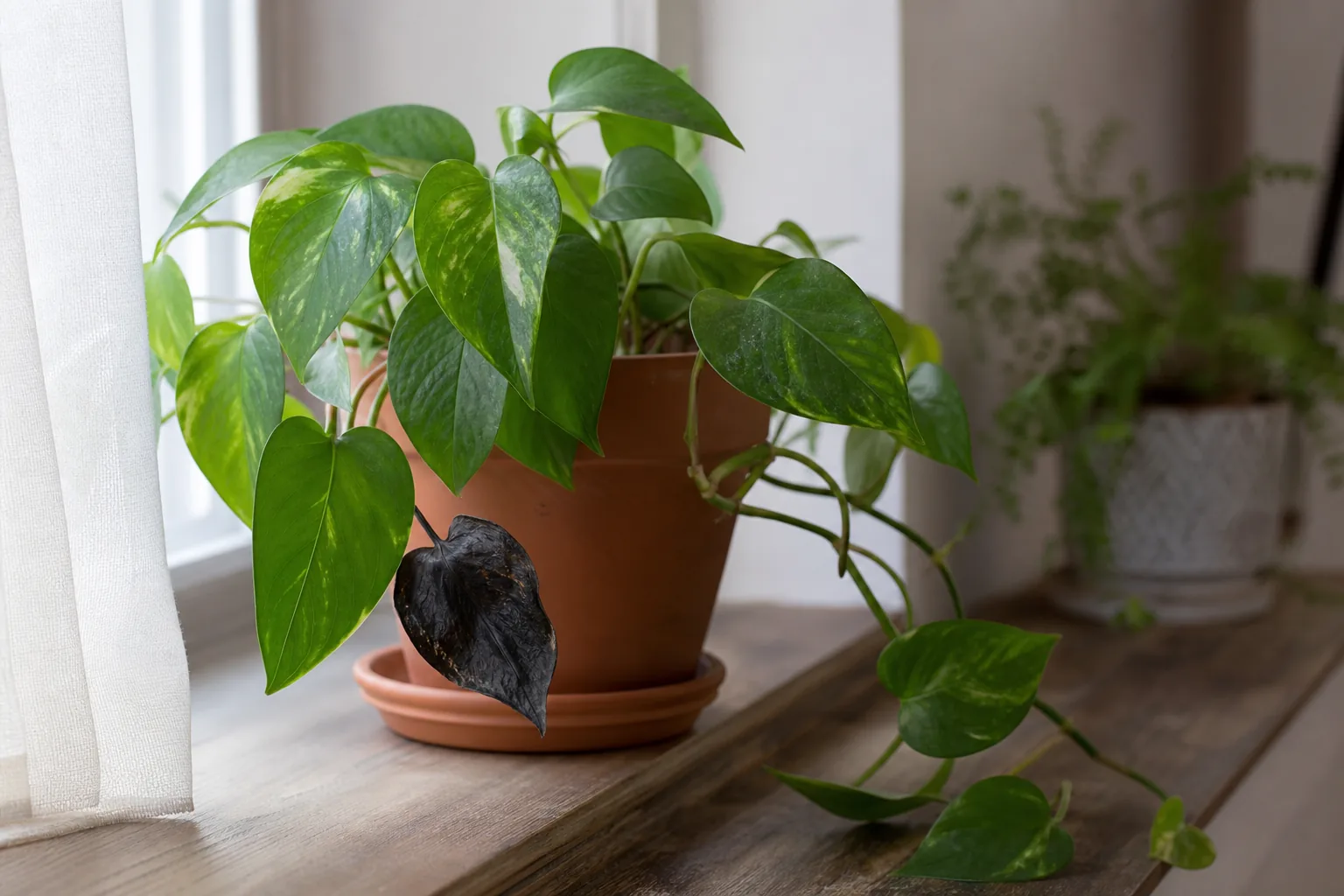
Houseplant leaves turning black: how to read the pattern and what to change first
· Updated
Why houseplant leaves turn black, and why “black” is not a diagnosis
Black leaves on a houseplant almost always mean something specific happened to that leaf, but the same dark color can come from very different causes. A leaf on a cold windowsill in February, a leaf over a heat vent, a leaf on a plant that has been sitting in soggy soil for two weeks, and a leaf with a single dark halo can all look similar in a photograph. University extension services are clear on the big picture. Most houseplant problems, including black leaves, are environmental rather than infectious, and disease is the exception rather than the rule on indoor plants. That matters because it changes what you do next.
The pattern on the leaf, more than the color, tells you which environmental cause fits and whether you should adjust a condition or call a local expert. Below is a short observation order, then the four most common patterns and what each one usually means.
Step 1: read the pattern before you read the cause
Before changing anything, take 60 seconds and look at the leaf in this order. Each question narrows the possibilities.
- Where is the black. Whole leaf, only the edges or tip, a discrete spot with or without a halo, or starting at the base or petiole.
- What does it feel like. Soft, wet, and mushy suggests rot. Dry, papery, and crisp suggests cold, sun, or salt damage.
- When did it start. Blackening that appears within hours or several days — sometimes up to about a week — after a cold night, a delivery, a move to a brighter spot, a repotting, or a feeding usually traces back to that event.
- What is the soil doing. Wet days after watering, with the plant wilted, points to root stress. A white crust on the soil or pot rim points to soluble salt buildup.
- What is the rest of the plant doing. Wilting with wet soil and a sour smell is more urgent than one crisp black leaf on an otherwise healthy plant.
- What about the neighbours. If other plants are starting to show spots, isolation is worth doing while you sort this out.
If you can answer those six questions, you can usually narrow things down to a small set of possibilities without changing anything yet.
Pattern A: the whole leaf or most of it blackens suddenly
A whole leaf, or most of one leaf, going black at once usually traces to one of three triggers: a chill event, an overwatering episode followed by rot, or a sudden move into much brighter light.
Chill damage from a cold window, an air-conditioning vent, or a delivery that sat on a porch is a common cause on tropical foliage. Symptoms can show within hours or several days later, can appear on only the side of the plant facing the cold source, and may show as black, purple, red, or straw-coloured patches. Sensitive tropicals can show damage at temperatures around 15°C / 59°F, while tolerant plants usually only show it below roughly 5°C / 41°F. There is no single threshold that fits every houseplant, so treat that range as a guideline rather than a rule. Our drafts and cold windows guide walks through which placements tend to cause this in real homes.
If blackening shows up a few days after a repotting, the cause is more often stress plus a watering problem than the repotting itself. Our post on what to do after repotting reframes the same symptoms in that context.
If the soil has been wet for many days and the lower leaves are going soft and dark while the plant wilts, the cause is more likely below the leaf. Our wilting in wet soil checklist covers that pattern in more detail.
If the move into bright sun was recent, suspect sunscald rather than disease. Indoor sunscald on a tropical plant usually looks like a pale, tan, or light-brown patch on the side facing the light, more often than a dramatic bleach.
Pattern B: only the edges or leaf tips are black
Tip-and-margin blackening with a dry, crisp texture is most often fertilizer or soluble-salt damage, especially when paired with a white crust on the soil surface or pot rim. UC IPM lists overfertilization and salt buildup among the most common causes of brown and black leaf tips and margins, alongside excessively dry or wet soil. The white crust is the diagnostic fingerprint: tap water and fertilizer both leave salts behind, and those salts migrate to the surface as the soil dries. If you have just fed the plant, our houseplant fertilizer basics piece walks through how to scale back without shocking the plant further.
Dry, brown-to-black margins can also show up on plants that have been kept very dry for a long stretch and then watered, or on plants next to a heat vent with low humidity. Distinguish the two by looking at the soil. Soil that is dry, hard, and pulling away from the pot suggests drought stress and possibly low humidity. Soil that is damp with a visible crust suggests salt or fertilizer damage.
Pattern C: black spots or patches, sometimes with a halo
Distinct, separate black or dark-brown spots on otherwise healthy leaves are the pattern most often confused with general blackening, and the one where the dry-versus-wet rule matters most.
Fungal leaf spots, from genera like Alternaria, Cercospora, Colletotrichum (which causes anthracnose), and Myrothecium, tend to be dry, rounder, and may show defined margins, concentric rings, or a yellow halo. They sometimes produce very small raised structures on the underside. Bacterial leaf spots — from genera such as Xanthomonas and Pseudomonas — tend to look different: the margins are water-soaked or glassy, the shape is often angular and limited by the veins, and they spread faster in warm, wet conditions.
Colour alone does not separate them. Texture, margin shape, and whether the lesion follows veins matter more. If the margins are dry and the spots are round with a yellow halo, it leans fungal. If the margins are wet-looking and the spots are angular and vein-limited, it leans bacterial. Even with this rule, the Royal Horticultural Society points out that white or straw-coloured rings or patches are more often cold damage than fungal, which is why extension services ask you to confirm rather than guess.
What to do here is isolate the plant, stop misting the leaves, and avoid overhead watering until the situation is resolved. If unsure whether the pattern is fungal, bacterial, or environmental, do not self-treat with a kitchen-cabinet spray. Confirm with a local nursery, a master gardener hotline, or your state extension office before using any product. Our general houseplant leaf spot triage guide is a useful pairing read.
Pattern D: blackening starts at the base, petiole, or stem
Blackening that begins at the bottom of the leaf, the petiole, or where the stem meets the soil is a different and more urgent problem. Texture is the giveaway. If the tissue is soft, mushy, or smells sour, and the soil has been wet, the cause is usually root rot, crown rot, or a stem-level rot — for example Pythium or southern blight — rather than anything happening on the leaf surface. Clemson HGIC and UF EPI are consistent on the pattern: most whole-plant collapse indoors is environmental, not disease, and it is usually an overwatering problem combined with low light and low temperature.
This is the case where the job is to triage fast. Stop watering, move the plant to bright indirect light if possible, and check whether the base is firm. If the soil seems to be staying wet for days at a stretch, our pot drainage and cachepots piece covers the most common setup mistakes that lead here. If the base is firm and only a lower leaf or two is dark, the plant may be salvageable by adjusting conditions. If the base is soft or the stem is collapsing, escalation to a local expert is the right next step.
Step 2: match the pattern to the most common indoor causes
Once you have the pattern, the most common indoor causes fall into a small list.
Cold and chill damage. Above-freezing exposure near a window, vent, or exterior door. Black, purple, or red patches that may show a day or more later. Tissue can be dry or limp depending on the speed of the event.
Soggy soil and root stress. Pots without drainage, dense mixes, repeated watering on a schedule the plant does not need. Usually starts at the base. Soil stays wet. Roots may turn soft and dark with a sour smell.
Sunscald and heat stress. A recent move to brighter light, sun through heated glass, or a heat register nearby. Pale-to-brown patches on the sun-facing side. Margins may curl.
Fertilizer and soluble-salt burn. Recent feeding, hard tap water, or accumulated salts. Tip and margin blackening. White crust on soil.
Mechanical or chemical damage. A bruise from a fold in the leaf, contact with hot or cold surfaces, leaf-shine sprays, or cleaning products. Usually localized, asymmetric, and does not spread.
Foliar disease. Distinct spots or lesions, possible halo, can spread leaf to leaf. Treat this pattern as a possible but not default cause, and confirm before treating.
Step 3: decide what to do, in this order
Adjust one condition at a time. Pick the most likely cause from your pattern read, change that one thing, then wait a week and look at new growth, not the already-black leaves. Fully blackened tissue will not recover, so the only useful diagnostic is what is happening on the rest of the plant and on the new leaves coming in.
Isolate if the pattern looks like it could spread. That means a plant with multiple spreading spots, a plant that arrived recently from a greenhouse with active lesions, or any plant you are unsure about. Our guide on how to isolate a new houseplant walks through the practical steps if separation makes sense for your setup.
Ask a local nursery or extension service before treating. If a fungal or bacterial pathogen is in play, UC IPM frames the rules this way: confirm the diagnosis, match the product to the confirmed pathogen, follow the label, and verify the product is labelled for indoor use on the listed site. Never use an outdoor-labelled product indoors. Common home remedies such as baking soda spray, hydrogen peroxide, milk spray, or neem oil are not verified cures for black-leaf patterns and should not replace a diagnosis-matched, label-compliant option.
What not to do when a houseplant leaf turns black
- Do not assume a fungus. Most indoor black-leaf cases are environmental.
- Do not fertilize a stressed plant to “give it strength.” That usually makes the tip and margin burn worse.
- Do not mist a plant with spreading spots. Wet leaves help bacteria and many fungi.
- Do not use outdoor fungicide or bactericide products inside the home.
- Do not remove every black leaf at once. Leaves still attached feed the plant and tell you whether the cause is fixed.
A short checklist you can use today
- Note where the black is and what it feels like.
- Note what changed in the last week: cold night, move, watering, repotting, feeding.
- Check the soil: wet or dry, crust present or not, sour smell or not.
- Move the plant away from the most likely culprit, whether that is a cold window, a vent, or direct sun, without making other changes at the same time.
- Wait and watch new growth before any treatment.
- If the base or stem is going soft, or the spots are spreading, isolate and call a local nursery or extension office.
Black leaves are a signal, not a verdict. With a calm read of the pattern, the most common indoor causes can usually be ruled in or out, and the next step becomes a small change rather than a big one.
Sources
- UC IPM Home and Landscape: Houseplant Problems. https://ipm.ucanr.edu/home-and-landscape/houseplant-problems/
- UC IPM: Chilling Injury. https://ipm.ucanr.edu/PMG/GARDEN/ENVIRON/chill.html
- Clemson HGIC: Houseplant Diseases & Disorders. https://hgic.clemson.edu/factsheet/houseplant-diseases-disorders/
- Royal Horticultural Society: Leaf Damage on Houseplants. https://www.rhs.org.uk/prevention-protection/leaf-damage-on-houseplants
- University of Florida EPI: Diagnosing Houseplants 101 — Is your plant diseased or just overwatered. https://epi.ufl.edu/2024/07/03/diagnosing-houseplants-101-is-your-plant-diseased-or-just-overwatered/
- PMC / NIH: Rapid Responses of Plants to Temperature Changes. https://pmc.ncbi.nlm.nih.gov/articles/PMC5800372/
- UMass Center for Agriculture, Food and the Environment: Leaf Spot Diseases of Floricultural Crops Caused by Fungi and Bacteria. https://www.umass.edu/agriculture-food-environment/greenhouse-floriculture/fact-sheets/leaf-spot-diseases-of-floricultural-crops-caused-by-fungi-bacteria
- NCSU Cooperative Extension: Diseases of Foliage Plants (compendium). https://hortscans.ces.ncsu.edu/uploads/d/i/diseases_53a064b1c6b3f.pdf
- SDSU Extension: Leaf Scorch and Sunscald in the Garden. https://extension.sdstate.edu/leaf-scorch-and-sunscald-garden
- Missouri Botanical Garden: Scorch, Sunburn, and Heat Stress. https://www.missouribotanicalgarden.org/gardens-gardening/your-garden/help-for-the-home-gardener/advice-tips-resources/insects-pests-and-problems/environmental/scorch
- University of Florida IFAS: Chilling Injury in Tropical Foliage Plants — Dieffenbachia (EP530). https://ask.ifas.ufl.edu/publication/EP530
- NCSU Cooperative Extension, Durham County: Calling Plant 911 — Understanding Cold Injuries. https://durham.ces.ncsu.edu/news/calling-plant-911-understanding-cold-injuries-and-caring-for-plants-after-extreme-weather-hits/