Plant care
Water droplets on houseplant leaves: guttation, and when it is worth a closer look
· Updated
Water droplets on houseplant leaves: guttation, and when it is worth a closer look
If you have noticed clear droplets on the tips or edges of your houseplant’s leaves, especially in the morning on a plant you watered the night before, you are probably looking at guttation. Guttation is a normal process in which the plant pushes xylem fluid out through specialized pores called hydathodes at the leaf margins. It happens when the roots keep taking up water from wet soil while transpiration is low, which is most often overnight and in cool, still, humid, or low-light rooms.
Guttation is not a disease, not a sign of damage, and not, on its own, a reason to panic. It is, however, a useful signal that the root zone is on the wet side and that the plant is not transpiring quickly. The right response is usually a calm inspection of your watering rhythm, your pot, and the room, not a search for something to spray or wipe away.
What guttation actually is
Guttation is the exudation of liquid from intact plant tissue through hydathodes, which are small pores at the leaf tips and along the leaf margins. The driving force is root pressure: when the soil is wet and the air is still or humid, the roots keep absorbing water, the plant’s internal water pressure rises, and the excess fluid is released through those leaf-tip pores as droplets.
Two things have to be true at the same time for guttation to appear. The root zone needs to be quite wet, and the plant needs to be losing little water through its leaves. That second condition is why guttation is most often visible in the morning after a cool, still night, or during stretches of low light, high humidity, and reduced air movement. If you have noticed the droplets mainly after you water in the evening, or only when the room has been closed up for a while, guttation is the most likely explanation.
The fluid itself is essentially xylem sap, mostly water with dissolved minerals and small amounts of organic compounds carried up from the root zone. It looks like clear water, it feels like water, and as it dries it can sometimes leave a faint mineral mark on the leaf, especially in rooms that stay still and humid for long periods.
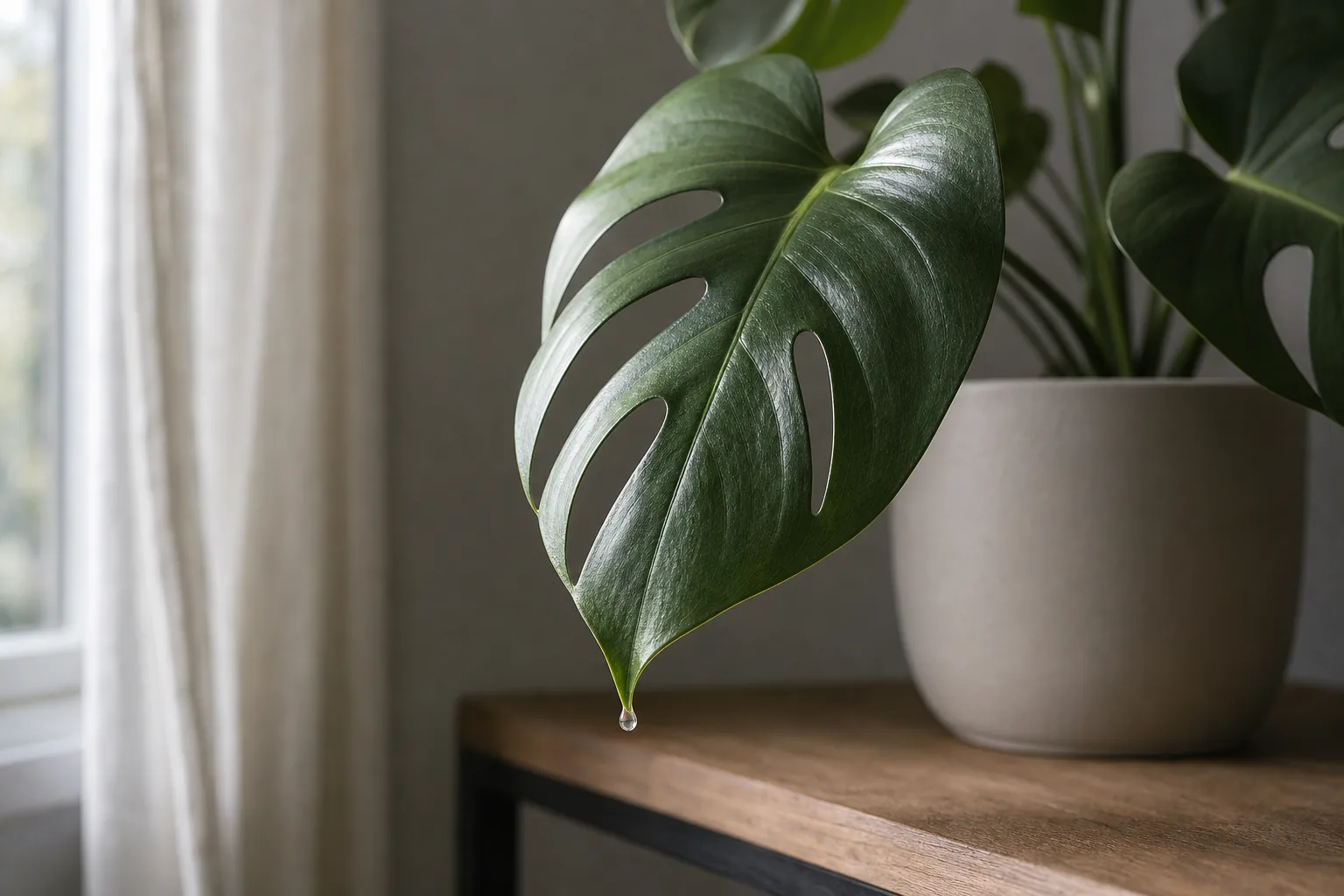
The plants on which readers most often notice guttation are broad-leaved tropicals with visible hydathodes, including Monstera, Alocasia, Calathea, pothos, and philodendron. On a Monstera or a philodendron, the droplet usually forms at the very tip of the leaf, sometimes at the end of the central vein. On an Alocasia or a Calathea, droplets often appear at the edges of the leaf or at the pointed tip.
How to tell guttation from other droplets on the same plant
Guttation is not the only reason a leaf can look wet, and the fastest way to calm yourself down is to look at where the droplets sit, when they appear, and how they feel.
Guttation is clear and watery. The droplets sit at the leaf tip or along the leaf margin, where the hydathodes are. They usually show up in the morning after a cool, still night on a plant that has been watered recently. The rest of the leaf surface is dry.
Honeydew is sticky and glossy, and it sits on the upper surface of the leaf rather than at the tip or margin. If you touch it, your finger comes away tacky. Honeydew often appears alongside ants, whiteflies, soft scale, mealybugs, aphids, or sooty mold. If what you are seeing looks sticky or smudged rather than watery, the sticky leaves and honeydew guide is the next read.
Condensation tends to cover more of the leaf as a fine film or as scattered droplets across the surface, especially after a sudden drop in temperature, a humidifier turned on overnight, or a cold window. It is atmospheric moisture condensing on the leaf rather than fluid coming from inside the plant.
Watering splash sits where the water physically fell. The pattern usually matches the path of the watering can, with droplets on the soil surface, the lower leaves, and any leaves that overhang the pot, and it dries within minutes.
If the droplets reappear every morning on the same leaves in still conditions, guttation is the most likely cause. If the droplets are sticky, sit on the leaf surface, or show up with insects, you are dealing with something different.
Why guttation often shows up when the soil is on the wet side
Guttation needs two ingredients: wet soil and slow transpiration. When you see it often, it is worth asking which of those two conditions is doing more of the work in your specific room.
On the wet-soil side, the usual suspects are watering more often than the plant actually uses, a pot that holds more moisture than the root system needs, a pot without a drainage hole, a dense or peaty mix that stays soggy, or a pot that is too large for the root ball. If you want a calmer starting point, watering by soil feel and pot weight rather than a schedule usually fixes the wet-soil side of the equation. If the pot is part of the problem, how drainage and cachepots change how long a pot stays wet is the next read.
On the slow-transpiration side, the usual suspects are a dim corner far from a window, a recent drop in daylight as the seasons change, a still room with little air movement, a humidifier running overnight, a cool windowsill, or moving the plant somewhere that gets less light than it used to. None of these are problems on their own, but each one shifts the plant toward the conditions that produce guttation.
The reason guttation is worth paying attention to is that the same wet-soil-plus-low-transpiration state that produces it is also the state that produces the more serious symptoms of overwatering, like yellowing lower leaves, soft stems, sour-smelling soil, fungus gnats, or wilting in wet soil. Guttation itself is not those symptoms. It is just an early, gentle signal that the root zone is sitting on the wet side longer than the plant can use.
A short observation routine if you want to respond
If you would like to do something about frequent guttation, change one variable at a time and give the plant a couple of weeks to respond. A simple routine looks like this.
Check the soil an inch or two below the surface with a finger or a wooden skewer. If it is still damp several days after watering, the soil is holding more moisture than the plant can use.
Lift the pot and feel its weight right after watering, then again a few days later. A pot that feels heavy for a long time is staying wetter than the plant wants.
Confirm the pot has a drainage hole and that water actually exits when you water. Standing water in a cachepot or saucer keeps the root zone wet long after the surface dries.
Notice the light the plant actually receives across the day. A plant that has been moved further from a window, or one that is in a dim corner, will transpire more slowly and is more likely to show guttation. The post on how low light slows transpiration and changes the watering rhythm walks through how to judge what your room is actually giving the plant.
Look at the room. A cool room, a still room, a humidifier running overnight, and closed-up heating vents can all slow transpiration.
Look at the rest of the plant. A few morning droplets on healthy leaves are normal. Yellowing, soft stems, sour soil, fungus gnats, or wilting in wet soil are signals to dig further rather than a problem with the droplets themselves.
If you change only one thing, change the watering rhythm. Let the top of the soil dry to the depth recommended for your plant, then water thoroughly and let the pot drain. Most plants that show frequent guttation will respond within a couple of weeks.
When guttation is fine, and when it is worth a closer look
A few droplets on the tips of healthy leaves in the morning is a normal pressure-relief event. The plant is essentially letting off a little of the water its roots have taken up overnight. Nothing needs to be sprayed, wiped, or treated.
Persistent guttation paired with other symptoms is a different story. If you are seeing frequent guttation and any of the following, it is worth slowing down and inspecting the plant, the soil, and the pot more carefully:
- yellowing lower leaves while the soil stays wet
- soft, mushy, or blackened stems
- a sour or rotten smell from the soil
- fungus gnats hovering around the pot
- wilting that does not improve after watering, or wilting in soil that is still damp
These are not guttation problems. They are root-zone or watering-rhythm problems that guttation is gently pointing at. For a step-by-step, the calm inspection order for overwatered versus underwatered houseplants walks through how to tell which one you are looking at before you change anything. The right response is to work through the observation routine above, address the wettest part of the picture first, and resist the urge to add anything to the soil or the leaves to fix the droplets themselves.
When to ask a local source
If you have worked through watering rhythm, drainage, light, and recent room changes and the plant still looks unhappy, the next step is a local one. A nearby nursery, a master gardener extension service in your area, or an in-person horticulturist can look at the actual plant, the actual soil, and the actual room. They can also check for pests and root health in ways that a photo and a paragraph cannot.
For most indoor gardeners, the short version is this: morning droplets at the leaf tip or margin are usually guttation, the plant is fine, and the signal is pointing you toward the watering rhythm, the pot, and the light rather than toward a problem on the leaf.
Sources
- University of Missouri IPM, Guttation: A Pressure Relief for Plants: https://ipm.missouri.edu/MEG/2009/6/Guttation-A-Pressure-Relief-for-Plants/index.cfm
- New York Botanical Garden Mertz Library Reference, Why are my plant leaves dripping water?: https://libanswers.nybg.org/faq/222841
- The Spruce, What Causes Water Droplets on Indoor Plant Leaves?: https://www.thespruce.com/why-do-houseplant-leaves-drip-1402999
- Gardening Know How, What Is Guttation - Learn About The Causes Of Guttation In Plants: https://www.gardeningknowhow.com/houseplants/hpgen/guttation-in-plants.htm
- Plantura, Guttation in plants: what is it and how to stop it: https://plantura.garden/uk/green-living/knowledge/guttation