Plant care
How far should a grow light be from a houseplant?
· Updated
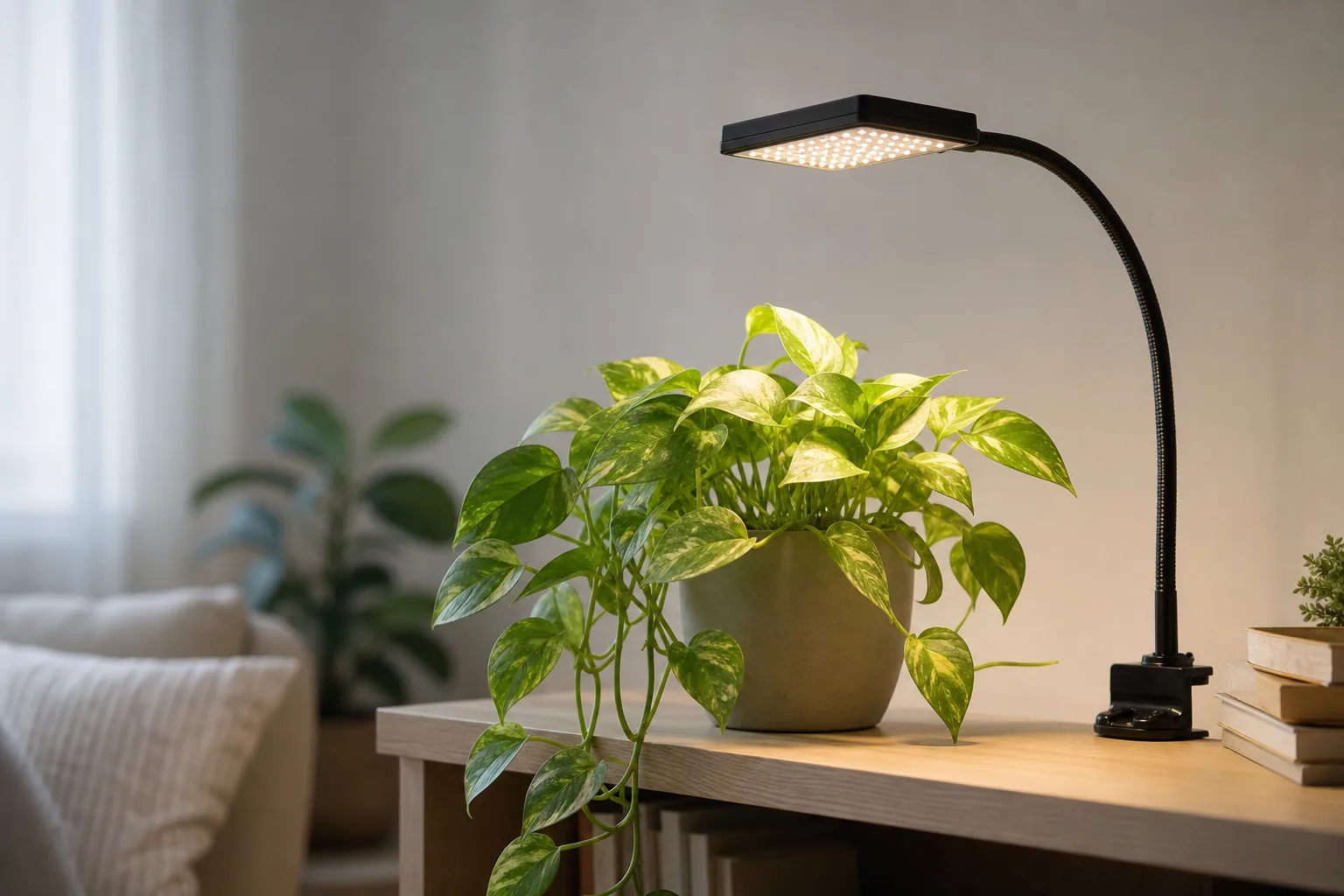
There is no single correct distance for every grow light and every plant. A practical starting range for a typical home full-spectrum LED panel or bulb is roughly 6 to 24 inches above the top foliage, with succulents, herbs, and other high-light plants sitting at the closer end and low-light-tolerant tropical foliage farther out. Fluorescent tubes can sit closer because they run cooler. Incandescent and HID fixtures need to sit much farther because they run hot.
Treat any number you find as a starting point, not a verdict. The honest answer is a range tied to your light type and your plant, followed by a one- to two-week observation period where you watch the uppermost leaves and the spacing of new leaves to fine-tune the height.
Why there is no single correct grow light distance
Distance controls how much usable light actually reaches the canopy. Two fixtures of the same advertised wattage can behave very differently at the same gap if their output, spread, and housing temperature differ. A small screw-in bulb in a clamp lamp needs to sit closer than a larger panel that spreads the same light across a wider area. A succulent tolerates a tighter gap than a pothos or a philodendron.
University extension services generally do not publish a single inch number for general LED houseplant use. Instead, they give ranges for specific setups (seedlings, hydroponic greens) and tell home growers to read their own fixture, then watch the plant. Before adding supplemental light at all, it can help to start by reading the natural light your plant already receives so you know what the room is already providing.
The two variables that change the answer
The two variables that do most of the work are light type and plant type. Once those are pinned down, the answer becomes a much smaller range.
- Light type: How much usable light the fixture puts out at the canopy, how wide that light spreads, and how warm the housing gets. A small screw-in bulb and a 100-watt panel are both LEDs but they behave differently at the same gap.
- Plant type: How much light the species evolved to use. A succulent kept at the same distance as a Calathea will likely bleach on top and stretch on the sides.
Practical starting distances by light type
These are starting ranges, not maximums or guarantees. Pick the end of the range that matches your plant, then adjust from there.
LED panels and screw-in LED bulbs. Most home panels and bulbs land somewhere in the 6 to 24 inch band. Commercial LED suppliers commonly frame a starting range of roughly 6 to 24 inches, with smaller bulbs and lower-wattage panels nearer the closer end (about 6 to 12 inches) and larger or higher-output panels farther out (about 12 to 24 inches). If your fixture’s outer casing feels noticeably warm to the back of your hand at the canopy, give it a few more inches; an LED housing that runs hot can scorch foliage that touches it.
T5 or T8 fluorescent tubes. These run cooler and can sit very close. University extension guidance puts seedlings about 4 to 6 inches under fluorescents and hydroponic lettuce and herbs about 6 to 12 inches, with one extension source noting that tubes can be kept within about 1 to 2 inches of plant tops because they stay cool. The trade-off is coverage: a fluorescent tube lights mainly the strip directly underneath it, so wider canopies need a wider fixture or more than one tube.
Incandescent, halogen, and HID fixtures. These produce significant radiant heat and need a much larger gap to avoid scorching. If you are using an older incandescent or HID bulb to grow foliage houseplants, read the manufacturer’s heat guidance carefully and err on the side of more distance. A range that is safe for a fluorescent tube is not safe for a hot-running bulb.
How plant type shifts the starting range
Under the same fixture, high-light species and low-light-tolerant species want different gaps. The exact inch number is a guideline that grows out of these patterns rather than a published species-specific figure.
- High-light plants (succulents, cacti, herbs, many flowering houseplants). Tolerate and usually need the closer end of the range. Under a typical home LED, this usually means roughly 6 to 12 inches above the top foliage, snug placement without leaf contact.
- Medium-light tropical foliage (pothos, philodendron, monsteras, most aroids). Generally comfortable toward the middle of the range, often starting around 12 to 18 inches under a typical home LED as a guideline rather than a fixed rule.
- Lower-light-tolerant foliage (ZZ plant, snake plant, Calathea, Aglaonema). Generally do better with a wider gap or under a lower output setting on the same fixture, often toward or beyond 18 inches as a starting point. These species still appreciate brightness, but their foliage evolved for shaded conditions and can bleach under strong, close LEDs. For a sense of what to realistically expect from these plants, the low-light houseplant expectations guide is a useful companion read.
Distance alone cannot rewrite what a plant is. A succulent moved very far from a strong light will still stretch. A shade-tolerant plant jammed close to a strong LED will still bleach on the uppermost leaves.
How to read the plant and adjust over one to two weeks
The plant tells you where the light should be. New growth and the topmost existing leaves are the two windows to watch.
Signals that the light is too close.
- Yellowing, bleaching, or pale patches on the leaves closest to the fixture, while the lower foliage looks fine.
- Downward curling or cupping on the newest leaves.
- Brown patches concentrated on the top leaves, with the leaf edges elsewhere on the plant unchanged.
- Leaves pointing hard toward the light and the upper surfaces looking washed out.
When one or more of these patterns show up only on the uppermost leaves, raise the fixture a few inches and recheck in about a week. For a fuller walk-through of how light-related leaf damage differs from watering or humidity damage, the calm diagnostic order for leaf-edge damage is a useful companion read.
Signals that the light is too far (or the output is too low).
- Long gaps between leaves (stretched internodes) on new growth.
- New leaves noticeably smaller than older leaves.
- Pale color across the whole plant, not just the top.
- The plant leaning or reaching toward the fixture and needing to be turned often.
These are the same patterns plants show under insufficient natural light, which is why it’s worth confirming the gap before assuming the fixture is the problem. The leggy houseplant growth guide covers the stretching pattern in more detail.
A simple rhythm: set the fixture somewhere in your starting range, leave the plant there for 7 to 14 days, then make one small adjustment at a time. Adjust in modest steps and let new growth be the signal; existing leaves are slow to change.
Pairing height with how long the light stays on
Distance and duration trade off against each other. The closer the fixture sits, the less total daily light is needed for the same dose, and the lower the bleaching risk at long durations. A useful anchor from extension guidance is about 12 to 14 hours per day for typical foliage houseplants, with 10 hours as a workable lower bound. Seedlings are commonly kept on longer days, often about 16 to 18 hours, and also under the closer end of the range.
If you are running the light at the closer end of the height range and the plant is on the bleaching side of things, shorten the daily duration before pushing the fixture farther away. Seasonal shifts matter too: winter days shorten indoor light noticeably, and a fixture that worked in summer may sit at the wrong distance once the room is darker overall.
Adjusting height as the plant grows, and keeping the fixture stable
A static height is not really static. Every new leaf brings the canopy closer to the fixture. A plant that sat comfortably at 12 inches in spring can grow into a fixture by midsummer and start showing top-leaf damage with no other cause. Plan to raise the fixture every few weeks during active growth so the canopy gap stays roughly constant.
A few practical notes on stability and the surrounding microclimate:
- Mount the fixture to something rated for its weight. Clamp and gooseneck arms may shift over time, especially as the lamp warms up.
- Keep cords routed away from the canopy and from where you’ll water. A hot bulb or warm housing close to wet foliage is a stress on both the plant and the cord.
- Treat the air right under the light as a warmer, drier microclimate than the rest of the room; this matters most for non-LED fixtures. The drafts, vents, and windows guide covers the related idea that distance is partly about airflow and heat, not just light intensity.
These are placement habits, not installation instructions. If you are unsure how to mount a specific fixture, follow the manufacturer’s guidance or have someone with the right tools help.
A short weekly check for distance and light response
A brief weekly habit makes distance adjustments calmer.
- Look at the uppermost leaves first. Any yellowing, bleaching, curling, or papery patches there point to too close.
- Look at the spacing of the newest leaves. Long gaps between leaves point to too far.
- Note the canopy-to-fixture gap and compare it to where you started. If the plant has grown a few inches, raise the light to restore the original distance.
- Glide the back of your hand at canopy height for a few seconds. Warm air or radiant heat at canopy level is a reason to add a little more height, especially with non-LED fixtures.
Give any change a full 7 to 14 days before judging it. New growth is the cleanest signal; existing leaves usually don’t recover, so the goal is to read the next flush of leaves, not to wait for damaged ones to bounce back.
Sources
- University of Minnesota Extension. Lighting for indoor plants and starting seeds. extension.umn.edu/planting-and-growing-guides/lighting-indoor-plants
- Iowa State University Extension. Important considerations for providing supplemental light to indoor plants. yardandgarden.extension.iastate.edu
- University of Vermont Extension. Tips for choosing grow lights. uvm.edu
- K-State Research and Extension (Johnson County). Lighting options for starting seed (LEDs vs. fluorescent). johnson.k-state.edu
- Soltech. What is light burn in plants and how do you fix it? soltech.com